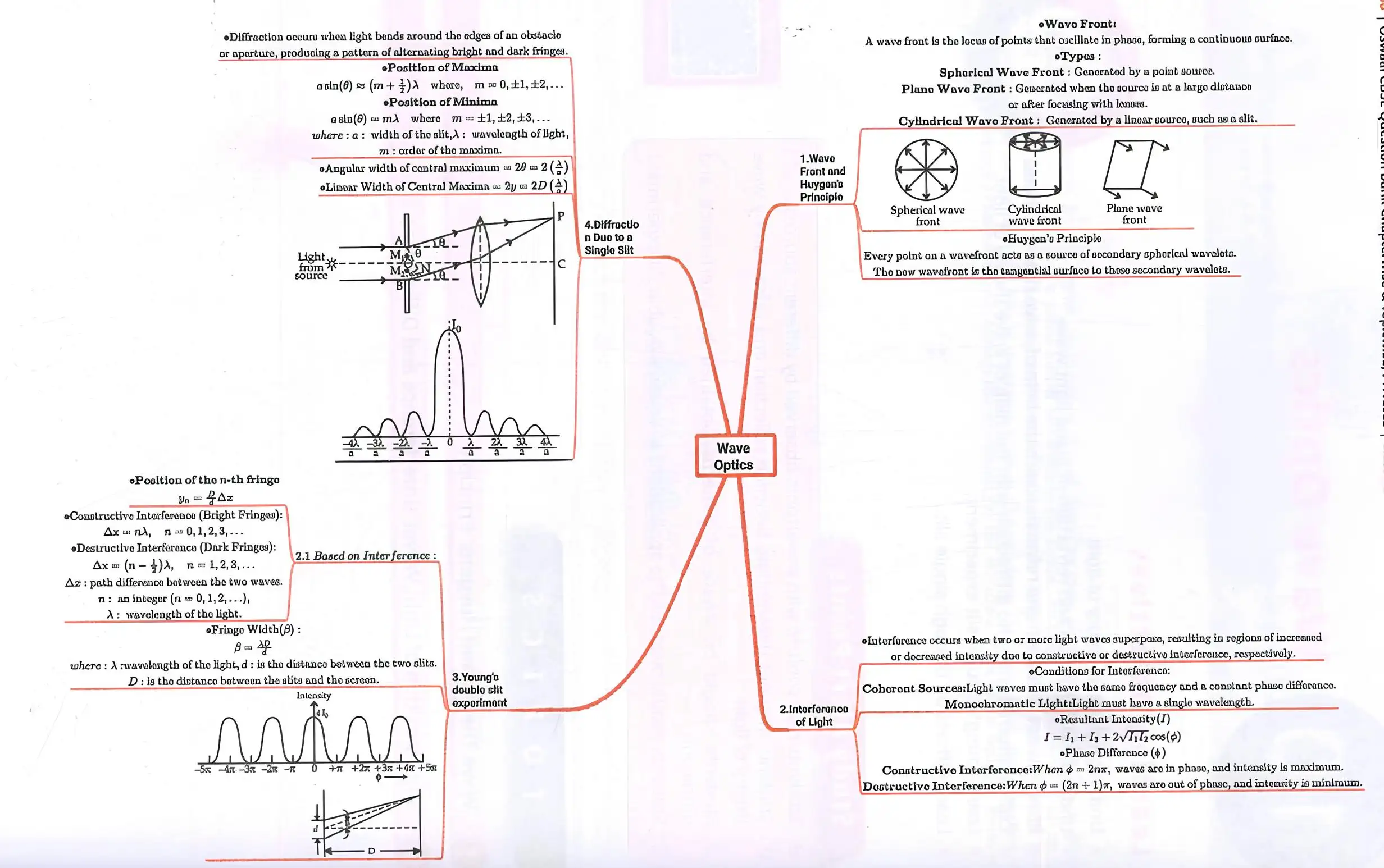
Wave Theory and Huygens' Principle
Corpuscular Theory and Its Limitations
The corpuscular theory proposed that light consists of tiny massless particles called corpuscles emitted by sources. These corpuscles were thought to be perfectly elastic, rigid, and moving at high speeds. While this theory could explain reflection and refraction, it failed to explain phenomena such as interference and diffraction.
Wave Theory of Light
Huygens proposed that light travels as longitudinal waves with uniform speed in a homogeneous medium. He introduced the concept of a hypothetical medium called 'ether' through which light waves propagate. However, the Michelson-Morley experiment disproved the existence of ether.
Electromagnetic Wave Nature of Light
Maxwell's theory established that light is an electromagnetic wave that does not require a medium and travels at a speed of 3 × 10⁸ m/s in vacuum. This wave nature explains interference, diffraction, and polarization phenomena. Polarization further showed that light waves are transverse, not longitudinal.
Huygens' Principle and Wavefronts
Huygens' principle states that every point on a wavefront acts as a secondary source of wavelets that spread out in the forward direction. The new wavefront at any instant is the envelope of these secondary wavelets. Wavefronts are surfaces of constant phase, and the direction of wave propagation is perpendicular to the wavefront.
Shapes of Wavefronts
Depending on the source, wavefronts can be spherical (point source), cylindrical (line source), or plane (plane source or distant point source). Lenses can change the shape of wavefronts, such as concave lenses converting plane wavefronts to convex wavefronts.
Reflection and Refraction via Huygens' Principle
The laws of reflection and refraction can be derived using Huygens' principle by considering the secondary wavelets and their propagation.
Solved Examples
Example 1: Explain why the Michelson-Morley experiment disproved the existence of ether.
Solution: The experiment attempted to detect the relative motion of Earth through the ether by measuring changes in the speed of light. No such changes were observed, indicating that ether does not exist, and light does not require a medium to propagate.
Example 2: Describe how Huygens' principle explains the formation of a new wavefront.
Solution: According to Huygens' principle, each point on the current wavefront acts as a source of secondary wavelets. These wavelets spread out with the same speed and wavelength as the original wave. The new wavefront is the tangent surface to all these wavelets, moving forward in the direction perpendicular to the wavefront.
Practice Set
- Level 1: What is a wavefront? Describe its significance in wave propagation.
- Level 2: Explain why light is considered a transverse wave and not a longitudinal wave.
- Level 3: Using Huygens' principle, derive the law of reflection.
Answer Key
- Level 1: A wavefront is a surface over which all points have the same phase of vibration. It is significant because the direction of wave propagation is perpendicular to the wavefront.
- Level 2: Polarization experiments show that light waves vibrate perpendicular to the direction of propagation, which is characteristic of transverse waves. Longitudinal waves cannot be polarized.
- Level 3: According to Huygens' principle, each point on the incident wavefront acts as a source of secondary wavelets. The reflected wavefront is the envelope of these wavelets. By constructing the geometry, it can be shown that the angle of incidence equals the angle of reflection.
Superposition of Light Waves (Interference and Diffraction)
Superposition Principle
The superposition principle states that when two or more waves meet at a point, the resultant displacement is the vector sum of the individual displacements. For two coherent waves of equal amplitude and frequency, the resultant amplitude can be up to twice the individual amplitude, leading to increased intensity.
Interference of Light
Interference occurs when two coherent light waves superpose, producing regions of constructive interference (bright fringes) where waves are in phase, and destructive interference (dark fringes) where waves are out of phase.
Conditions for Interference
Constructive interference occurs when the path difference is an integral multiple of the wavelength (0, λ, 2λ, ...). Destructive interference occurs when the path difference is an odd multiple of half wavelengths (λ/2, 3λ/2, ...). Coherence requires constant phase difference and equal frequency.
Young's Double Slit Experiment
Light passing through two narrow slits produces an interference pattern of bright and dark fringes on a screen. The fringe width (distance between successive bright or dark fringes) is given by β = (Dλ)/d, where D is the distance to the screen, λ is the wavelength, and d is the slit separation.
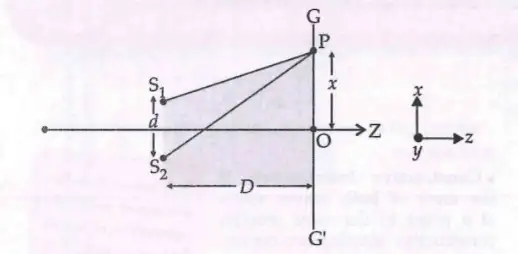
Diffraction
Diffraction is the bending of light waves around obstacles or through narrow slits, producing a pattern of bright and dark fringes. The angle θ for the first minimum in single-slit diffraction is given by θ = λ/a, where a is the slit width.
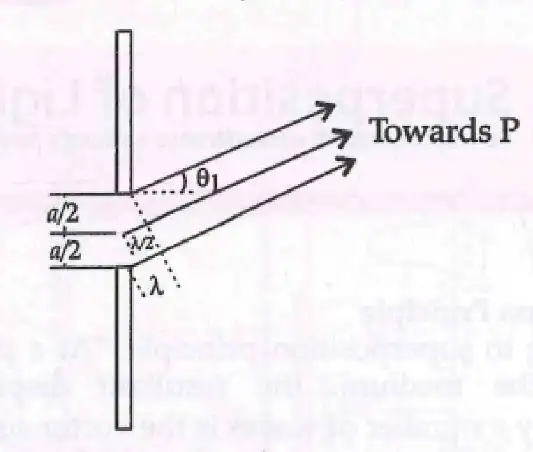
Energy Conservation in Interference and Diffraction
There is no loss or gain of energy in interference or diffraction; energy is redistributed to form the observed patterns.
Solved Examples
Example 1: Calculate the fringe width in Young's double slit experiment if the wavelength of light is 600 nm, the distance between slits is 0.2 mm, and the screen is 1.5 m away.
Solution:
Given: λ = 600 × 10-9 m, d = 0.2 × 10⁻³ m, D = 1.5 m
Fringe width, β = (Dλ)/d = (1.5 × 600 × 10-9)/(0.2 × 10-3) = 4.5 × 10⁻³ m = 4.5 mm
Example 2: Explain the difference between constructive and destructive interference in terms of phase difference.
Solution: Constructive interference occurs when the phase difference between two waves is 0, 2π, 4π, etc., causing the waves to reinforce each other. Destructive interference occurs when the phase difference is π, 3π, 5π, etc., causing the waves to cancel each other out.
Practice Set
- Level 1: Define coherence in the context of light waves.
- Level 2: Derive the expression for fringe width in Young's double slit experiment.
- Level 3: A single slit of width 0.1 mm is illuminated by light of wavelength 500 nm. Calculate the angle for the first diffraction minimum.
Answer Key
- Level 1: Coherence means that two waves have a constant phase difference and the same frequency, allowing stable interference patterns.
- Level 2: Fringe width β = (Dλ)/d, derived by considering the path difference and geometry of the setup where D is the distance to the screen, λ is the wavelength, and d is the slit separation.
- Level 3: Given a = 0.1 × 10⁻³ m, λ = 500 × 10-9 m, angle θ = λ/a = (500 × 10-9)/(0.1 × 10-3) = 5 × 10⁻³ radians ≈ 0.29°.
Quick Reference Table
Wave Theory and Huygens' Principle
- Light is an electromagnetic transverse wave traveling at 3 × 10⁸ m/s in vacuum.
- Wavefront: Surface of constant phase; propagation is perpendicular to wavefront.
- Huygens' Principle: Every point on a wavefront acts as a source of secondary wavelets.
- Reflection and refraction laws can be derived using Huygens' principle.
Interference and Diffraction
- Superposition principle: Resultant displacement is vector sum of individual displacements.
- Constructive interference: Path difference = nλ (n = 0,1,2,...), bright fringes.
- Destructive interference: Path difference = (2n+1)λ/2, dark fringes.
- Fringe width in Young's experiment: β = (Dλ)/d.
- Diffraction angle for first minimum: θ = λ/a.
Common Mistakes and Misconceptions
- Confusing wavefront shapes from different sources; spherical, cylindrical, and plane wavefronts differ based on source geometry.
- Mixing up reflection and refraction explanations; both can be explained by wave theory using Huygens' principle.
- Assuming interference and diffraction patterns result in energy loss; energy is conserved and redistributed.
- Believing light requires a medium (ether) for propagation; disproved by Michelson-Morley experiment.
- Thinking light is a longitudinal wave; polarization proves it is transverse.
Glossary
- Wavefront: Surface over which all points have the same phase of a wave.
- Huygens' Principle: Every point on a wavefront acts as a source of secondary wavelets.
- Coherent Waves: Waves with constant phase difference and same frequency.
- Interference: Superposition of two or more waves resulting in bright and dark fringes.
- Diffraction: Bending of waves around obstacles or through slits.
- Fringe Width: Distance between two successive bright or dark fringes in an interference pattern.