CLASS 12-PCB . PHYSICS . PHYSICS PART II . RAY OPTICS-AND-OPTICAL-INSTRUMENTS
Chapter 1 : Ray Optics And Optical Instruments
Ch 1
PHYSICS
CLASS 12-PCB
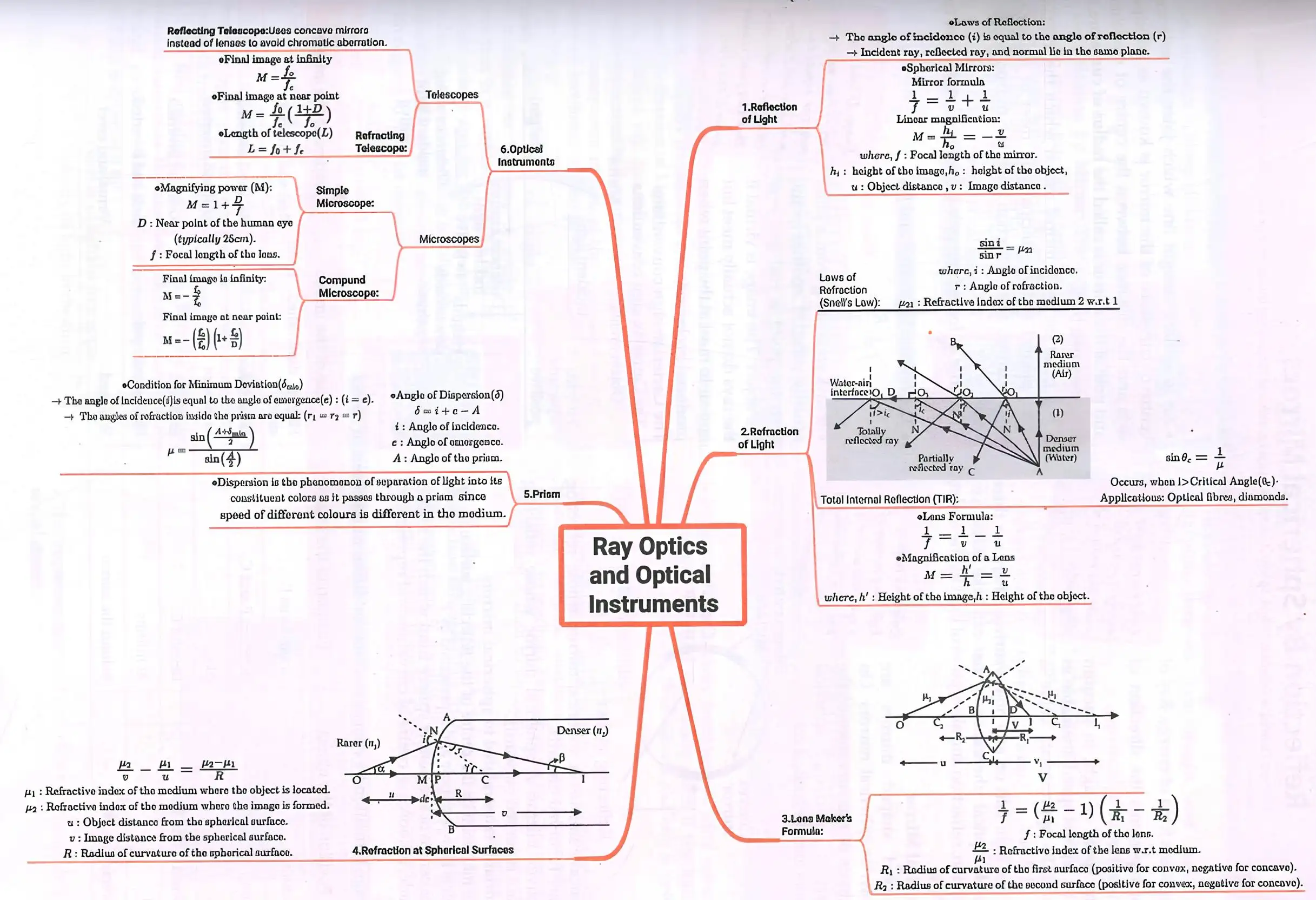
Reflection by Spherical Mirrors
Light and Its Properties
Light is a form of energy that travels in straight lines called rays. The speed of light in vacuum is approximately 3.0 × 10⁸ meters per second, which is the highest speed attainable in nature. When light falls on a surface, it can be reflected, refracted, or absorbed.
Spherical Mirrors
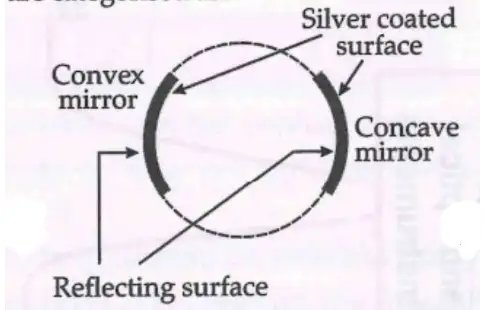
Spherical mirrors are curved mirrors whose reflecting surfaces are parts of a hollow sphere. They are classified into two types based on the curvature of the reflecting surface:
- Concave Mirror: The reflecting surface is curved inward.
- Convex Mirror: The reflecting surface is curved outward.
Important Terms Related to Spherical Mirrors
- Pole (P): The midpoint of the reflecting surface.
- Centre of Curvature (C): The center of the hollow sphere from which the mirror is made.
- Principal Axis: The imaginary line joining the pole and the center of curvature.
- Radius of Curvature (R): The distance between the center of curvature and the pole.
- Focus (F): The point on the principal axis where rays parallel to the principal axis converge (concave) or appear to diverge from (convex) after reflection.
- Focal Length (f): The distance between the pole and the focus, related to the radius of curvature by f = R/2.
- Real Image: Formed when reflected rays actually meet.
- Virtual Image: Formed when reflected rays appear to meet but do not actually meet.
Cartesian Sign Conventions
In ray optics, the Cartesian sign convention is used to assign positive and negative signs to distances and heights:
- Distances measured in the direction of incident light (usually to the right) are positive.
- Distances measured against the direction of incident light (usually to the left) are negative.
- Heights measured above the principal axis are positive.
- Heights measured below the principal axis are negative.
Image Formation by Concave Mirror
The nature, position, and size of the image formed by a concave mirror depend on the position of the object relative to the mirror's focal point (F) and center of curvature (C). For example:
- Object at infinity: Image at focus, real, inverted, and highly diminished.
- Object beyond C: Image between F and C, real, inverted, and diminished.
- Object at C: Image at C, real, inverted, and same size.
- Object between F and C: Image beyond C, real, inverted, and magnified.
- Object at F: Image at infinity, real, and highly magnified.
- Object between F and pole: Image behind mirror, virtual, erect, and magnified.
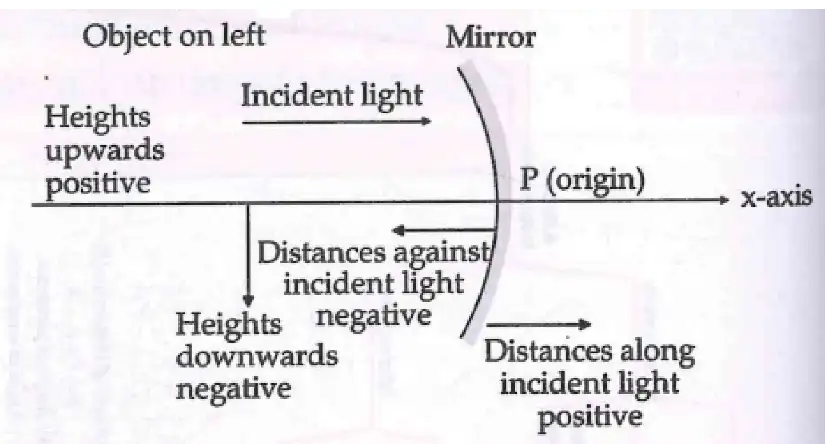
Image Formation by Convex Mirror
Convex mirrors always form virtual, erect, and diminished images located behind the mirror, regardless of the object's position.
Mirror Formula and Magnification
The mirror formula relates the object distance (u), image distance (v), and focal length (f):
\[ \frac{1}{v} + \frac{1}{u} = \frac{1}{f} \]
Magnification (m) is the ratio of the image height (hi) to the object height (ho) and is also related to distances:
\[ m = \frac{h_i}{h_o} = -\frac{v}{u} \]
Solved Examples
Example 1: An object is placed 30 cm in front of a concave mirror with a focal length of 15 cm. Find the position and nature of the image.
Solution:
Given: u = -30 cm (object distance is negative as per sign convention), f = -15 cm (concave mirror focal length is negative)
Using mirror formula:
\[ \frac{1}{v} + \frac{1}{u} = \frac{1}{f} \]
\[ \frac{1}{v} = \frac{1}{f} - \frac{1}{u} = \frac{1}{-15} - \frac{1}{-30} = -\frac{1}{15} + \frac{1}{30} = -\frac{2}{30} + \frac{1}{30} = -\frac{1}{30} \]
\[ v = -30 \text{ cm} \]
Image distance is -30 cm, meaning the image is formed 30 cm in front of the mirror (real side).
Magnification:
\[ m = -\frac{v}{u} = -\frac{-30}{-30} = -1 \]
Image is real, inverted, and same size as the object.
Example 2: An object is placed 20 cm in front of a convex mirror with a focal length of 25 cm. Find the image distance and magnification.
Solution:
Given: u = -20 cm, f = +25 cm (convex mirror focal length is positive)
Using mirror formula:
\[ \frac{1}{v} = \frac{1}{f} - \frac{1}{u} = \frac{1}{25} - \frac{1}{-20} = \frac{1}{25} + \frac{1}{20} = \frac{4}{100} + \frac{5}{100} = \frac{9}{100} \]
\[ v = \frac{100}{9} \approx 11.11 \text{ cm} \]
Image distance is +11.11 cm, meaning the image is virtual and behind the mirror.
Magnification:
\[ m = -\frac{v}{u} = -\frac{11.11}{-20} = 0.555 \]
Image is virtual, erect, and smaller than the object.
Practice Set
- Level 1 (Easy): Define the focal length of a concave mirror and state its relation with the radius of curvature.
- Level 2 (Moderate): An object is placed 10 cm in front of a concave mirror of focal length 15 cm. Find the image distance and magnification.
- Level 3 (Challenging): A convex mirror has a radius of curvature of 30 cm. An object is placed 20 cm in front of it. Calculate the position and size of the image formed.
Answer Key
- Level 1: The focal length of a concave mirror is the distance between its pole and focus. It is half the radius of curvature, i.e., f = R/2.
- Level 2: Given u = -10 cm, f = -15 cm. Using mirror formula: \( \frac{1}{v} = \frac{1}{f} - \frac{1}{u} = \frac{1}{-15} - \frac{1}{-10} = -\frac{1}{15} + \frac{1}{10} = \frac{1}{30} \) \( v = 30 \text{ cm} \) Magnification: \( m = -\frac{v}{u} = -\frac{30}{-10} = 3 \) Image is real, inverted, and magnified 3 times.
- Level 3: Given R = +30 cm (convex mirror), f = +15 cm, u = -20 cm. Using mirror formula: \( \frac{1}{v} = \frac{1}{f} - \frac{1}{u} = \frac{1}{15} - \frac{1}{-20} = \frac{1}{15} + \frac{1}{20} = \frac{7}{60} \) \( v = \frac{60}{7} \approx 8.57 \text{ cm} \) Magnification: \( m = -\frac{v}{u} = -\frac{8.57}{-20} = 0.43 \) Image is virtual, erect, and smaller than the object.
Refraction Through Glass Slab, Prism, Lenses and Total Internal Reflection
Refraction of Light
Refraction is the bending of light when it passes obliquely from one transparent medium to another. The laws of refraction are:
- The incident ray, refracted ray, and the normal at the point of incidence lie in the same plane.
- The ratio of the sine of the angle of incidence (i) to the sine of the angle of refraction (r) is constant for a given pair of media and wavelength of light. This constant is called the refractive index (n).
Mathematically, Snell's law is expressed as:
\[ \frac{\sin i}{\sin r} = n_{21} \]
where \( n_{21} \) is the refractive index of medium 2 with respect to medium 1.
Absolute Refractive Index
The absolute refractive index of a medium is the ratio of the speed of light in vacuum (c) to the speed of light in that medium (v):
\[ n = \frac{c}{v} \]
Since light travels slower in any medium than in vacuum, \( n > 1 \).
Refraction Through a Glass Slab
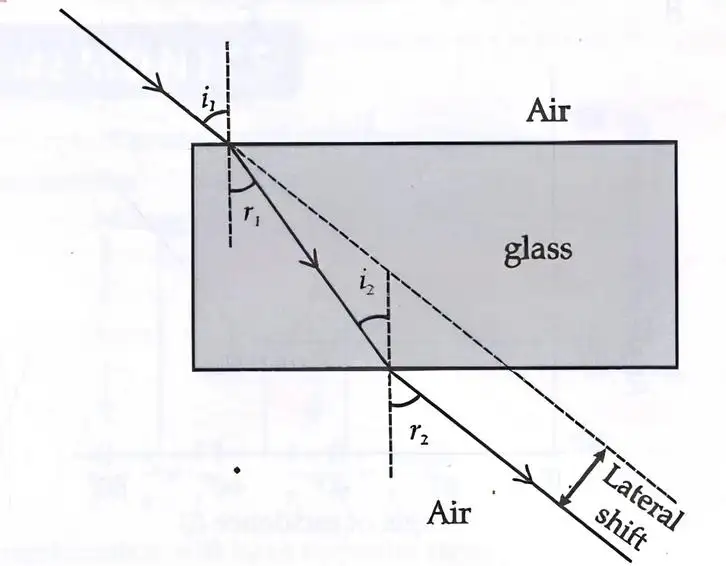
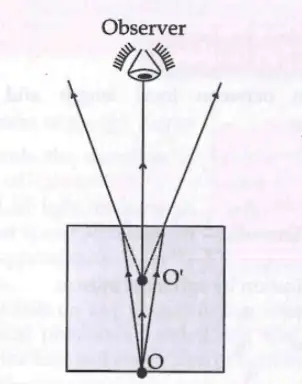
When light passes through a glass slab, the emergent ray is parallel to the incident ray but is laterally displaced. The lateral shift depends on the thickness of the slab and the angle of incidence.
Refraction Through a Prism
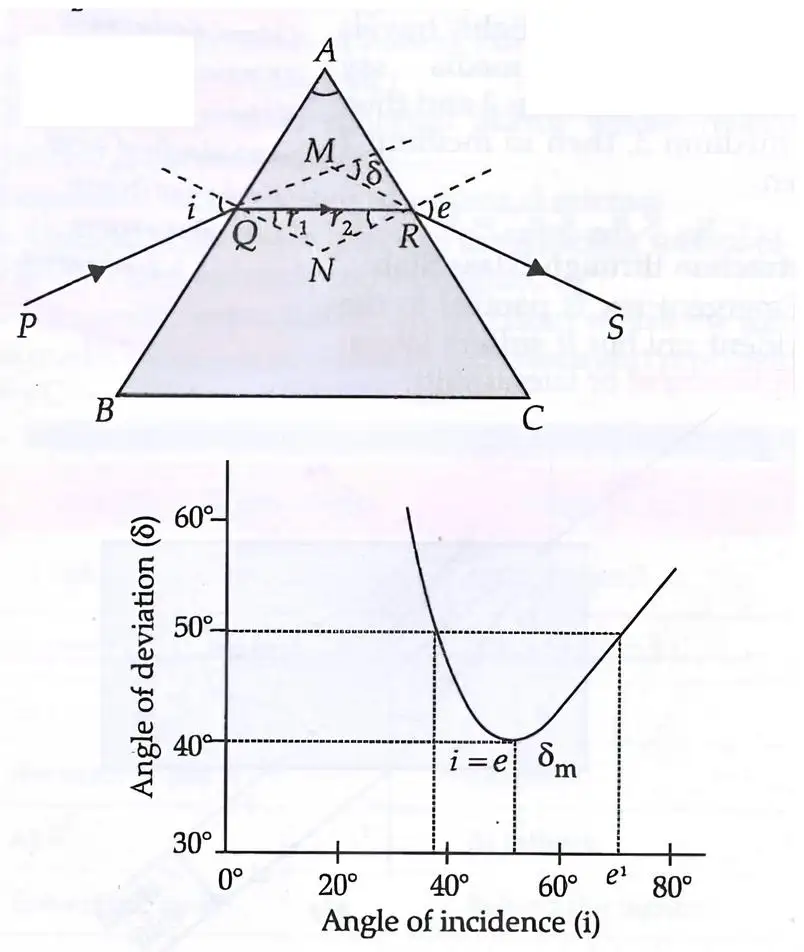
A prism is a transparent solid with two triangular bases and three rectangular faces. When light passes through a prism, it bends towards the base of the prism. The angle of deviation (\( \delta \)) is given by:
\[ \delta = (i - r_1) + (e - r_2) \]
where \( i \) is the angle of incidence, \( r_1 \) and \( r_2 \) are the angles of refraction at the two surfaces, and \( e \) is the angle of emergence.
The angle of minimum deviation (\( \delta_m \)) occurs when \( i = e \) and is related to the refractive index by:
\[ n = \frac{\sin \left( \frac{A + \delta_m}{2} \right)}{\sin \left( \frac{A}{2} \right)} \]
where \( A \) is the angle of the prism.
Total Internal Reflection
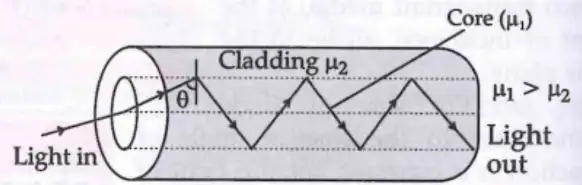
When light travels from an optically denser medium to a rarer medium, it is totally reflected back into the denser medium if the angle of incidence exceeds the critical angle (\( i_c \)). The critical angle is given by:
\[ \sin i_c = \frac{n_2}{n_1} \]
where \( n_1 \) and \( n_2 \) are the refractive indices of the denser and rarer media respectively.
Optical fibers use the principle of total internal reflection to transmit light over long distances with minimal loss.
Refraction at Spherical Surfaces
When light passes from one medium to another through a spherical surface, the relation between object distance (u), image distance (v), radius of curvature (R), and refractive indices (n1, n2) is:
\[ \frac{n_2}{v} - \frac{n_1}{u} = \frac{n_2 - n_1}{R} \]
Lenses
A lens is a transparent medium bounded by two surfaces, at least one of which is spherical. There are two types:
- Convex Lens: Thicker at the center than at the edges.
- Concave Lens: Thinner at the center than at the edges.
The lens formula relates object distance (u), image distance (v), and focal length (f):
\[ \frac{1}{v} - \frac{1}{u} = \frac{1}{f} \]
Magnification (m) is given by:
\[ m = \frac{h_i}{h_o} = \frac{v}{u} \]
The power (P) of a lens is the reciprocal of its focal length in meters:
\[ P = \frac{1}{f} \]
When lenses are combined, their powers add up:
\[ P = P_1 + P_2 + \ldots \]
The lens maker's formula relates the focal length to the radii of curvature and refractive index:
\[ \frac{1}{f} = (n - 1) \left( \frac{1}{R_1} - \frac{1}{R_2} \right) \]
Solved Examples
Example 1: A ray of light passes from air into glass with a refractive index of 1.5. If the angle of incidence is 30°, find the angle of refraction.
Solution:
Given: \( n_1 = 1 \) (air), \( n_2 = 1.5 \), \( i = 30^\circ \)
Using Snell's law:
\[ n_1 \sin i = n_2 \sin r \Rightarrow \sin r = \frac{n_1}{n_2} \sin i = \frac{1}{1.5} \times \sin 30^\circ = \frac{1}{1.5} \times 0.5 = 0.333 \]
\[ r = \sin^{-1} 0.333 \approx 19.47^\circ \]
Example 2: Calculate the focal length of a convex lens with radii of curvature 20 cm and 30 cm and refractive index 1.5.
Solution:
Given: \( R_1 = 20 \text{ cm} = 0.20 \text{ m} \), \( R_2 = -30 \text{ cm} = -0.30 \text{ m} \) (negative because second surface is concave), \( n = 1.5 \)
Using lens maker's formula:
\[ \frac{1}{f} = (n - 1) \left( \frac{1}{R_1} - \frac{1}{R_2} \right) = 0.5 \left( \frac{1}{0.20} - \frac{1}{-0.30} \right) = 0.5 \left( 5 + 3.33 \right) = 0.5 \times 8.33 = 4.165 \]
\[ f = \frac{1}{4.165} \approx 0.24 \text{ m} = 24 \text{ cm} \]
Practice Set
- Level 1 (Easy): State Snell's law of refraction.
- Level 2 (Moderate): A ray of light passes from water (n=1.33) to air. Calculate the critical angle for total internal reflection.
- Level 3 (Challenging): A convex lens has radii of curvature 15 cm and 25 cm and refractive index 1.6. Calculate its focal length and power.
Answer Key
- Level 1: Snell's law states that the ratio of the sine of the angle of incidence to the sine of the angle of refraction is constant for a given pair of media.
- Level 2: Critical angle \( i_c \) is given by \( \sin i_c = \frac{n_2}{n_1} = \frac{1}{1.33} = 0.75 \), so \( i_c = \sin^{-1} 0.75 = 48.75^\circ \).
- Level 3: Using lens maker's formula: \( \frac{1}{f} = (1.6 - 1) \left( \frac{1}{0.15} - \frac{1}{-0.25} \right) = 0.6 \times (6.67 + 4) = 0.6 \times 10.67 = 6.4 \) \( f = \frac{1}{6.4} = 0.156 \text{ m} = 15.6 \text{ cm} \) Power: \( P = \frac{100}{f \text{ in cm}} = \frac{100}{15.6} = 6.41 \text{ dioptres} \)
Optical Instruments
Microscope
A microscope is an optical instrument used to view very small objects by magnifying them. It typically consists of two convex lenses: the objective and the eyepiece.
The resolving power of a microscope is its ability to distinguish two close points as separate and is given by:
\[ R.P. = \frac{1}{d} = \frac{2 \mu \sin \theta}{\lambda} \]
where \( d \) is the minimum resolvable distance, \( \mu \) is the refractive index of the medium between the object and the objective lens, \( \theta \) is half the angular aperture, and \( \lambda \) is the wavelength of light used.
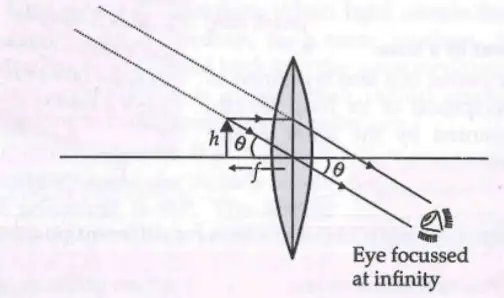
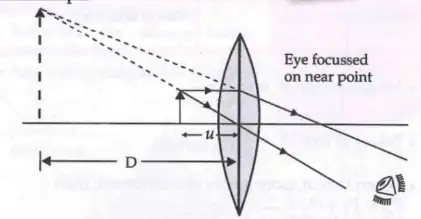
The magnifying power of a simple microscope is:
\[ m = 1 + \frac{D}{f} \]
where \( D \) is the least distance of distinct vision (usually 25 cm) and \( f \) is the focal length of the lens.
Compound Microscope
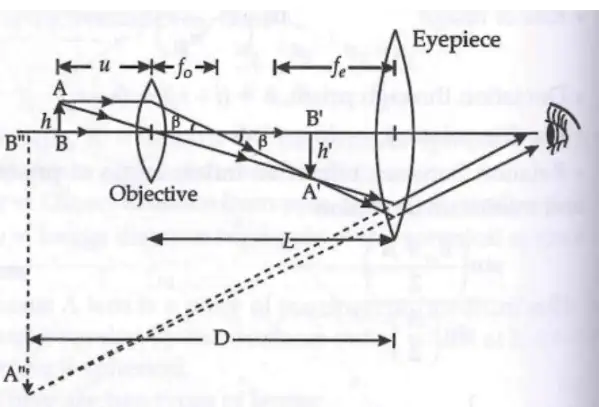
A compound microscope uses two convex lenses: the objective lens (near the object) and the eyepiece lens (near the eye). The total magnification is the product of the magnifications of the two lenses:
\[ m = m_o \times m_e = \frac{L}{f_o} \times \left(1 + \frac{D}{f_e} \right) \]
where \( L \) is the tube length (distance between the focal points of the objective and eyepiece), \( f_o \) and \( f_e \) are the focal lengths of the objective and eyepiece respectively.
Telescope
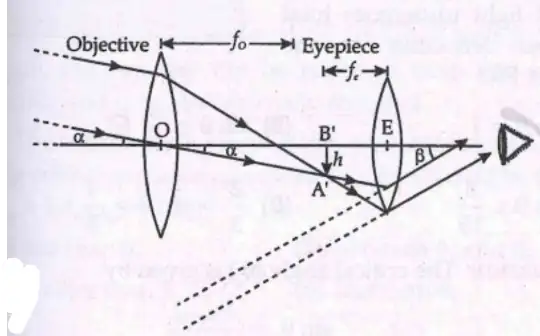
A telescope is an optical instrument used to view distant objects by magnifying them. It consists of an objective lens and an eyepiece lens.
The magnifying power of an astronomical telescope for the least distance of distinct vision is:
\[ m = - \frac{f_o}{f_e} \left(1 + \frac{f_e}{D} \right) \]
For relaxed eye (image at infinity), the magnification is:
\[ m = - \frac{f_o}{f_e} \]
The length of the telescope tube is approximately \( L = f_o + f_e \).
Reflecting Telescope
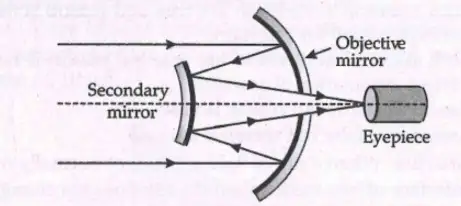
Reflecting telescopes use a concave mirror as the objective instead of a lens. They avoid chromatic aberration and can have larger apertures.
The magnifying power is:
\[ m = \frac{f_o}{f_e} \]
Aberrations
Spherical Aberration: Occurs when rays passing through different parts of a lens or mirror do not converge at the same point, causing a blurred image.
Solved Examples
Example 1: Calculate the magnifying power of a simple microscope with a focal length of 5 cm, if the least distance of distinct vision is 25 cm.
Solution:
\[ m = 1 + \frac{D}{f} = 1 + \frac{25}{5} = 1 + 5 = 6 \]
The magnifying power is 6.
Example 2: A compound microscope has an objective focal length of 2 cm, eyepiece focal length of 5 cm, and tube length of 16 cm. Calculate its total magnification for the least distance of distinct vision 25 cm.
Solution:
Magnification by objective:
\[ m_o = \frac{L}{f_o} = \frac{16}{2} = 8 \]
Magnification by eyepiece:
\[ m_e = 1 + \frac{D}{f_e} = 1 + \frac{25}{5} = 6 \]
Total magnification:
\[ m = m_o \times m_e = 8 \times 6 = 48 \]
Practice Set
- Level 1 (Easy): Define resolving power of an optical instrument.
- Level 2 (Moderate): Calculate the magnifying power of a simple microscope with focal length 10 cm and least distance of distinct vision 25 cm.
- Level 3 (Challenging): A compound microscope has an objective focal length of 1.5 cm, eyepiece focal length of 5 cm, and tube length of 20 cm. Calculate its total magnification for relaxed eye.
Answer Key
- Level 1: Resolving power is the ability of an optical instrument to produce separate and clear images of two nearby objects.
- Level 2: \( m = 1 + \frac{D}{f} = 1 + \frac{25}{10} = 3.5 \)
- Level 3: For relaxed eye, magnification by eyepiece is \( m_e = \frac{D}{f_e} = \frac{25}{5} = 5 \) Magnification by objective: \( m_o = \frac{L}{f_o} = \frac{20}{1.5} = 13.33 \) Total magnification: \( m = m_o \times m_e = 13.33 \times 5 = 66.65 \)
Quick Reference Table
- Mirror Formula: \( \frac{1}{v} + \frac{1}{u} = \frac{1}{f} \)
- Magnification by Mirror: \( m = -\frac{v}{u} = \frac{h_i}{h_o} \)
- Lens Formula: \( \frac{1}{v} - \frac{1}{u} = \frac{1}{f} \)
- Magnification by Lens: \( m = \frac{v}{u} = \frac{h_i}{h_o} \)
- Power of Lens: \( P = \frac{100}{f \text{ (cm)}} \) dioptres
- Snell's Law: \( \frac{\sin i}{\sin r} = n \)
- Lens Maker's Formula: \( \frac{1}{f} = (n - 1) \left( \frac{1}{R_1} - \frac{1}{R_2} \right) \)
- Total Internal Reflection: Occurs when \( i > i_c \), where \( \sin i_c = \frac{n_2}{n_1} \)
- Magnifying Power of Simple Microscope: \( m = 1 + \frac{D}{f} \)
- Magnifying Power of Compound Microscope: \( m = \frac{L}{f_o} \times \left(1 + \frac{D}{f_e} \right) \)
- Magnifying Power of Telescope (Relaxed Eye): \( m = - \frac{f_o}{f_e} \)
Common Mistakes and Misconceptions
- Confusing the sign conventions for object and image distances in mirror and lens formulas.
- Mixing up the focal length signs for concave and convex mirrors or lenses.
- Assuming the image formed by a convex mirror is real; it is always virtual.
- Forgetting that the emergent ray in a glass slab is parallel to the incident ray but laterally shifted.
- Misapplying Snell's law by not identifying the correct refractive indices for the media involved.
- Overlooking the conditions required for total internal reflection.
- Confusing magnification formulas for mirrors and lenses; note the negative sign in mirror magnification.
- Neglecting the difference between image formation in microscopes and telescopes.
Glossary
- Concave Mirror: A mirror with reflecting surface curved inward.
- Convex Mirror: A mirror with reflecting surface curved outward.
- Focal Length: Distance between the pole and the focus of a mirror or lens.
- Refractive Index: Ratio of the speed of light in vacuum to that in a medium.
- Snell's Law: Law relating angles of incidence and refraction at an interface.
- Total Internal Reflection: Complete reflection of light inside a denser medium when incident angle exceeds critical angle.
- Optical Fiber: Thin flexible fibers that transmit light by total internal reflection.
- Magnification: Ratio of image size to object size.
- Resolving Power: Ability of an optical instrument to distinguish two close objects.
- Compound Microscope: Microscope using two lenses for higher magnification.
- Telescope: Instrument to view distant objects by magnification.