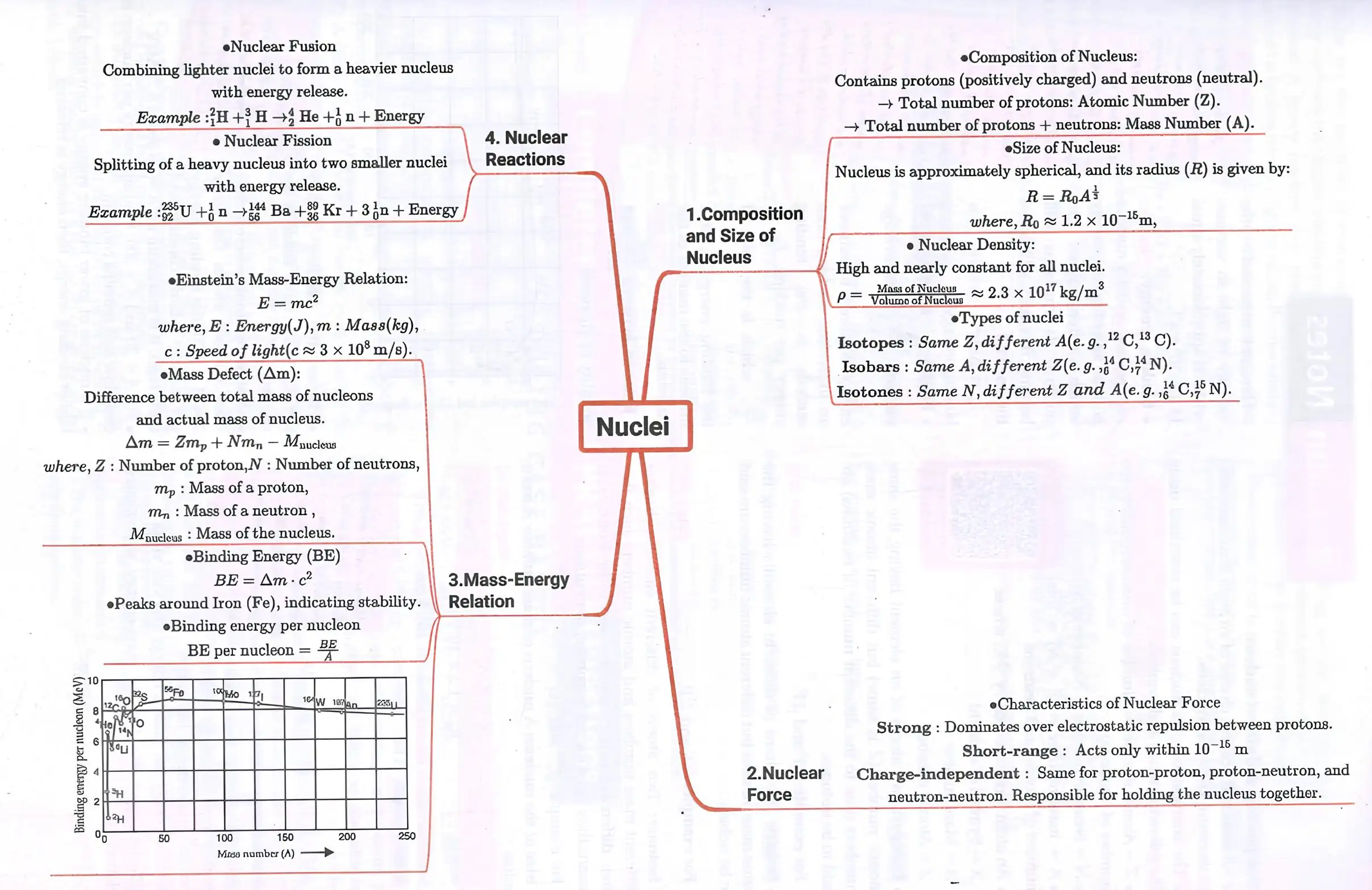
Composition and Size of Nucleus
Atomic Structure and Nucleus Composition
The nucleus is the central part of an atom where all its positive charge and almost all its mass are concentrated. It consists of protons, which carry a positive charge, and neutrons, which are neutral particles. The number of protons in the nucleus is called the atomic number (Z), and the total number of protons and neutrons is called the mass number (A).
Notation and Types of Nuclei
An atom is represented as ^{A}_{Z}X, where X is the chemical symbol, A is the mass number, and Z is the atomic number. Different types of nuclei include:
- Isotopes: Atoms with the same atomic number but different mass numbers due to varying neutron counts.
- Isobars: Atoms of different elements with the same mass number but different atomic numbers.
- Isotones: Atoms with different atomic and mass numbers but the same number of neutrons.
Size and Density of the Nucleus
The radius of a nucleus with mass number A is given by the formula:
\[ R = R_0 A^{1/3} \]
where \( R_0 \approx 1.2 \times 10^{-15} \) meters. The nuclear matter density is extremely high and approximately constant for all nuclei, about \( 2.3 \times 10^{17} \) kg/m³.
Mass Defect
The mass of a nucleus is less than the sum of the masses of its constituent protons and neutrons. This difference is called the mass defect (\( \Delta M \)) and is calculated as:
\[ \Delta M = [Z m_p + (A - Z) m_n] - M \]
where \( m_p \) and \( m_n \) are the masses of a proton and neutron respectively, and \( M \) is the actual mass of the nucleus.
Solved Examples
Example 1: Calculate the radius of a nucleus with mass number 64.
Solution:
Given, \( A = 64 \), \( R_0 = 1.2 \times 10^{-15} \) m
Using the formula:
\[ R = R_0 A^{1/3} = 1.2 \times 10^{-15} \times 64^{1/3} \]
Since \( 64^{1/3} = 4 \),
\[ R = 1.2 \times 10^{-15} \times 4 = 4.8 \times 10^{-15} \text{ meters} \]
Therefore, the radius of the nucleus is \( 4.8 \times 10^{-15} \) meters.
Example 2: Calculate the mass defect of a nucleus with 2 protons and 2 neutrons. Given: \( m_p = 1.0073 \) u, \( m_n = 1.0087 \) u, actual mass of nucleus \( M = 4.0015 \) u.
Solution:
Number of protons, \( Z = 2 \)
Number of neutrons, \( N = 2 \)
Mass defect,
\[ \Delta M = [Z m_p + N m_n] - M = [2 \times 1.0073 + 2 \times 1.0087] - 4.0015 \]
\[ = (2.0146 + 2.0174) - 4.0015 = 4.0320 - 4.0015 = 0.0305 \text{ u} \]
Thus, the mass defect is 0.0305 atomic mass units.
Practice Set
- Level 1: Define isotopes and give an example.
- Level 2: Calculate the radius of a nucleus with mass number 27.
- Level 3: A nucleus has 8 protons and 8 neutrons. Given \( m_p = 1.0073 \) u, \( m_n = 1.0087 \) u, and actual mass \( M = 15.9949 \) u, calculate the mass defect.
Answer Key
- Level 1: Isotopes are atoms of the same element with the same atomic number but different mass numbers due to different numbers of neutrons. Example: \( ^1_1H \) and \( ^2_1H \).
- Level 2: Using \( R = R_0 A^{1/3} \), \( A=27 \), \( R_0=1.2 \times 10^{-15} \) m, \( 27^{1/3} = 3 \), so \( R = 1.2 \times 10^{-15} \times 3 = 3.6 \times 10^{-15} \) m.
- Level 3: \( \Delta M = [8 \times 1.0073 + 8 \times 1.0087] - 15.9949 = (8.0584 + 8.0696) - 15.9949 = 16.128 - 15.9949 = 0.1331 \) u.
Mass Energy Relation
Einstein’s Mass-Energy Equivalence
Einstein’s famous equation \( E = mc^2 \) shows that mass (m) can be converted into energy (E), where \( c \) is the speed of light in vacuum (approximately \( 3 \times 10^8 \) m/s). This principle explains the energy released in nuclear reactions.
Binding Energy and Mass Defect
The mass defect corresponds to the binding energy (\( E_b \)) of the nucleus, which is the energy required to separate all nucleons. It is calculated as:
\[ E_b = \Delta M c^2 \]
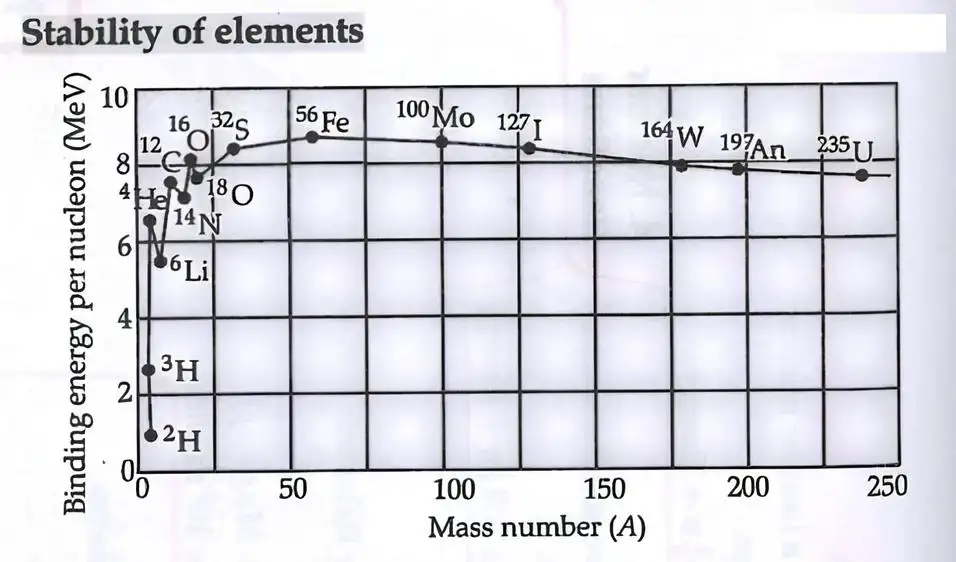
Binding energy per nucleon (\( E_{bn} \)) is the average energy that binds each nucleon and is given by:
\[ E_{bn} = \frac{E_b}{A} \]
Stability and Binding Energy
The binding energy per nucleon varies with the mass number. It peaks near iron (Fe), indicating maximum stability. Nuclei with higher binding energy per nucleon are more stable.
Solved Examples
Example 1: Calculate the binding energy of a nucleus with a mass defect of 0.0305 u. (1 u = 931.5 MeV/c²)
Solution:
Binding energy,
\[ E_b = \Delta M \times 931.5 \text{ MeV} = 0.0305 \times 931.5 = 28.4 \text{ MeV} \]
Therefore, the binding energy is 28.4 MeV.
Example 2: Find the binding energy per nucleon for a nucleus with mass number 4 and binding energy 28.4 MeV.
Solution:
\[ E_{bn} = \frac{E_b}{A} = \frac{28.4}{4} = 7.1 \text{ MeV} \]
Thus, the binding energy per nucleon is 7.1 MeV.
Practice Set
- Level 1: State Einstein’s mass-energy equivalence formula.
- Level 2: Calculate the binding energy of a nucleus with a mass defect of 0.05 u.
- Level 3: A nucleus has a binding energy of 56 MeV and mass number 8. Calculate the binding energy per nucleon.
Answer Key
- Level 1: \( E = mc^2 \)
- Level 2: \( E_b = 0.05 \times 931.5 = 46.575 \) MeV
- Level 3: \( E_{bn} = \frac{56}{8} = 7 \) MeV
Nuclear Force
Nature of Nuclear Force
Nuclear force is a very strong force that holds protons and neutrons together in the nucleus. It overcomes the electrostatic repulsion between positively charged protons.
Characteristics of Nuclear Force
- It acts only at very short distances, approximately \( 10^{-15} \) meters.
- It is attractive and acts equally between proton-proton, neutron-neutron, and proton-neutron pairs.
- It is much stronger than electromagnetic and gravitational forces within the nucleus.
Solved Examples
Example: Explain why the nucleus does not fly apart despite the repulsion between protons.
Solution: The nuclear force is a strong attractive force acting between nucleons at very short distances. It overcomes the repulsive electrostatic force between protons, thus holding the nucleus together and maintaining its stability.
Practice Set
- Level 1: What particles does the nuclear force act between?
- Level 2: Why is nuclear force considered a short-range force?
- Level 3: Compare the strength of nuclear force with electromagnetic force inside the nucleus.
Answer Key
- Level 1: Nuclear force acts between protons and neutrons (nucleons).
- Level 2: Because it acts effectively only at distances of about \( 10^{-15} \) meters, beyond which it rapidly decreases.
- Level 3: Nuclear force is much stronger than electromagnetic force within the nucleus, enabling it to hold the nucleons together despite proton repulsion.
Nuclear Reactions
Nuclear Fusion
Nuclear fusion is the process where two light nuclei combine to form a heavier nucleus, releasing energy. This occurs because the binding energy per nucleon of the resulting nucleus is higher, indicating greater stability.
Example:
\[ ^1_1H + ^1_1H \rightarrow ^2_1H + e^+ + \nu + 0.42 \text{ MeV} \]
Nuclear Fission
Nuclear fission is the splitting of a heavy nucleus into two lighter nuclei, accompanied by the release of energy. This happens because the lighter nuclei have higher binding energy per nucleon.
Example:
\[ ^1_0n + ^{235}_{92}U \rightarrow ^{236}_{92}U \rightarrow ^{144}_{56}Ba + ^{89}_{36}Kr + 3 ^1_0n + 200 \text{ MeV} \]
Solved Examples
Example: Explain why energy is released in nuclear fusion and fission.
Solution: Energy is released in both fusion and fission because the products have higher binding energy per nucleon than the reactants. This difference in binding energy is converted into energy according to \( E = mc^2 \).
Practice Set
- Level 1: Define nuclear fusion.
- Level 2: Write a nuclear fission reaction involving uranium-235.
- Level 3: Explain why fusion releases energy for light nuclei but fission releases energy for heavy nuclei.
Answer Key
- Level 1: Nuclear fusion is the process of combining two light nuclei to form a heavier nucleus with energy release.
- Level 2: \( ^1_0n + ^{235}_{92}U \rightarrow ^{236}_{92}U \rightarrow ^{144}_{56}Ba + ^{89}_{36}Kr + 3 ^1_0n + 200 \text{ MeV} \)
- Level 3: Fusion releases energy for light nuclei because combining them increases binding energy per nucleon. Fission releases energy for heavy nuclei because splitting them produces nuclei with higher binding energy per nucleon.
Quick Reference Table
- Radius of Nucleus: \( R = R_0 A^{1/3} \), where \( R_0 = 1.2 \times 10^{-15} \) m
- Mass Defect: \( \Delta M = [Z m_p + (A - Z) m_n] - M \)
- Binding Energy: \( E_b = \Delta M c^2 \)
- Binding Energy per Nucleon: \( E_{bn} = \frac{E_b}{A} \)
- Einstein's Mass-Energy Equivalence: \( E = mc^2 \)
- Nuclear Force: Strong, short-range force acting between nucleons, overcoming proton repulsion.
- Isotopes: Same atomic number, different mass number.
- Isobars: Different atomic number, same mass number.
- Isotones: Same neutron number, different atomic and mass numbers.
- Nuclear Reactions: Fusion (light nuclei combine), Fission (heavy nucleus splits), both releasing energy.
Common Mistakes and Misconceptions
- Confusing isotopes, isobars, and isotones due to similar terminology.
- Not converting atomic mass units (amu) to energy units (MeV) correctly when calculating binding energy.
- Ignoring the mass number when discussing nuclear stability and binding energy per nucleon.
- Assuming nuclear force acts over long distances; it is actually a short-range force.
- Forgetting that nuclear binding energy is the energy required to separate nucleons, not just any energy.
- Misinterpreting the graph of binding energy per nucleon, especially the peak near iron indicating maximum stability.
- Mixing up nuclear fusion and fission processes and their energy release mechanisms.
Glossary
- Atomic Number (Z): Number of protons in the nucleus.
- Mass Number (A): Total number of protons and neutrons in the nucleus.
- Isotopes: Atoms with the same atomic number but different mass numbers.
- Isobars: Atoms with the same mass number but different atomic numbers.
- Isotones: Atoms with the same number of neutrons but different atomic and mass numbers.
- Mass Defect: Difference between the sum of individual nucleon masses and the actual mass of the nucleus.
- Binding Energy: Energy required to separate all nucleons in a nucleus.
- Binding Energy per Nucleon: Average energy binding each nucleon in the nucleus.
- Nuclear Force: Strong, short-range force that holds nucleons together.
- Nuclear Fusion: Process of combining light nuclei to form a heavier nucleus with energy release.
- Nuclear Fission: Splitting of a heavy nucleus into lighter nuclei with energy release.
- Einstein’s Mass-Energy Equivalence: \( E = mc^2 \), relating mass and energy.