CLASS 12-PCB . PHYSICS . PHYSICS PART I . MAGNETISM AND-MATTER
Chapter 5 : Magnetism And Matter
Ch 5
PHYSICS
CLASS 12-PCB
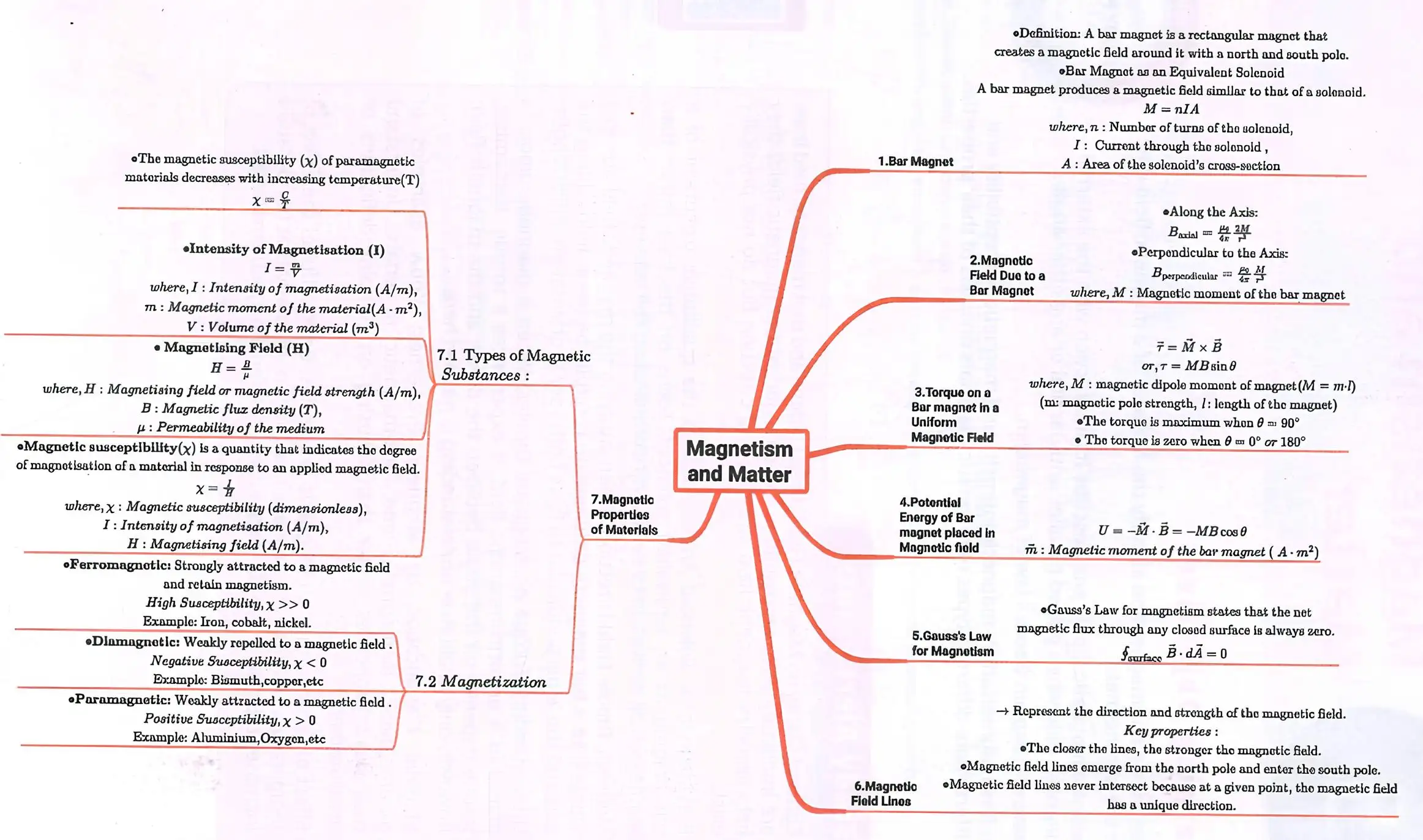
Bar Magnet
Definition and Structure
A bar magnet is a rectangular piece of magnetic material with two poles: a north pole and a south pole. These poles are of equal strength and are separated by a small distance. The bar magnet is also known as a magnetic dipole.
Properties
Attraction: Poles of a magnet attract small pieces of magnetic materials such as iron, steel, cobalt, and nickel. The strength of attraction is called the pole strength.
Alignment: When suspended freely, a bar magnet aligns itself such that its north pole points towards the geographical north and its south pole towards the geographical south.
Magnetic Axis and Meridian: The line joining the north and south poles is called the magnetic axis. The vertical plane passing through this axis is called the magnetic meridian.
Poles Interaction: Like poles repel each other, while unlike poles attract.
Existence of Poles: Magnetic poles always exist in pairs; magnetic monopoles do not exist.
Repulsion Test: Repulsion is the surest test of magnetism.
Magnetic Dipole Moment
The magnetic dipole moment (M) of a bar magnet is given by the product of the pole strength (m) and the distance between the poles (2l):
M = m \times 2l
The direction of the magnetic dipole moment is from the south pole to the north pole.
Magnetic Length
Magnetic length is the distance between the two poles of the magnet.
Magnetic Field of Bar Magnet
Magnetic Field Lines
Magnetic field lines are imaginary closed loops that represent the direction and strength of the magnetic field. They emerge from the north pole and enter the south pole, never intersecting each other. The tangent at any point on these lines gives the direction of the magnetic field at that point.
Field on Axial Line
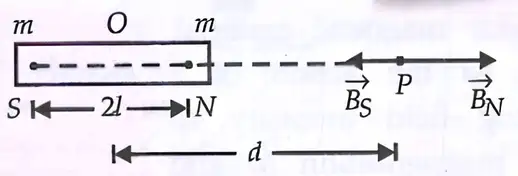
The magnetic field at a point on the axial line of a bar magnet at a distance d from its center is the vector sum of the fields due to the north and south poles:
\[ B_{net} = \frac{\mu_0}{4\pi} \left( \frac{m}{(d - l)^2} - \frac{m}{(d + l)^2} \right) \]
For points far from the magnet (\( 2l \ll d \)), this simplifies to:
\[ B_{net} = \frac{\mu_0 2M}{4 \pi d^3} \]
Field on Equatorial Line
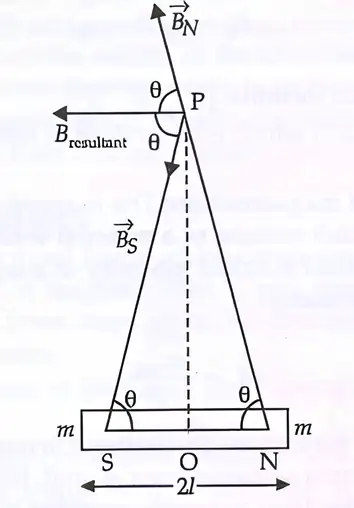
The magnetic field at a point on the equatorial line (perpendicular bisector) of the bar magnet at distance d is given by:
\[ B = \frac{\mu_0 M}{4 \pi d^3} \]
Direction of Field
On the axial line, the field points from the north pole outward, while on the equatorial line, it points opposite to the magnetic moment.
Torque on Magnetic Dipole
Concept
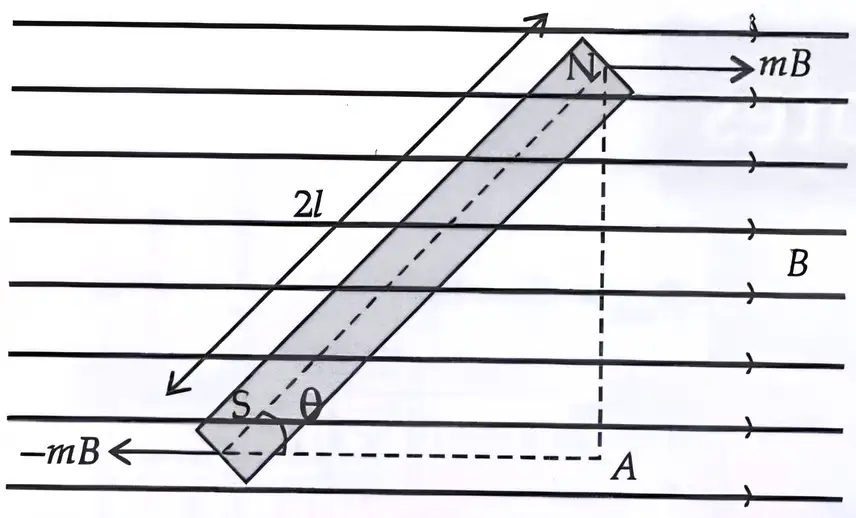
A magnetic dipole (such as a bar magnet) placed in a uniform magnetic field experiences a torque that tends to align the dipole with the field.
Formula
The torque \( \tau \) experienced by a magnetic dipole with magnetic moment \( M \) in a magnetic field \( B \) at an angle \( \theta \) is:
\[ \tau = MB \sin \theta \]
In vector form:
\[ \vec{\tau} = \vec{M} \times \vec{B} \]
Explanation
The torque is maximum when the dipole is perpendicular to the magnetic field (\( \theta = 90^\circ \)) and zero when it is aligned (\( \theta = 0^\circ \) or \( 180^\circ \)).
Magnetic Properties of Materials
Classification
Diamagnetic Materials: Weakly repelled by magnetic fields; permeability less than one; susceptibility small and negative. Examples: gold, silver, copper, water.
Paramagnetic Materials: Weakly attracted by magnetic fields; permeability slightly greater than one; susceptibility small and positive; follows Curie's law. Examples: calcium, sodium, aluminum.
Ferromagnetic Materials: Strongly attracted by magnetic fields; permeability much greater than one; susceptibility large and positive; lose ferromagnetism above Curie temperature. Examples: iron, steel, nickel.
Curie's Law
For paramagnetic materials, magnetic susceptibility \( X_m \) is inversely proportional to absolute temperature \( T \):
\[ X_m \propto \frac{1}{T} \]
For ferromagnetic materials above Curie temperature \( T_C \):
\[ X_m = \frac{C}{T - T_C} \]
where \( C \) is Curie's constant.
Ferromagnetic substances behave as paramagnetic substances at temperatures above the Curie temperature.
Mnemonic for Curie's Law: "Fever Cures Ferromagnetism" (High temperature causes loss of ferromagnetic property).
Magnetism and Gauss's Law
Gauss's Law for Magnetism
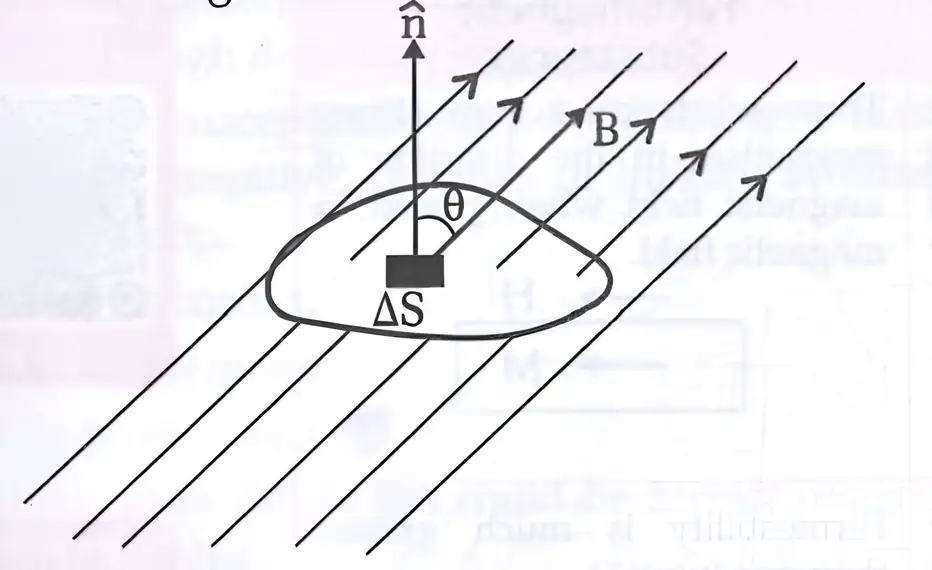
The net magnetic flux through any closed surface is zero, indicating that magnetic field lines form continuous loops and do not begin or end inside the surface.
Magnetic Flux
Magnetic flux \( \Phi_B \) through a surface is the total number of magnetic field lines passing through it, given by:
\[ \Phi_B = \int \vec{B} \cdot d\vec{S} \]
SI unit: weber (Wb)
Solved Examples
Example 1
Problem: A solenoid has a core with relative permeability 400. The solenoid has 1000 turns per meter and carries a current of 2 A. Calculate:
- Magnetising field intensity \( H \)
- Magnetic field \( B \)
- Magnetisation \( M \)
- Magnetising current \( I_m \)
Solution:
(a) Magnetising field intensity:
\[ H = nI = 1000 \times 2 = 2000 \text{ A/m} \]
(b) Magnetic field:
\[ B = \mu_r \mu_0 H = 400 \times 4\pi \times 10^{-7} \times 2000 = 1.0 \text{ T} \]
(c) Magnetisation:
\[ M = \frac{B - \mu_0 H}{\mu_0} = (\mu_r - 1) H = 399 \times 2000 = 7.98 \times 10^5 \text{ A/m} \]
(d) Magnetising current:
Using \( B = \mu_r n (I + I_m) \),
\[ I_m = \frac{B}{\mu_r n} - I = \frac{1.0}{400 \times 1000} - 2 = 794 \text{ A} \]
Example 2
Problem: What happens if a bar magnet is cut into two pieces:
- Transverse to its length
- Along its length
Solution: In both cases, each piece becomes a smaller bar magnet with its own north and south poles. Magnetic poles always exist in pairs.
Example 3
Problem: A magnetic dipole is placed in a uniform magnetic field at an angle \( \theta = 90^\circ \). Calculate the torque experienced if the magnetic moment is \( M \) and magnetic field strength is \( B \).
Solution:
Using \( \tau = MB \sin \theta \),
\[ \tau = MB \sin 90^\circ = MB \]
Practice Set
Conceptual Questions
Level 1: Why do magnetic field lines never intersect?
Level 2: Explain why a bar magnet always has two poles, even if cut into smaller pieces.
Application-based Question
Level 3: A bar magnet with magnetic moment \( 0.5 \text{ A m}^2 \) is placed in a uniform magnetic field of strength \( 0.2 \text{ T} \) at an angle of \( 60^\circ \). Calculate the torque experienced by the magnet.
Numerical Question
Level 2: A solenoid with 500 turns per meter carries a current of 3 A. If the relative permeability of the core is 200, calculate the magnetic field inside the solenoid.
Answer Key
Q1: Magnetic field lines represent the direction of the magnetic field at any point. If they intersected, there would be two directions of the magnetic field at the point of intersection, which is impossible.
Q2: Magnetic poles always exist in pairs. Cutting a bar magnet creates smaller magnets each with a north and south pole.
Q3: Torque \( \tau = MB \sin \theta = 0.5 \times 0.2 \times \sin 60^\circ = 0.5 \times 0.2 \times 0.866 = 0.0866 \text{ Nm} \).
Q4: Magnetic field inside solenoid \( B = \mu_r \mu_0 n I = 200 \times 4\pi \times 10^{-7} \times 500 \times 3 = 0.377 \text{ T} \).
Quick Reference Table
Magnetic Dipole Moment: \( M = m \times 2l \)
Magnetic Field on Axial Line: \( B = \frac{\mu_0 2M}{4 \pi d^3} \)
Magnetic Field on Equatorial Line: \( B = \frac{\mu_0 M}{4 \pi d^3} \)
Torque on Magnetic Dipole: \( \tau = MB \sin \theta \)
Magnetic Susceptibility: \( X_m = \frac{M}{H} \)
Magnetic Permeability: \( \mu = \frac{B}{H} = \mu_0 (1 + X_m) \)
Gauss's Law for Magnetism: Net magnetic flux through any closed surface is zero.
Common Mistakes and Misconceptions
Magnetic monopoles do not exist; every magnet has both north and south poles.
Magnetic field lines are imaginary and do not physically exist.
Torque on a magnetic dipole is zero when it is aligned with the magnetic field, not when perpendicular.
Magnetic susceptibility can be positive or negative depending on the material type.
Cutting a magnet does not isolate a single pole; smaller magnets with both poles are formed.
Glossary
Magnetic Dipole: A system of two equal and opposite magnetic poles separated by a small distance.
Magnetic Dipole Moment: Product of pole strength and distance between poles; a vector quantity.
Magnetic Field Lines: Imaginary lines representing the direction and strength of magnetic fields.
Magnetisation: Magnetic moment per unit volume of a material.
Magnetic Susceptibility: Measure of how much a material gets magnetised in an external magnetic field.
Magnetic Permeability: Measure of a material's ability to allow magnetic flux.
Gauss's Law for Magnetism: The net magnetic flux through any closed surface is zero.