CLASS 12-PCB . PHYSICS . PHYSICS PART I . ELECTROSTATIC POTENTIAL-AND-CAPACITANCE
Chapter 2 : Electrostatic Potential And Capacitance
Ch 2
PHYSICS
CLASS 12-PCB
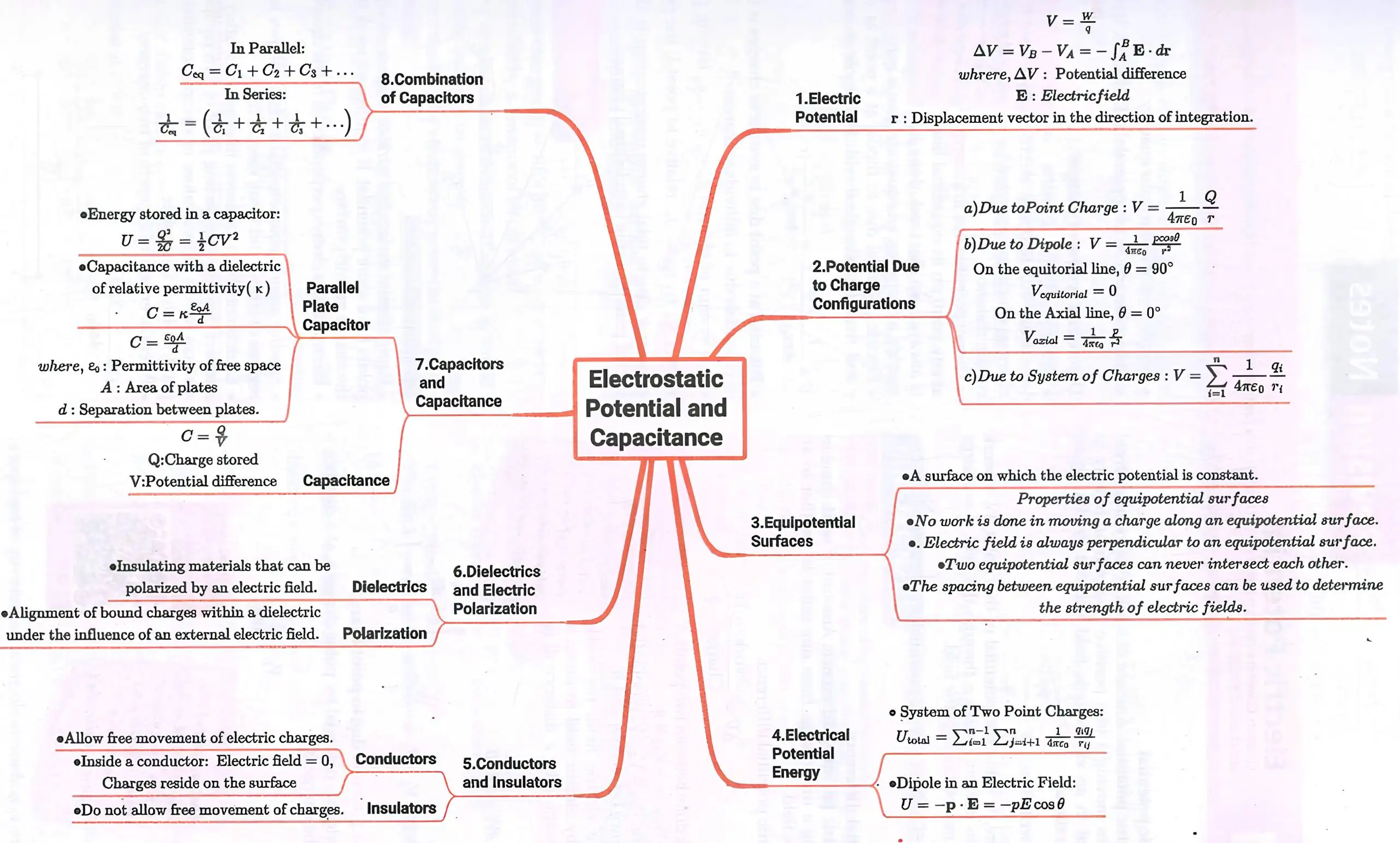
Electrostatic Potential
Definition and Formula
Electric potential at a point is the work done by an external force in moving a unit positive charge from infinity to that point in an electrostatic field without acceleration. It is a scalar quantity.
Mathematically, electric potential V is given by:
V = W / q
where,
- V = Electric potential at the point
- W = Work done in moving charge q through the field
- q = Charge being moved
The SI unit of electric potential is volt (V), equivalent to joule per coulomb (J/C).
Potential Difference
Electric potential difference between two points is the work done in moving a unit charge from one point to another in an electric field.
It is expressed as:
ΔV = W / q = V_B - V_A
The work done by the electric field in moving a charge q over a small displacement d\vec{l} is:
dW = q \vec{E} \cdot d\vec{l}
where \vec{E} is the electric field vector.
Electric Potential Due to Point Charge
The electric potential V_E at a distance r from a point charge q is:
V_E = (1 / 4πε₀) × (q / r)
where ε₀ is the permittivity of free space.
Electric Dipole and System of Charges
An electric dipole consists of two equal and opposite charges separated by a distance.
The potential due to a dipole at a point at distance r and angle θ with the dipole moment p is:
V = (1 / 4πε₀) × (p cos θ / r²)
For a system of charges, the total potential at a point is the algebraic sum of potentials due to individual charges.
Equipotential Surfaces
Equipotential surfaces are surfaces where the electric potential is constant. No work is required to move a charge along such surfaces.
Electric field lines are always perpendicular to equipotential surfaces.
Equipotential surfaces never intersect.
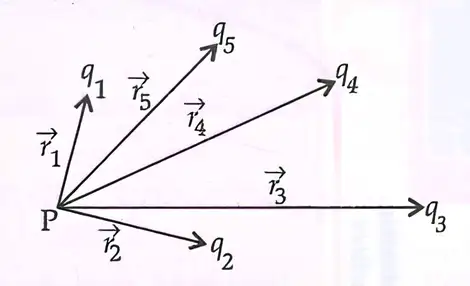
Electric Potential Energy
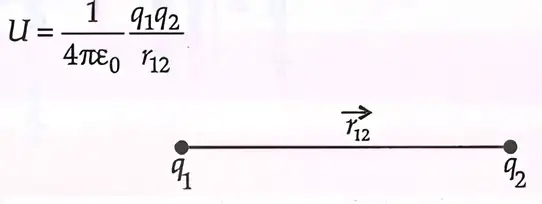
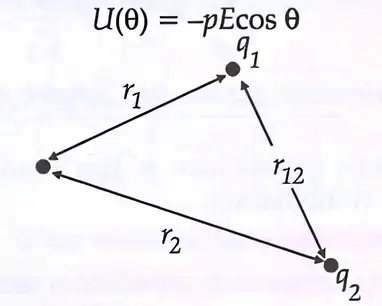
Potential energy of two point charges q₁ and q₂ separated by distance r₁₂ is:
U = (1 / 4πε₀) × (q₁ q₂ / r₁₂)
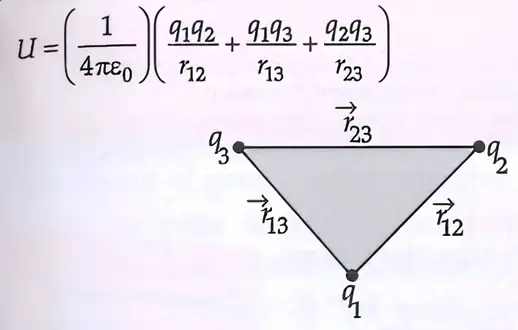
For three charges, total potential energy is the sum of energies of all pairs.
Potential energy of a charge q in an external potential V(\vec{r}) is:
U = q V(\vec{r})
Potential energy of a dipole in an external electric field \vec{E} making angle θ with dipole moment p is:
U(θ) = -p E cos θ
Solved Examples
Example 1: Two point charges, q₁= 10 × 10⁻⁸ C, q₂ = -2 × 10⁻⁸ C, are separated by 60 cm in air.
(i) Find at what distance from the 1ˢᵗ charge the electric potential is zero.
(ii) Calculate the electrostatic potential energy of the system.
Solution:
Let the distance from the first charge be x, then distance from the second charge is 0.6 - x meters.
Potential at point P due to q₁: V₁ = k q₁ / x
Potential at point P due to q₂: V₂ = k q₂ / (0.6 - x)
At zero potential, V₁ + V₂ = 0
⇒ k q₁ / x + k q₂ / (0.6 - x) = 0
⇒ 10 × 10⁻⁸ / x = -2 × 10⁻⁸ / (0.6 - x)
⇒ 2x + 10x = 6
⇒ 12x = 6
⇒ x = 0.5 m
Distance from first charge = 0.5 m = 50 cm.
Electrostatic potential energy of the system:
U = k q₁ q₂ / r = (9 × 10⁹) × (10 × 10⁻⁸) × (-2 × 10⁻⁸) / 0.6 = -3 × 10⁻⁵ J
Practice Set
- Level 1: Define electric potential and state its SI unit.
- Level 2: Calculate the electric potential at a point 0.2 m away from a charge of 5 × 10⁻⁶ C.
- Level 3: Two charges +3 × 10⁻⁶ C and -3 × 10⁻⁶ C are 0.5 m apart. Find the potential at the midpoint.
Answer Key
- Level 1: Electric potential is the work done in moving a unit positive charge from infinity to a point in an electric field. SI unit is volt (V).
- Level 2: V = (1 / 4πε₀) × (q / r) = 9 × 10⁹ × (5 × 10⁻⁶) / 0.2 = 225000 V
- Level 3: Potential at midpoint is sum of potentials due to both charges. Distance from each charge is 0.25 m.
V = 9 × 10⁹ × (3 × 10⁻⁶ / 0.25) - 9 × 10⁹ × (3 × 10⁻⁶ / 0.25) = 0 V
Capacitance
Conductors, Insulators and Dielectrics
Conductors are materials through which charge can move freely, e.g., metals, graphite, carbon.
Insulators are materials in which electric current does not flow easily, e.g., plastics, glass.
Dielectrics are insulating materials that become polarized in an electric field, inducing dipole moments proportional to the field.
Electrical displacement or flux density in dielectrics is given by:
D = εᵣ ε₀ E
where εᵣ is the relative permittivity (dielectric constant), ε₀ is permittivity of free space, and E is electric field.
Electric Polarisation
Polarisation P in dielectrics is the difference between induced and imposed electric fields, expressed as:
P = (D - E) / 4π
In terms of electric susceptibility Xₑ:
P = Xₑ E
In MKS units:
P = ε₀ Xₑ E
Dielectric constant K = 1 + Xₑ, always greater than 1.
Electric polarisation is the separation of centers of positive and negative charges in a material caused by an electric field.
Capacitor and Capacitance
A capacitor is a device used to store electric charge.
It consists of two conducting plates placed opposite each other, connected to positive and negative terminals of a battery.
Charge stored Q is proportional to potential difference V:
Q = C V
where C is capacitance, measured in farads (F).
1 F = 1 C / 1 V = 9 × 10¹¹ statfarad
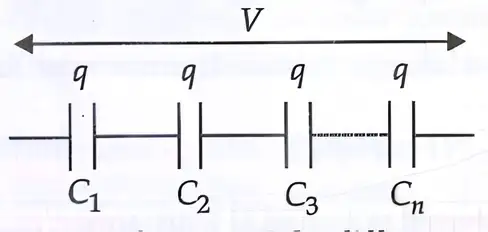
Capacitors in Series
Charge on each capacitor is the same: q₁ = q₂ = q₃ = ... = qₙ = q
Voltage across capacitors adds up:
V = V₁ + V₂ + V₃ + ... + Vₙ
Equivalent capacitance:
1 / C_eq = 1 / C₁ + 1 / C₂ + 1 / C₃ + ... + 1 / Cₙ
Capacitors in Parallel
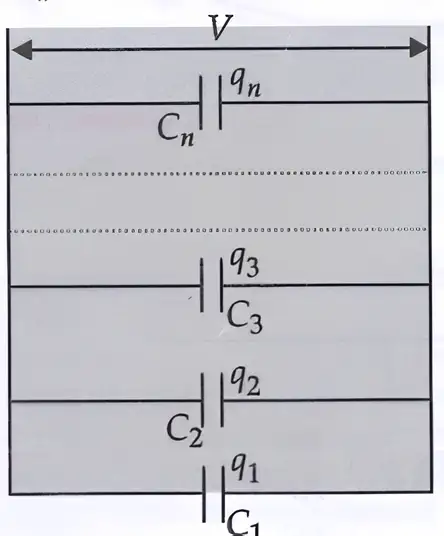
Voltage across each capacitor is the same:
V = V₁ = V₂ = V₃ = ... = Vₙ
Total charge is sum of individual charges:
Q = q₁ + q₂ + q₃ + ... + qₙ
Equivalent capacitance:
C_eq = C₁ + C₂ + C₃ + ... + Cₙ
Capacitance of Parallel Plate Capacitor
Capacitance with dielectric constant εᵣ:
C = (εᵣ ε₀ A) / d
where A is plate area and d is separation.
For multiple dielectric slabs of thickness t_i and dielectric constants k_i:
C = ε₀ A / Σ (t_i / k_i)
Where d = t₁ + t₂ + t₃ + ...
When space between plates is partly filled with dielectric of thickness t and dielectric constant k:
C = ε₀ A / (d - t + t / k)
When there is no medium between plates (vacuum):
C = ε₀ A / d
If a conductor slab of thickness t is introduced between plates:
C = ε₀ A / (d - t)
When medium consists of dielectric slabs of same thickness but different areas A_i and dielectric constants k_i:
C = ε₀ (k₁ A₁ + k₂ A₂ + k₃ A₃ + ...) / d
Dielectric: An insulating material placed between capacitor plates to increase capacitance.
Energy Stored in Capacitor
Energy stored U is given by:
U = (1/2) Q² / C = (1/2) Q V = (1/2) C V²
Solved Examples
Example 2: A slab of dielectric constant K has the same area as the plates of a parallel-plate capacitor but thickness (3/4)d, where d is the plate separation. How is the capacitance changed when the slab is inserted?
Solution:
Electric field without dielectric: E₀ = V₀ / d
Electric field in dielectric: E = E₀ / K
Potential difference:
V = E₀ × (1/4)d + (E₀ / K) × (3/4)d = E₀ d (1/4 + 3/4K) = V₀ (K + 3) / 4K
Capacitance increases by factor:
C = 4K / (K + 3) × C₀
Practice Set
- Level 1: Define dielectric and give two examples.
- Level 2: Calculate the equivalent capacitance of three capacitors 2 μF, 3 μF, and 6 μF connected in series.
- Level 3: A parallel plate capacitor has plate area 0.02 m² and plate separation 1 mm. Calculate its capacitance if the space between plates is filled with a dielectric of constant 5.
Answer Key
- Level 1: Dielectric is an insulating material that increases capacitance when placed between capacitor plates. Examples: glass, mica.
- Level 2: 1 / C_eq = 1/2 + 1/3 + 1/6 = 1; C_eq = 1 μF
- Level 3: C = (ε_r ε₀ A) / d = (5 × 8.85 × 10⁻¹² × 0.02) / (1 × 10⁻³) = 8.85 × 10⁻¹⁰ F = 0.885 nF
Quick Reference Table
Electric Potential: V = W / q; unit: volt (V)
Potential due to point charge: V = (1 / 4πε₀) × (q / r)
Capacitance of parallel plate capacitor: C = (ε_r ε₀ A) / d
Capacitors in series: 1 / C_eq = Σ (1 / C_i)
Capacitors in parallel: C_eq = Σ C_i
Energy stored in capacitor: U = (1/2) C V²
Common Mistakes and Misconceptions
- Confusing electric potential (scalar) with electric field (vector).
- Incorrect unit conversions, especially for capacitance (e.g., microfarads to farads).
- Misapplying capacitance formulas without considering geometry and dielectric properties.
- Assuming potential difference is always positive; it depends on direction.
- For capacitors in series, forgetting that charge is the same on all capacitors.
- For capacitors in parallel, forgetting that voltage across each capacitor is the same.
Glossary
- Electric Potential: Work done per unit charge in bringing a charge from infinity to a point.
- Capacitance: Ability of a capacitor to store charge per unit voltage.
- Dielectric: Insulating material that increases capacitance when placed between capacitor plates.
- Equipotential Surface: Surface where electric potential is constant.
- Electric Dipole: Two equal and opposite charges separated by a distance.
- Polarisation: Alignment of dipoles in a dielectric under an electric field.