CLASS 12-PCB . PHYSICS . PHYSICS PART I . ELECTROMAGNETIC WAVES
Chapter 8 : Electromagnetic Waves
Ch 8
PHYSICS
CLASS 12-PCB

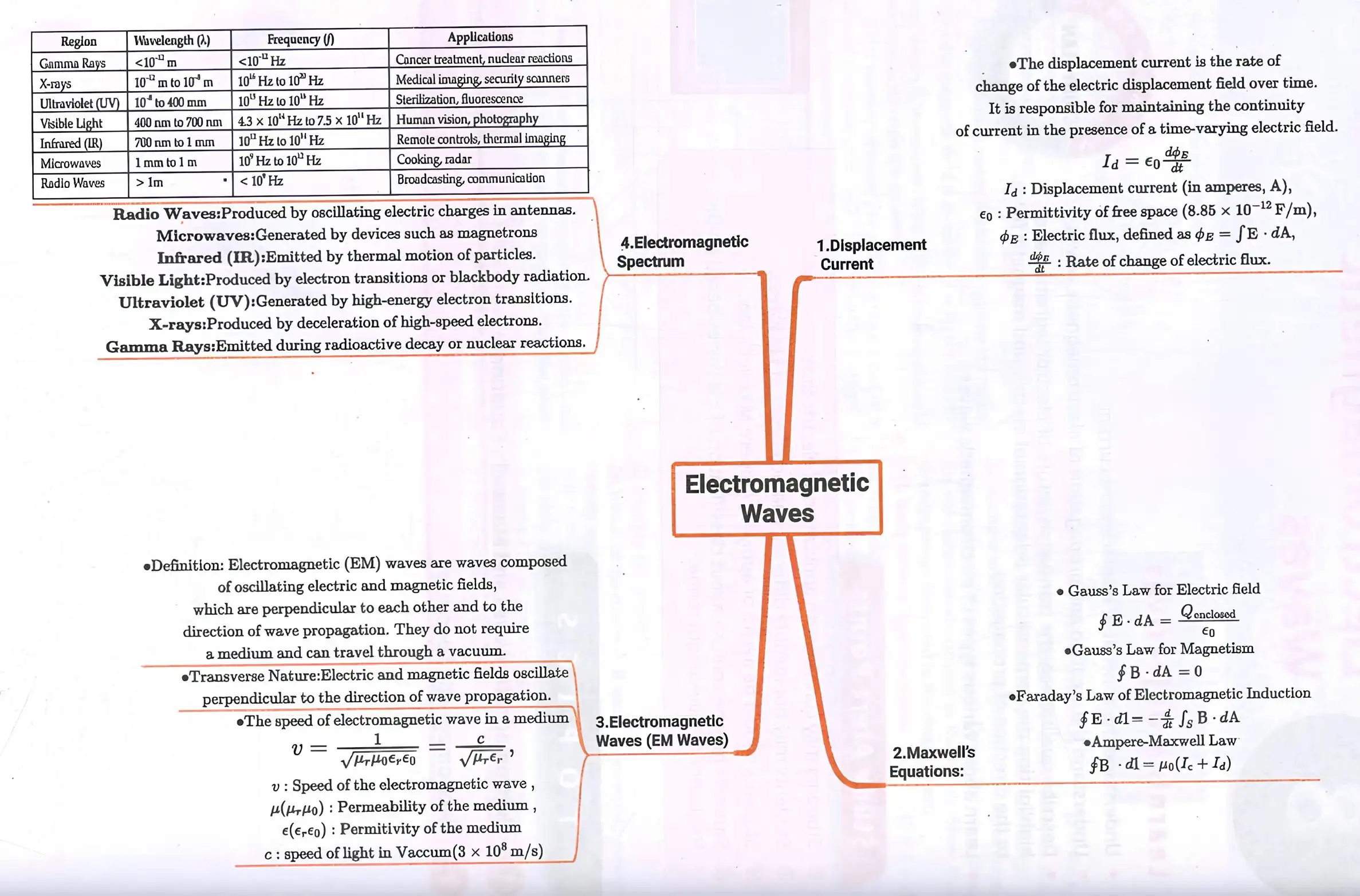
Electromagnetic Waves and Maxwell’s Equations
Displacement Current Concept
Displacement current is a quantity introduced by Maxwell to account for the changing electric field in situations where there is no actual conduction current, such as between the plates of a capacitor. It is defined as the rate of change of electric flux multiplied by the permittivity of free space.
Displacement current has the units of electric current and produces a magnetic field similar to that of conduction current.
Mathematically, displacement current \(I_d\) is given by:
\[ I_d = \varepsilon_0 \frac{d\Phi_E}{dt} = \varepsilon_0 A \frac{dE}{dt} \]
where \(\Phi_E = \int \vec{E} \cdot d\vec{A}\) is the electric flux, \(A\) is the area, \(E\) is the electric field, and \(\varepsilon_0\) is the permittivity of free space.
Ampere-Maxwell Law
The Ampere-Maxwell law modifies Ampere's circuital law by including displacement current. It states that the line integral of the magnetic field \(\vec{B}\) around a closed loop equals \(\mu_0\) times the sum of conduction current \(I_c\) and displacement current \(I_d\) passing through the loop:
\[ \oint \vec{B} \cdot d\vec{l} = \mu_0 (I_c + I_d) = \mu_0 I_c + \mu_0 \varepsilon_0 \frac{d\Phi_E}{dt} \]
This law shows that a changing electric field produces a magnetic field, completing the symmetry in Maxwell's equations.
Electromagnetic Waves
Electromagnetic (EM) waves are waves consisting of oscillating electric and magnetic fields that propagate through space. They do not require a medium and can travel through vacuum at the speed of light \(c = 3 \times 10^8\) m/s.
EM waves are produced by accelerated charged particles. Examples include electrons jumping between atomic orbits, oscillations in LC circuits, and electric sparks.
Characteristics of Electromagnetic Waves
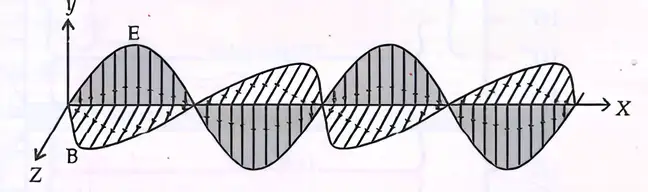
- Electric and magnetic fields oscillate perpendicular to each other and to the direction of wave propagation, showing the transverse nature of EM waves.
- They travel in straight lines at speed \(c = \frac{1}{\sqrt{\mu_0 \varepsilon_0}} \approx 3 \times 10^8\) m/s in vacuum.
- EM waves are not affected by external electric or magnetic fields.
- The magnitudes of electric and magnetic fields are related by \(B_0 = \frac{E_0}{c}\).
- The wavelength \(\lambda\) and frequency \(f\) satisfy \(c = f \lambda\).
Transverse Nature and Wave Propagation
In an EM wave traveling along the z-axis, the electric field \(E\) and magnetic field \(B\) vary sinusoidally as:
\[ E = E_0 \sin(kz - \omega t) \quad \text{and} \quad B = B_0 \sin(kz - \omega t) \]
where \(k\) is the wave number and \(\omega\) is the angular frequency.
The electric and magnetic fields are perpendicular to each other and to the direction of propagation, confirming the transverse nature of EM waves.
Electromagnetic waves transmit energy through space, but exposure to high intensities can be harmful to living organisms and the environment.
Maxwell's equations summarize the fundamental laws of electricity and magnetism, describing how electric and magnetic fields interact and propagate as electromagnetic waves.
Solved Examples
Example 1: Calculate the displacement current between the plates of a capacitor of area \(0.01\) m² if the electric field between the plates changes at a rate of \(5 \times 10^6\) V/m/s.
Solution:
- Area \(A = 0.01\) m²
- Rate of change of electric field \(\frac{dE}{dt} = 5 \times 10^6\) V/m/s
- Permittivity of free space \(\varepsilon_0 = 8.85 \times 10^{-12}\) F/m
Displacement current \(I_d = \varepsilon_0 A \frac{dE}{dt} = 8.85 \times 10^{-12} \times 0.01 \times 5 \times 10^6 = 4.425 \times 10^{-7}\) A
Therefore, the displacement current is \(4.425 \times 10^{-7}\) amperes.
Example 2: An electromagnetic wave has an electric field amplitude of \(100\) V/m. Find the amplitude of the magnetic field.
Solution:
- Electric field amplitude \(E_0 = 100\) V/m
- Speed of light \(c = 3 \times 10^8\) m/s
Magnetic field amplitude \(B_0 = \frac{E_0}{c} = \frac{100}{3 \times 10^8} = 3.33 \times 10^{-7}\) T
Thus, the magnetic field amplitude is \(3.33 \times 10^{-7}\) tesla.
Practice Set
- Level 1 (Easy): What is displacement current and why is it important in Maxwell's equations?
- Level 2 (Moderate): Explain why electromagnetic waves are transverse in nature.
- Level 3 (Challenging): A capacitor with plate area \(0.02\) m² has an electric field changing at \(2 \times 10^6\) V/m/s. Calculate the displacement current between the plates.
Answer Key
- Level 1: Displacement current is the rate of change of electric flux multiplied by permittivity of free space. It is important because it allows Maxwell to modify Ampere's law to include changing electric fields, ensuring continuity of current and predicting electromagnetic waves.
- Level 2: Electromagnetic waves are transverse because their electric and magnetic fields oscillate perpendicular to the direction of wave propagation and to each other.
- Level 3: \(I_d = \varepsilon_0 A \frac{dE}{dt} = 8.85 \times 10^{-12} \times 0.02 \times 2 \times 10^6 = 3.54 \times 10^{-7}\) A.
Electromagnetic Spectrum
Classification of Electromagnetic Waves
Electromagnetic waves are classified based on their frequency or wavelength into the following types:
- Radio waves
- Microwaves
- Infrared radiation
- Visible light
- Ultraviolet radiation
- X-rays
- Gamma rays
The frequency increases and wavelength decreases from radio waves to gamma rays.
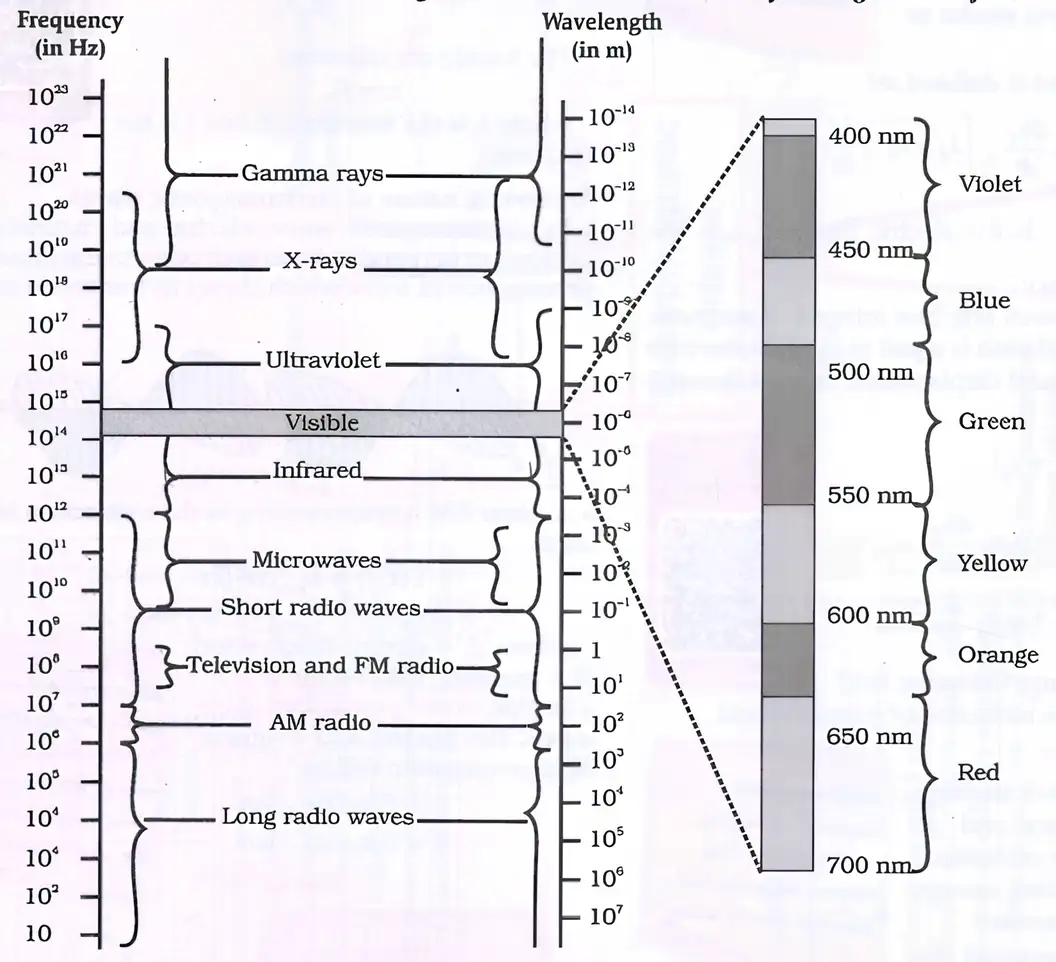
Properties of Electromagnetic Waves
- They do not require a medium and can travel through vacuum.
- They are transverse waves with oscillating electric and magnetic fields.
- Frequency and wavelength are related by \(c = f \lambda\).
Uses of Electromagnetic Waves
- Radio waves: Communication and broadcasting.
- Microwaves: Cooking and radar.
- Infrared: Remote controls and thermal imaging.
- Visible light: Vision and photography.
- Ultraviolet: Sterilization and fluorescent lamps.
- X-rays: Medical imaging.
- Gamma rays: Cancer treatment and sterilization.
Production and Detection
Each type of electromagnetic wave is produced and detected by specific methods:
- Radio waves: Produced by oscillating electrons; detected by antennas.
- Microwaves: Produced by magnetrons; detected by receivers.
- Infrared: Produced by hot objects; detected by photodiodes.
- Visible light: Produced by atoms and molecules; detected by eyes and cameras.
- Ultraviolet: Produced by hot objects and electronic transitions; detected by photodiodes.
- X-rays: Produced by high-energy electron impacts; detected by photographic plates.
- Gamma rays: Produced by nuclear reactions; detected by Geiger counters.
Mnemonic for Electromagnetic Spectrum
To remember the order of EM waves from longest wavelength to shortest:
Russian magicians introduced a very unusual X-ray eye game.
R - Radio waves, m - Microwaves, i - Infrared, V - Visible light, u - Ultraviolet, X - X-rays, g - Gamma rays.
Energy in Electromagnetic Waves
The energy in an electromagnetic wave is divided equally on average between the electric and magnetic fields.
It is given by the expression:
\[ U = \frac{1}{2} \varepsilon_0 E^2 + \frac{B^2}{2 \mu_0} \]
Additional Concepts
Acoustics: The science that deals with the study of sound and its production, transmission, and effects.
Thermopiles and Bolometer: Instruments that measure temperature changes; bolometers are more sensitive and measure radiation intensity by detecting temperature changes.
Solved Examples
Example 1: Identify the type of electromagnetic wave with frequency \(5 \times 10^{14}\) Hz.
Solution:
This frequency lies in the visible light range (approximately \(4 \times 10^{14}\) to \(7.5 \times 10^{14}\) Hz). Therefore, the wave is visible light.
Example 2: Calculate the wavelength of an electromagnetic wave with frequency \(3 \times 10^{8}\) Hz.
Solution:
Using \(c = f \lambda\),
\[ \lambda = \frac{c}{f} = \frac{3 \times 10^8}{3 \times 10^8} = 1 \text{ meter} \]
The wavelength is 1 meter, which corresponds to radio waves.
Practice Set
- Level 1 (Easy): Name the electromagnetic wave with the shortest wavelength.
- Level 2 (Moderate): Explain why ultraviolet rays are harmful to living organisms.
- Level 3 (Challenging): Calculate the frequency of an electromagnetic wave with wavelength \(600\) nm.
Answer Key
- Level 1: Gamma rays have the shortest wavelength.
- Level 2: Ultraviolet rays have high energy that can damage DNA and cause skin burns, leading to harmful effects on living organisms.
- Level 3: \(f = \frac{c}{\lambda} = \frac{3 \times 10^8}{600 \times 10^{-9}} = 5 \times 10^{14}\) Hz.
Quick Reference Table
Displacement Current: \(I_d = \varepsilon_0 \frac{d\Phi_E}{dt}\)
Ampere-Maxwell Law: \(\oint \vec{B} \cdot d\vec{l} = \mu_0 (I_c + I_d)\)
Speed of EM Waves: \(c = \frac{1}{\sqrt{\mu_0 \varepsilon_0}} = 3 \times 10^8\) m/s
Relation between E and B fields: \(B_0 = \frac{E_0}{c}\)
Wave Equation: \(c = f \lambda\)
EM Spectrum Order: Radio < Microwave < Infrared < Visible < Ultraviolet < X-rays < Gamma rays
Common Mistakes and Misconceptions
- Confusing displacement current with conduction current; displacement current arises from changing electric fields, not actual charge flow.
- Assuming EM waves require a medium; they can travel through vacuum.
- Mixing up the order of EM spectrum; remember frequency increases and wavelength decreases from radio to gamma rays.
- Believing electric and magnetic fields in EM waves are parallel; they are perpendicular to each other and to the direction of propagation.
- Ignoring the transverse nature of EM waves.
Glossary
- Displacement Current: A current-like quantity due to changing electric field, important in Maxwell's equations.
- Electric Flux: The product of electric field and area through which it passes.
- Permittivity of Free Space (\(\varepsilon_0\)): A constant that characterizes the ability of vacuum to permit electric field.
- Permeability of Free Space (\(\mu_0\)): A constant that characterizes the ability of vacuum to support magnetic field.
- Electromagnetic Wave: A wave consisting of oscillating electric and magnetic fields propagating through space.
- Frequency (\(f\)): Number of wave cycles per second, measured in Hertz (Hz).
- Wavelength (\(\lambda\)): Distance between two consecutive peaks of a wave.
- Transverse Wave: A wave in which oscillations are perpendicular to the direction of wave propagation.