CLASS 12-PCB . PHYSICS . PHYSICS PART I . ELECTROMAGNETIC INDUCTION
Chapter 6 : Electromagnetic Induction
Ch 6
PHYSICS
CLASS 12-PCB
Electromagnetic Induction
Magnetic Flux and Faraday's Laws
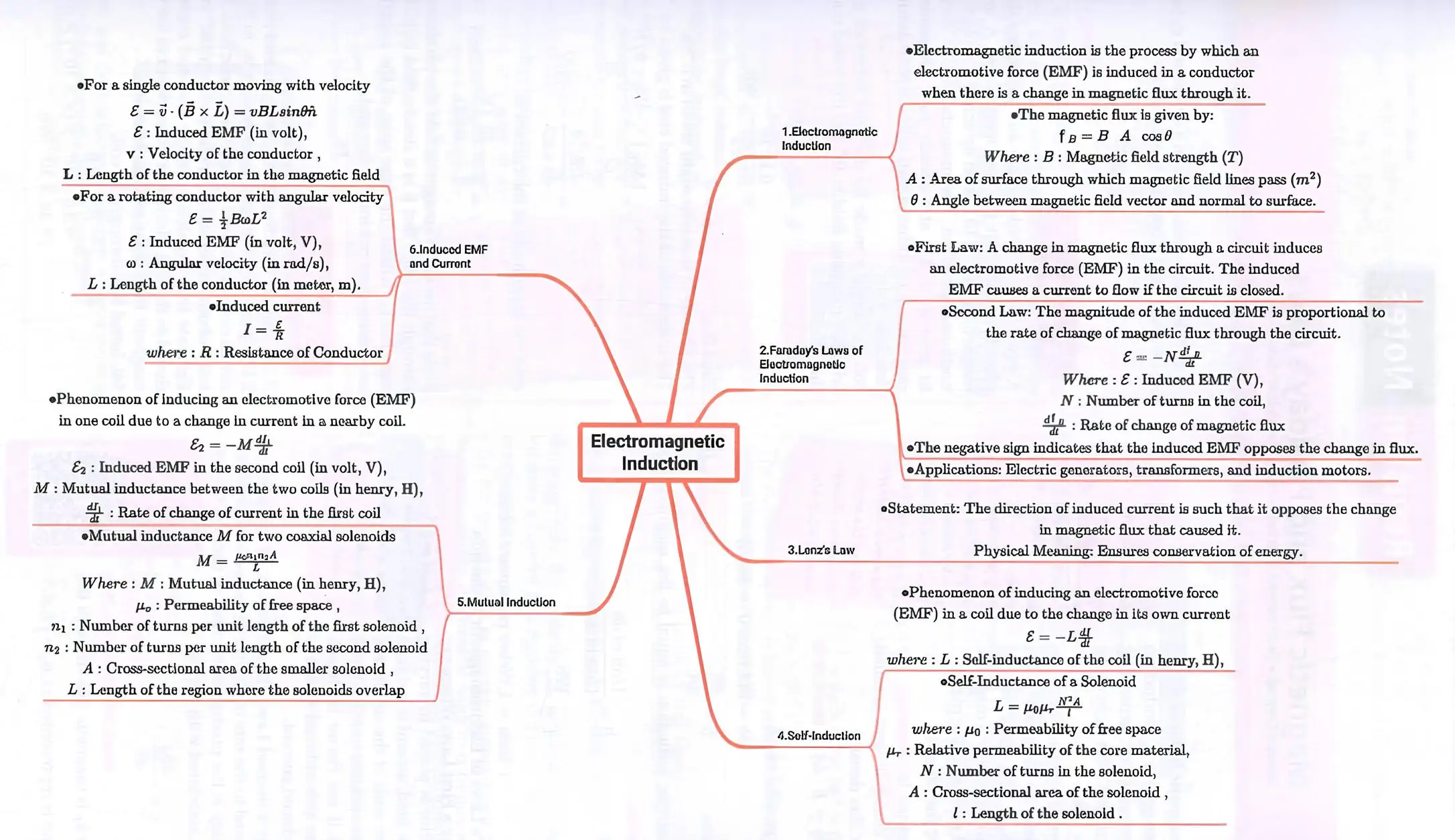
Electromagnetic induction is the process of generating electric current with a changing magnetic field. Magnetic flux is a measure of how many magnetic field lines pass through an area. It depends on the magnetic field strength, the size of the area, and the angle between them.
Magnetic flux \( \Phi = B A \cos \theta \), where \( B \) is the magnetic field strength, \( A \) is the area, and \( \theta \) is the angle between the magnetic field and the normal to the plane.
The change in magnetic flux per unit change in area is called the average magnetic flux density.
Mathematically, \( d\Phi = \vec{B} \cdot d\vec{A} \). For \( \vec{B} \) parallel to \( d\vec{A} \), \( d\Phi = B (dA) \cos 0^\circ = B (dA) \). Therefore, magnetic induction \( B = \frac{d\Phi}{dA} \).
1 Tesla (T) is equal to 1 Weber per square meter (Wb/m²).
Faraday's First Law: Whenever a conductor is placed in a varying magnetic field, an emf is induced across the ends of the conductor. If the circuit is closed, an induced current flows.
Faraday's Second Law: The magnitude of the induced emf is equal to the rate of change of magnetic flux linkage, where flux linkage is the product of the number of turns in the coil and the flux through each turn.
Mathematically, \( \varepsilon = -N \frac{d\Phi}{dt} \), where \( N \) is the number of turns.
The negative sign indicates the direction of induced emf as per Lenz's Law.
Induced emf is a short-lived voltage generated in a conductor or coil while moving in a magnetic field.
Induced current flows when a magnet is moved towards or away from a loop of wire connected to an ammeter. The direction of current reverses when the magnet is moved away.
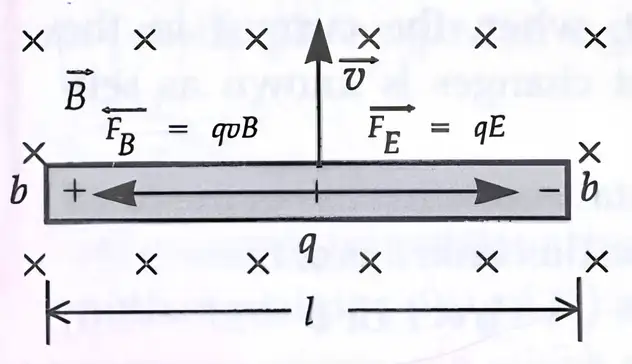
Motional emf is the emf induced across the ends of a conductor due to its motion in a magnetic field. The emf induced in a conductor of length \( l \) moving at velocity \( v \) perpendicular to a magnetic field \( B \) is \( \varepsilon = B l v \).
At equilibrium, the electric force \( F_E = qE \) balances the magnetic force \( F_B = qvB \), giving \( E = vB \). The potential difference between the ends of the rod is \( \varepsilon = E l = v B l \).
Example: A wheel with 10 metallic spokes each 0.5 m long is rotated at 120 revolutions per minute in a plane normal to the horizontal component of Earth's magnetic field \( H_E = 0.4 \text{ G} \). Calculate the induced emf between the axle and the rim of the wheel. (1 G = 10-4 T)
Solution: Induced emf \( = \frac{1}{2} \omega B R^2 \)
= \( \frac{1}{2} \times 4 \pi \times 0.4 \times 10^{-4} \times (0.5)^2 = 6.28 \times 10^{-5} \text{ V} \)
The number of spokes is immaterial because the emf across the spokes are in parallel.
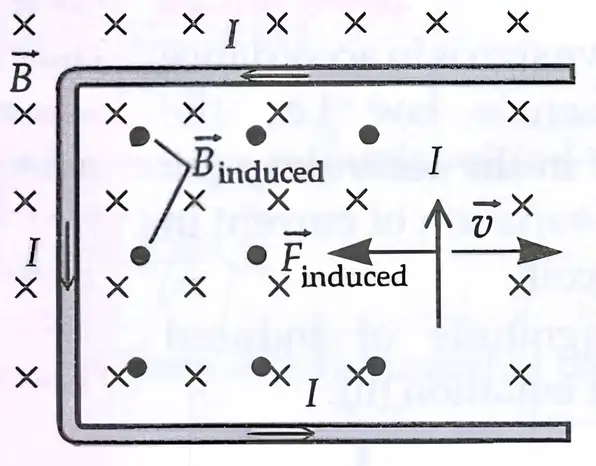
Lenz's Law: The direction of induced emf always opposes the change in magnetic flux which causes it. This explains the negative sign in Faraday's law.
It ensures conservation of energy by opposing the cause of induction.
Mnemonics for induced emf in a conductor moving in a magnetic field: "I eat Plain Loaf and Boiled Vegetables" where:
- I: Induce
- eat: emf
- Plain: product of
- Loaf: Length of conductor
- Boiled: Magnetic field (B)
- Vegetables: Velocity (v)
Thus, induced emf \( = B l v \).
Self and Mutual Induction
Self Induction is the production of induced emf in a circuit when the current in the same circuit changes. The magnetic flux linked \( \Phi \) is proportional to the current \( I \):
\( \Phi = L I \), where \( L \) is the coefficient of self-induction.
The induced emf is \( \varepsilon = -L \frac{dI}{dt} \), where the negative sign follows Lenz's law.
The coefficient of self-induction \( L = \frac{|\varepsilon|}{|dI/dt|} \).
Inductance in an electrical circuit is analogous to inertia in mechanics.
When a bar magnet is dropped into a coil, the induced emf opposes its motion, causing it to fall slower than free fall.
Unit of inductance is Henry (H), where 1 H = 1 Weber per Ampere (Wb/A) = 1 Volt-second per Ampere (Vs/A) = 1 Ohm-second (Ωs).
The self-inductance of a circular coil is given by \( L = \frac{\mu_0 N^2 \pi r^2}{2 r} \), where \( N \) is the number of turns, \( r \) is the radius, and \( \mu_0 \) is the permeability of free space.
The self-inductance of a solenoid is \( L = \frac{\mu_0 N^2 A}{l} \), where \( A \) is the cross-sectional area and \( l \) is the length.
Mutual Induction is the production of induced emf in a circuit when the current in a neighbouring circuit changes.
The mutual inductance \( M \) relates the magnetic flux \( \Phi \) linked with the secondary coil to the current \( I \) in the primary coil:
\( \Phi = M I \).
The induced emf in the secondary coil is \( \varepsilon = -M \frac{dI}{dt} \).
The coefficient of mutual induction depends on the number of turns, shape, size, and geometry of the coils.
For two coils with inductances \( L_1 \) and \( L_2 \) coupled with coupling constant \( k \), the mutual inductance is \( M = k \sqrt{L_1 L_2} \), where \( 0 \leq k \leq 1 \).
Magnetic energy stored in a coil is \( U_m = \frac{1}{2} L I^2 \).
Mutual inductance for two concentric circular coils with radii \( r_1 \) and \( r_2 \) (\( r_1 \ll r_2 \)) placed coaxially is \( M = \frac{\mu_0 \pi r_1^2}{2 r_2} \).
Magnetic energy stored in a solenoid is \( U_B = \frac{1}{2 \mu_0} B^2 A l \), where \( B \) is magnetic field, \( A \) is cross-sectional area, and \( l \) is length.
Magnetic energy density is \( u_B = \frac{B^2}{2 \mu_0} \), analogous to electrostatic energy density \( u_E = \frac{1}{2} \epsilon_0 E^2 \).
Solved Examples
Example 1: A square loop of side 0.1 m is placed in a magnetic field of 0.5 T at an angle of 45°. The magnetic field decreases to zero in 0.1 s. Calculate the induced emf and current if the resistance of the loop is 2 Ω.
Solution:
Area of loop, \( A = 0.1 \times 0.1 = 0.01 \text{ m}^2 \)
Initial magnetic flux, \( \Phi_i = B A \cos \theta = 0.5 \times 0.01 \times \cos 45^\circ = 0.5 \times 0.01 \times 0.707 = 0.003535 \text{ Wb} \)
Final magnetic flux, \( \Phi_f = 0 \) (since field decreases to zero)
Change in flux, \( \Delta \Phi = \Phi_f - \Phi_i = -0.003535 \text{ Wb} \)
Time interval, \( \Delta t = 0.1 \text{ s} \)
Induced emf, \( \varepsilon = \left| \frac{\Delta \Phi}{\Delta t} \right| = \frac{0.003535}{0.1} = 0.03535 \text{ V} \)
Induced current, \( I = \frac{\varepsilon}{R} = \frac{0.03535}{2} = 0.0177 \text{ A} \)
Example 2: A circular coil of radius 10 cm with 500 turns and resistance 2 Ω is rotated 180° in Earth's magnetic field of 0.5 × 10⁻⁴ T in 0.1 s. Find the induced emf and current.
Solution:
Radius, \( r = 0.1 \text{ m} \)
Area, \( A = \pi r^2 = 3.1416 \times (0.1)^2 = 0.0314 \text{ m}^2 \)
Number of turns, \( N = 500 \)
Initial flux, \( \Phi_i = N B A \cos 0^\circ = 500 \times 0.5 \times 10^{-4} \times 0.0314 = 0.000785 \text{ Wb} \)
Final flux after 180° rotation, \( \Phi_f = N B A \cos 180^\circ = -0.000785 \text{ Wb} \)
Change in flux, \( \Delta \Phi = \Phi_f - \Phi_i = -0.000785 - 0.000785 = -0.00157 \text{ Wb} \)
Time interval, \( \Delta t = 0.1 \text{ s} \)
Induced emf, \( \varepsilon = \left| \frac{\Delta \Phi}{\Delta t} \right| = \frac{0.00157}{0.1} = 0.0157 \text{ V} = 15.7 \text{ mV} \)
Induced current, \( I = \frac{\varepsilon}{R} = \frac{0.0157}{2} = 0.00785 \text{ A} = 7.85 \text{ mA} \)
Practice Set
- Level 1 (Easy): Define magnetic flux and state Faraday's First Law of electromagnetic induction.
- Level 2 (Moderate): A coil of 100 turns and area 0.02 m² is placed in a magnetic field of 0.3 T. The coil is rotated such that the magnetic flux changes from maximum to zero in 0.05 s. Calculate the induced emf.
- Level 3 (Challenging): Two coils with inductances 2 H and 3 H are coupled with a coupling constant of 0.8. Calculate the mutual inductance. If the current in the first coil changes at a rate of 5 A/s, find the induced emf in the second coil.
Answer Key
- Level 1: Magnetic flux is the total magnetic field passing through a given area. Faraday's First Law states that an emf is induced in a conductor when the magnetic flux linked with it changes.
- Level 2: Area \( A = 0.02 \text{ m}^2 \), Number of turns \( N = 100 \), Magnetic field \( B = 0.3 \text{ T} \), Time \( \Delta t = 0.05 \text{ s} \). Initial flux \( \Phi_i = N B A = 100 \times 0.3 \times 0.02 = 0.6 \text{ Wb} \). Final flux \( \Phi_f = 0 \). Induced emf \( \varepsilon = \frac{\Delta \Phi}{\Delta t} = \frac{0.6}{0.05} = 12 \text{ V} \).
- Level 3: Mutual inductance \( M = k \sqrt{L_1 L_2} = 0.8 \times \sqrt{2 \times 3} = 0.8 \times 2.45 = 1.96 \text{ H} \). Rate of change of current \( \frac{dI}{dt} = 5 \text{ A/s} \). Induced emf \( \varepsilon = M \frac{dI}{dt} = 1.96 \times 5 = 9.8 \text{ V} \).
Quick Reference Table
Magnetic Flux: \( \Phi = B A \cos \theta \)
Faraday's Law: \( \varepsilon = -N \frac{d\Phi}{dt} \)
Self-Inductance: \( \varepsilon = -L \frac{dI}{dt} \)
Mutual Inductance: \( \varepsilon = -M \frac{dI}{dt} \), \( M = k \sqrt{L_1 L_2} \)
Unit of Inductance: Henry (H)
Common Mistakes and Misconceptions
- Confusing magnetic field strength with magnetic flux; only changing magnetic flux induces emf.
- Ignoring the negative sign in Faraday's law, which indicates the direction of induced emf.
- Mixing up self-induction and mutual induction effects.
- Using inconsistent units, leading to calculation errors.
- Assuming a constant magnetic field induces emf; only changing fields do.
Glossary
- Electromagnetic Induction: Generation of emf due to change in magnetic flux.
- Magnetic Flux: Total magnetic field passing through an area.
- Faraday's Laws: Laws describing induced emf due to changing magnetic flux.
- Lenz's Law: Direction of induced emf opposes the change causing it.
- Self-Inductance: Induction of emf in the same coil due to changing current.
- Mutual Inductance: Induction of emf in one coil due to changing current in another coil.
- Inductance: Property of a coil to oppose change in current.