Alpha Particle Scattering
Experimental Setup and Observations
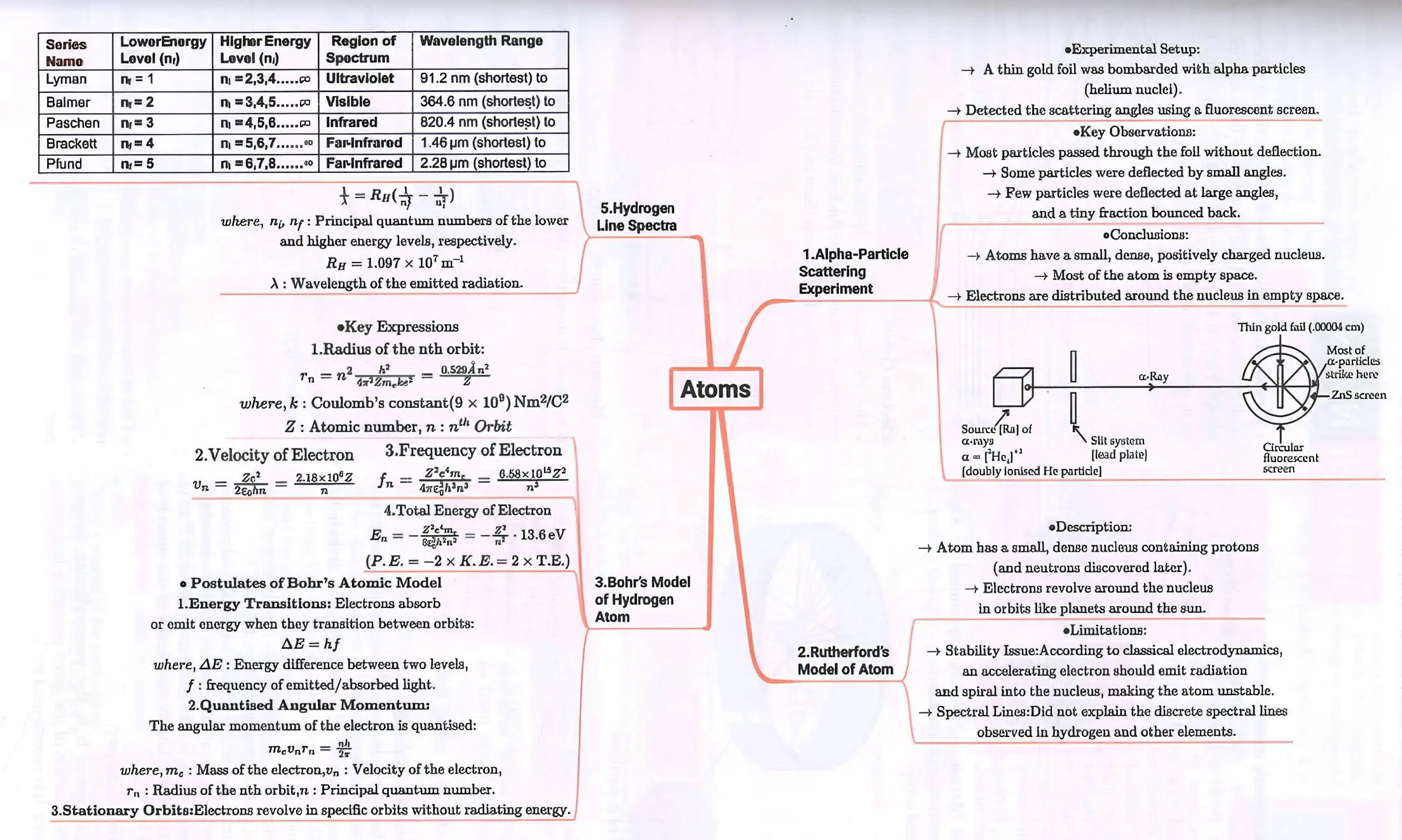
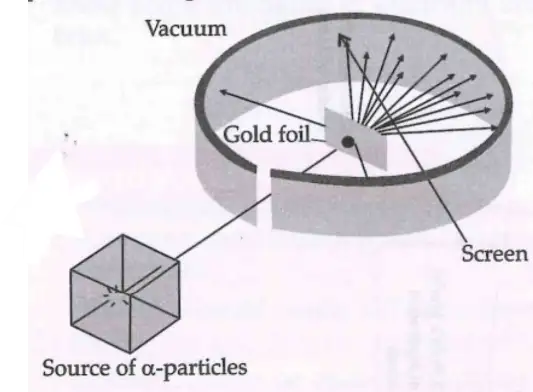
The alpha particle scattering experiment was conducted by Geiger and Marsden under Rutherford's guidance. A source of alpha particles (positively charged helium nuclei) was directed at a thin gold foil. A circular fluorescent screen surrounded the foil to detect scattered alpha particles.
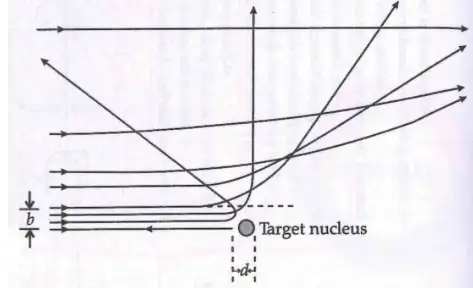
Most alpha particles passed straight through the foil, some were deflected at small angles, and a very few were deflected at large angles, even bouncing back.
Conclusions from the Experiment
The observations led to the conclusion that atoms consist mostly of empty space with a small, dense, positively charged nucleus at the center. The nucleus contains most of the atom's mass, and electrons revolve around it.
Rutherford's Atomic Model
Model Description
Rutherford proposed that the atom has a tiny, dense nucleus containing all positive charge and most of the mass. Electrons revolve around the nucleus in orbits, similar to planets orbiting the Sun.
Limitations
Classical physics predicted that orbiting electrons should lose energy and spiral into the nucleus, which does not happen. Rutherford's model could not explain the stability of atoms or the discrete spectral lines observed in atomic spectra.
Bohr's Atomic Model
Postulates
- Electrons revolve in certain stable orbits without emitting radiation, called stationary states.
- Angular momentum of an electron in these orbits is quantized and given by L = n\hbar, where n is an integer and \hbar = h/2\pi.
- Electrons can transition between orbits by absorbing or emitting photons with energy equal to the difference between energy levels.
Key Formulas
- Radius of nth orbit: r_n = \frac{n^2 h^2 \epsilon_0}{\pi m e^2}
- Velocity of electron in nth orbit: v_n = \frac{e^2}{2 \epsilon_0 h n}
- Total energy of electron in nth orbit: E_n = -\frac{13.6}{n^2} \text{ eV}
- Energy of photon emitted or absorbed during transition: h \nu = E_i - E_f
Spectral Series of Hydrogen
Hydrogen atom emits spectral lines grouped into series based on electron transitions:
- Lyman series: Transitions to n=1, ultraviolet region.
- Balmer series: Transitions to n=2, visible region.
- Paschen series: Transitions to n=3, infrared region.
- Pfund series: Transitions to n=5, far infrared region.
Solved Examples
Example 1: Calculate the radius of the first Bohr orbit for hydrogen.
Given: Planck's constant h = 6.626 \times 10^{-34} \text{ Js}, permittivity of free space \epsilon_0 = 8.854 \times 10^{-12} \text{ C}^2/\text{N m}^2, electron mass m = 9.11 \times 10^{-31} \text{ kg}, electron charge e = 1.6 \times 10^{-19} \text{ C}.
Formula: a_0 = \frac{h^2 \epsilon_0}{\pi m e^2}
Calculation:
a_0 = \frac{(6.626 \times 10^{-34})^2 \times 8.854 \times 10^{-12}}{\pi \times 9.11 \times 10^{-31} \times (1.6 \times 10^{-19})^2}
= 5.29 \times 10^{-11} \text{ m}
Answer: The radius of the first Bohr orbit is approximately 0.53 angstroms.
Example 2: Find the wavelength of the photon emitted when an electron transitions from n=3 to n=2 in hydrogen.
Given: Rydberg constant R = 1.097 \times 10^7 \text{ m}^{-1}.
Formula: \frac{1}{\lambda} = R \left( \frac{1}{n_1^2} - \frac{1}{n_2^2} \right)
Calculation:
\frac{1}{\lambda} = 1.097 \times 10^7 \left( \frac{1}{2^2} - \frac{1}{3^2} \right) = 1.097 \times 10^7 \left( \frac{1}{4} - \frac{1}{9} \right)
= 1.097 \times 10^7 \times \frac{5}{36} = 1.5236 \times 10^6 \text{ m}^{-1}
\lambda = \frac{1}{1.5236 \times 10^6} = 6.56 \times 10^{-7} \text{ m} = 656 \text{ nm}
Answer: The wavelength of the emitted photon is 656 nm, which is in the visible red region.
Practice Set
- Level 1: What did the alpha particle scattering experiment reveal about the structure of the atom?
- Level 2: Explain why electrons in Rutherford's atomic model do not spiral into the nucleus.
- Level 3: Calculate the velocity of an electron in the second Bohr orbit of hydrogen. (Given: e = 1.6 \times 10^{-19} C, \epsilon_0 = 8.854 \times 10^{-12} C^2/Nm^2, h = 6.626 \times 10^{-34} Js, m = 9.11 \times 10^{-31} kg)
Answer Key
- Level 1: The experiment showed that atoms have a small, dense, positively charged nucleus and most of the atom is empty space.
- Level 2: Rutherford's model could not explain this; classical physics predicted electrons would lose energy and spiral into the nucleus, but this does not happen. Bohr's model introduced stationary orbits where electrons do not emit radiation.
- Level 3: Velocity in nth orbit: v_n = \frac{e^2}{2 \epsilon_0 h n}
Calculate numerator: e^2 = (1.6 \times 10^{-19})^2 = 2.56 \times 10^{-38}
Calculate denominator: 2 \times 8.854 \times 10^{-12} \times 6.626 \times 10^{-34} \times 2 = 2.35 \times 10^{-44}
Velocity: v_2 = \frac{2.56 \times 10^{-38}}{2.35 \times 10^{-44}} = 1.09 \times 10^6 \text{ m/s}
Quick Reference Table
- Alpha Particle Scattering: Revealed nucleus and empty space in atom.
- Rutherford Model: Nucleus with electrons orbiting; could not explain stability.
- Bohr Model Postulates: Stationary orbits, quantized angular momentum, energy transitions emit/absorb photons.
- Bohr Radius: 5.29 × 10⁻¹¹ m
- Energy Levels: E_n = -13.6/n² eV
- Rydberg Formula: 1/λ = R (1/n₁² - 1/n₂²)
- Spectral Series: Lyman (UV), Balmer (Visible), Paschen (IR), Pfund (Far IR)
Common Mistakes and Misconceptions
- Assuming electrons spiral into the nucleus in Rutherford's model.
- Confusing the spectral series and their corresponding regions.
- Forgetting that energy levels are quantized and negative, indicating bound states.
- Misapplying formulas for velocity and radius without considering the orbit number n.
Glossary
- Atom: The smallest unit of an element, consisting of a nucleus and electrons.
- Nucleus: The dense, positively charged center of an atom containing protons and neutrons.
- Alpha Particle: A helium nucleus consisting of two protons and two neutrons.
- Stationary Orbit: An electron orbit in which it does not emit radiation.
- Bohr Radius: The radius of the smallest orbit in the hydrogen atom.
- Spectral Series: Groups of spectral lines corresponding to electron transitions to a particular energy level.