CLASS 12-PCB . CHEMISTRY . CHEMISTRY PART I . THE D-AND-F-BLOCK-ELEMENTS
Chapter 4 : The D- And F -Block Elements
Ch 4
CHEMISTRY
CLASS 12-PCB
d-Block Elements
Definition and Position
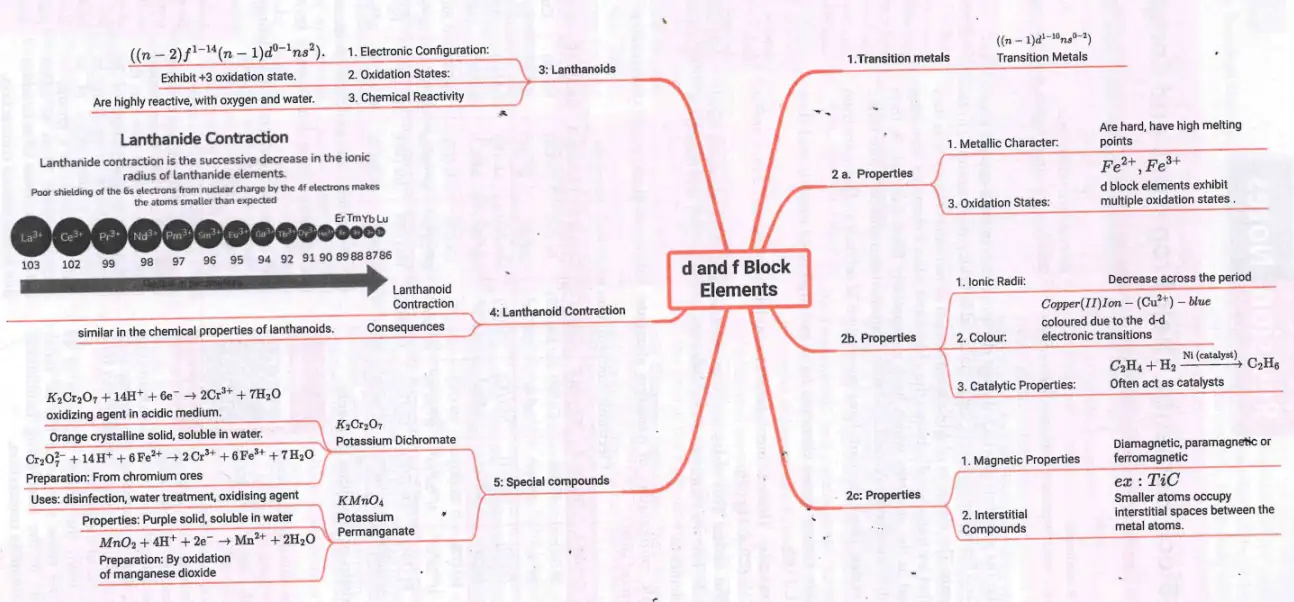
d-block elements are those in which the last electron enters the d-sub-shell of the penultimate shell. They are located in the middle of the periodic table, spanning groups 3 to 12.
Penultimate Shell
The penultimate shell is the shell just inside the valence shell. If the valence shell is numbered n, the penultimate shell is n−1.
Transition Elements
Transition elements are d-block elements with incompletely filled d-orbitals in their ground or common oxidation states. They exhibit properties transitional between s- and p-block elements.
Series of Transition Elements
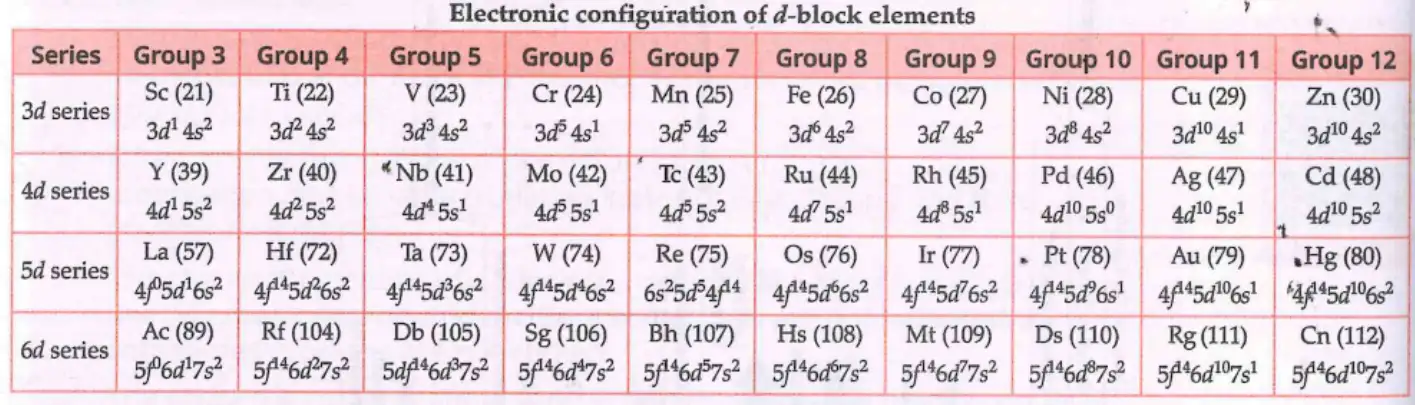
- First transition series: 3d orbitals, Sc (21) to Zn (30)
- Second transition series: 4d orbitals, Y (39) to Cd (48)
- Third transition series: 5d orbitals, La (57) and Hf (72) to Hg (80)
- Fourth transition series: 6d orbitals, Actinium (89) and Rf (104) onwards (incomplete)
General Electronic Configuration
Valence shell configuration: (n−1)d¹⁻¹⁰ ns¹⁻², where n is the outermost shell.
Physical Properties
- All are metals, malleable and ductile except mercury (liquid).
- High thermal and electrical conductivity.
- Metallic lustre and sonorous.
- Atomic radii smaller than s-block but larger than p-block elements in the same period.
- Lanthanide contraction causes 4d and 5d elements to have similar sizes.
- Ionic radii decrease with increasing oxidation state.
- Density increases across a period.
- Ionisation enthalpy generally increases across the series with some irregularities.
Metallic Bonding and Enthalpy of Atomisation
Strong metallic bonds arise due to delocalised d-electrons, high charge density, and close packing. Enthalpy of atomisation is high, peaking mid-series.
Variable Oxidation States
Transition elements show variable oxidation states due to similar energies of ns and (n−1)d electrons.
Electrode Potential
Transition metals have low and irregular electrode potentials due to variations in ionisation enthalpy and other factors.
Catalytic and Magnetic Properties
Many transition metals and their oxides act as catalysts. Magnetic behaviour depends on unpaired electrons: diamagnetic substances have none, paramagnetic have one or more.
Melting and Boiling Points
High melting and boiling points except for Zn, Cd, and Hg due to strong metallic bonding.
Complex Formation and Colour
Transition metals form complex ions due to availability of d-orbitals and show coloured compounds due to d–d electronic transitions.
Alloys and Interstitial Compounds
Alloys form due to similar atomic sizes and bonding. Interstitial compounds form when small atoms occupy voids in metal lattices, exhibiting high melting points and hardness.
Oxides of Transition Metals
Oxides vary in composition and chemical nature (basic, amphoteric, acidic) depending on oxidation state.
Potassium Dichromate (K₂Cr₂O₇)
Preparation involves fusion of chromite ore, acidification, and treatment with KCl.
- Chromite ore is fused with sodium carbonate in air to form sodium chromate.
- Sodium chromate is acidified to sodium dichromate.
- Sodium dichromate solution is treated with KCl to give potassium dichromate.
It is an orange crystalline solid and a powerful oxidising agent in acidic medium.
Potassium Permanganate (KMnO₄)
Prepared from pyrolusite ore by alkaline fusion and electrolytic oxidation. It is a dark purple solid, sparingly soluble, decomposes on heating, and acts as a strong oxidising agent in acidic, alkaline, and neutral media.


Solved Examples
Example 1
Given standard electrode potentials for Cr, Mn, and Fe in different oxidation states, comment on the stability of Fe³⁺ compared to Cr³⁺ and Mn³⁺, and the ease of oxidation of iron compared to Cr and Mn.
Solution
(a) Cr³⁺ is most stable due to negative reduction potential for Cr³⁺/Cr²⁺. Mn³⁺ is least stable with a large positive potential, easily reduced to Mn²⁺. Fe³⁺ stability is intermediate.
(b) Mn²⁺ has the most negative reduction potential, so Mn is most easily oxidised, followed by Cr and then Fe.
Example 2
Interpret the magnetic moment of K₄[Mn(CN)₆] (2.2 BM).
Mn is +2 oxidation state with one unpaired electron, indicating a low-spin octahedral complex with d²sp³ hybridisation due to strong field CN⁻ ligands.
Example 3
Explain why actinoid contraction is greater than lanthanoid contraction and why transition metals form coloured compounds.
Actinoid contraction is greater due to poorer shielding by 5f electrons compared to 4f electrons. Transition metals form coloured compounds due to d–d electronic transitions absorbing visible light.
Example 4
Complete the redox reaction: 2MnO₄⁻ + 6H⁺ + 5NO₂⁻ →
Answer: 5NO₃⁻ + 2Mn²⁺ + 3H₂O
Practice Set
Conceptual Questions
- Level 1: What defines a transition element in terms of electronic configuration?
- Level 2: Explain the cause and effect of lanthanoid contraction on the properties of elements.
Application Question
- Level 3: Write the balanced chemical equation for the preparation of potassium dichromate from chromite ore and explain its oxidising action in acidic medium.
Answer Key
Level 1: Transition elements have incompletely filled d-orbitals in their ground or common oxidation states.
Level 2: Lanthanoid contraction is caused by poor shielding of nuclear charge by 4f electrons, leading to a gradual decrease in atomic and ionic radii across the series. This results in similar chemical properties and difficulty in separating lanthanoids.
Level 3: Preparation involves fusion of chromite ore with sodium carbonate and air to form sodium chromate, acidification to sodium dichromate, and treatment with KCl to get potassium dichromate. In acidic medium, dichromate ion acts as a powerful oxidising agent, reducing to Cr³⁺ while oxidising other substances.
f-Block Elements
Definition and Series
f-block elements fill the (n−2)f sub-shell and include lanthanoids and actinoids, also called inner transition elements.
Electronic Configuration
General configuration: (n−2)f¹⁻¹⁴ (n−1)d⁰⁻¹ ns². For lanthanoids, n=6; for actinoids, n=7.
Lanthanoids
Elements from Ce (58) to Lu (71) filling 4f orbitals. They are dense, soft metals with high melting points, form alloys, and show paramagnetism except La³⁺ and Lu³⁺ which are diamagnetic.
Lanthanoid Contraction
Gradual decrease in atomic and ionic radii across the series due to poor shielding by 4f electrons, causing similar properties and difficulty in separation.
Chemical Properties and Uses
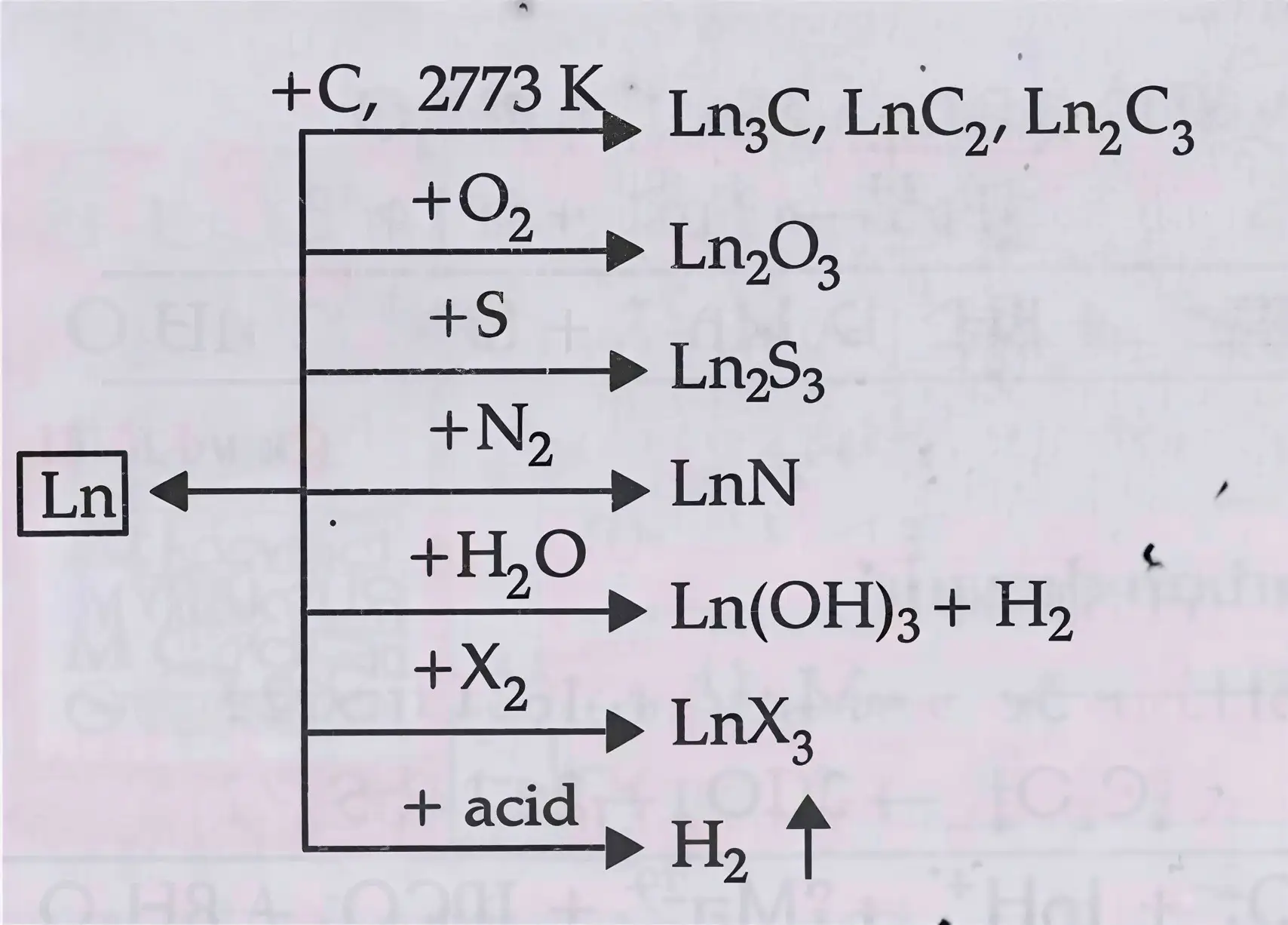
Lanthanoids are highly electropositive, mainly show +3 oxidation state, and form coloured ions due to f–f transitions.
Uses include misch metal (lighter flints), polishing glass, dyeing, and catalysis.
Actinoids
Elements from Ac (89) to Lr (103) filling 5f orbitals. They are dense, silvery, electropositive metals with high melting points, show actinoid contraction, paramagnetism, multiple oxidation states, and radioactivity.
Chemical Reactivity and Uses
Less reactive towards acids. Thorium is used in cancer treatment and gas mantles; uranium in glass, medicine, and nuclear fuel; plutonium in reactors and bombs.
Differences Between Lanthanoids and Actinoids
Lanthanoids fill 4f orbitals, mostly +3 oxidation state, mostly non-radioactive, fewer complexes, less reactive. Actinoids fill 5f orbitals, multiple oxidation states, radioactive, form many complexes, more reactive.
Solved Examples
Example 1
Given standard electrode potentials for Cr, Mn, and Fe in different oxidation states, comment on the stability of Fe³⁺ compared to Cr³⁺ and Mn³⁺, and the ease of oxidation of iron compared to Cr and Mn.
Solution
(a) Cr³⁺ is most stable due to negative reduction potential for Cr³⁺/Cr²⁺. Mn³⁺ is least stable with a large positive potential, easily reduced to Mn²⁺. Fe³⁺ stability is intermediate.
(b) Mn²⁺ has the most negative reduction potential, so Mn is most easily oxidised, followed by Cr and then Fe.
Example 2
Interpret the magnetic moment of K₄[Mn(CN)₆] (2.2 BM).
Mn is +2 oxidation state with one unpaired electron, indicating a low-spin octahedral complex with d²sp³ hybridisation due to strong field CN⁻ ligands.
Example 3
Explain why actinoid contraction is greater than lanthanoid contraction and why transition metals form coloured compounds.
Actinoid contraction is greater due to poorer shielding by 5f electrons compared to 4f electrons. Transition metals form coloured compounds due to d–d electronic transitions absorbing visible light.
Example 4
Complete the redox reaction: 2MnO₄⁻ + 6H⁺ + 5NO₂⁻ →
Answer: 5NO₃⁻ + 2Mn²⁺ + 3H₂O
Practice Set
Conceptual Questions
- Level 1: What is the general electronic configuration that defines transition elements?
- Level 2: Describe the lanthanoid contraction and its effects on the properties of lanthanoids and other elements.
Application Question
- Level 3: Write the balanced chemical equations for the preparation of potassium permanganate and explain its oxidising action in acidic medium.
Answer Key
Level 1: Transition elements have incompletely filled d-orbitals in their ground or common oxidation states, with general electronic configuration (n−1)d¹⁻¹⁰ ns¹⁻².
Level 2: Lanthanoid contraction is the gradual decrease in atomic and ionic radii across the lanthanoid series due to poor shielding by 4f electrons. This causes similar chemical properties among lanthanoids, difficulty in separation, and affects the size and properties of elements like zirconium and hafnium.
Level 3: Preparation of potassium permanganate involves alkaline fusion of manganese dioxide with KOH and oxidation to manganate, followed by electrolytic oxidation to permanganate. In acidic medium, permanganate ion acts as a strong oxidising agent, reducing to Mn²⁺ while oxidising other substances.
Quick Reference Table
d-Block Elements
- General electronic configuration: (n−1)d¹⁻¹⁰ ns¹⁻²
- Variable oxidation states due to similar ns and (n−1)d electron energies
- High melting points and densities
- Form coloured compounds due to d–d transitions
- Act as catalysts and form complex ions
f-Block Elements
- General electronic configuration: (n−2)f¹⁻¹⁴ (n−1)d⁰⁻¹ ns²
- Lanthanoid contraction causes gradual decrease in size
- Mostly +3 oxidation state
- Lanthanoids mostly non-radioactive; actinoids radioactive
- Used in alloys, catalysts, and nuclear applications
Common Mistakes and Misconceptions
- Incorrect placement of electron numbers in d- and f-block electronic configurations.
- Confusion about ionisation energies and oxidation states among transition elements.
- Unbalanced or incorrect chemical reactions of KMnO₄ and K₂Cr₂O₇ in different media.
- Misunderstanding lanthanoid and actinoid properties such as basicity and atomic/ionic radii trends.
Glossary
- Transition Elements: d-block elements with incomplete d-orbitals in ground or common oxidation states.
- Lanthanoid Contraction: The gradual decrease in atomic and ionic radii across the lanthanoid series due to poor shielding by 4f electrons.
- Actinoid Contraction: Similar decrease in size across actinoids due to poor shielding by 5f electrons.
- Variable Oxidation State: Ability of transition metals to exhibit multiple oxidation states due to similar energy levels of ns and (n−1)d electrons.
- Metallic Bonding: Bonding in metals where positive ions are surrounded by a sea of delocalised electrons.
- Complex Ion: A central metal ion bonded to molecules or ions called ligands.
- Paramagnetism: Magnetic property due to unpaired electrons causing attraction to magnetic fields.
- Diamagnetism: Magnetic property due to all electrons paired causing repulsion from magnetic fields.
- Oxidising Agent: Substance that gains electrons and causes oxidation of another substance.