CLASS 12-PCB . CHEMISTRY . CHEMISTRY PART I . SOLUTIONS
Chapter 1 : Solutions
Ch 1
CHEMISTRY
CLASS 12-PCB
Solutions and Expression of Concentration
Definition and Constituents
A solution is a homogeneous mixture of two or more pure substances. It consists of two main constituents:
- Solute: The substance dissolved in lesser amount, e.g., sugar or salt in water.
- Solvent: The substance in which the solute is dissolved in larger amount, e.g., water or milk.
The solvent determines the physical state of the solution.
Types of Solutions
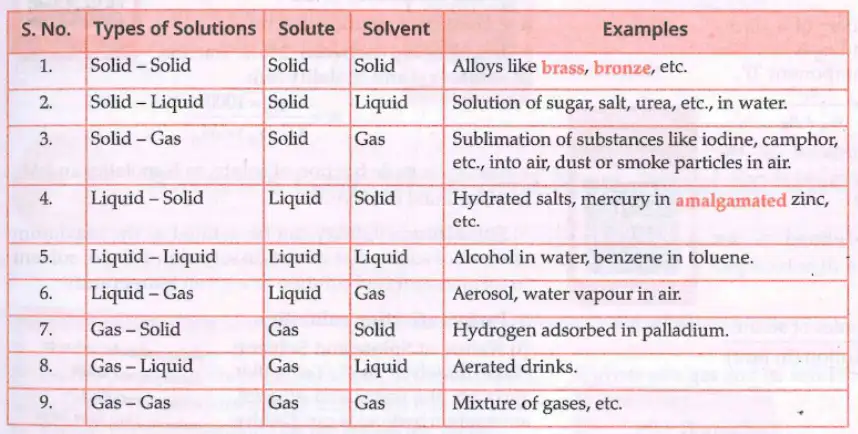
Solutions can be classified based on the physical states of solute and solvent. There are nine types:
- Solid in liquid (e.g., sugar in water)
- Liquid in liquid (e.g., alcohol in water)
- Gas in liquid (e.g., oxygen in water)
- Solid in solid (e.g., brass)
- Gas in gas (e.g., oxygen in nitrogen)
- And other combinations as per the states of solute and solvent.
Aqueous solutions have water as solvent, while non-aqueous solutions have solvents other than water.
Concentration of Solutions
Concentration expresses the amount of solute in a given quantity of solution or solvent. Common expressions include:
- Mass percentage (w/w): Mass of solute per 100 g of solution.
- Volume percentage (v/v): Volume of solute per 100 mL of solution.
- Mass by volume percentage (w/v): Mass of solute per 100 mL of solution, used in medicine.
- Parts per million (ppm): Parts of solute per million parts of solution, used for trace quantities.
- Mole fraction: Ratio of moles of a component to total moles in solution.
- Molarity (M): Moles of solute per litre of solution.
- Molality (m): Moles of solute per kilogram of solvent.
- Normality (N): Gram equivalents of solute per litre of solution.
Solubility of Gases and Henry's Law
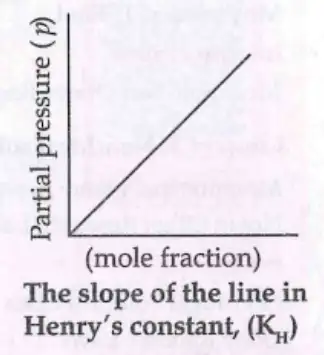
Solubility of gases in liquids depends on pressure and temperature. Henry's Law states that the mass of a gas dissolved in a liquid at constant temperature is proportional to the pressure of the gas above the liquid:
p = KH x
where p is the partial pressure, x is the mole fraction of the gas in solution, and KH is Henry's constant.
Applications of Henry's Law
- To increase the solubility of CO₂ in soda water and soft drinks, the bottle is sealed under high pressure.
- To avoid toxic effects of high nitrogen concentration in blood, scuba divers use air diluted with helium, nitrogen, and oxygen.
- At high altitudes, low blood oxygen causes anoxia, impairing mental function.
Solved Examples
Example: Calculating Nitrogen Gas Solubility Using Henry's Law
Given: Partial pressure of N2 = 0.987 bar, Henry's constant KH = 76480 bar at 293 K.
Calculate mole fraction of N2 dissolved:
x = p / KH = 0.987 / 76480 = 1.29 × 10⁻⁵
Convert to millimoles per litre:
1.29 × 10-5 × 1000 = 0.0129 mmol/L
Thus, 0.0129 millimoles of nitrogen dissolve in 1 litre of water under given conditions.
Practice Set
- Level 1: Define solute and solvent with examples.
- Level 2: Explain the difference between molarity and molality.
- Level 3: Calculate the mole fraction of a gas dissolved in a liquid if the partial pressure is 1.5 bar and Henry's constant is 50000 bar.
Answer Key
- Level 1: Solute is the substance dissolved in lesser amount (e.g., sugar), solvent is the substance in which solute dissolves in larger amount (e.g., water).
- Level 2: Molarity is moles of solute per litre of solution; molality is moles of solute per kilogram of solvent. Molarity depends on temperature, molality does not.
- Level 3: Mole fraction x = p / KH = 1.5 / 50000 = 3 × 10⁻⁵.
Raoult's Law and Solutions
Vapour Pressure and Raoult's Law
Vapour pressure is the pressure exerted by vapours over a liquid at equilibrium at constant temperature. It depends on the nature of the liquid and temperature.
Raoult's Law states that the partial vapour pressure of each volatile component in a solution is proportional to its mole fraction:
pA = p°A xA
For non-volatile solutes, the relative lowering of vapour pressure equals the mole fraction of solute:
(p°A - pA) / p°A = xB
Ideal and Non-Ideal Solutions
Ideal solutions obey Raoult's law over all concentrations, with similar intermolecular forces between solute and solvent.
Examples: n-hexane and n-heptane, benzene and toluene.
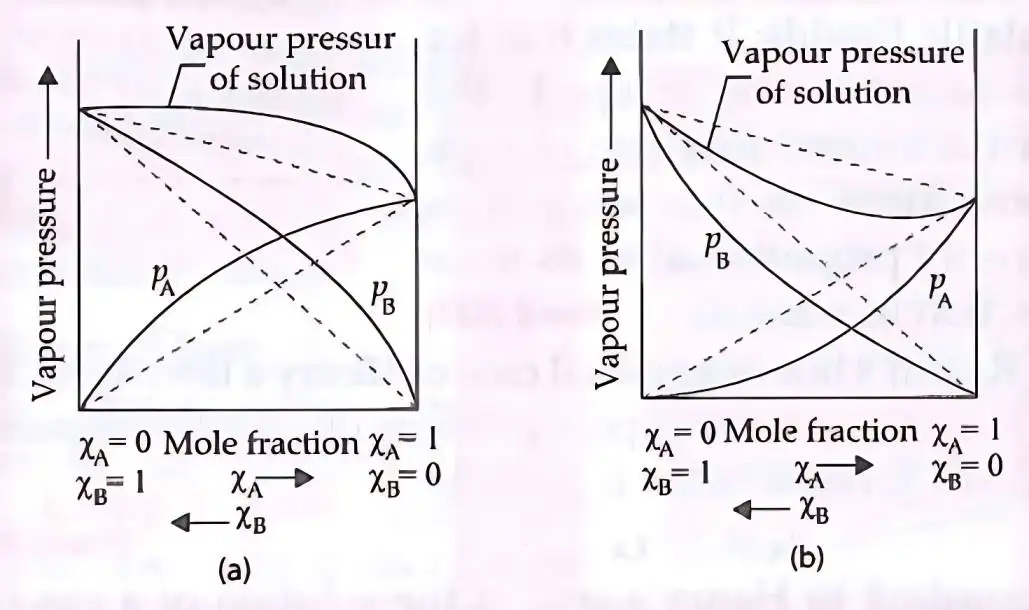
Non-ideal solutions do not obey Raoult's law and show deviations:
- Positive deviation: Weaker A-B interactions, increased vapour pressure (e.g., water and ethanol).
- Negative deviation: Stronger A-B interactions, decreased vapour pressure (e.g., chloroform and acetone).
Azeotropes
Azeotropes are liquid mixtures that boil without change in composition. Minimum boiling azeotropes show positive deviation; maximum boiling azeotropes show negative deviation.
Solved Examples
Example: Vapour Composition in a Binary Solution
Given mole fractions xA and xB of two volatile liquids A and B, and their pure vapour pressures p°A and p°B, calculate total vapour pressure and vapour composition.
Using Raoult's law:
pA = p°A xA, pB = p°B xB
Total pressure ptotal = pA + pB
Vapour mole fractions:
yA = pA / ptotal, yB = pB / ptotal
Practice Set
- Level 1: State Raoult's law for volatile liquids.
- Level 2: Differentiate between ideal and non-ideal solutions with examples.
- Level 3: Explain positive and negative deviations from Raoult's law and give examples.
Answer Key
- Level 1: Raoult's law states that the partial vapour pressure of a component is proportional to its mole fraction in the solution.
- Level 2: Ideal solutions obey Raoult's law with similar intermolecular forces; non-ideal solutions do not and show deviations.
- Level 3: Positive deviation occurs when A-B interactions are weaker (e.g., water and ethanol); negative deviation occurs when A-B interactions are stronger (e.g., chloroform and acetone).
Colligative Properties and Molecular Mass
Colligative Properties
Colligative properties depend only on the number of solute particles, not their nature. They include:
- Relative lowering of vapour pressure
- Depression of freezing point
- Elevation of boiling point
- Osmotic pressure
Elevation of Boiling Point
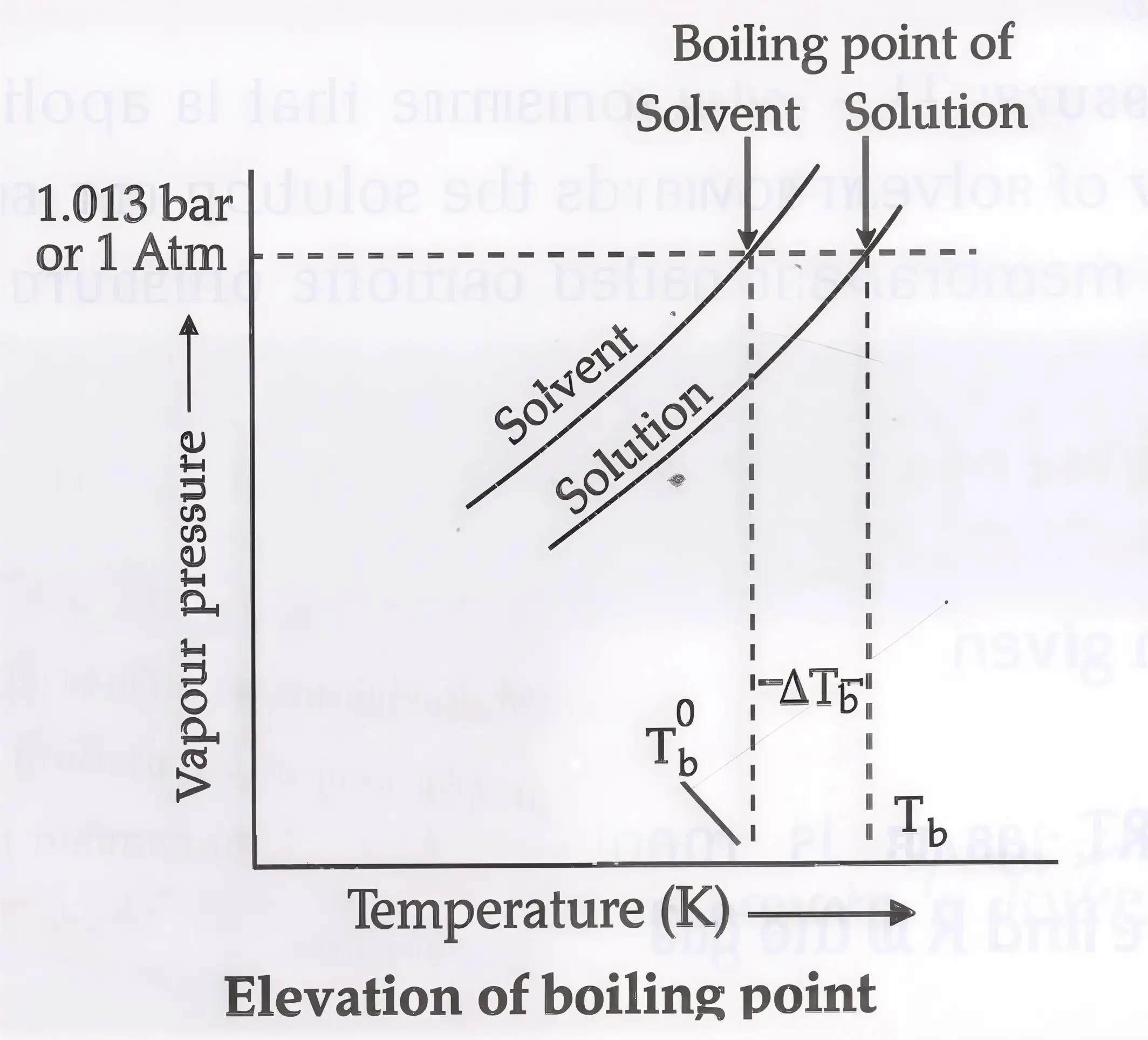
The boiling point of a solution is higher than that of the pure solvent. The elevation is proportional to molality:
ΔTb = Kb m
where Kb is the ebullioscopic constant.
Depression of Freezing Point
The freezing point of a solution is lower than that of the pure solvent. The depression is proportional to molality:
ΔTf = Kf m
where Kf is the cryoscopic constant.
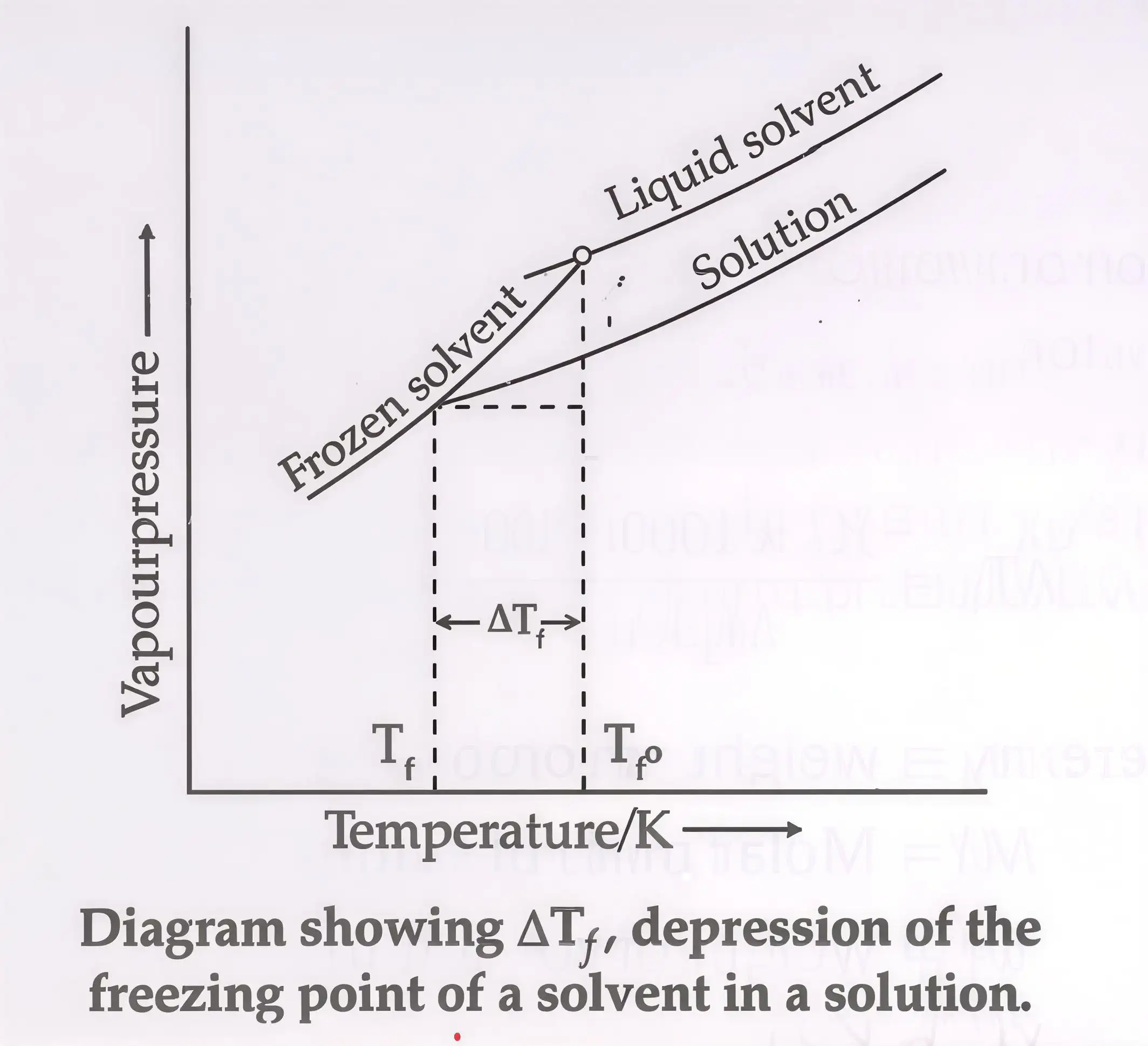
Osmosis and Osmotic Pressure
Osmosis is the flow of solvent through a semipermeable membrane into a solution. Osmotic pressure is the pressure required to stop this flow and is proportional to molar concentration:
π = C R T
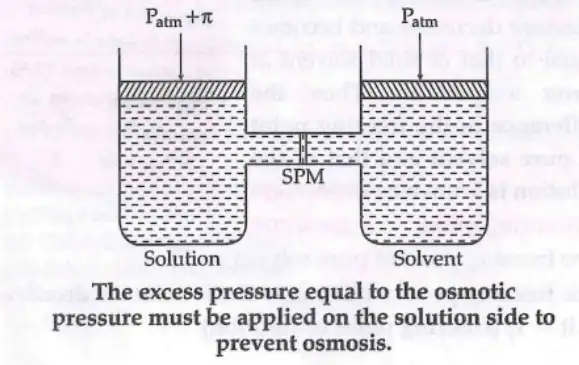
Reverse Osmosis
The direction of osmosis can be reversed if a pressure larger than the osmotic pressure is applied to the solution side. This causes pure solvent to flow out of the solution through the semipermeable membrane. Reverse osmosis is commonly used for water purification.
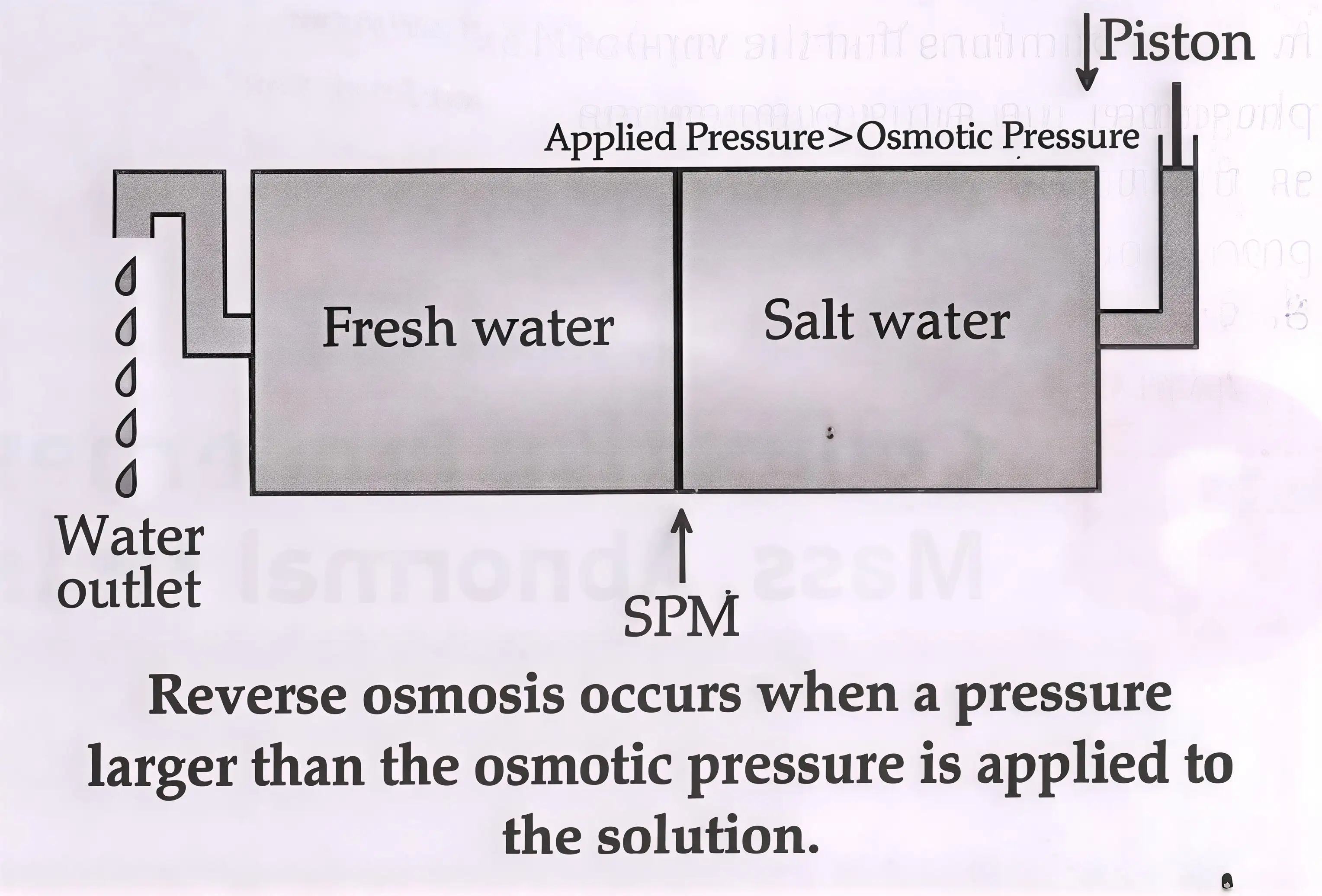
Abnormal Molecular Mass
When the molecular mass calculated from colligative properties differs from the theoretical molecular mass, it is called abnormal molecular mass. This occurs due to association or dissociation of solute particles.
Solved Example: Molecular Mass from Freezing Point Depression
Given: 0.721 g compound in 75 mL benzene, freezing point depression from 5.51 °C to 5.03 °C, density of benzene 0.879 g/mL, Kf = 5.12 K kg mol-1.
Calculate molecular mass:
Mass of benzene = 0.879 × 75 = 65.925 g = 0.06593 kg
Molality m = moles solute / kg solvent = (0.721 / M) / 0.06593
ΔTf = Kf m = 5.12 × (0.721 / (M × 0.06593)) = 0.48
Solving for M gives molecular mass ≈ 116.65 g/mol.
Van't Hoff Factor
The Van't Hoff factor (i) is the ratio of observed to calculated colligative property values, accounting for dissociation or association:
i = (observed value) / (calculated value)
For ionic compounds, i > 1 due to dissociation.
Osmotic Solutions
- Hypertonic solution: Has higher solute concentration than the solution it is separated from by a semipermeable membrane.
- Hypotonic solution: Has lower solute concentration than the solution it is separated from.
- Isotonic solution: Two solutions with the same osmotic pressure; no net osmosis occurs between them.
Solved Examples
Example: Molecular Mass from Freezing Point Depression
Calculate the molecular mass of a compound given the freezing point depression data as above.
Practice Set
- Level 1: Define colligative properties with examples.
- Level 2: Explain the significance of Van't Hoff factor.
- Level 3: Calculate the molecular mass of a solute given freezing point depression data.
Answer Key
- Level 1: Colligative properties depend on the number of solute particles, e.g., boiling point elevation.
- Level 2: Van't Hoff factor accounts for dissociation/association affecting colligative properties.
- Level 3: Use ΔTf = Kf m and molality formula to calculate molecular mass.
Quick Reference Table
| Concept | Formula | Key Point |
|---|---|---|
| Mass percentage (w/w) | (Mass of solute / Mass of solution) × 100 | Independent of temperature |
| Volume percentage (v/v) | (Volume of solute / Volume of solution) × 100 | Used for liquid-liquid solutions |
| Mass by volume (w/v) | (Mass of solute in g / Volume of solution in mL) × 100 | Common in pharmacy/medicine |
| Parts per million (ppm) | (Number of parts of solute / Total parts of solution) × 106 | Used for trace impurities, pollutants |
| Mole fraction (x) | Moles of component / Total moles of all components | No units; sum of all mole fractions = 1 |
| Molarity (M) | Moles of solute / Volume of solution (L) | Changes with temperature (volume expands/contracts) |
| Molality (m) | Moles of solute / Mass of solvent (kg) | Independent of temperature |
| Henry's Law | p = KH x | Higher KH → lower solubility of gas |
| Raoult's Law (volatile solute) | pA = p°A xA | Applies to each component in a solution |
| Relative lowering of vapour pressure | (p°A − pA) / p°A = xB | Used for non-volatile solute |
| Elevation of boiling point | ΔTb = Kb m | Kb = ebullioscopic/molal elevation constant |
| Depression of freezing point | ΔTf = Kf m | Kf = cryoscopic/molal depression constant |
| Osmotic pressure | π = C R T | C = molar concentration; only for dilute solutions |
| Van't Hoff factor | i = Observed colligative property / Calculated (normal) colligative property | i > 1: dissociation; i < 1: association; i = 1: no change |
| Modified colligative property equations | ΔTb = i Kb m, ΔTf = i Kf m, π = i C R T | Used when solute dissociates/associates |
Common Mistakes and Misconceptions
- Confusing molarity and molality: Students often use them interchangeably. Molarity (M) is per litre of solution and varies with temperature; molality (m) is per kilogram of solvent and is temperature-independent. For dilute aqueous solutions at room temperature, they are numerically close but not identical.
- Forgetting units in Henry's Law: KH has units of pressure, and a common error is to confuse "higher KH means higher solubility." Actually, the opposite is true — higher KH means lower solubility of the gas at a given pressure.
- Applying Raoult's law incorrectly to non-ideal solutions: Students sometimes assume all solutions obey Raoult's law across the full concentration range. Only ideal solutions do; real solutions show positive or negative deviation.
- Mixing up positive and negative deviation examples: A frequent slip is reversing the examples — positive deviation (weaker A-B forces, e.g., water-ethanol) shows higher vapour pressure than expected, while negative deviation (stronger A-B forces, e.g., chloroform-acetone) shows lower vapour pressure than expected.
- Ignoring the Van't Hoff factor for electrolytes: A common calculation error is applying ΔTb = Kbm or ΔTf = Kfm directly to ionic compounds like NaCl or CaCl₂ without including the factor "i," leading to apparently "abnormal" molecular masses.
- Assuming abnormal molecular mass always means an experimental error: It usually reflects real molecular behavior — association (e.g., benzoic acid dimerizing in benzene, i < 1) or dissociation (e.g., salts in water, i > 1) — not necessarily a mistake.
- Confusing osmotic pressure with vapour pressure lowering: These are separate colligative properties; osmotic pressure relates to solvent flow across a semipermeable membrane, not the vapour phase above the solution.
- Mixing up hypertonic and hypotonic: These terms are relative — a solution is only hyper/hypotonic compared to another solution, not in absolute terms.
- Treating ppm as a fixed unit type: ppm can be expressed as mass/mass, volume/volume, or mass/volume depending on context; mixing these up leads to calculation errors.
Glossary
- Solution: A homogeneous mixture of two or more substances at the molecular level.
- Solute: The component present in smaller quantity in a solution; the substance that gets dissolved.
- Solvent: The component present in larger quantity; the medium in which the solute dissolves.
- Aqueous solution: A solution in which water is the solvent.
- Non-aqueous solution: A solution in which the solvent is a substance other than water.
- Molarity (M): Number of moles of solute per litre of solution.
- Molality (m): Number of moles of solute per kilogram of solvent.
- Normality (N): Number of gram equivalents of solute per litre of solution.
- Mole fraction: The ratio of the number of moles of one component to the total number of moles of all components in the solution.
- Henry's Law: A law stating that the partial pressure of a gas over a liquid is proportional to its mole fraction in the solution.
- Henry's constant (KH): The proportionality constant in Henry's law, dependent on the nature of the gas and temperature.
- Vapour pressure: The pressure exerted by the vapour of a liquid in equilibrium with its liquid phase at a given temperature.
- Raoult's Law: A law stating that the partial vapour pressure of each volatile component in an ideal solution is proportional to its mole fraction.
- Ideal solution: A solution that obeys Raoult's law at all concentrations, with solute-solvent interactions similar in strength to solute-solute and solvent-solvent interactions.
- Non-ideal solution: A solution that deviates from Raoult's law due to differing intermolecular forces between components.
- Azeotrope: A mixture of two liquids that boils at a constant composition, behaving as if it were a single pure substance.
- Colligative properties: Properties of a solution that depend only on the number of solute particles present, not their identity.
- Elevation of boiling point (ΔTb): The increase in boiling point of a solvent caused by the addition of a non-volatile solute.
- Ebullioscopic constant (Kb): The molal boiling point elevation constant, characteristic of the solvent.
- Depression of freezing point (ΔTf): The decrease in freezing point of a solvent caused by the addition of a solute.
- Cryoscopic constant (Kf): The molal freezing point depression constant, characteristic of the solvent.
- Osmosis: The spontaneous movement of solvent molecules through a semipermeable membrane from a region of lower solute concentration to higher solute concentration.
- Osmotic pressure (π): The pressure that must be applied to a solution to prevent the inward flow of solvent across a semipermeable membrane.
- Reverse osmosis: A process in which pressure greater than osmotic pressure is applied to force solvent out of a solution, used commonly in water purification.
- Semipermeable membrane: A membrane that allows solvent molecules to pass through but blocks solute particles.
- Isotonic solutions: Two solutions having equal osmotic pressure, resulting in no net solvent flow between them.
- Hypertonic solution: A solution with higher osmotic pressure (solute concentration) relative to another solution.
- Hypotonic solution: A solution with lower osmotic pressure (solute concentration) relative to another solution.
- Abnormal molecular mass: A molecular mass value, calculated from colligative property data, that differs from the theoretical value due to solute association or dissociation.
- Van't Hoff factor (i): A correction factor representing the ratio of the observed colligative property to the value calculated assuming no dissociation or association.
- Association: The combining of solute particles (e.g., dimerization) in solution, leading to a Van't Hoff factor less than 1.
- Dissociation: The splitting of a solute into ions or smaller particles in solution, leading to a Van't Hoff factor greater than 1.