CLASS 12-PCB . CHEMISTRY . CHEMISTRY PART I . ELECTROCHEMISTRY
Chapter 2 : Electrochemistry
Ch 2
CHEMISTRY
CLASS 12-PCB
Electrolytic Conductivity and Kohlrausch's Law
Electrochemistry is the branch of chemistry that studies the production of electricity from energy released during spontaneous chemical reactions and the use of electrical energy to cause non-spontaneous chemical changes.
Electrolytic conduction refers to the flow of electric current through an electrolytic solution.
An electrolyte is a substance that dissociates into ions in solution or molten state, allowing the conduction of electricity. Examples include weak electrolytes like H₂CO₃, CH₃COOH, HCN and strong electrolytes like NaCl, HCl, NaOH.
The degree of ionisation is the ratio of the number of ions produced to the total number of molecules in the electrolyte.
Resistance is the property of a substance that opposes the flow of electric current. It is directly proportional to the length (l) and inversely proportional to the cross-sectional area (A) of the conductor, expressed as R = ρ l / A, where ρ is resistivity.
Resistivity (ρ) measures how strongly a material opposes electric current. It is calculated as ρ = R × A / l and has SI units ohm-meter (Ω·m) or ohm-centimeter (Ω·cm).
Conductance (C) is the reciprocal of resistance and measures how easily current flows through a material. It is given by C = 1 / R = A / (ρ l) with SI unit Siemens (S).
Conductivity (κ) is the reciprocal of resistivity and is related to conductance by κ = C × l / A. Its SI unit is Siemens per meter (S m⁻¹) or Siemens per centimeter (S cm⁻¹).
Conductivity depends on the nature of the material, temperature, number of valence electrons or ion size, and solvation in electrolytes.
Metallic conductance arises from free electrons in metals and depends on the metal's nature, structure, valence electrons, and temperature.
Electrolytic or ionic conductance occurs due to ions in solution and depends on electrolyte nature, ion solvation, solvent viscosity, and temperature.
Viscosity is the resistance of a liquid to flow; lower viscosity means easier flow.
The cell constant (G) is the ratio of the distance between electrodes to the cross-sectional area, G = l / A, measured in cm⁻¹ or m⁻¹.
Molar conductivity (Λₘ) is the conducting power of all ions produced by one mole of electrolyte in solution, calculated as Λₘ = κ / C × 1000, with SI unit S m² mol⁻¹.
Debye-Huckel equation for strong electrolytes: Λₘ = Λ°ₘ − A√C, where Λ°ₘ is limiting molar conductivity, A is a constant, and C is concentration.
Kohlrausch's law states that the limiting molar conductivity at infinite dilution is the sum of the individual ionic conductivities: Λ°ₘ = ν⁺ λ°₊ + ν⁻ λ°₋, where ν⁺ and ν⁻ are the number of cations and anions.
Applications of Kohlrausch's law include calculating molar conductivities of weak electrolytes, degree of dissociation (α = Λₘ / Λ°ₘ), dissociation constant (Kₐ = C α² / (1 − α)), and solubility of sparingly soluble salts (Solubility = κ × 1000 / Λ°ₘ).
Solved Examples
Example 1: A conductivity cell with 0.1 mol/L KCl solution has resistance 100 Ω. When concentration changes to 0.02 mol/L, resistance is 520 Ω. Given conductivity of 0.1 mol/L KCl is 1.29 S/m, find conductivity and molar conductivity of 0.02 mol/L KCl.
Given: R₁ = 100 Ω, M₁ = 0.1 mol/L, R₂ = 520 Ω, M₂ = 0.02 mol/L, κ₁ = 1.29 S/m
Calculate cell constant: G = κ₁ × R₁ = 1.29 × 100 = 129 m⁻¹ = 1.29 cm⁻¹
Calculate conductivity at 0.02 mol/L: κ = G / R₂ = 1.29 / 520 = 0.00248 Ω⁻¹ cm⁻¹ = 2.48 × 10⁻³ Ω⁻¹ cm⁻¹
Convert concentration to mol/cm³: 0.02 mol/L = 2 × 10⁻⁵ mol/cm³
Calculate molar conductivity: Λₘ = κ / C = (2.48 × 10⁻³) / (2 × 10⁻⁵) = 1.24 × 10² Ω⁻¹ mol⁻¹ cm²
Practice Set
- Level 1: Define molar conductivity and explain its dependence on concentration.
- Level 2: Explain Kohlrausch's law of independent migration of ions and its applications.
- Level 3: Calculate the degree of dissociation of a weak electrolyte given its molar conductivity and limiting molar conductivity.
Answer Key
- Level 1: Molar conductivity is the conducting power of all ions produced by one mole of electrolyte in solution. It increases with dilution because ion interactions decrease.
- Level 2: Kohlrausch's law states that limiting molar conductivity is the sum of individual ionic conductivities. It is used to calculate molar conductivities of weak electrolytes, degree of dissociation, and dissociation constants.
- Level 3: Degree of dissociation α = Λₘ / Λ°ₘ. Substitute given values to find α.
Redox Reactions and Electrochemical Cells
A redox reaction involves simultaneous oxidation (loss of electrons) and reduction (gain of electrons).
A galvanic cell (or voltaic cell) converts chemical energy into electrical energy through spontaneous redox reactions occurring in two half-cells with metallic electrodes.
A redox couple consists of the oxidised and reduced forms of a substance involved in a half-reaction.
The Daniell cell is a galvanic cell with zinc and copper electrodes in ZnSO₄ and CuSO₄ solutions respectively, represented as Zn(s) | Zn²⁺(aq) || Cu²⁺(aq) | Cu(s).
A salt bridge is an inverted U-shaped tube containing a salt paste that completes the circuit, prevents mixing of electrolytes, and maintains electrical neutrality in the half-cells.
Electrode potential is the potential developed by an electrode relative to the standard hydrogen electrode (SHE), which has zero potential at 25 °C, 1 bar, and 1 M H⁺ concentration.
Cell potential or electromotive force (EMF) is the potential difference between two electrodes in a galvanic cell when no current flows, calculated as E_cell = E_cathode − E_anode.
Standard electrode potential (E°) is the electrode potential measured under standard conditions (25 °C, 1 bar, 1 M).
Standard oxidation potential is the potential when an electrode undergoes oxidation compared to SHE.
Electrochemical series arranges elements by increasing electrode potential values measured against SHE.
The Nernst equation calculates electrode potential under non-standard conditions: E = E° − (RT / nF) ln Q, where Q is the reaction quotient.
At 298 K, the Nernst equation simplifies to E_cell = E°_cell − (0.059 / n) log Q.
Gibbs free energy change (ΔG) relates to cell potential by ΔG = −nFE_cell; a negative ΔG indicates a spontaneous reaction.
Solved Examples
Example 2: Calculate ΔG° for the reaction Zn(s) + Cu²⁺(aq) → Zn²⁺(aq) + Cu(s) with standard electrode potential +1.1 V.
At anode: Zn(s) → Zn²⁺ + 2e⁻; at cathode: Cu²⁺ + 2e⁻ → Cu(s); n = 2
ΔG° = −nFE° = −2 × 96500 × 1.1 = −212300 J = −212.3 kJ
Practice Set
- Level 1: Define redox reaction and give an example.
- Level 2: Explain the function of a salt bridge in a galvanic cell.
- Level 3: Derive the Nernst equation for a general electrode reaction.
Answer Key
- Level 1: A redox reaction involves simultaneous oxidation and reduction, e.g., Zn + Cu²⁺ → Zn²⁺ + Cu.
- Level 2: The salt bridge completes the circuit, prevents electrolyte mixing, and maintains electrical neutrality.
- Level 3: The Nernst equation is derived by relating electrode potential to reaction quotient and standard potential, incorporating temperature and number of electrons.
Electrolysis, Batteries, Fuel Cells and Corrosion
Electrolysis is the decomposition of an electrolyte by passing electric current through its aqueous or molten state in an electrolytic cell.
Faraday's first law states that the amount of substance liberated at an electrode is proportional to the quantity of electricity passed: m = Z × I × t, where Z is electrochemical equivalent.
Faraday's second law states that amounts of substances liberated by the same quantity of electricity are proportional to their chemical equivalent weights: w₁ / E₁ = w₂ / E₂.
Products of electrolysis depend on the physical state of the material and the type of electrodes used.
Batteries are combinations of galvanic cells used as sources of electrical energy.
Primary batteries (non-rechargeable) include Leclanche and dry cells; mercury cells are used in low-current devices.
Secondary batteries (rechargeable) include lead storage and nickel–cadmium cells.
Dry cell (Leclanche cell) consists of a zinc container anode and a graphite cathode surrounded by manganese dioxide and carbon, with a paste of ammonium chloride and zinc chloride as electrolyte.
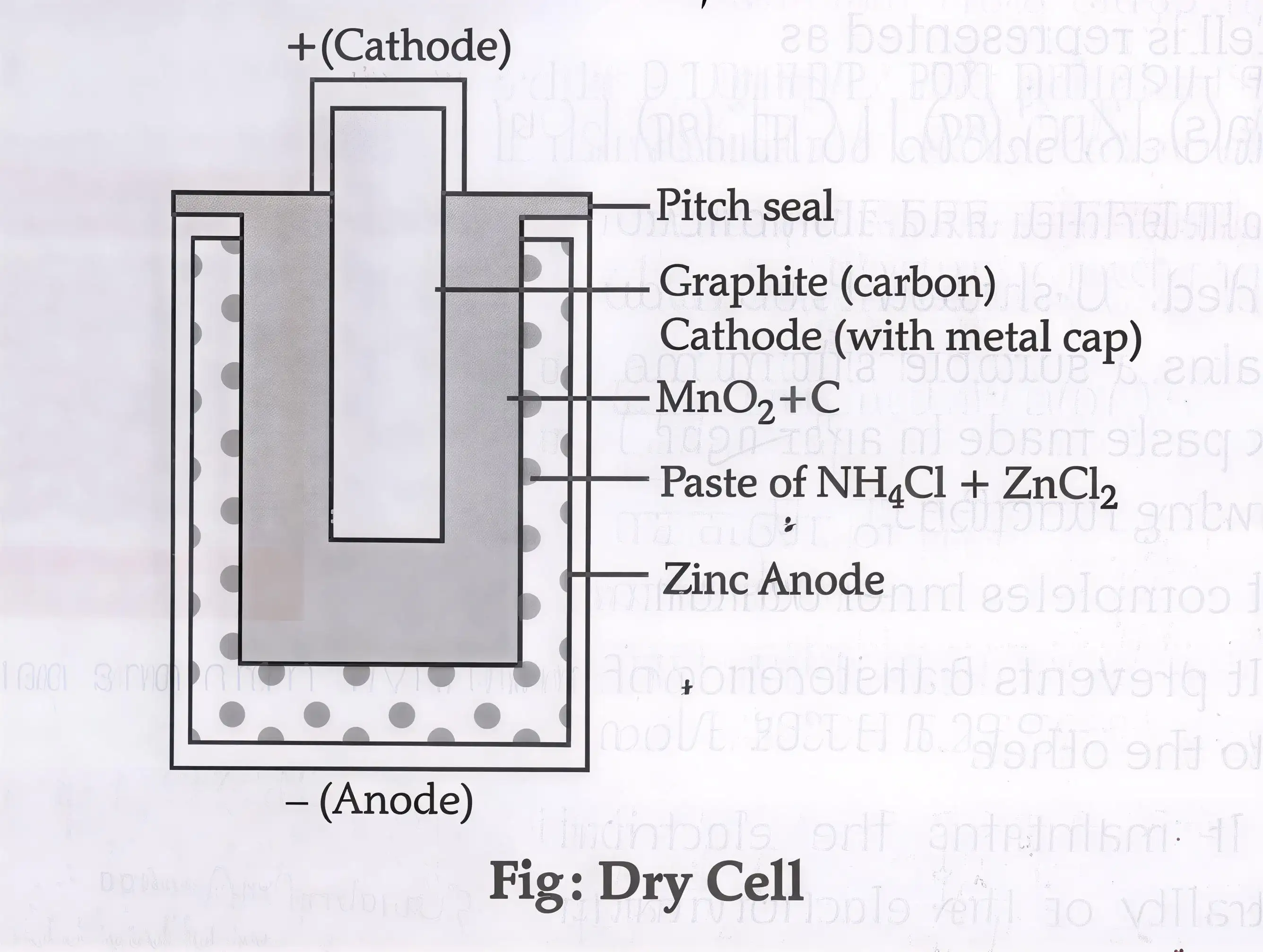
At anode: Zn(s) → Zn²⁺(aq) + 2e⁻
At cathode: MnO₂(s) + NH₄⁺(aq) + 2e⁻ → MnO(OH) + NH₃
Net reaction: Zn + NH₄⁺ + MnO₂ → Zn²⁺ + MnO(OH) + NH₃
Lead storage battery has spongy lead as anode, lead dioxide packed with lead as cathode, and 38% H₂SO₄ aqueous solution as electrolyte. It is rechargeable.
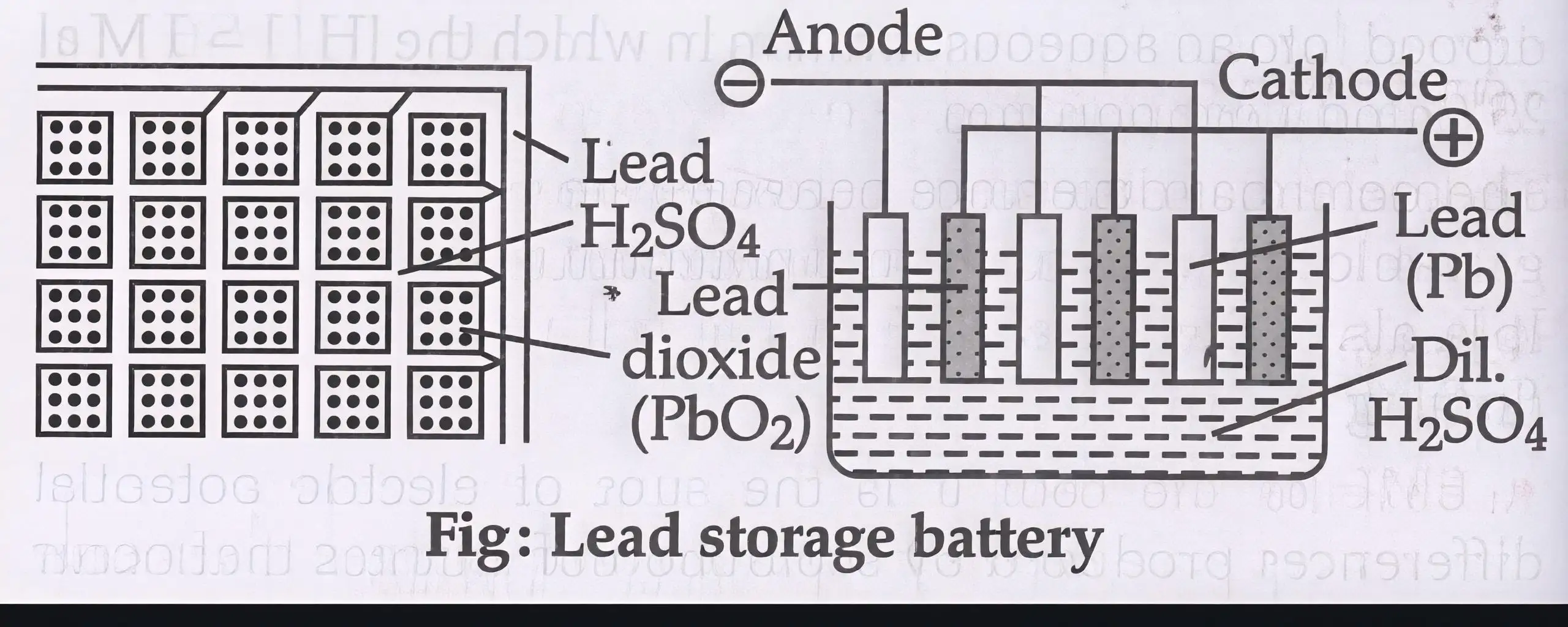
Discharge reactions:
Anode: Pb(s) + SO₄²⁻(aq) → PbSO₄(s) + 2e⁻
Cathode: PbO₂(s) + 4H⁺(aq) + SO₄²⁻(aq) + 2e⁻ → PbSO₄(s) + 2H₂O(l)
Overall: Pb(s) + PbO₂(s) + 2H₂SO₄(aq) → 2PbSO₄(s) + 2H₂O(l)
Recharge reactions reverse the discharge process.
Fuel cells convert chemical energy of fuels like hydrogen directly into electrical energy without recharging.
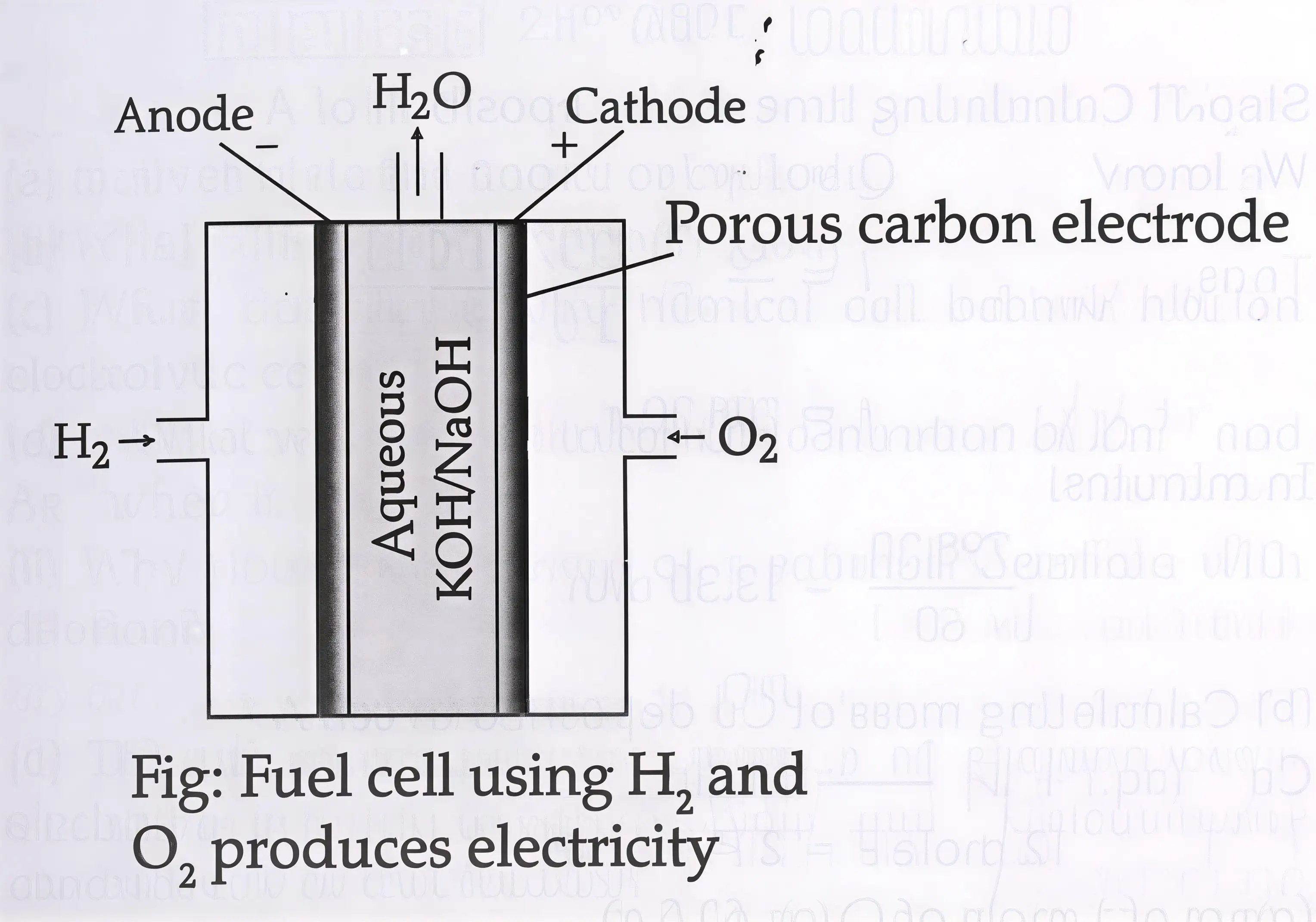
Fuel cell reactions:
Anode: H₂(g) + 2OH⁻(aq) → 2H₂O(l) + 2e⁻
Cathode: O₂(g) + 2H₂O(l) + 4e⁻ → 4OH⁻(aq)
Net: 2H₂(g) + O₂(g) → 2H₂O(l)
Corrosion is the slow chemical deterioration of metals, such as rusting of iron.
Rusting reactions:
Fe(s) + 2H⁺(aq) + ½ O₂(aq) → Fe²⁺(aq) + H₂O(l)
2Fe²⁺(s) + ½ O₂(g) + 2H₂O(l) → Fe₂O₃(s) + 4H⁺
Fe₂O₃ + xH₂O → Fe₂O₃·xH₂O (Rust)
Prevention methods include barrier protection (painting, grease, electroplating), sacrificial protection (galvanisation), and alloying.
Solved Examples
Example 3:
(a) Differentiate between primary and secondary batteries with examples.
(b) Describe the lead storage battery.
(c) Write the reactions at anode, cathode, and overall in the lead storage battery.
Practice Set
- Level 1: Define electrolysis and state Faraday's first law.
- Level 2: Explain the working of a dry cell with its reactions.
- Level 3: Describe the reactions occurring in a lead storage battery during discharge and recharge.
Answer Key
- Level 1: Electrolysis is decomposition of electrolyte by electric current. Faraday's first law states amount of substance liberated is proportional to charge passed.
- Level 2: Dry cell has zinc anode and graphite cathode with MnO₂ and NH₄Cl paste. At anode Zn oxidizes, at cathode MnO₂ reduces producing electricity.
- Level 3: Discharge: Anode Pb + SO₄²⁻ → PbSO₄ + 2e⁻; Cathode PbO₂ + 4H⁺ + SO₄²⁻ + 2e⁻ → PbSO₄ + 2H₂O; Recharge reverses these reactions.
Quick Reference Table
| Concept | Formula | Key Point |
|---|---|---|
| Resistance | R = ρ l / A | Opposes current flow; SI unit ohm (Ω) |
| Resistivity (ρ) | ρ = R × A / l | Characteristic of the material; unit Ω·m or Ω·cm |
| Conductance | C = 1 / R | Unit Siemens (S) |
| Conductivity (κ) | κ = C × l / A | Unit S m⁻¹ or S cm⁻¹; reciprocal of resistivity |
| Cell constant (G) | G = l / A | Fixed for a given conductivity cell; unit cm⁻¹ |
| Molar conductivity (Λₘ) | Λₘ = κ / C × 1000 | Increases with dilution; unit S m² mol⁻¹ |
| Debye-Hückel equation | Λₘ = Λ°ₘ − A√C | Applies to strong electrolytes |
| Kohlrausch's law | Λ°ₘ = ν⁺λ°₊ + ν⁻λ°₋ | Limiting molar conductivity from ionic contributions |
| Degree of dissociation (α) | α = Λₘ / Λ°ₘ | Used for weak electrolytes |
| Dissociation constant (Kₐ) | Kₐ = Cα² / (1 − α) | Derived using Ostwald's dilution law |
| Solubility from conductivity | Solubility = κ × 1000 / Λ°ₘ | Used for sparingly soluble salts |
| Cell EMF | E_cell = E_cathode − E_anode | Positive value indicates spontaneous cell reaction |
| Nernst equation | E = E° − (RT/nF) ln Q | General form for non-standard conditions |
| Nernst equation at 298 K | E_cell = E°_cell − (0.059/n) log Q | Simplified form commonly used in problems |
| Gibbs free energy | ΔG = −nFE_cell | Negative ΔG means spontaneous reaction |
| Faraday's first law | m = Z × I × t | Mass liberated proportional to charge passed |
| Faraday's second law | w₁/E₁ = w₂/E₂ | Compares substances liberated by same charge |
Common Mistakes and Misconceptions
- Confusing conductance and conductivity: Conductance (C) depends on the dimensions of the specific cell used, while conductivity (κ) is an intrinsic property of the material independent of cell geometry.
- Assuming molar conductivity always increases the same way with dilution: For strong electrolytes, Λₘ increases slowly and linearly with √C (Debye-Hückel behavior); for weak electrolytes, Λₘ increases sharply near infinite dilution due to increased dissociation. Treating both cases identically leads to errors.
- Mixing up anode and cathode in galvanic vs electrolytic cells: In a galvanic cell, oxidation occurs at the anode (negative terminal) and reduction at the cathode (positive terminal). In an electrolytic cell, the polarity is reversed relative to current source, but oxidation still occurs at the anode and reduction at the cathode — students often incorrectly assume the sign of the electrode changes the fundamental definition.
- Forgetting the salt bridge's role: Some students think the salt bridge generates current; it actually only maintains electrical neutrality and completes the internal circuit — it does not participate in electron flow.
- Misapplying the Nernst equation sign convention: A common error is using the wrong sign for E° or forgetting to convert ln to log (factor of 2.303) when using the 0.059/n form at 298 K.
- Assuming ΔG and E_cell have the same sign relationship for all reactions: Remember, ΔG = −nFE_cell — a positive E_cell always gives a negative ΔG (spontaneous), and the negative sign is often mistakenly dropped in calculations.
- Confusing primary and secondary batteries: Primary batteries (e.g., dry cell) cannot be recharged as their electrode reactions are not easily reversible; secondary batteries (e.g., lead storage battery) can be recharged because their reactions are reversible.
- Overlooking that fuel cells require continuous fuel supply: Unlike batteries, fuel cells do not store chemical energy internally — they need a continuous supply of reactants (e.g., H₂ and O₂) to keep producing electricity.
- Thinking corrosion only affects iron: While rusting is the most common example, corrosion affects many metals (e.g., tarnishing of silver, corrosion of copper), though the specific chemistry and products differ.
Glossary
- Electrochemistry: The branch of chemistry dealing with the interconversion of chemical and electrical energy.
- Electrolyte: A substance that dissociates into ions in solution or molten state and conducts electricity.
- Degree of ionisation: The fraction of electrolyte molecules that dissociate into ions.
- Resistance (R): The opposition offered by a conductor to the flow of electric current.
- Resistivity (ρ): An intrinsic material property representing how strongly it resists current flow.
- Conductance (C): The ease with which current flows through a conductor; reciprocal of resistance.
- Conductivity (κ): An intrinsic material property representing how easily it conducts current; reciprocal of resistivity.
- Cell constant (G): The ratio of electrode separation to electrode area in a conductivity cell.
- Molar conductivity (Λₘ): The conducting power of all ions from one mole of electrolyte in solution.
- Limiting molar conductivity (Λ°ₘ): The molar conductivity of an electrolyte at infinite dilution.
- Kohlrausch's law: States that limiting molar conductivity is the sum of the independent contributions of the constituent ions.
- Redox reaction: A reaction involving simultaneous oxidation and reduction.
- Galvanic cell: A device that converts chemical energy from a spontaneous redox reaction into electrical energy.
- Electrolytic cell: A device that uses electrical energy to drive a non-spontaneous chemical reaction.
- Salt bridge: A tube containing an inert electrolyte that connects two half-cells, maintaining electrical neutrality without mixing the solutions.
- Standard hydrogen electrode (SHE): A reference electrode assigned zero potential, used to measure standard electrode potentials.
- Electrode potential: The potential difference developed between an electrode and its surrounding electrolyte.
- Cell potential (EMF): The potential difference between the two electrodes of a galvanic cell under no-current conditions.
- Electrochemical series: A list of elements arranged in order of their standard electrode potentials.
- Nernst equation: An equation relating electrode potential to standard potential and the concentrations of reacting species.
- Gibbs free energy (ΔG): A thermodynamic quantity indicating the spontaneity of a reaction; related to cell potential by ΔG = −nFE_cell.
- Electrolysis: The process of using electrical energy to bring about a non-spontaneous chemical reaction.
- Faraday's laws of electrolysis: Laws relating the amount of substance liberated at an electrode to the quantity of electric charge passed.
- Battery: A device consisting of one or more galvanic cells used as a source of electrical energy.
- Primary battery: A battery that cannot be recharged once its reactants are consumed (e.g., dry cell).
- Secondary battery: A rechargeable battery in which the electrode reactions can be reversed by passing current (e.g., lead storage battery).
- Fuel cell: A device that converts the chemical energy of a fuel directly and continuously into electrical energy.
- Corrosion: The gradual chemical or electrochemical deterioration of a metal due to reaction with its environment.
- Rust: Hydrated iron(III) oxide formed as a product of the corrosion of iron.
- Galvanisation: A corrosion prevention method involving coating iron with a layer of zinc.