CLASS 12-PCB . CHEMISTRY . CHEMISTRY PART I . COORDINATION COMPOUNDS
Chapter 5 : Coordination Compounds
Ch 5
CHEMISTRY
CLASS 12-PCB
Coordination Compounds
Definition and Structure
A coordination compound contains a central metal atom or ion surrounded by a number of oppositely charged ions or neutral molecules called ligands. These ligands are attached to the metal atom or ion by coordinate bonds, where both electrons in the bond are donated by the ligand. For example, in the complex ion [Cu(NH3)4]2+, ammonia acts as a ligand donating electron pairs to copper.
Coordinate Bond
A coordinate bond, also known as a dative covalent bond, is a type of covalent bond in which both shared electrons are donated by one atom, typically the ligand, to the metal ion which has an empty orbital capable of accepting them.
Double Salts
Double salts are stable solids formed by the combination of two or more salts. They dissociate into their constituent ions when dissolved in water or any solvent. For example, Mohr's salt, FeSO4·(NH4)2SO4·6H2O, is a double salt.
Properties of Double Salts
- They dissociate into simple ions in aqueous solution because they are ionic compounds.
- They do not contain coordinate bonds.
- They exist only in solid state as double salts.
- They are soluble in water.
Central Metal Atom or Ion
The metal atom or ion surrounded by a fixed number of ions or molecules is called the central metal atom or ion. For example, in K4[Fe(CN)6], Fe2+ is the central metal ion.
Ligands
Ligands are neutral molecules or ions (usually anions) that are attached to the central metal atom or ion in a complex compound. They act as Lewis bases by donating a pair of electrons to the metal ion. Examples include Cl-, OH-, CN-, CO, NH3, and H2O.
Types of Ligands
(a) On the basis of number of donor sites:
(i) Unidentate Ligands
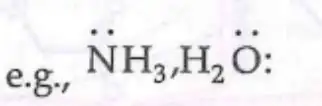
Contain one donor atom, e.g., NH3 (ammonia), H2O (water).
(ii) Bidentate Ligands
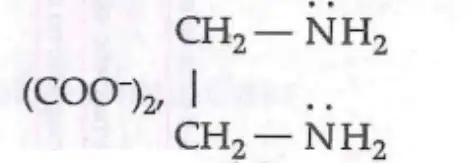
Contain two donor atoms, e.g., ethylenediamine (en).
(iii) Polydentate Ligands
Contain several donor atoms, e.g., EDTA.
(b) On the basis of charge:
(i) Cationic Ligands
Carry positive charge, e.g., NO2+, N2H5+.
(ii) Anionic Ligands
Carry negative charge, e.g., X- (halo), CN- (cyano).
(iii) Neutral Ligands
Do not carry any charge, e.g., NH3 (amine), H2O (aqua).
(c) On the basis of nature of ligand:
(i) Chelate Ligands
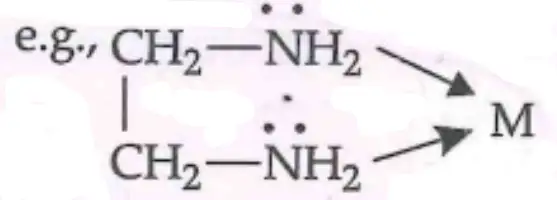
A bidentate or polydentate ligand uses its two or more donor atoms to bind a single metal ion, forming a ring-like structure called a chelate. The ligand is known as a chelate ligand.
(ii) Ambidentate Ligands
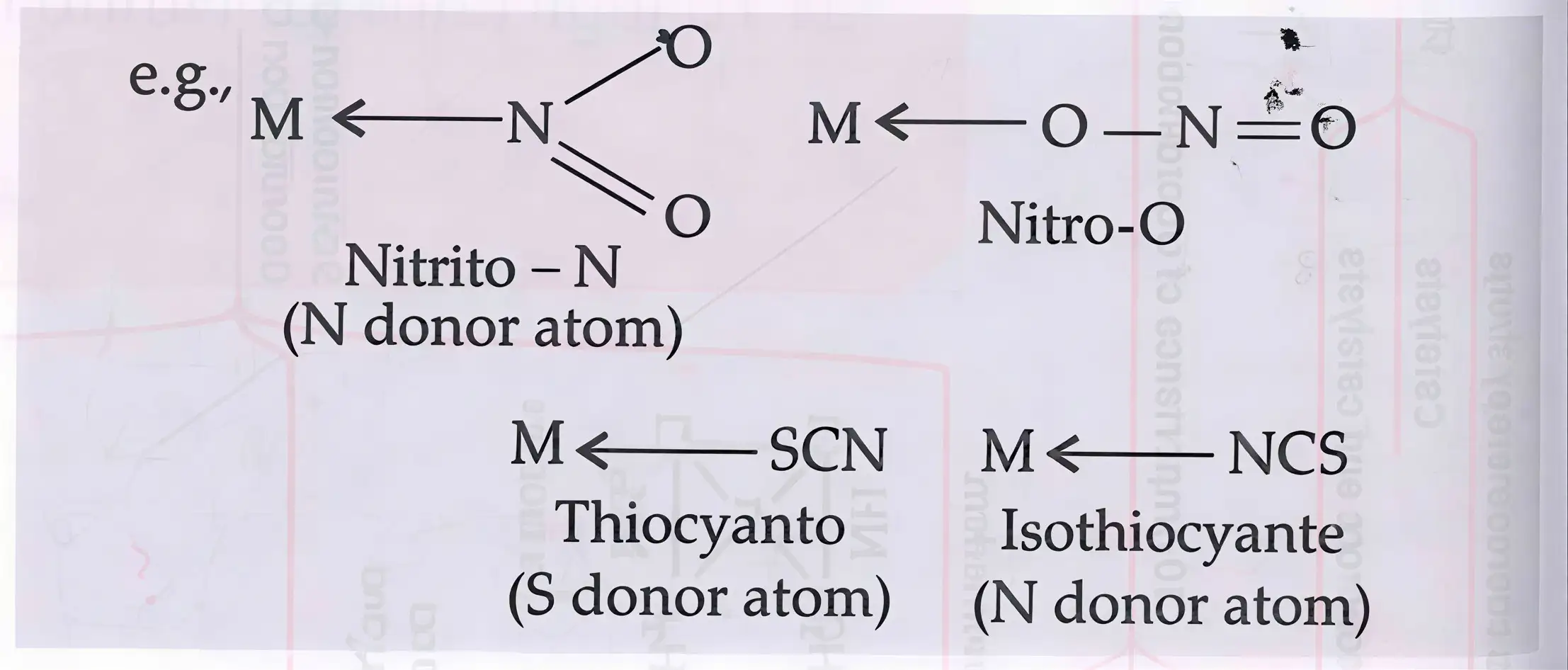
A ligand that contains two donor atoms but only one of them forms a coordinate bond at a time with the central metal ion is called an ambidentate ligand.
Coordination Number
The number of monodentate ligands attached to the central metal ion in a complex is called the coordination number. It is also the total number of chemical bonds formed between the central metal ion and donor atoms of ligands. For example, in [Ni(NH3)6]2+, the coordination number of Ni is 6.
Coordination Polyhedron
The spatial arrangement of the ligand atoms directly attached to the central atom or ion is called the coordination polyhedron. For example, [PtCl4]2- is square planar.
Charge on the Complex Ion
The charge on the complex ion is equal to the algebraic sum of the charges on all the ligands coordinated to the central metal ion.
Donor Atom
An atom or ion in the Lewis base that forms the bond with the central atom or ion is called the donor atom because it donates the pair of electrons.
Denticity
Denticity is the number of coordination bonds a ligand can form with a central metal atom or ion in a coordination complex. It describes how many donor atoms in the ligand are directly bonded to the metal centre. For example, unidentate ligands have denticity one, bidentate have two, etc.
Applications of Chelates
- Softening of hard water.
- Separation of lanthanoids and actinoids.
- Detection and estimation of some metal ions, such as nickel(II) ion.
Coordination Sphere
The central atom or ion and the ligands attached to it are enclosed in square brackets and collectively termed as the coordination sphere. For example, in K4[Fe(CN)6], the coordination sphere is [Fe(CN)6]4-.
Flexidentate Character of Ligands
Certain polydentate ligands have flexible character and are called flexidentates. For example, EDTA is hexadentate in nature but may act as pentadentate or tetradentate in some cases.
Oxidation Number of Central Atom
It is defined as the charge the central atom would carry if all the ligands are removed along with the electron pairs shared with the central atom. It is represented by Roman numerals.
Homoleptic and Heteroleptic Complexes
Complexes in which the metal atom or ion is linked to only one type of ligand are called homoleptic complexes, e.g., [Co(NH3)6]3+, [Fe(CN)6]4-. Complexes in which the metal atom or ion is linked to more than one kind of ligand are called heteroleptic complexes, e.g., [Co(NH3)4Cl2]+, [Cr(en)2Cl2]+.
Counter Ions
The ions that are not included in the primary coordination sphere are known as counter ions. For example, in K4[Fe(CN)6], K+ ions are counter ions.
Coordination Ions
The coordination entity with charge is called a coordination ion.
Nomenclature of Coordination Compounds
- The cation, whether simple or complex, is named first, followed by the anion.
- Ligands are named in alphabetical order.
- Numerical prefixes (di, tri, tetra, etc.) indicate the number of each kind of ligand within the coordination entity. For ligands containing these prefixes in their names, prefixes bis, tris, tetrakis, etc. are used.
- Anionic ligands end in -o, neutral ligands retain their names, and cationic ligands end in -ium.
- The coordination sphere is written in square brackets.
- Ligands are named first in alphabetical order, followed by the metal atom, and then the oxidation state of the metal in Roman numerals in parentheses.
- The name of the coordination compound starts with a small letter and the complex part is written as one word.
- The oxidation number of the central atom is indicated in Roman numerals without space.
Isomerism
Two or more coordination compounds with the same molecular formula but different arrangements of ligands around the central metal atom or ion are called isomers. This phenomenon is called isomerism.
Types of Isomerism
Structural Isomerism
- Ionisation Isomerism: Isomers have the same molecular formula but give different ions in solution, e.g., [Co(NH3)5Cl]SO4 and [Co(NH3)5(SO4)]Cl.
- Coordination Isomerism: Isomers differ in the coordination of ligands between cation and anion, e.g., [Co(NH3)6][Cr(C2O4)3] and [Cr(NH3)6][Co(C2O4)3].
- Solvate Isomerism: Isomers differ by whether a solvent molecule is directly bonded to the metal ion or present as free solvent molecules in the crystal lattice, e.g., [Cr(H2O)5Cl]Cl2·H2O and [Cr(H2O)6]Cl3.
- Linkage Isomerism: Isomers have the same molecular formula but different linking atoms due to ambidentate ligands, e.g., [Co(NH3)5(NO2)]2+ and [Co(NH3)5(ONO)]2+.
Stereoisomerism
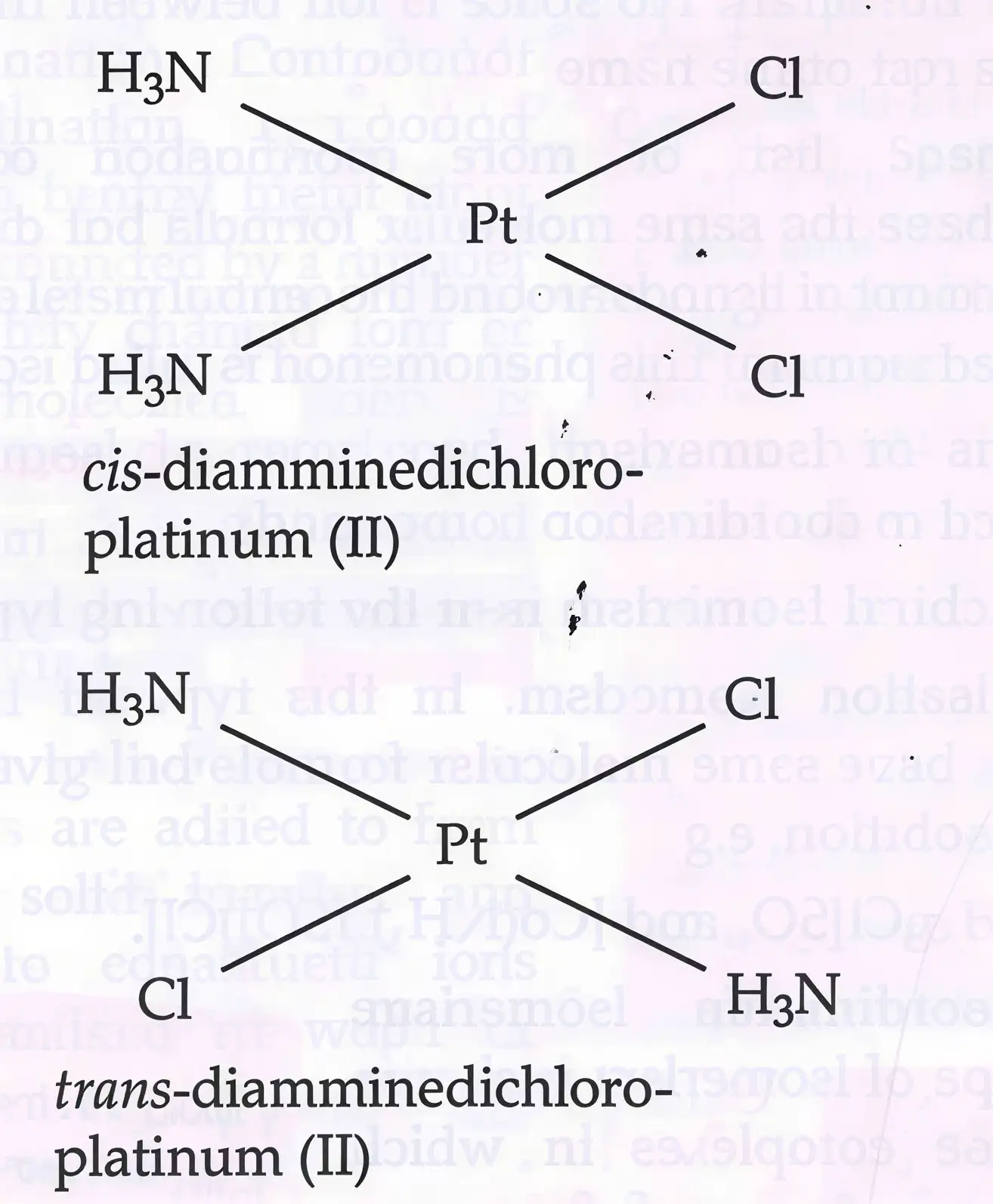
- Geometrical Isomerism: In tetracoordinated square planar complexes, the cis-isomer has the same groups on the same side, whereas the trans-isomer has the same groups on opposite sides, e.g., cis- and trans-diamminedichloroplatinum(II).
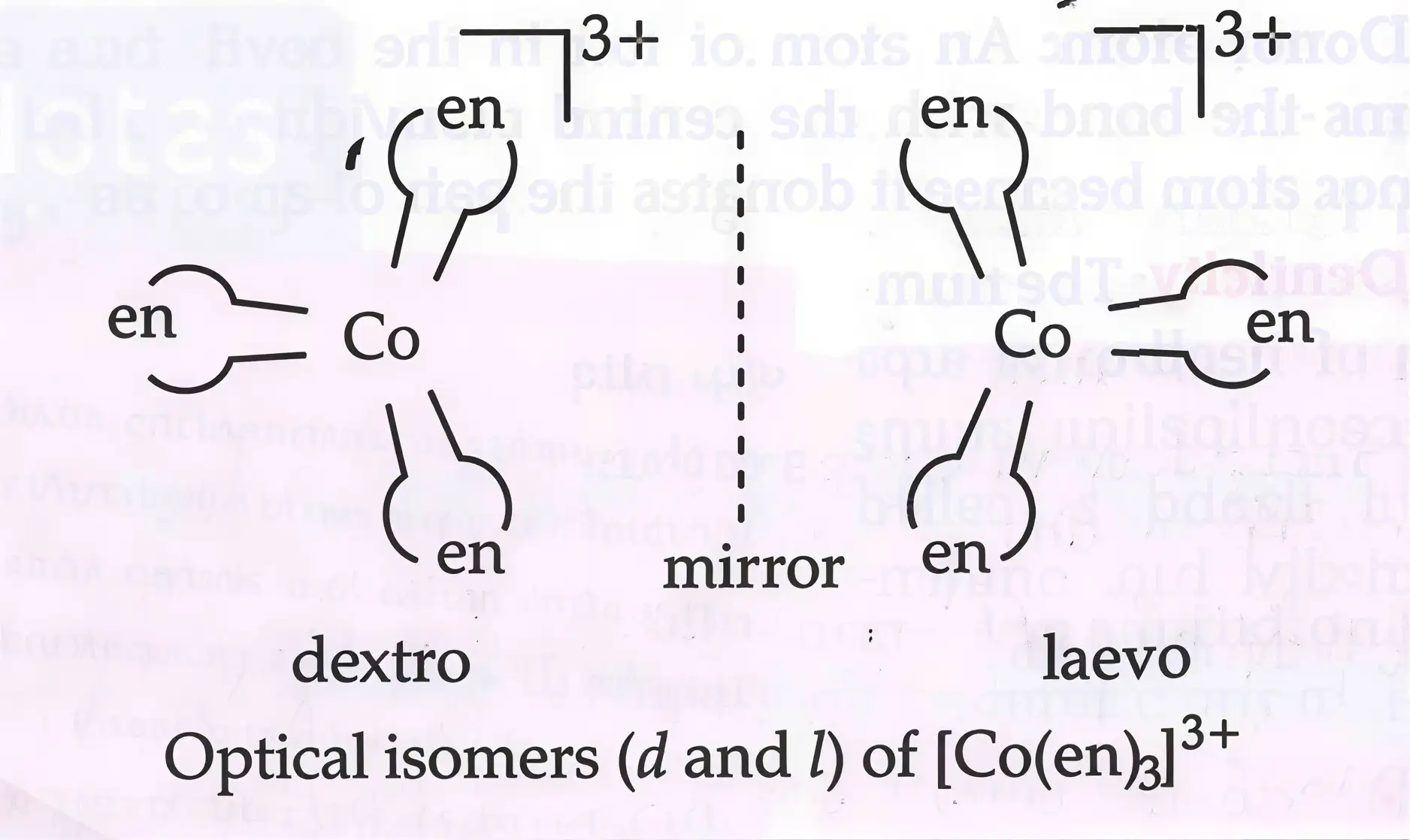
- Optical Isomerism: Optical isomers are non-superimposable mirror images called enantiomers. They rotate plane-polarised light in different directions and are common in octahedral complexes involving bidentate ligands.
Solved Examples
Example 1
What type of isomerism is shown by the pair [Cr(H2O)6]Cl3 and [Cr(H2O)5Cl]Cl2·H2O?
Solution: These compounds have the same molecular formula but differ in the number of water molecules inside and outside the coordination sphere. The first has six water molecules coordinated and none outside, while the second has five coordinated and one outside. This is an example of solvate isomerism.
Example 2
Assign secondary valency to metals in the following compounds based on moles of AgCl precipitated when reacted with excess AgNO3:
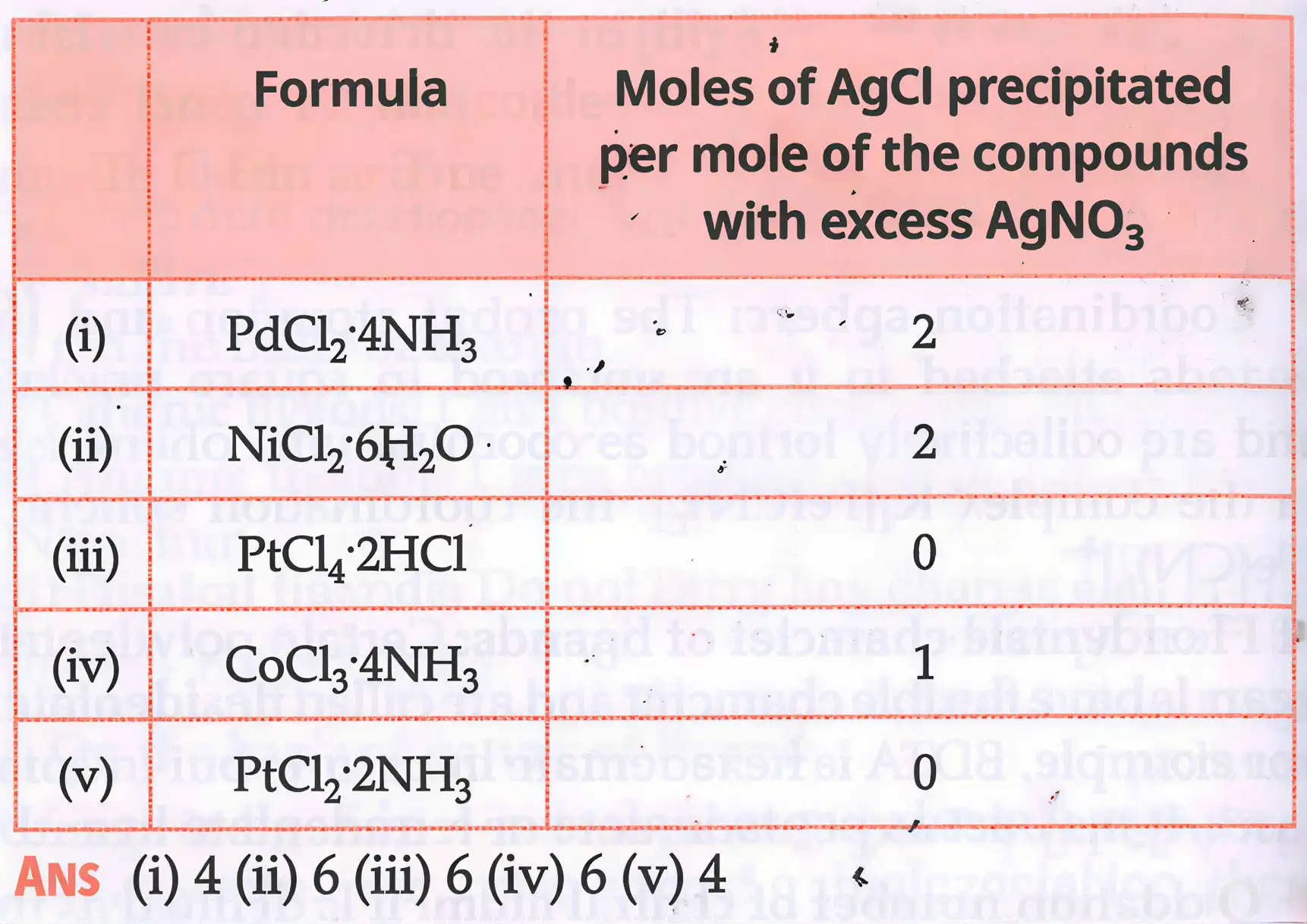
Solution: The moles of AgCl formed correspond to the number of chloride ions outside the coordination sphere, indicating the primary valency. The remaining ligands satisfy the secondary valency (coordination number).
Example 3
Write the formulas for the following coordination compounds:
- Tetraammineaquachloridocobalt(III) chloride
- Potassium tetrahydroxidozincate(II)
- Potassium trioxalatoaluminate(III)
- Dichloridobis(ethane-1,2-diamine)cobalt(III)
- Tetracarbonylnickel(0)
Answer:
- [Co(NH3)4(H2O)Cl]Cl2
- K2[Zn(OH)4]
- K3[Al(C2O4)3]
- [CoCl2(en)2]+
- [Ni(CO)4]
Example 4
Describe the type of hybridisation for the complex ion [Fe(H2O)6]2+.
Answer: Fe exists as Fe2+. The electronic configuration of Fe(II) in [Fe(H2O)6]2+ is 3d6 4s0 4p0 4d0. As water is a weak ligand, pairing does not occur and the six lone pairs available from each water molecule move to one 4s, three 4p and two 4d orbitals. Thus, the hybridisation involved is sp3d2.
Example 5
The spin-only magnetic moment of [MnBr4]2- is 5.9 BM. Predict the geometry of the complex ion.
Answer: Since the coordination number of Mn2+ ion in the complex ion is 4, it will be either tetrahedral (sp3 hybridisation) or square planar (dsp2 hybridisation). But the magnetic moment of 5.9 BM indicates the presence of five unpaired electrons, so the complex is tetrahedral in shape.
Practice Set
Conceptual Questions
- Level 1: What is a coordinate bond and how does it differ from a covalent bond?
- Level 2: Explain the difference between unidentate and bidentate ligands with examples.
Application Question
- Level 3: Predict the type of isomerism in the complex [Co(NH3)5(NO2)]2+ and explain the reason.
Answer Key
- Level 1: A coordinate bond is a covalent bond where both electrons come from one atom (ligand), unlike a normal covalent bond where each atom contributes one electron.
- Level 2: Unidentate ligands have one donor atom (e.g., NH3), while bidentate ligands have two donor atoms (e.g., ethylenediamine).
- Level 3: The complex shows linkage isomerism because the NO2 ligand can bind through nitrogen (nitro) or oxygen (nitrito), resulting in different isomers.
Werner Theory and Bonding
Werner's Theory
Werner proposed that metal ions possess two types of valencies: primary (ionisable valency) and secondary (non-ionisable valency). Primary valencies are satisfied by anions, while secondary valencies are satisfied by negative groups or neutral molecules with lone pairs of electrons (ligands). The secondary valencies correspond to the coordination number and are directed in space towards internal positions.
Limitations of Werner's Theory
- It does not explain why complex formation tendency is limited to a few elements only.
- It cannot explain the directional nature of bonds in coordination complexes.
- It fails to explain magnetic properties and geometrical and optical isomerism.
Valence Bond Theory (VBT)
Developed by Pauling, VBT explains bonding in coordination compounds by hybridisation of metal orbitals (s, p, d) to form hybrid orbitals that overlap with ligand orbitals donating electron pairs.
Key Points of VBT
- A suitable number of vacant orbitals must be present in the central metal atom or ion for coordinate bond formation.
- The central metal ion uses an appropriate number of s, p, or d orbitals for hybridisation depending on the number of ligands.
- The hybridised orbitals overlap with ligand orbitals that donate electron pairs.
- Complexes can be high spin (outer orbitals used) or low spin (inner orbitals used) depending on ligand field strength.
Limitations of Valence Bond Theory
- Cannot explain detailed magnetic properties of complexes.
- Cannot explain optical absorption spectra of coordination compounds.
- Cannot predict whether a four-coordinate complex is square planar or tetrahedral.
- Fails to distinguish between strong and weak field ligands.
- Does not explain thermodynamic or kinetic stability of complexes.
Crystal Field Theory (CFT)
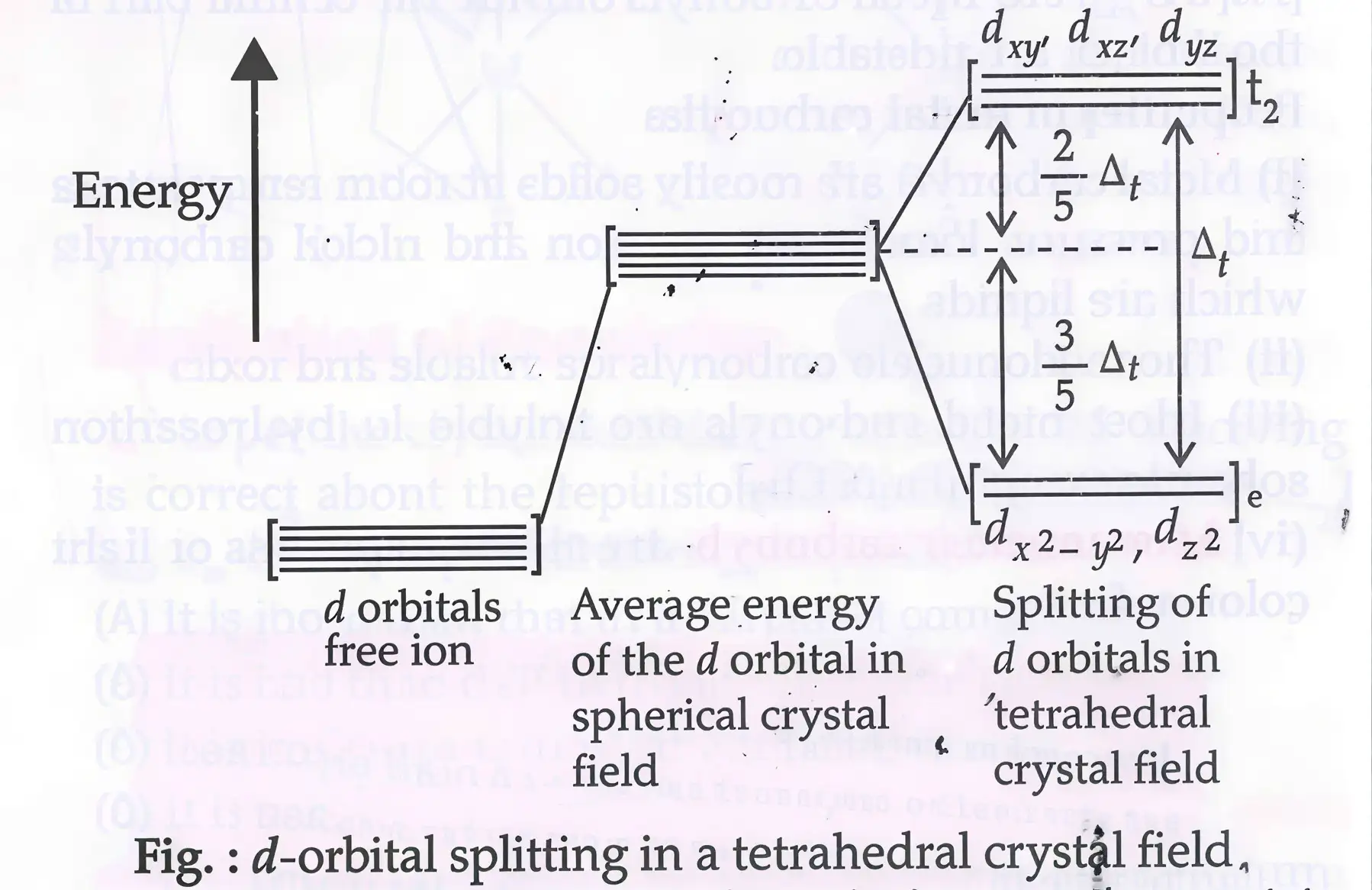
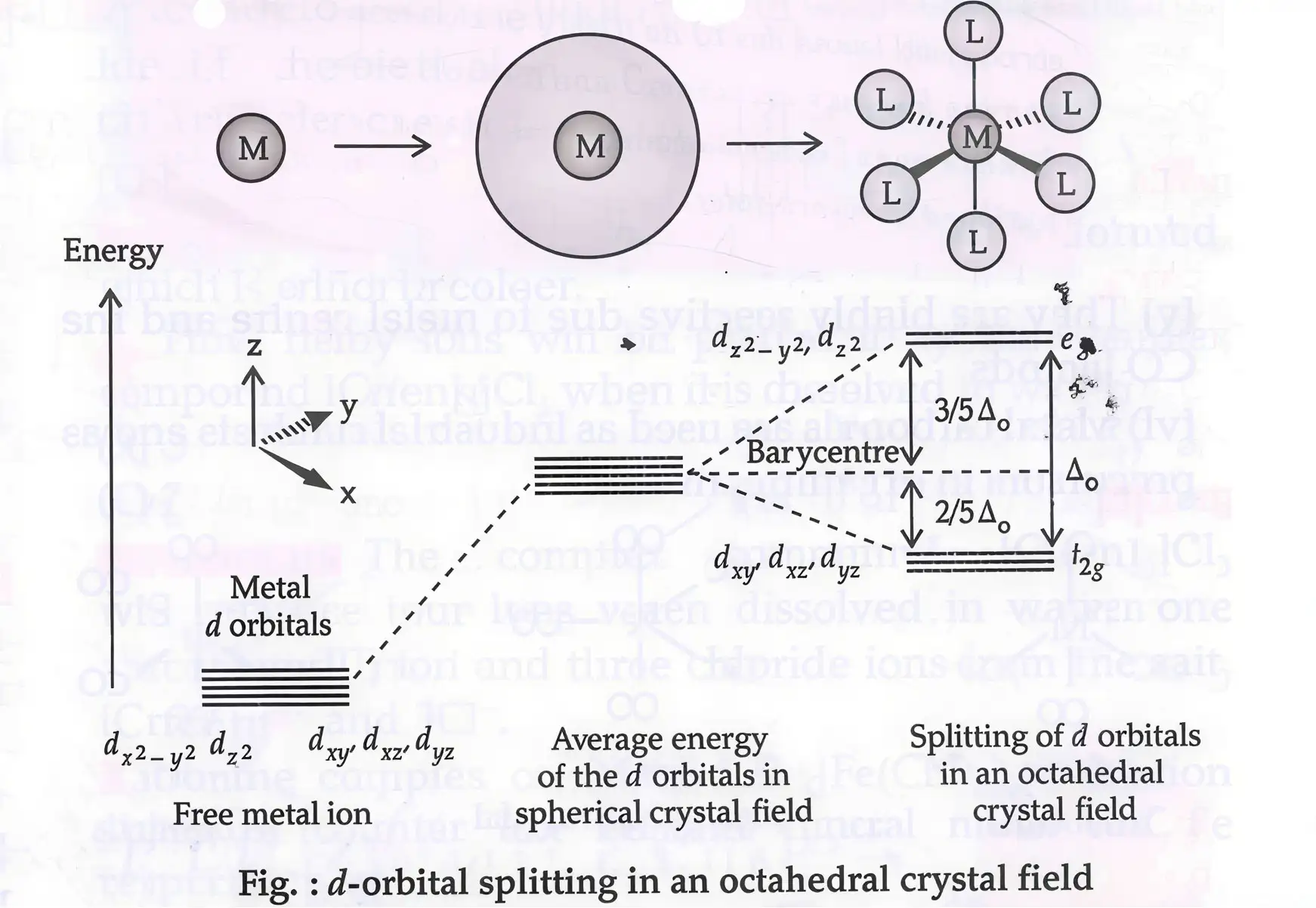
CFT treats ligands as point charges or point dipoles that create an electrostatic field around the metal ion, causing splitting of degenerate d-orbitals into groups of different energies. The extent of splitting depends on the ligand field strength.
Key Points of CFT
- Ligands are considered as point charges or point dipoles.
- Interaction between metal ion and ligands is electrostatic.
- Metal ion is at the origin; ligands approach along axes depending on geometry (octahedral, tetrahedral, square planar).
- Electrostatic interaction causes splitting of d-orbitals into groups with different energies.
- Strong field ligands cause large splitting; weak field ligands cause small splitting.
Spectrochemical Series
Ligands arranged in order of increasing field strength:
I- < Br- < SCN- < Cl- < S2- < F- < OH- < C2O42- < H2O < NCS- < EDTA4- < NH3 < en < CN- < CO
Explanation of Colour and Magnetic Behaviour
The splitting of d-orbitals explains the colour of coordination compounds due to electronic transitions and their magnetic properties depending on the number of unpaired electrons.
Metal Carbonyls
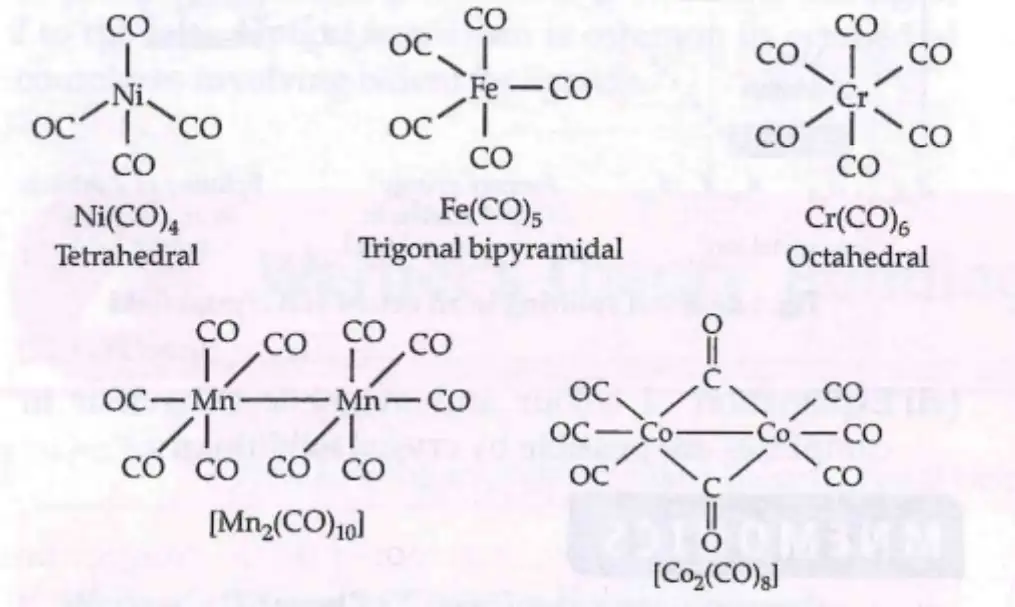
Metal carbonyls are homoleptic complexes of d-block metals with carbonyl (CO) ligands. Bonding involves both sigma donation from CO to metal and pi back donation from metal d-electrons to CO antibonding orbitals.
Properties of Metal Carbonyls
- Mostly solids at room temperature and pressure, except iron and nickel carbonyls which are liquids.
- Mononuclear carbonyls are volatile and toxic.
- Most metal carbonyls are soluble in hydrocarbon solvents, except [Fe2(CO)9].
- Mononuclear carbonyls are colourless or light coloured.
- Highly reactive due to metal centre and CO ligands.
- Used as industrial catalysts and precursors in organic synthesis.
Bonding in Metal Carbonyls
Bonding involves both sigma and pi bonds. Sigma bond is formed by overlapping of the lone pair on CO with vacant d-orbitals of the metal, whereas pi bond is formed by back donation of a pair of d-electrons to the vacant antibonding orbitals of carbonyl.
Factors Affecting Stability of Coordination Complexes
- Nature of the Central Ion: Greater charge density on the central metal ion increases complex stability.
- Nature of the Ligand: More basic ligands donate electron pairs more easily, resulting in stable complexes.
- Chelate Effect: Chelation increases entropy by displacing multiple monodentate ligands with one polydentate ligand, making complex formation more favourable.
Applications of Coordination Compounds
- Used in photography, e.g., AgBr forms a soluble complex with sodium thiosulphate.
- K[Ag(CN)2] is used for silver electroplating; K[Au(CN)2] for gold plating.
- Some ligands oxidise Co2+ to Co3+.
- EDTA is used for estimation of Ca2+ and Mg2+ in hard water.
- Silver and gold are extracted by treating Zn with their cyanide complexes.
- Ni2+ is tested and estimated by dimethylglyoxime (DMG).
- Cis-platin [Pt(NH3)2Cl2] is used as an anti-tumour agent in cancer treatment.
- EDTA is used to remove Pb by forming Pb–EDTA complex, which is eliminated in urine.
- Haemoglobin contains Fe, chlorophyll contains Mg, and vitamin B12 contains Co2+, all coordination compounds.
- Bauxite is purified by forming complexes with NaOH.
- Coordination compounds are used as catalysts in many industrial processes.
Practice Set
Conceptual Questions
- Level 1: What is the difference between primary and secondary valencies in Werner's theory?
- Level 2: Explain the chelate effect and its impact on complex stability.
Application Question
- Level 3: Describe the bonding in metal carbonyls and explain the role of pi back bonding.
Answer Key
- Level 1: Primary valencies are ionisable and satisfied by anions; secondary valencies are non-ionisable and satisfied by ligands.
- Level 2: Chelate effect occurs when polydentate ligands form ring structures with metal ions, increasing entropy and stability of the complex.
- Level 3: Bonding involves sigma donation from CO to metal and pi back donation from metal d-electrons to CO antibonding orbitals, stabilizing the complex.
Quick Reference Table
Coordination Compounds: Central metal ion bonded to ligands via coordinate bonds.
Coordinate Bond: Covalent bond where both electrons come from ligand.
Ligands: Unidentate, bidentate, polydentate; cationic, anionic, neutral; chelate and ambidentate.
Coordination Number: Number of ligand donor atoms bonded to metal ion.
Isomerism: Structural (ionisation, coordination, solvate, linkage) and stereoisomerism (geometrical, optical).
Werner's Theory: Primary and secondary valencies; coordination number equals secondary valency.
Valence Bond Theory: Hybridisation of metal orbitals to form bonds with ligands.
Crystal Field Theory: Electrostatic interaction causing d-orbital splitting; explains colour and magnetism.
Spectrochemical Series: I- < Br- < SCN- < Cl- < S2- < F- < OH- < C2O42- < H2O < NCS- < EDTA4- < NH3 < en < CN- < CO.
Metal Carbonyls: Homoleptic complexes with CO ligands; sigma and pi bonding.
Common Mistakes and Misconceptions
- Confusing coordinate bonds with covalent bonds formed by equal sharing of electrons.
- Errors in naming coordination compounds, especially oxidation states.
- Misidentifying strong and weak field ligands when predicting hybridisation.
- Confusing types of isomerism, especially linkage and coordination isomerism.
- Incorrect electronic configuration assignments for low spin and high spin complexes in crystal field theory.
- Assuming all four-coordinate complexes are square planar without considering magnetic data.
Glossary
- Coordination Compound: A compound with a central metal ion bonded to ligands via coordinate bonds.
- Ligand: Molecule or ion donating electron pairs to metal ion.
- Coordinate Bond: Covalent bond where both electrons come from one atom.
- Coordination Number: Number of ligand donor atoms bonded to metal ion.
- Isomerism: Existence of compounds with same formula but different arrangements.
- Hybridisation: Mixing of atomic orbitals to form new hybrid orbitals.
- Crystal Field Theory: Model explaining d-orbital splitting due to ligand field.
- Chelate: Ligand forming multiple bonds creating ring structures with metal ion.
- Ambidentate Ligand: Ligand with two donor atoms but binds through only one at a time.
- Optical Isomerism: Isomers that are non-superimposable mirror images.