CLASS 12-PCB . CHEMISTRY . CHEMISTRY PART I . CHEMICAL KINETICS
Chapter 3 : Chemical Kinetics
Ch 3
CHEMISTRY
CLASS 12-PCB
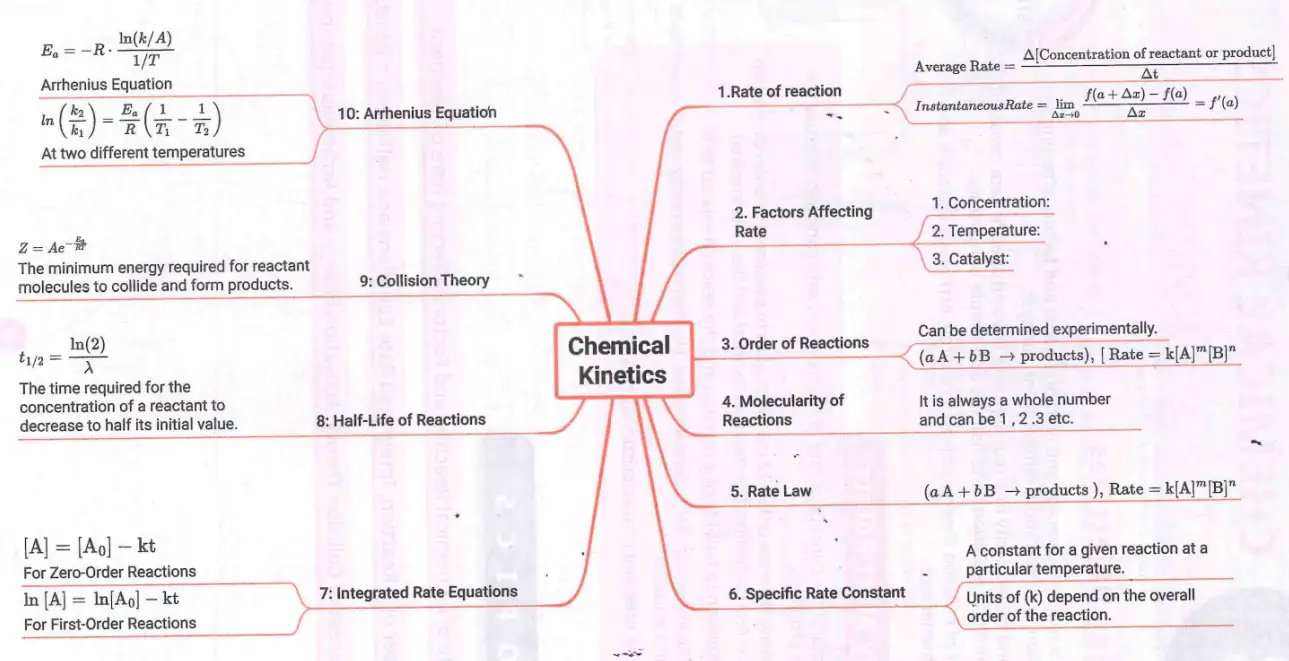
Rate of Reaction
Chemical Kinetics
Chemical kinetics is the branch of physical chemistry that studies the rate of chemical reactions and the mechanisms by which they occur.
Definition of Rate of Reaction
The rate of reaction is the change in concentration of a reactant or product per unit time. For a reaction A + B → C, the rate can be expressed as:
Rate of disappearance of A = −Δ[A] / Δt
Rate of disappearance of B = −Δ[B] / Δt
Rate of appearance of C = Δ[C] / Δt
Here, [A], [B], and [C] represent molar concentrations of the reactants and product respectively.
Molar Concentration
Molar concentration is the amount of solute (in moles) dissolved in one litre of solution. It is the most convenient way to express concentration.
Units of Rate
The unit of rate of reaction is mol L⁻¹ s⁻¹ or mol L⁻¹ min⁻¹ for reactions in liquid phase, and atm s⁻¹ or atm min⁻¹ for gaseous reactions.
Instantaneous and Average Rate
Instantaneous rate is the rate at a particular moment and is given by the derivative of concentration with respect to time, e.g., −d[A]/dt.
Average rate is the change in concentration over a finite time interval, Δx/Δt.
Factors Affecting Rate
- Concentration: Rate increases with increase in reactant concentration.
- Temperature: Higher temperature increases kinetic energy, increasing rate.
- Pressure: Affects gaseous reactions by increasing concentration.
- Catalyst: Lowers activation energy, increasing rate without being consumed.
- Nature of Reactants: Simpler molecules react faster due to fewer bonds to break.
- Surface Area: Greater surface area increases rate in heterogeneous reactions.
- Radiations: Photochemical reactions initiated by light proceed faster.
- Physical State: Reactants in gaseous or aqueous state react faster than solids.
Rate Law and Rate Constant
Rate law expresses the rate as a function of reactant concentrations: Rate = k[A]^m[B]^n, where k is the rate constant.
Rate constant k depends on temperature and catalyst presence.
Molecularity and Elementary Reactions
Molecularity is the number of reactant particles involved in an elementary step; it is always a whole number (1, 2, or 3).
Elementary reactions occur in a single step with no intermediates.
Solved Examples
Example 1
For the reaction R → P, the concentration of R changes from 0.03 M to 0.02 M in 25 minutes. Calculate the average rate of reaction in mol L⁻¹ min⁻¹ and mol L⁻¹ s⁻¹.
Solution:
Average rate = −Δ[R] / Δt = −(0.02 − 0.03) / 25 = 4 × 10⁻⁴ mol L⁻¹ min⁻¹
Converting to seconds: 4 × 10⁻⁴ / 60 = 6.67 × 10⁻⁶ mol L⁻¹ s⁻¹
Practice Set
- Level 1: Define rate of reaction and state its units.
- Level 2: Explain how temperature affects the rate of a chemical reaction.
- Level 3: A reaction has a rate that becomes twenty-seven times when the concentration of a reactant is tripled. What is the order of the reaction with respect to that reactant?
Answer Key
- Level 1: Rate of reaction is the change in concentration of reactants or products per unit time. Units are mol L⁻¹ s⁻¹ or mol L⁻¹ min⁻¹.
- Level 2: Increasing temperature increases kinetic energy of molecules, leading to more frequent and energetic collisions, thus increasing the reaction rate.
- Level 3: Since rate becomes twenty-seven times when concentration triples, the order with respect to that reactant is 3 (third order).
Order of Reaction
Definition
Order of reaction is the sum of the powers of concentration terms in the experimentally determined rate law. It can be zero, whole number, or fractional.
Zero Order Reaction
Rate is independent of reactant concentration: Rate = k.
Unit of k is mol L⁻¹ s⁻¹.
Example: Thermal decomposition of HI on gold surface.
First Order Reaction
Rate is directly proportional to the first power of reactant concentration: Rate = k[A].
Unit of k is s⁻¹.
Example: Decomposition of N₂O₅.
Pseudo First Order Reaction
A reaction that behaves like first order under certain conditions, e.g., acidic hydrolysis of ester.
Second Order Reaction
Rate depends on the square of one reactant or product of two reactants: Rate = k[A][B].
Unit of k is mol⁻¹ L s⁻¹.
Integrated Rate Equations
Used to calculate concentration changes over time for zero and first order reactions.
Half-life
Time taken for concentration to reduce to half its initial value.
For zero order: t₁/₂ = [A]₀ / 2k
For first order: t₁/₂ = 0.693 / k
Solved Examples
Example 2
If a first-order reaction is 20% complete in 40 minutes, find the time to complete 60% of the reaction.
Solution:
Using k = (2.303 / t) log (a / (a − x)), calculate k for 20% completion, then use it to find time for 60% completion.
Time for 60% completion = 164.42 minutes.
Practice Set
- Level 1: Define order of reaction and give an example of a zero order reaction.
- Level 2: Write the integrated rate law for a first order reaction.
- Level 3: Calculate the half-life of a zero order reaction with initial concentration 0.1 mol L⁻¹ and rate constant 0.02 mol L⁻¹ s⁻¹.
Answer Key
- Level 1: Order of reaction is the sum of powers of concentration in rate law. Example: Thermal decomposition of HI is zero order.
- Level 2: Integrated rate law for first order: ln [A] = −kt + ln [A]₀.
- Level 3: Half-life for zero order: t₁/₂ = [A]₀ / 2k = 0.1 / (2 × 0.02) = 2.5 seconds.
Collision Theory
Concept
Collision theory states that chemical reactions occur when reactant molecules collide with sufficient energy and proper orientation.
Activation Energy
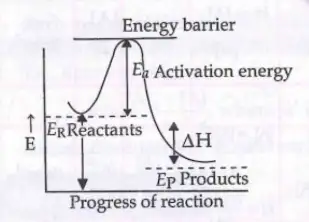
Activation energy is the minimum energy required for reactants to form products during collision.
Effective Collision
Only collisions with energy equal to or greater than activation energy and correct orientation lead to reaction.
Arrhenius Equation
Relates rate constant k to temperature T and activation energy Eₐ:
k = A e⁻ᴱᵃ⁄ᴿᵀ
where A is frequency factor, R is gas constant, and T is temperature in kelvin.
Graphical Representation
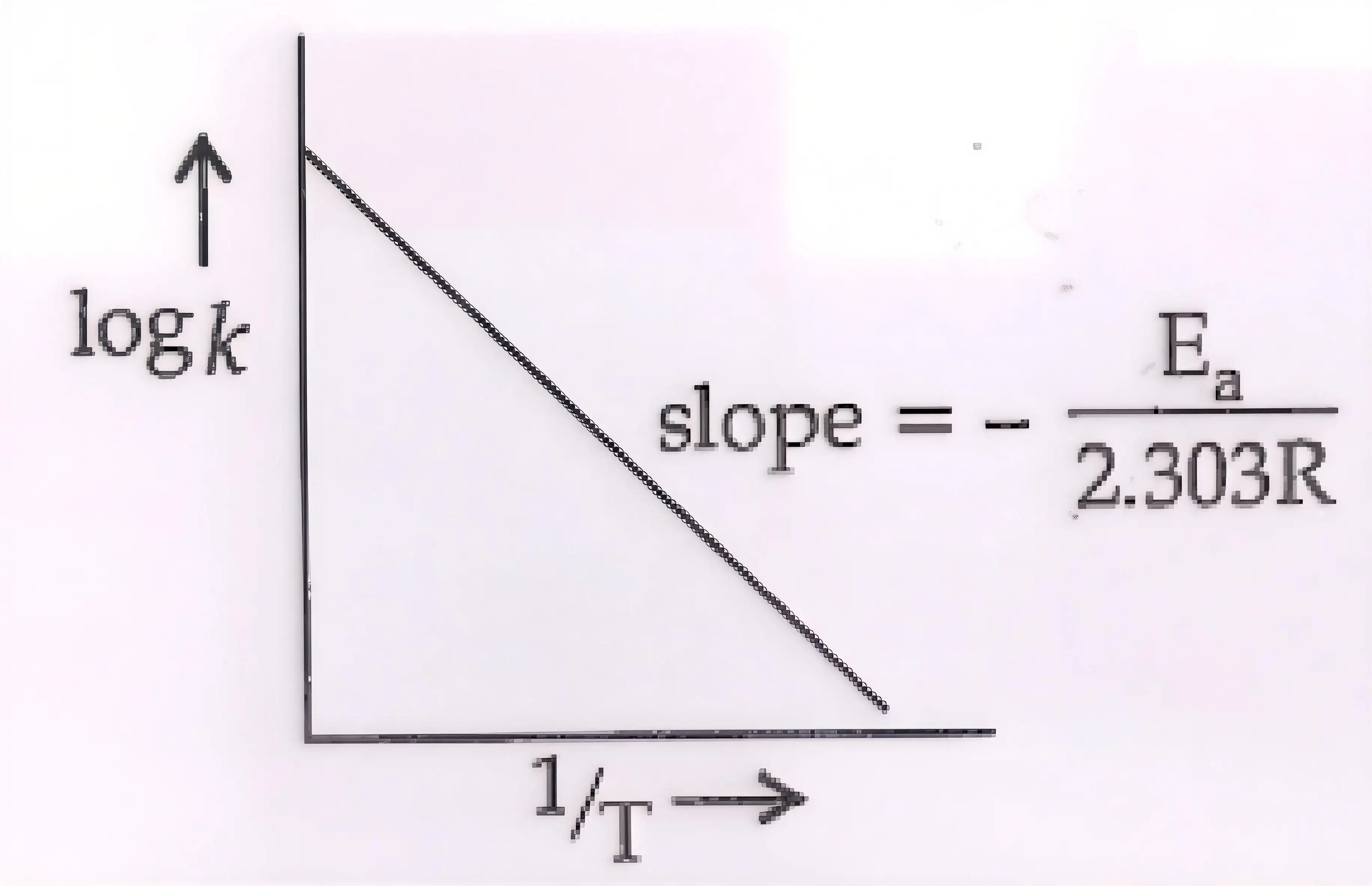
Plotting log k vs 1/T gives a straight line with slope −Eₐ / (2.303 R).
Catalysts
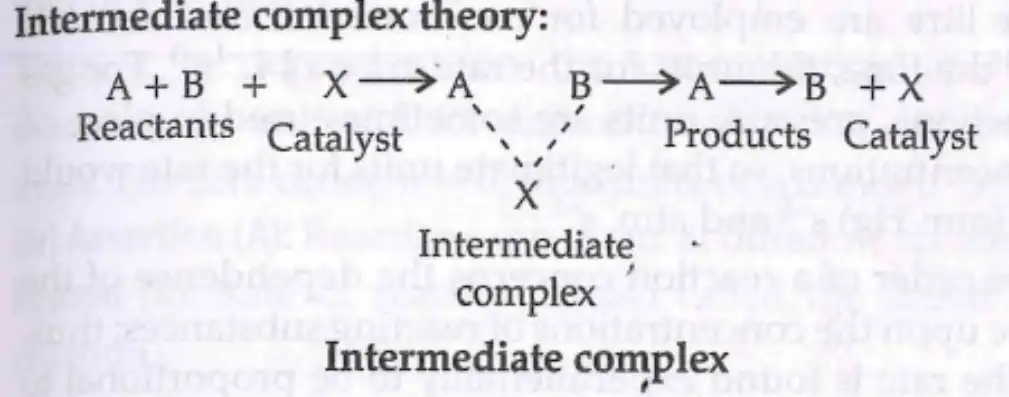
A catalyst increases reaction rate by lowering activation energy without being consumed.
Characteristics include not changing equilibrium constant or free energy change, and catalysing both forward and backward reactions.
Solved Examples
Example 3
(i) For reaction A → B, if rate increases 27 times when concentration triples, find the order.
(ii) Activation energy decreases from 75.2 kJ mol⁻¹ to 50.14 kJ mol⁻¹ with catalyst at 25 °C. Calculate rate increase.
Solution:
(i) Rate r = k[R]ⁿ. Given r' = 27r when [R]' = 3[R], so 27 = 3ⁿ implies n=3.
(ii) Using Arrhenius equation, rate increases by 2.46 × 10⁴ times with catalyst.
Practice Set
- Level 1: Define activation energy and explain its significance.
- Level 2: State the Arrhenius equation and explain each term.
- Level 3: Explain how a catalyst affects the activation energy and rate of reaction.
Answer Key
- Level 1: Activation energy is the minimum energy required for reactants to form products during collision.
- Level 2: Arrhenius equation: k = A e⁻ᴱᵃ⁄ᴿᵀ, where k is rate constant, A frequency factor, Eₐ activation energy, R gas constant, T temperature.
- Level 3: A catalyst lowers activation energy, increasing the fraction of effective collisions, thus increasing the reaction rate.
Quick Reference Table
| Concept | Formula | Key Point |
|---|---|---|
| Average rate | Rate = ±Δ[conc.] / Δt | Measured over a finite time interval |
| Instantaneous rate | Rate = ±d[conc.] / dt | Rate at a specific moment; slope of concentration-time curve |
| Rate law | Rate = k[A]^m[B]^n | m, n are experimentally determined, not from stoichiometry |
| Order of reaction | Sum of exponents (m + n) in rate law | Can be zero, whole number, or fractional |
| Molecularity | Number of reacting species in an elementary step | Always a whole number (1, 2, or 3); never zero or fractional |
| Zero order rate law | Rate = k, unit of k: mol L⁻¹ s⁻¹ | Rate independent of concentration |
| Zero order integrated equation | [A] = [A]₀ − kt | Straight line plot of [A] vs t |
| Zero order half-life | t₁/₂ = [A]₀ / 2k | Half-life depends on initial concentration |
| First order rate law | Rate = k[A], unit of k: s⁻¹ | Rate proportional to concentration |
| First order integrated equation | ln [A] = −kt + ln [A]₀, or k = (2.303/t) log([A]₀/[A]) | Straight line plot of log [A] vs t |
| First order half-life | t₁/₂ = 0.693 / k | Independent of initial concentration |
| Second order rate law | Rate = k[A][B], unit of k: mol⁻¹ L s⁻¹ | Depends on two reactant concentrations or square of one |
| Arrhenius equation | k = A e⁻ᴱᵃ⁄ᴿᵀ | Relates rate constant to temperature and activation energy |
| Arrhenius plot | log k vs 1/T, slope = −Eₐ / (2.303 R) | Used to determine activation energy graphically |
| Effect of catalyst | Lowers Eₐ, increases k | Does not change ΔG or equilibrium constant |
Common Mistakes and Misconceptions
- Confusing order of reaction with molecularity: Order is determined experimentally and can be zero, fractional, or a whole number; molecularity is a theoretical concept for elementary steps and must always be a whole number (1, 2, or 3).
- Assuming order matches stoichiometric coefficients: Unlike molecularity, the order of reaction with respect to a species is not necessarily equal to its stoichiometric coefficient — it must be found from experimental rate data, not written directly from the balanced equation.
- Mixing up average rate and instantaneous rate: Average rate is calculated over a finite time interval (Δ), while instantaneous rate is the rate at one specific moment, found using derivatives (d/dt) or the slope of the tangent on a concentration-time graph.
- Forgetting the negative sign for reactants: Since reactant concentration decreases with time, the rate of disappearance is written as −Δ[A]/Δt (with a negative sign) so that the overall rate remains a positive quantity.
- Misremembering half-life dependence: A common error is assuming half-life is always independent of initial concentration. This is true only for first order reactions (t₁/₂ = 0.693/k); for zero order reactions, half-life does depend on initial concentration (t₁/₂ = [A]₀/2k).
- Believing a catalyst changes the reaction's thermodynamics: A catalyst only lowers the activation energy and speeds up the reaction (both forward and backward); it does not alter the equilibrium constant, the equilibrium position, or the free energy change of the reaction.
- Assuming higher temperature always means higher activation energy: Temperature and activation energy are independent quantities — increasing temperature increases the fraction of molecules with energy ≥ Eₐ, but does not change the value of Eₐ itself.
- Ignoring orientation in collision theory: Students often think any collision with enough energy will lead to a reaction; proper molecular orientation during collision is equally necessary for an effective collision.
Glossary
- Chemical kinetics: The branch of chemistry that studies the rate and mechanism of chemical reactions.
- Rate of reaction: The change in concentration of a reactant or product per unit time.
- Average rate: The rate of reaction measured over a finite time interval.
- Instantaneous rate: The rate of reaction at a particular instant, given by the derivative of concentration with respect to time.
- Rate law: An expression relating the rate of reaction to the concentrations of reactants, each raised to an experimentally determined power.
- Rate constant (k): The proportionality constant in the rate law, dependent on temperature and the presence of a catalyst.
- Order of reaction: The sum of the powers of the concentration terms in the experimentally determined rate law.
- Molecularity: The number of reacting species (atoms, ions, or molecules) that collide simultaneously in an elementary reaction step.
- Elementary reaction: A reaction that occurs in a single step without the formation of any intermediate.
- Zero order reaction: A reaction whose rate is independent of the concentration of the reactant(s).
- First order reaction: A reaction whose rate is directly proportional to the concentration of one reactant.
- Pseudo first order reaction: A reaction that is not truly first order but behaves as one under specific conditions, usually because one reactant is present in large excess.
- Second order reaction: A reaction whose rate depends on the concentration of two reactants, or the square of one reactant's concentration.
- Integrated rate equation: An equation obtained by integrating the rate law, expressing concentration as a function of time.
- Half-life (t₁/₂): The time required for the concentration of a reactant to reduce to half of its initial value.
- Collision theory: A theory stating that a chemical reaction occurs when reactant molecules collide with sufficient energy and correct orientation.
- Activation energy (Eₐ): The minimum energy that colliding reactant molecules must possess for a reaction to occur.
- Effective collision: A collision between reactant molecules that has both sufficient energy and proper orientation to result in a reaction.
- Arrhenius equation: An equation expressing the temperature dependence of the rate constant in terms of activation energy and a frequency factor.
- Frequency factor (A): A constant in the Arrhenius equation representing the frequency of collisions with proper orientation.
- Catalyst: A substance that increases the rate of a reaction by lowering its activation energy, without being consumed in the process.