CLASS 12-PCB . CHEMISTRY . CHEMISTRY PART II . ALDEHYDES KETONES-AND-CARBOXYLIC-ACIDS
Chapter 8 : Aldehydes, Ketones and Carboxylic Acids
Ch 8
CHEMISTRY
CLASS 12-PCB
Aldehydes and Ketones
Carbonyl Group and Classification
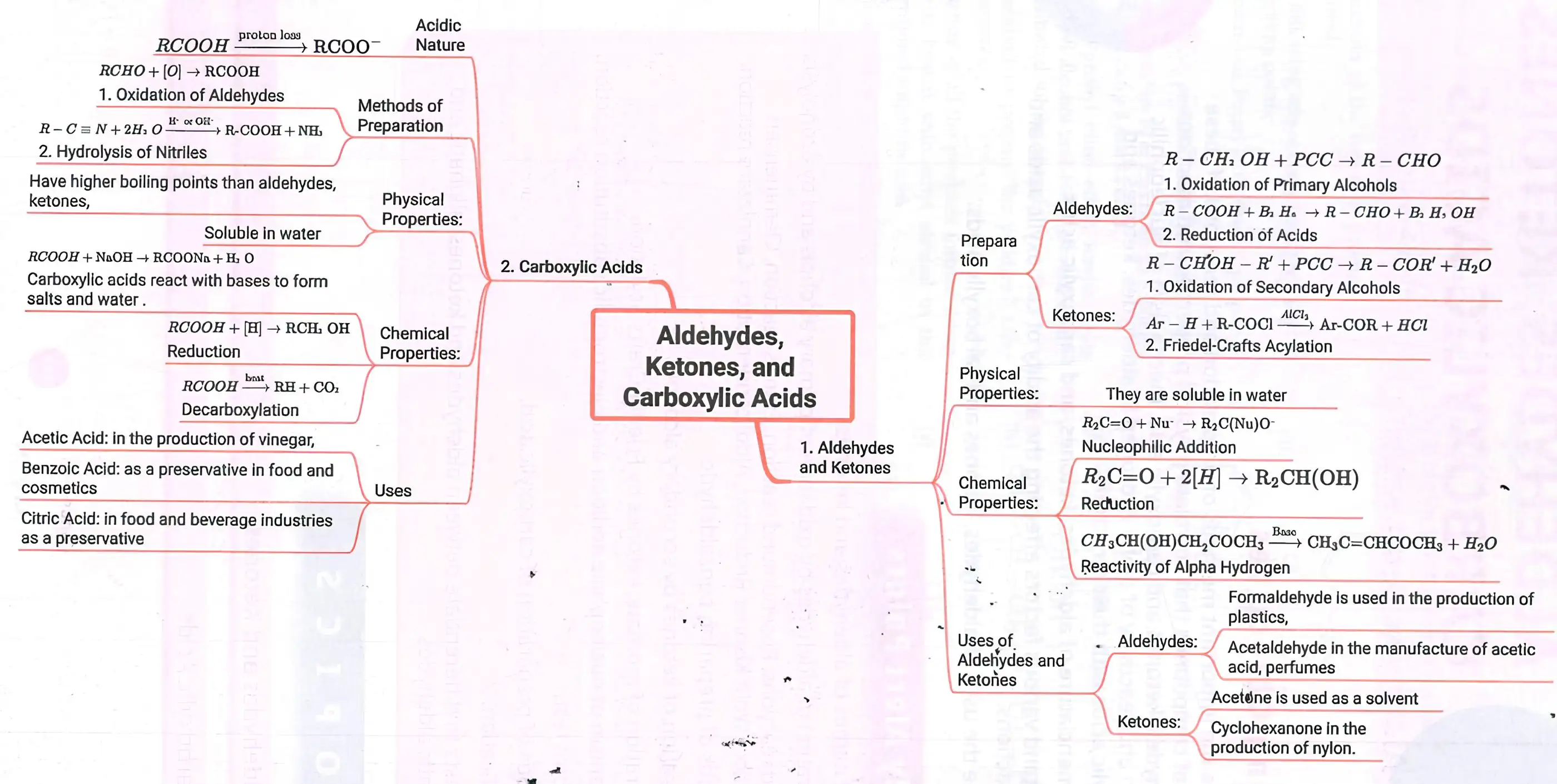
The carbonyl group (>C=O) is the functional group present in aldehydes and ketones. In aldehydes, the carbonyl carbon is attached to at least one hydrogen atom, while in ketones it is attached to two carbon atoms. Because of this, aldehydes have the general formula RCHO and ketones have the general formula RCOR′.
Nomenclature
Aldehydes are named by replacing the terminal 'e' of the corresponding alkane with 'al'. The carbonyl carbon of an aldehyde is always numbered as carbon 1, so the position need not be separately indicated. Ketones are named by replacing the terminal 'e' with 'one'. The position of the carbonyl group in ketones is indicated by a number, for example propanone and butan-2-one.
Preparation of Aldehydes
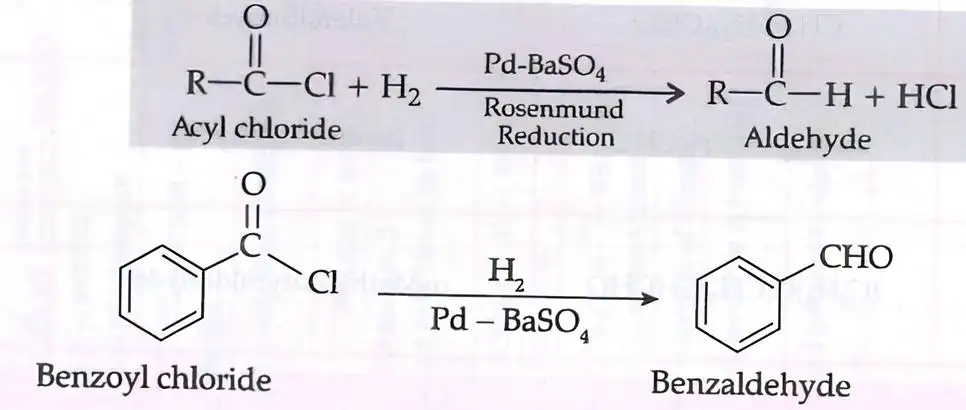
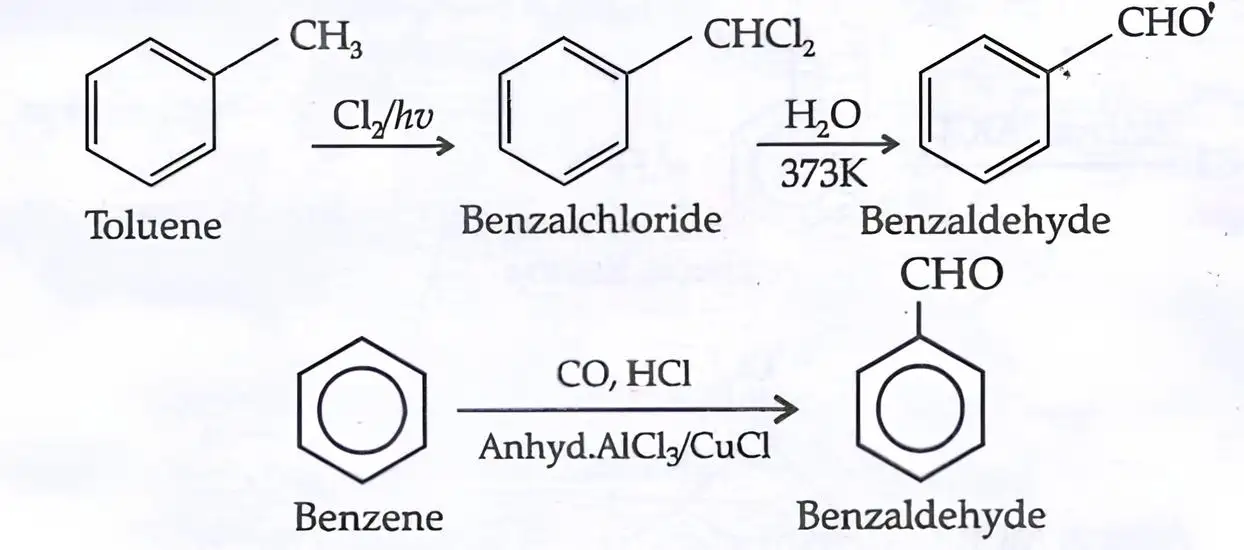
Aldehydes can be prepared by oxidation of primary alcohols, dehydrogenation of alcohols, ozonolysis of alkenes, hydration of alkynes, Rosenmund reduction of acyl chlorides, and reduction of nitriles and esters. Primary alcohols are usually oxidised under controlled conditions so that the aldehyde formed is not further oxidised to the acid.



Preparation of Ketones
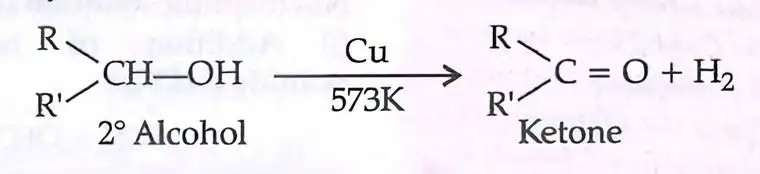
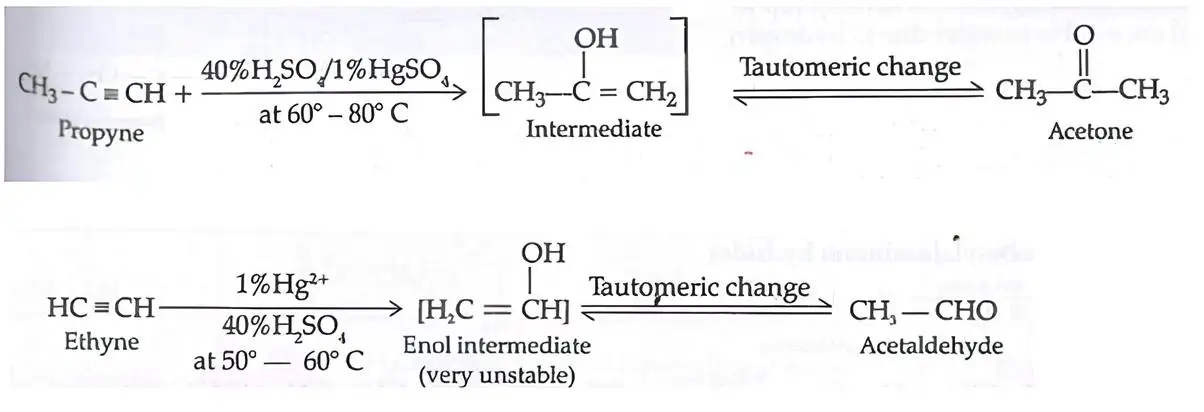
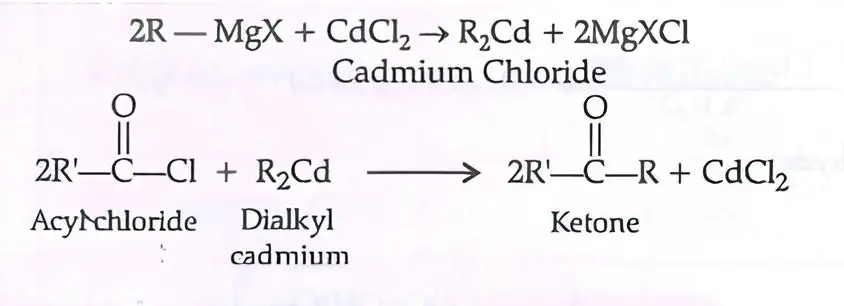
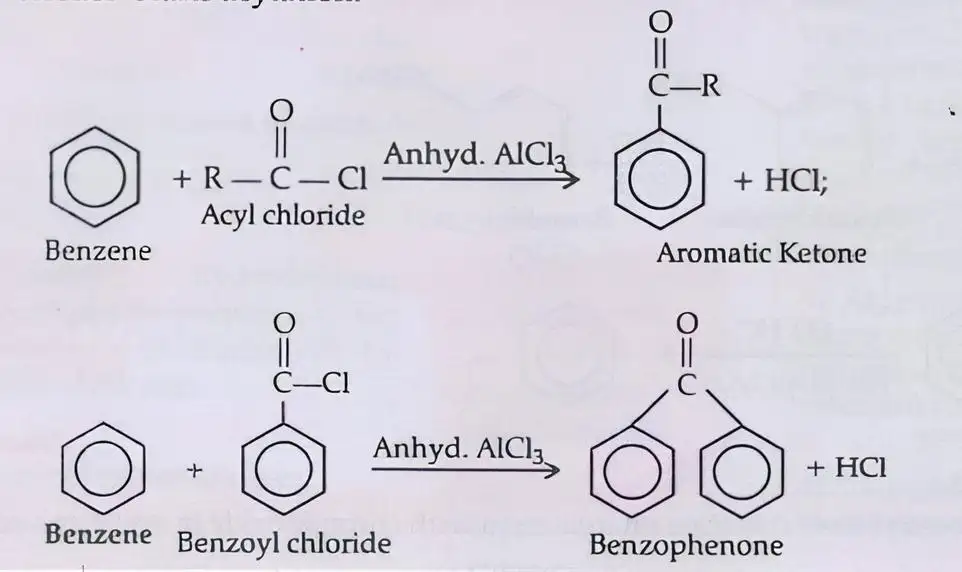
Ketones are prepared by oxidation of secondary alcohols, dehydrogenation of secondary alcohols, ozonolysis of alkenes, hydration of alkynes (Kucherov’s reaction), reaction of acyl chlorides with organocadmium compounds, and reaction of nitriles with Grignard reagents. Secondary alcohols on oxidation generally give ketones without further oxidation under ordinary conditions.



Physical Properties
Aldehydes and ketones are generally colorless liquids with pleasant smells. They have higher boiling points than hydrocarbons due to the polar carbonyl group but lower than alcohols because they do not form intermolecular hydrogen bonds with each other. Lower members are soluble in water due to hydrogen bonding with water molecules, and solubility decreases as the hydrocarbon part increases.
Chemical Properties
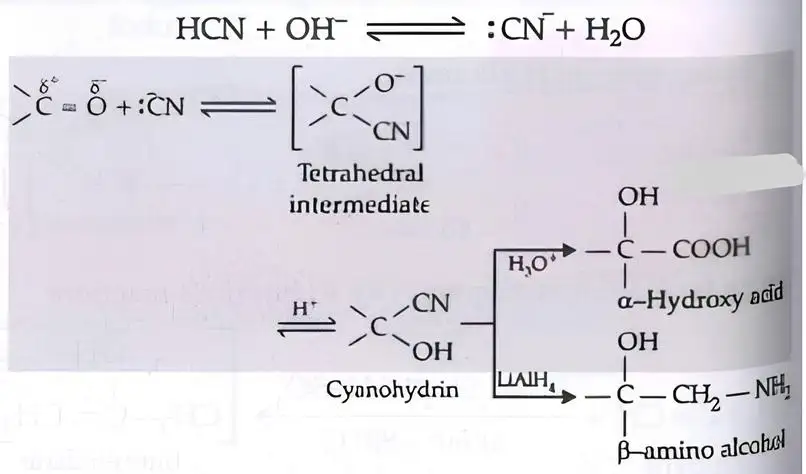
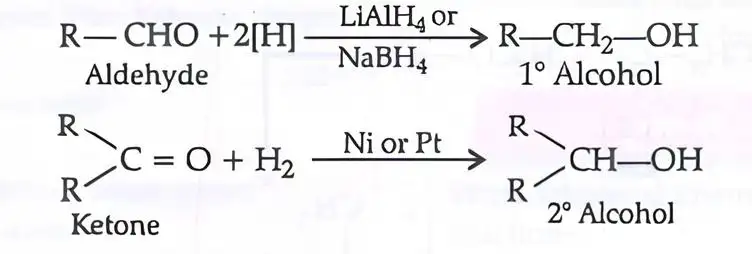
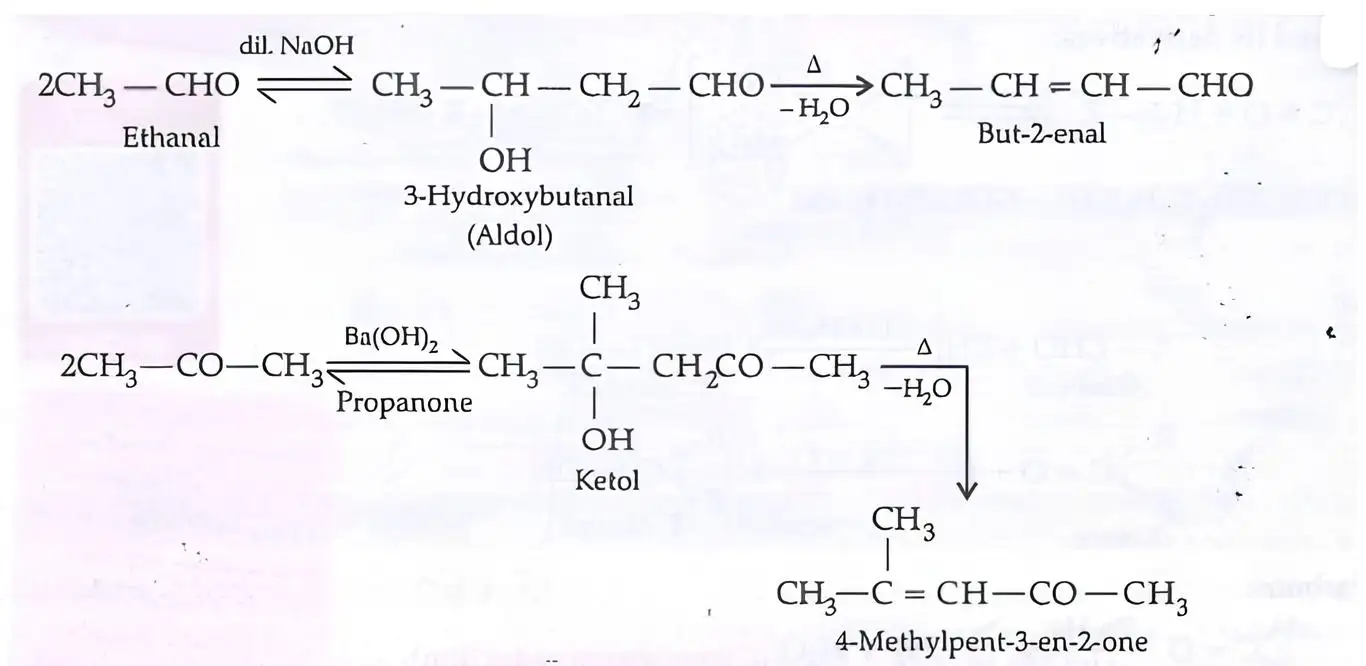
Aldehydes and ketones undergo nucleophilic addition reactions such as addition of hydrogen cyanide, sodium hydrogen sulphite, Grignard reagents, alcohols, and ammonia derivatives. They also undergo reduction to alcohols and hydrocarbons, oxidation (aldehydes to acids), aldol condensation, Cannizzaro reaction, and electrophilic substitution (aromatic aldehydes and ketones). Aldehydes are generally more reactive than ketones in nucleophilic addition because of less steric hindrance and the smaller +I effect of the alkyl groups.








Tests
Fehling’s test and Tollen’s test distinguish aldehydes from ketones. Iodoform test identifies methyl ketones and aldehydes with one alpha hydrogen. Aldehydes usually give a positive Fehling’s or Tollen’s test, while most ketones do not. In the iodoform test, a yellow precipitate of iodoform is formed.
Uses
Aldehydes and ketones are used as solvents, preservatives (formaldehyde), in perfumery (benzaldehyde), and for their characteristic odors and flavors (vanillin, camphor). Many are also important intermediates in the manufacture of dyes, drugs and other organic compounds.
Solved Examples
Example 1: Write the reaction for the preparation of benzaldehyde by the Etard reaction.
Solution:
Toluene reacts with chromium oxychloride (CrO₂Cl₂) in carbon disulfide (CS₂) to form a chromium complex, which on hydrolysis with acid gives benzaldehyde.
C₆H₅CH₃ + CrO₂Cl₂ → [Cr complex] → C₆H₅CHO
Example 2: Explain the Cannizzaro reaction with an example.
Solution:
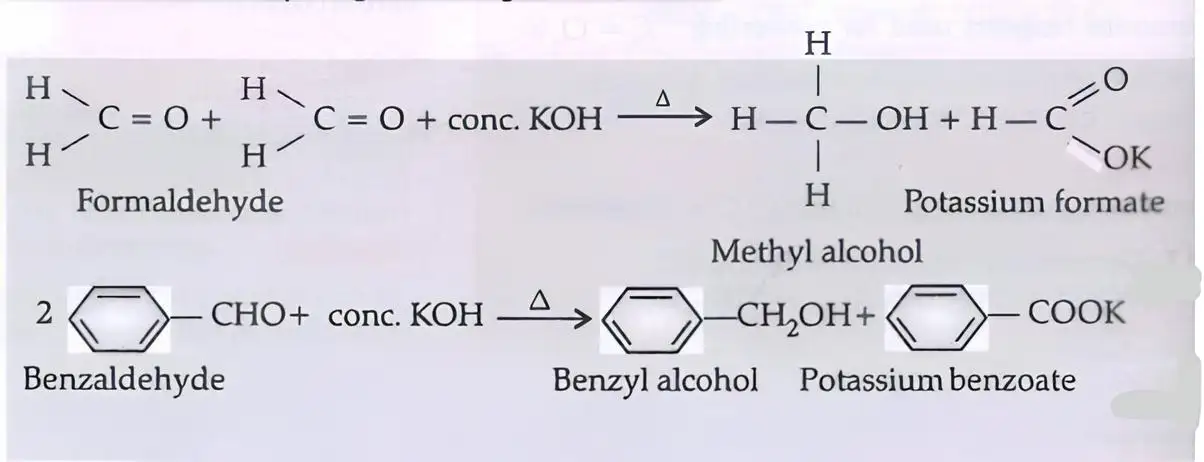
Aldehydes without alpha hydrogen undergo self-oxidation and reduction in the presence of concentrated alkali to give an alcohol and a carboxylate salt.
2 C₆H₅CHO + NaOH → C₆H₅CH₂OH + C₆H₅COONa
Practice Set
- Level 1: What is the functional group present in aldehydes and ketones?
- Level 1: Name the test used to distinguish aldehydes from ketones.
- Level 2: Write the reaction for the oxidation of a primary alcohol to an aldehyde.
- Level 3: Explain the mechanism of aldol condensation.
- Level 3: Calculate the amount of acetaldehyde formed by oxidation of 10 g of ethanol. (Molar mass of ethanol = 46 g/mol, acetaldehyde = 44 g/mol)
Answer Key
Level 1: The functional group is the carbonyl group (>C=O).
Level 1: Tollens’ test is used to distinguish aldehydes from ketones.
Level 2: Oxidation of primary alcohol:
RCH2OH + [O] → RCHO + H2O
Level 3: Aldol condensation involves the formation of an enolate ion from an aldehyde or ketone in the presence of dilute alkali, which then attacks another molecule of aldehyde or ketone to form β-hydroxy aldehyde or ketone, followed by dehydration to form α,β-unsaturated aldehyde or ketone.
Level 3 (Numerical):
Moles of ethanol = 10/46 = 0.217 mol
From the reaction, 1 mole of ethanol gives 1 mole of acetaldehyde.
Mass of acetaldehyde = 0.217 × 44 = 9.55 g
Carboxylic Acids

Structure and Nomenclature
Carboxylic acids contain the carboxyl group (-COOH), consisting of a carbonyl group (>C=O) and a hydroxyl group (-OH) attached to the same carbon atom. They are named by replacing the terminal 'e' of the alkane with 'oic acid'. In IUPAC nomenclature, the carboxyl carbon is always included in the parent chain and is numbered as carbon 1. Common examples are methanoic acid (HCOOH), ethanoic acid (CH3COOH) and propanoic acid (C2H5COOH). Dicarboxylic acids contain two -COOH groups and are named with the suffix 'dioic acid'.
Preparation Methods
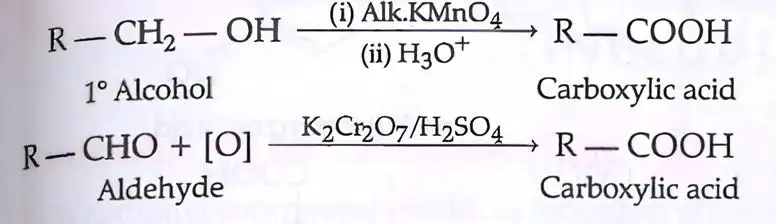
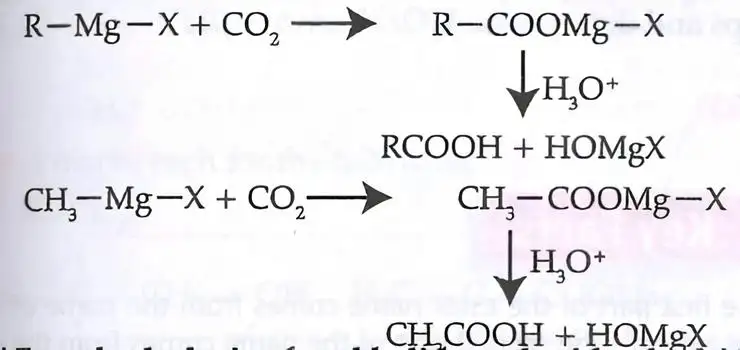
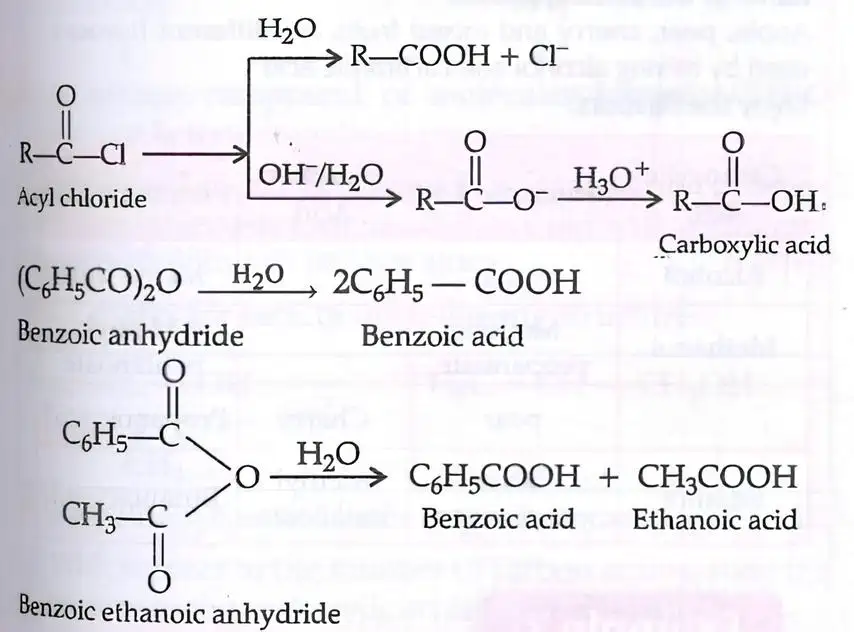
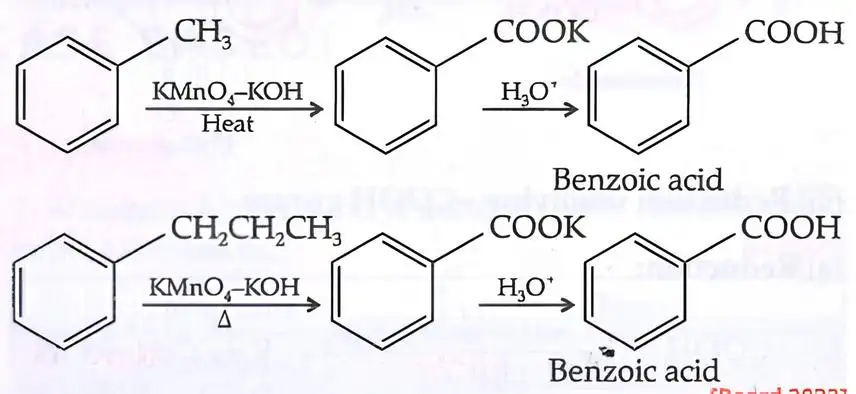
Carboxylic acids are prepared by oxidation of primary alcohols and aldehydes, hydrolysis of nitriles and amides, reaction of Grignard reagents with carbon dioxide, hydrolysis of acyl halides and acid anhydrides, hydrolysis of esters, and oxidation of alkylbenzenes. Primary alcohols and aldehydes generally give the corresponding acid on oxidation with strong oxidising agents such as acidified KMnO4 or K2Cr2O7. Nitriles on hydrolysis first form amides and then carboxylic acids. Grignard reagents react with dry CO2 to give magnesium carboxylates, which on acidification yield carboxylic acids with one extra carbon atom.

Physical Properties
Lower carboxylic acids are colorless liquids with pungent smell and are soluble in water due to hydrogen bonding. Higher acids are waxy solids and less soluble. They have higher boiling points due to intermolecular hydrogen bonding.
Chemical Properties
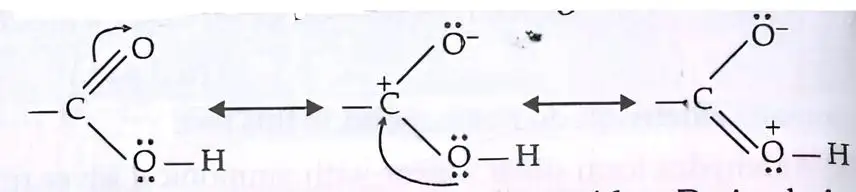
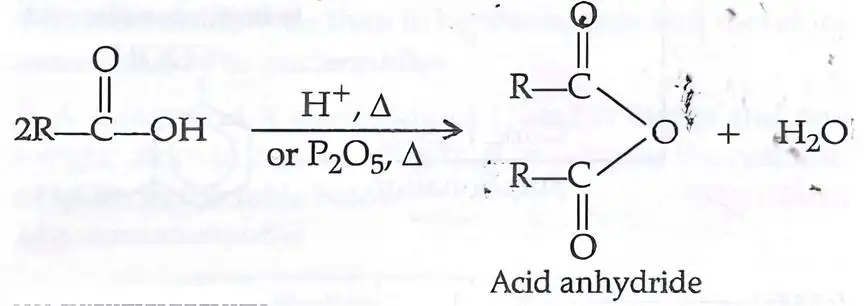
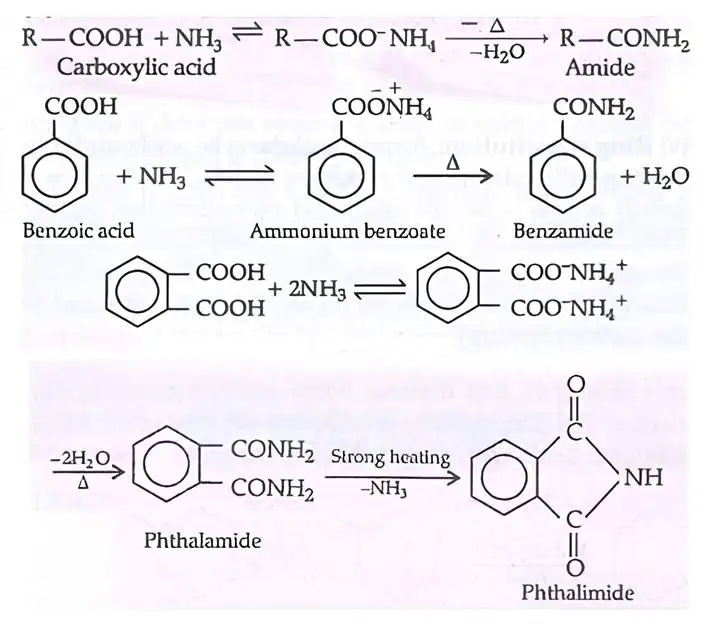
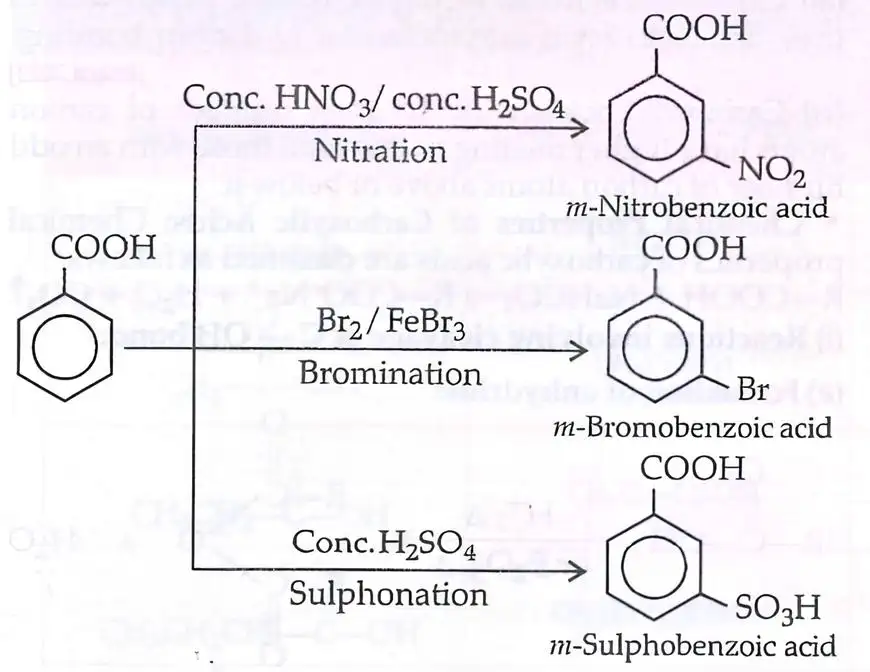
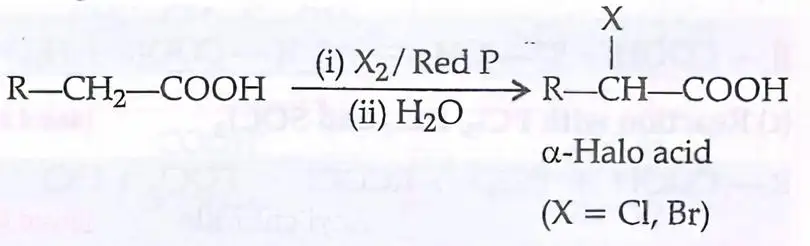
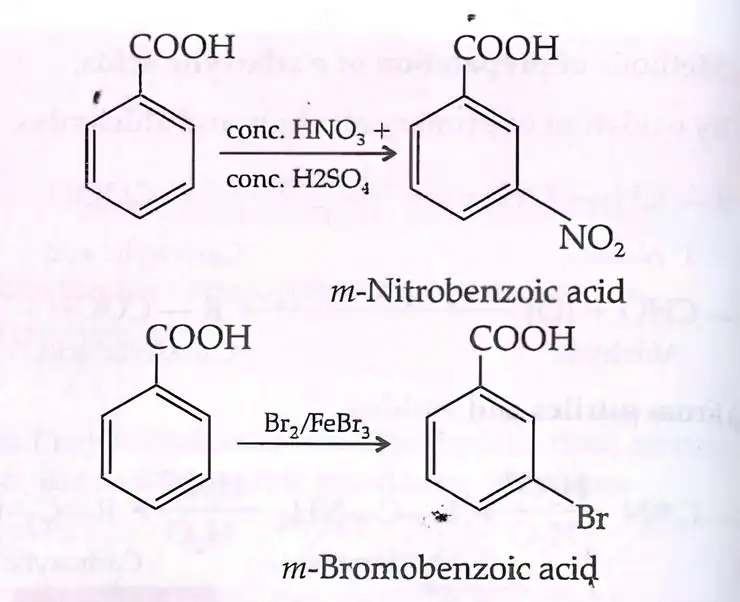
Carboxylic acids react by cleavage of C–OH bond (formation of anhydrides, esters, acyl chlorides), cleavage of O–H bond (reaction with metals and bases), reduction to alcohols, decarboxylation, electrophilic substitution on aromatic acids, halogenation (Hell-Volhard-Zelinsky reaction), and ring substitution. They are weak acids because the carboxylate ion is stabilised by resonance. The O–H bond shows acidic behaviour in reactions with active metals and bases such as Na, NaOH and NaHCO3. They undergo esterification with alcohols in the presence of concentrated H2SO4. On heating with soda lime, suitable carboxylic acids undergo decarboxylation to give alkanes with one carbon atom less. The Hell-Volhard-Zelinsky reaction causes α-halogenation of carboxylic acids containing an α-hydrogen atom. Aromatic carboxylic acids generally show meta-directing influence in electrophilic substitution.
Uses
Methanoic acid is used in rubber and textiles, ethanoic acid as vinegar and solvent, hexanedioic acid in nylon manufacture, esters in perfumery, sodium benzoate as food preservative, and higher fatty acids in soaps and detergents.
Solved Examples
Example 1: Write the reaction for the preparation of benzoic acid from toluene.
Solution:
Toluene is oxidized by potassium permanganate under basic conditions and then acidified to give benzoic acid.
C₆H₅CH₃ + KMnO₄ + OH⁻ → C₆H₅COOK + MnO₂ + H₂O
C₆H₅COOK + H₃O⁺ → C₆H₅COOH + K⁺ + H₂O
Example 2: Explain the Hell-Volhard-Zelinsky reaction.
Solution:
Carboxylic acids with alpha hydrogens react with halogens (Cl₂ or Br₂) in the presence of red phosphorus to form alpha-halo acids.
RCH₂COOH + X₂ + P → RCHXCOOH + HX
Practice Set
- Level 1: What is the functional group in carboxylic acids?
- Level 1: Name the reaction in which carboxylic acids react with alcohols to form esters.
- Level 2: Write the reaction for the preparation of carboxylic acid from nitriles.
- Level 3: Explain the mechanism of esterification.
- Level 3: Why do aromatic carboxylic acids not undergo Friedel-Crafts reactions?
Answer Key
Level 1: The functional group is the carboxyl group (-COOH).
Level 1: The reaction is called esterification.
Level 2: Hydrolysis of nitriles:
R-C≡N + 2H₂O + H₃O⁺ → R-COOH + NH₄⁺
Level 3: Esterification mechanism involves protonation of the carbonyl oxygen of the acid, nucleophilic attack by the alcohol oxygen, proton transfers, and loss of water to form the ester.
Level 3: Aromatic carboxylic acids do not undergo Friedel-Crafts reactions because the carboxyl group is deactivating and binds to the Lewis acid catalyst, preventing the reaction.
Quick Reference Table
- Carbonyl group: Aldehydes and ketones contain the carbonyl group (>C=O).
- Aldehyde structure: In aldehydes, the carbonyl carbon is attached to at least one hydrogen atom.
- Ketone structure: In ketones, the carbonyl carbon is attached to two carbon atoms.
- Aldehyde nomenclature: Replace the terminal 'e' of the corresponding alkane with 'al'.
- Ketone nomenclature: Replace the terminal 'e' of the corresponding alkane with 'one' and indicate the position of the carbonyl group by a number.
- Preparation of aldehydes: Primary alcohols, alkynes, acyl chlorides, nitriles and esters can be converted into aldehydes by suitable methods such as oxidation, dehydrogenation, ozonolysis, Rosenmund reduction and reduction.
- Preparation of ketones: Secondary alcohols, alkenes, alkynes, acyl chlorides and nitriles can be used to prepare ketones by oxidation, dehydrogenation, ozonolysis, Kucherov’s reaction and reactions with organocadmium or Grignard reagents.
- Physical properties: Aldehydes and ketones are generally colourless liquids with pleasant smells; they have higher boiling points than hydrocarbons but lower than alcohols.
- Solubility: Lower members are soluble in water because they can form hydrogen bonds with water.
- Nucleophilic addition: Hydrogen cyanide, sodium hydrogen sulphite, Grignard reagents, alcohols and ammonia derivatives add to the carbonyl group.
- Reduction: Aldehydes and ketones can be reduced to alcohols and hydrocarbons.
- Oxidation of aldehydes: Aldehydes are readily oxidised to carboxylic acids, whereas ketones are comparatively resistant to oxidation.
- Aldol condensation: Aldehydes and ketones having α-hydrogen atoms undergo aldol condensation in dilute alkali to form β-hydroxy compounds, which dehydrate to α,β-unsaturated compounds.
- Cannizzaro reaction: Aldehydes without α-hydrogen undergo disproportionation in concentrated alkali to give an alcohol and a carboxylate salt.
- Tests: Fehling’s test and Tollen’s test distinguish aldehydes from ketones; the iodoform test identifies methyl ketones and aldehydes with one α-hydrogen.
- Uses: Formaldehyde is used as a preservative, benzaldehyde in perfumery, and compounds like vanillin and camphor for flavour and odour.
Common Mistakes and Misconceptions
- Thinking the carbonyl group is just a C=O bond without noting that aldehydes have it at the end of the chain and ketones have it within the chain.
- Confusing aldehyde nomenclature with ketone nomenclature: aldehydes use the suffix -al, while ketones use -one.
- Forgetting that the position of the carbonyl group must be numbered in ketones when the chain has more than three carbon atoms.
- Assuming aldehydes and ketones have the same boiling points as alcohols; they are lower because they do not form intermolecular hydrogen bonds like alcohols.
- Believing all aldehydes and ketones are equally soluble in water; only the lower members are appreciably soluble due to hydrogen bonding with water.
- Mixing up Fehling’s test and Tollen’s test, both of which are used to distinguish aldehydes from ketones.
- Assuming ketones give a positive Tollen’s or Fehling’s test; in general, ketones do not oxidize easily under these conditions.
- Forgetting that the iodoform test is given by methyl ketones and also by aldehydes containing the CH3CO– group.
- Confusing aldol condensation with Cannizzaro reaction: aldol condensation occurs in aldehydes or ketones having α-hydrogen, while Cannizzaro reaction occurs with aldehydes without α-hydrogen.
- Thinking only aldehydes undergo oxidation easily; aldehydes are oxidized to carboxylic acids much more readily than ketones.
Glossary
- Aldehyde: An organic compound containing the carbonyl group at the end of the carbon chain, with at least one hydrogen attached to the carbonyl carbon.
- Ketone: An organic compound containing the carbonyl group between two carbon atoms.
- Carbonyl group: The functional group >C=O present in aldehydes and ketones.
- Oxo group: Another term used for the carbonyl group in some nomenclature systems.
- Primary alcohol: An alcohol in which the carbon bearing the -OH group is attached to one alkyl group or no alkyl groups.
- Secondary alcohol: An alcohol in which the carbon bearing the -OH group is attached to two alkyl groups.
- Rosenmund reduction: Reduction of acyl chlorides to aldehydes using hydrogen and a poisoned palladium catalyst.
- Etard reaction: Oxidation of toluene to benzaldehyde using chromium oxychloride.
- Cannizzaro reaction: Self oxidation-reduction of aldehydes without α-hydrogen in concentrated alkali to give an alcohol and a carboxylate salt.
- Hell-Volhard-Zelinsky reaction: α-Halogenation of carboxylic acids having α-hydrogen in the presence of halogen and red phosphorus.