CLASS 12-HUMANITIES . GEOGRAPHY . FUNDAMENTALS OF HUMAN GEOGRAPHY . TERTIARY AND-QUATERNARY-ACTIVITES
Chapter 6 : Tertiary And Quaternary Activites
Ch 6
GEOGRAPHY
CLASS 12-HUMANITIES
Tertiary Activities
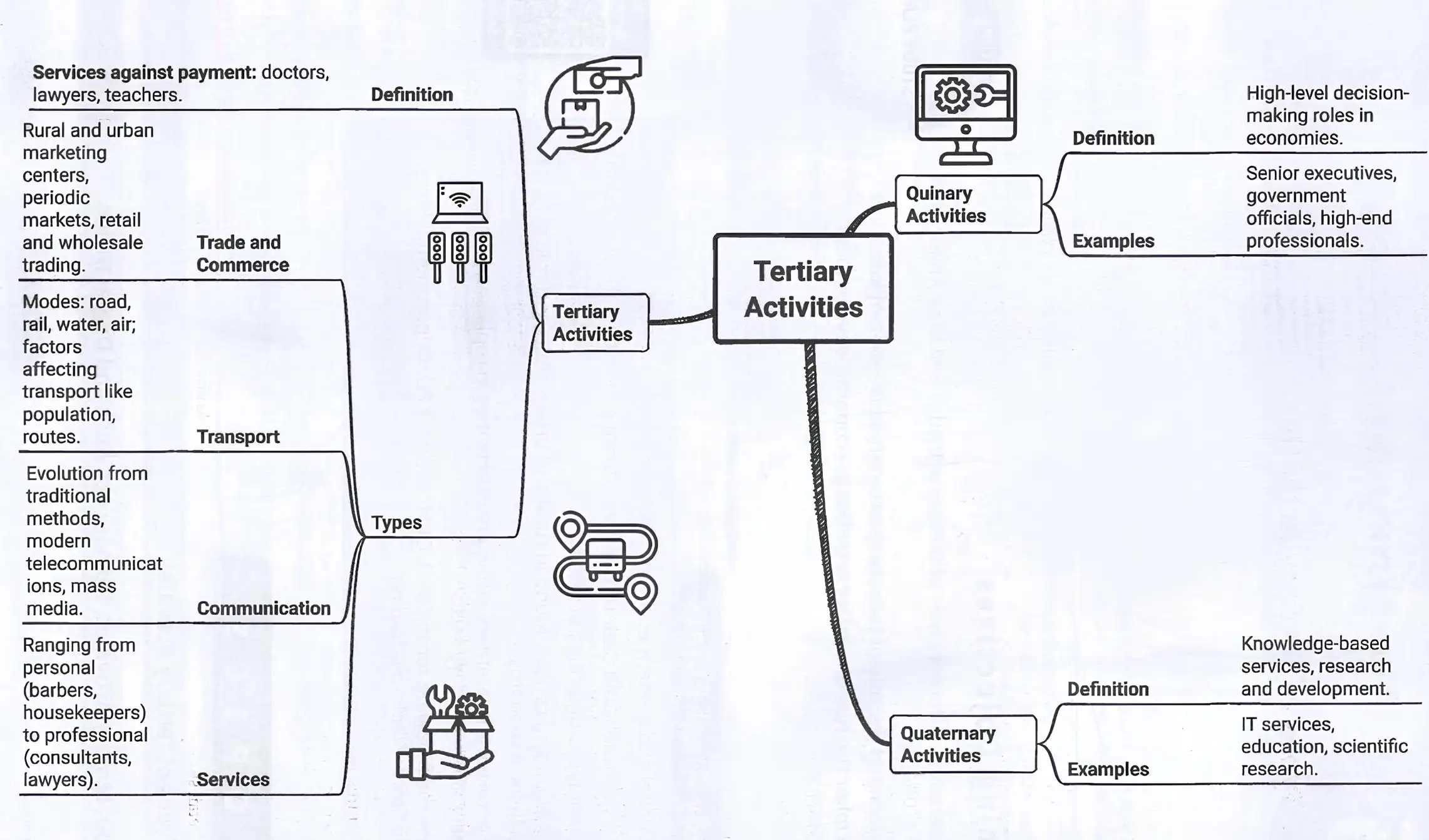
Tertiary activities refer to the service sector of the economy where services are provided rather than goods produced. These activities include professions such as doctors, teachers, lawyers, and other service providers who offer their skills in exchange for payment. The tertiary sector plays a crucial role in the economic development of a country by facilitating trade, transport, communication, and various personal and professional services.
Tertiary activities involve both production and exchange of services, with output measured indirectly through wages and salaries. They do not involve the processing of physical raw materials but focus on commercial output of services. Trading centres, both rural and urban, are important hubs for these activities. Rural marketing centres serve nearby settlements and often operate periodic markets, while urban centres provide a wider range of specialized goods and services.
Transport and communication are vital components of tertiary activities. Efficient transport systems support production, distribution, and consumption of goods, while communication services transmit information over distances through electronic means such as telephones, radio, television, and the internet. Tourism is a significant tertiary activity, contributing substantially to employment and GDP, and includes specialized forms like medical tourism.
Types of Tertiary Activities
Tertiary activities encompass a wide range of services provided by skilled professionals. These include health, education, law, governance, recreation, and more. The sector relies heavily on skilled labour and professional expertise.
Trade involves buying and selling goods produced elsewhere and occurs in trading centres. Rural trading centres are quasi-urban and often hold periodic markets, while urban centres offer both ordinary and specialized goods and services. Wholesale trading involves bulk transactions through intermediaries rather than retail stores.
Transport services satisfy the need for mobility and are essential for economic activities. Communication services facilitate the transmission of messages and information, with modern telecommunications revolutionizing global communication.
Personal services range from low-order services like grocery shops and laundries to high-order specialized services such as those provided by accountants and physicians. Tourism, a major tertiary activity, supports infrastructure growth and related industries.
Exam Questions
Q1: What are tertiary activities and why are they important for economic development?
Answer: Tertiary activities are service-based economic activities that involve providing services rather than producing goods. They are important because they support trade, transport, communication, and other services essential for the functioning and growth of the economy.
Q2: Differentiate between rural and urban trading centres.
Answer: Rural trading centres are quasi-urban centres that serve nearby settlements and often have periodic markets. Urban trading centres are more specialized, providing a wider range of goods and services to a larger population.
Quaternary Activities, Quinary Activities and Digital Divide
Quaternary and quinary activities are advanced segments of the service sector focused on knowledge and decision-making. Quaternary activities involve research, development, information collection, production, and dissemination. They require specialized knowledge, technical skills, and administrative competence.
Quinary activities represent the highest level of decision-making and include senior executives, government officials, research scientists, and consultants. These roles focus on creating, rearranging, and interpreting ideas and technologies.
Outsourcing is the practice of contracting work to external agencies to improve efficiency and reduce costs. When this work is transferred overseas, it is called off-shoring. Common outsourced activities include IT, human resources, customer support, and sometimes manufacturing.
The benefits of information and communication technology (ICT) development are unevenly distributed globally, leading to a digital divide. Developed countries have advanced rapidly, while developing countries lag behind in access to digital technologies.
Exam Questions
Q1: What are quaternary activities and how do they differ from tertiary activities?
Answer: Quaternary activities are knowledge-based services involving research, information processing, and development, whereas tertiary activities include general service provision like trade, transport, and communication.
Q2: Explain the concept of digital divide.
Answer: The digital divide refers to the gap between countries or regions in access to information and communication technologies, where developed countries have better access compared to developing countries.
Solved Examples
Example 1: Identify the main types of tertiary activities and give examples.
Solution: The main types of tertiary activities include trade and commerce (markets, retail stores), transport (road, rail, air), communication (telephones, internet), and services (healthcare, education, legal services).
Example 2: Describe the role of outsourcing in the modern economy.
Solution: Outsourcing allows businesses to contract out certain functions to external agencies, often in countries with cheaper skilled labour, to reduce costs and improve efficiency. It includes IT services, customer support, and manufacturing.
Practice Set
Easy
- Define tertiary activities.
- What is a periodic market?
Moderate
- Explain the difference between wholesale and retail trading.
- What are the main components of communication services?
Challenging
- Discuss the impact of the digital divide on developing countries.
- How do quinary activities contribute to economic growth?
Answer Key
- Define tertiary activities: Service-based economic activities providing services rather than goods.
- What is a periodic market? A market held at regular intervals in rural areas where no permanent market exists.
- Difference between wholesale and retail trading: Wholesale trading involves bulk sales through intermediaries; retail trading involves selling goods directly to consumers.
- Main components of communication services: Transmission of information via telephones, radio, television, internet, and other electronic means.
- Impact of digital divide: Limits access to technology and information in developing countries, hindering economic and social development.
- Contribution of quinary activities: High-level decision making and innovation that drive policy and economic growth.
Quick Reference
- Tertiary Activities: Service sector activities including trade, transport, communication, and services.
- Quaternary Activities: Knowledge-based services like research and information processing.
- Quinary Activities: High-level decision making and executive roles.
- Outsourcing: Contracting work to external agencies to reduce costs.
- Digital Divide: Gap in access to digital technologies between developed and developing countries.
Glossary
- Tertiary Activities: Economic activities that provide services rather than goods.
- Trading Centres: Places where buying and selling of goods and services occur.
- Telecommunication: Transmission of information over distances by electronic means.
- Tourism: Travel for recreation and leisure purposes.
- Quaternary Activities: Services involving knowledge and information processing.
- Quinary Activities: Services involving high-level decision making.
- Outsourcing: Contracting work to external agencies.
- Digital Divide: Inequality in access to digital technology.
| Time Period / Year | Event / Change | Importance |
|---|---|---|
| Pre-Industrial Era | Dominance of primary and secondary activities | Economy based on agriculture and manufacturing |
| Industrial Revolution | Growth of secondary sector and beginning of tertiary services | Shift towards manufacturing and service industries |
| 20th Century | Expansion of tertiary sector and emergence of quaternary activities | Knowledge-based services become important for economic growth |
| Late 20th Century | Rise of quinary activities and outsourcing | High-level decision making and global business processes |
| 21st Century | Digital divide becomes prominent | Unequal access to ICT affects global development |