CLASS 12-HUMANITIES . ECONOMICS . INDIAN ECONOMIC DEVELOPMENT . EMPLOYMENT GROWTH-INFORMALISATION-AND-OTHER-ISSUES
Chapter 6 : Employment : Growth, Informalisation And Other Issues
Ch 6
ECONOMICS
CLASS 12-HUMANITIES
Employment
Concept Explanation: Employment refers to the situation where a worker is engaged in some productive activity to earn a living. It is a key indicator of economic health and labor market conditions.
Key Definitions / Features:
- Employment: Engagement in productive work for earning livelihood.
- Labour Supply: The amount of labor willing to work at a given wage rate.
- Participation Rate: The ratio of total workforce to total population, expressed as a percentage.
Examples: The Mahatma Gandhi National Rural Employment Guarantee Act (MGNREGA) launched in 2006, first implemented in Uttar Pradesh, is a government scheme aimed at providing employment.
Practice Set:
- Level 1: Define employment and labour supply.
- Level 2: Explain the significance of participation rate in the labor market.
- Level 3: Discuss the impact of MGNREGA on rural employment.
Answer Key:
- Employment is the engagement in productive work for earning livelihood.
- Labour supply is the amount of labor willing to work at a given wage rate.
- Participation rate indicates the active portion of the population engaged in work.
- MGNREGA provides guaranteed employment to rural households, reducing unemployment and poverty.
Quick Reference: Employment → Productive work; Labour Supply → Willingness to work; Participation Rate = (Total Workforce / Total Population) × 100.
Glossary:
- MGNREGA: Mahatma Gandhi National Rural Employment Guarantee Act.
- Participation Rate: Percentage of population engaged in work.
Types of Workers
Concept Explanation: Workers are classified based on their employment status and nature of work.
Key Definitions / Features:
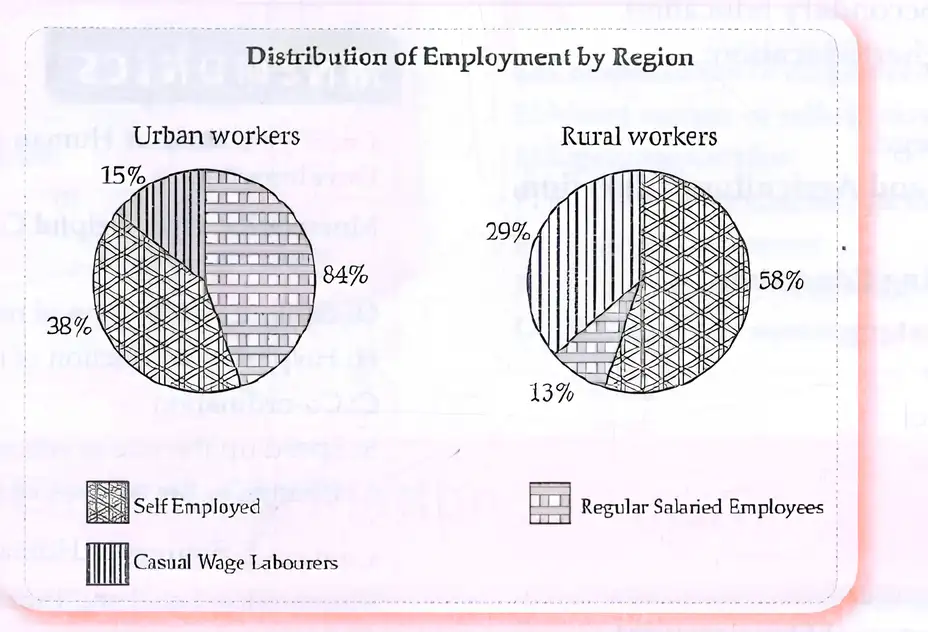
- Self-Employed Labour: Workers who use their own resources to earn a living by operating their own enterprise.
- Hired Workers: Workers employed by others for wages or salaries, subdivided into:
- Casual Workers: Employed on a non-permanent basis without social security benefits.
- Regular Workers: Employed on a permanent basis with job security.
Examples: A farmer running his own farm is self-employed; a factory worker on a permanent contract is a regular worker.
Practice Set:
- Level 1: Differentiate between self-employed and hired workers.
- Level 2: Explain the difference between casual and regular workers.
- Level 3: Analyze the implications of casual employment on worker security.
Answer Key:
- Self-employed workers own and operate their enterprise; hired workers work for others.
- Casual workers lack job security and benefits; regular workers have permanent employment.
- Casual employment leads to income instability and lack of social security.
Quick Reference: Self-employed = Own enterprise; Hired = Employed by others; Casual = Temporary; Regular = Permanent.
Glossary:
- Self-Employed: Independent workers using own resources.
- Casual Worker: Temporary worker without job security.
- Regular Worker: Permanent employee with benefits.
Size of Workforce in India
Concept Explanation: The workforce size indicates the number of people engaged in economic activities, categorized by gender, area, and sector.
Key Definitions / Features:
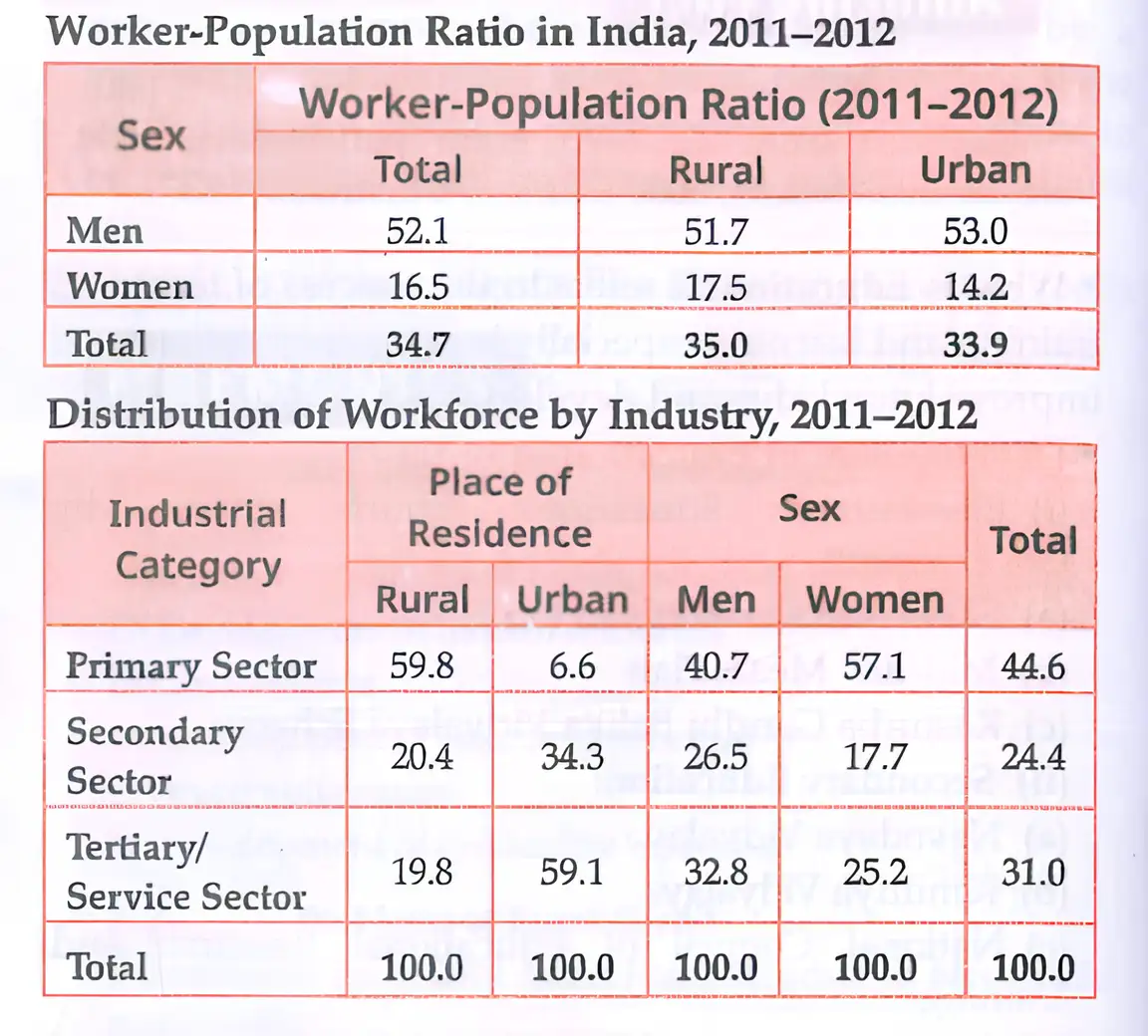
- Worker-Population Ratio: Percentage of people working in a group.
- Sector-wise Distribution: Employment divided into primary (agriculture), secondary (manufacturing), and tertiary (services) sectors.
- Participation Rate: Aggregate participation rate in India is approximately 39%, with rural areas slightly higher than urban.
Examples: In 2011-2012, men had a worker-population ratio of about 52%, women about 16.5%. Rural areas had more workers in primary sector; urban areas had more in secondary and tertiary sectors.
Practice Set:
- Level 1: Define worker-population ratio.
- Level 2: Describe sector-wise employment distribution in India.
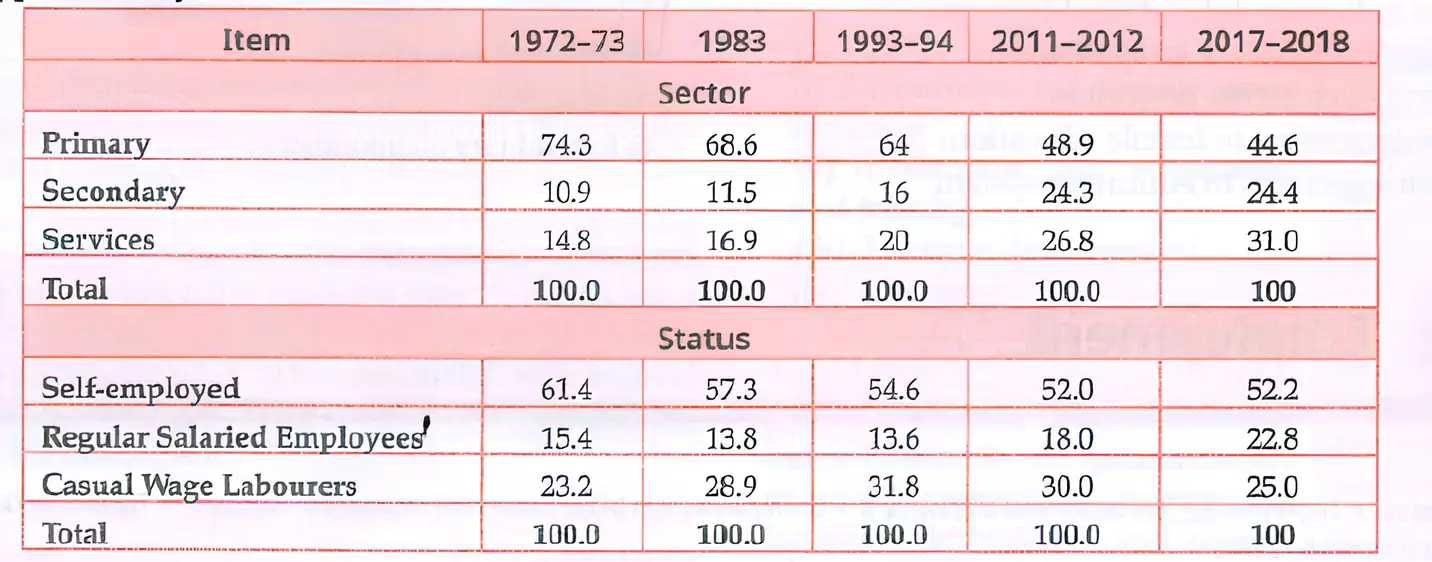
- Level 3: Analyze trends in workforce distribution from 1972 to 2018.
Answer Key:
- Worker-population ratio is the percentage of working people in a group.
- Primary sector employs more rural workers; secondary and tertiary sectors employ more urban workers.
- Over time, employment shifted from primary to secondary and tertiary sectors; self-employment decreased, regular salaried jobs increased.
Quick Reference: Workforce = Primary + Secondary + Tertiary sectors; Participation Rate ≈ 39%.
Glossary:
- Primary Sector: Agriculture and allied activities.
- Secondary Sector: Manufacturing and industry.
- Tertiary Sector: Services.
Jobless Growth
Concept Explanation: Jobless growth occurs when economic growth is driven by technology improvements but does not increase employment or labor participation.
Key Definitions / Features:
- Economic growth without corresponding increase in employment.
- Often due to automation and capital-intensive technologies.
Examples: A factory increasing output through machines but reducing the number of workers.
Practice Set:
- Level 1: Define jobless growth.
- Level 2: Explain causes of jobless growth.
- Level 3: Discuss the social implications of jobless growth.
Answer Key:
- Jobless growth is growth without employment increase.
- Caused by technology replacing labor.
- Leads to unemployment and social inequality.
Quick Reference: Growth ≠ Employment increase = Jobless growth.
Glossary:
- Jobless Growth: Economic growth without employment growth.
Unemployment
Concept Explanation: Unemployment is the condition where a person willing and able to work does not get employment at the prevailing wage rate.
Key Definitions / Features:
- Wage Rate: Payment rate to workers.
- Types of Unemployment in India: Rural - open and disguised unemployment; Urban - industrial, educated, and technological unemployment.
- Adverse Effects: Economic (waste of human power, poverty), social (inequality, political instability).
Causes:
- General: Rapid population growth, slow development, inadequate planning.
- Specific: Seasonal agriculture, shortage of capital and education, social status.
Measures to Reduce Unemployment:
- General: Population control, investment increase, manpower planning, social reforms.
- Specific: Rural industrialization, agricultural reforms, small industries, practical education.
- Government Schemes: MGNREGA, Skill India Mission, Start-up India.
Practice Set:
- Level 1: Define unemployment and wage rate.
- Level 2: List causes of unemployment in India.
- Level 3: Evaluate government measures to reduce unemployment.
Answer Key:
- Unemployment is lack of work despite willingness and ability.
- Causes include population growth, slow development, seasonal agriculture.
- Measures include population control, investment, rural industrialization, and employment schemes.
Quick Reference: Unemployment = Willingness to work without job; Causes = Population, development; Measures = Planning, schemes.
Glossary:
- Unemployment: Lack of employment despite willingness.
- MGNREGA: Employment guarantee scheme.
Example: Underemployment
Concept Explanation: Underemployment occurs when a person works less than desired or capable hours.
Example: Henry works only 3 hours a day but seeks work for the rest of the day, making him underemployed.
Solution Steps:
- Henry is unemployed for the majority of the day, thus underemployed.
- Underemployment means working less than desired hours.
- According to National Sample Survey, working less than 28 hours a week is underemployment.
- Henry could do part-time jobs like courier delivery or bank teller work.
Practice Set:
- Level 1: Define underemployment.
- Level 2: Explain Henry's employment status.
- Level 3: Suggest suitable jobs for underemployed workers.
Answer Key:
- Underemployment is working fewer hours than desired.
- Henry is underemployed as he works only 3 hours daily.
- Suitable jobs include part-time or casual work.
Quick Reference: Underemployment = Insufficient work hours.
Glossary:
- Underemployment: Working less than desired hours.