CLASS 12-COMMERCE . BUSINESS STUDIES . BUSINESS STUDIES PART I . PRINCIPLES OF-MANAGEMENT
Chapter 2 : PRINCIPLES OF MANAGEMENT
Ch 2
BUSINESS STUDIES
CLASS 12-COMMERCE
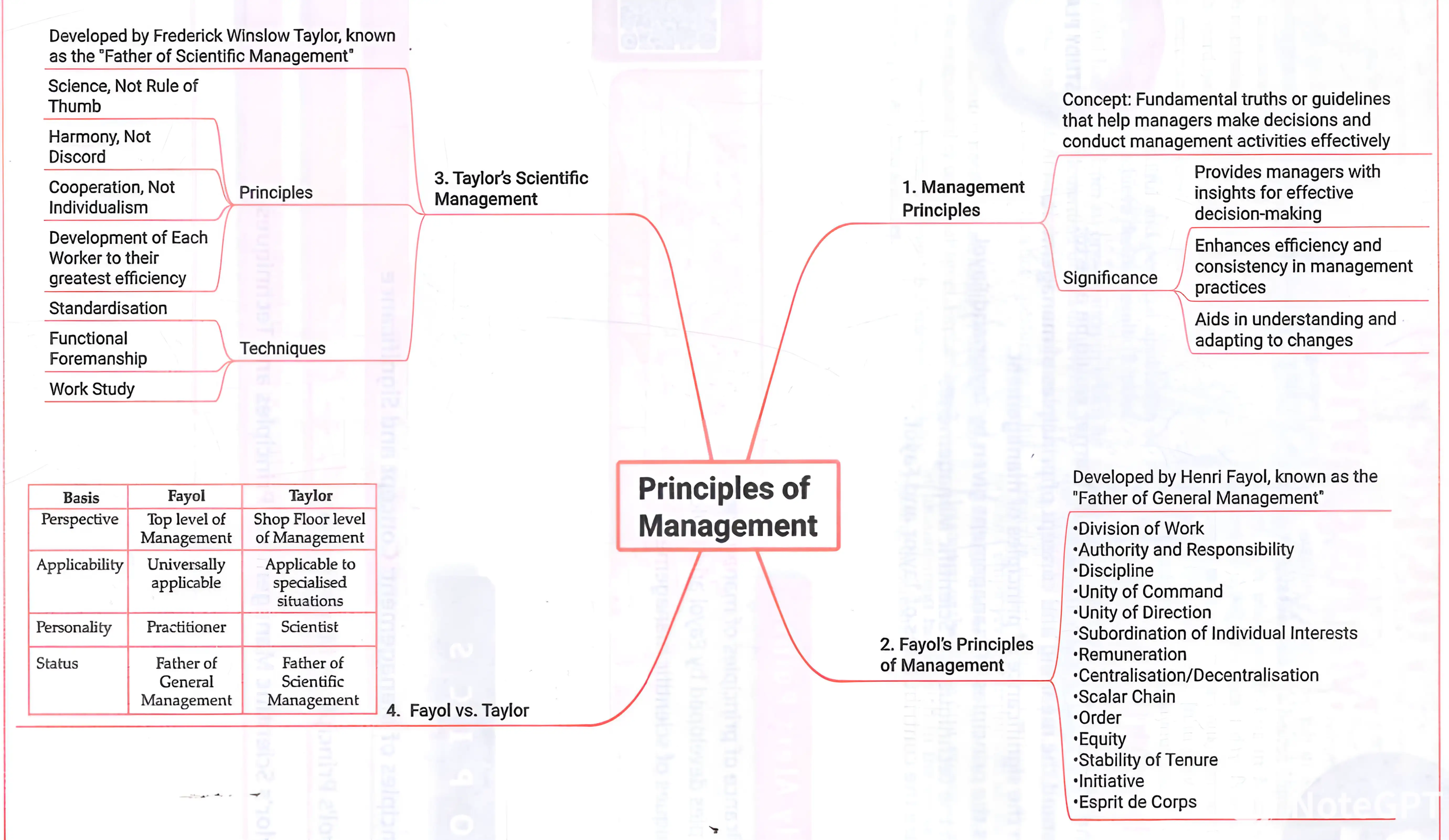
Principles of Management: Concept and Significance
Concept Explanation: Principles of management are broad and general guidelines that help managers make decisions and take actions effectively in an organization. They serve as a foundation for managerial decision-making and behaviour.
Key Definitions / Features:
- Universal applicability: Principles apply to all types of organizations regardless of size, nature, or objectives.
- Formed by practice and experience: Developed through experimentation, experience, and collective managerial wisdom.
- General guidelines: Provide guidance but are not rigid rules; they do not offer ready-made solutions.
- Flexible: Can be adapted by managers according to specific situations.
- Behavioural focus: Aim to influence human behaviour within organizations.
- Cause and effect relationship: Applying a principle in a situation leads to predictable outcomes.
- Contingent: Use depends on the prevailing circumstances.
Significance of Principles of Management:
- Provide managers with useful insights into real-world situations, enhancing efficiency.
- Help in optimum utilization of resources and effective administration by reducing trial and error.
- Enable scientific decision-making based on logic and objective assessment.
- Allow adaptation to changing environments.
- Help fulfill social responsibilities of organizations.
- Form the basis for management training, education, and research.
Practice Set:
- Level 1: Define principles of management and list their features.
- Level 2: Explain the significance of principles of management with examples.
- Level 3: Discuss how principles of management can be adapted to meet changing business environments.
Answer Key:
Answers should include definitions, features such as universality and flexibility, and significance points like scientific decision-making and resource optimization with relevant examples.
Quick Reference: Principles guide managerial decisions, are flexible, universal, behavioural, and contingent.
Glossary:
- Contingent: Dependent on specific conditions or situations.
- Trial and Error: Problem-solving method involving multiple attempts to find a solution.
- Social Responsibility: Obligation to act for the benefit of society.
Fayol's Principles of Management
Concept Explanation: Henri Fayol developed 14 principles of management that provide a framework for effective organizational management, focusing on administrative and managerial functions.
Key Principles:
- Division of Work: Specialization increases efficiency by assigning specific tasks to skilled workers.
- Authority and Responsibility: Authority to give orders must be balanced with responsibility.
- Discipline: Obedience to organizational rules is essential for smooth functioning.
- Unity of Command: Each employee should receive orders from only one superior.
- Unity of Direction: Activities with the same objective should be directed by one manager using one plan.
- Subordination of Individual Interest: Organizational interests take precedence over individual interests.
- Remuneration: Fair pay to employees and the organization.
- Centralisation and Decentralisation: Balance between decision-making authority and subordinate involvement.
- Scalar Chain: Clear chain of command from top to bottom; 'Gang Plank' allows direct communication in emergencies.
- Order: Proper arrangement of people and materials for efficiency.
- Equity: Fair and kind treatment of employees.
- Stability of Personnel: Minimize employee turnover for organizational efficiency.
- Initiative: Encourage employees to take initiative in planning and execution.
- Esprit de Corps: Promote team spirit and harmony.
Illustrative Examples:
- Assembly line workers specialize in tasks to increase efficiency (Division of Work).
- Construction workers report to one supervisor to avoid confusion (Unity of Command).
- Warehouse organizes inventory systematically for easy access (Order).
- Hospital nurses communicate patient updates through a clear chain of command (Scalar Chain).
Practice Set:
- Level 1: List any five principles of Fayol with brief explanations.
- Level 2: Explain the importance of unity of command and scalar chain with examples.
- Level 3: Analyze how centralisation and decentralisation affect decision-making in organizations.
Answer Key:
Answers should cover definitions, explanations, and examples illustrating each principle's application.
Quick Reference: Fayol’s 14 principles guide managerial functions focusing on structure, authority, and employee relations.
Glossary:
- Scalar Chain: The formal line of authority in an organization.
- Centralisation: Concentration of decision-making authority at the top levels.
- Decentralisation: Delegation of decision-making authority to lower levels.
Taylor’s Scientific Management: Principles and Techniques
Concept Explanation: Frederick Taylor introduced Scientific Management to improve worker efficiency through scientific study and analysis, replacing traditional trial and error methods.
Principles of Scientific Management:
- Science, not rule of thumb: Use scientific methods for decision-making.
- Harmony, not discord: Foster cooperation between management and workers.
- Co-operation, not individualism: Replace competition with teamwork.
- Development of each person: Scientific selection and training to maximize efficiency and prosperity.
Mental Revolution: A change in attitude where management and workers cooperate rather than compete, promoting trust and shared goals.
Techniques of Scientific Management:
- Functional Foremanship: Separate planning and execution functions with specialized foremen.
- Standardisation and Simplification: Set standards and eliminate unnecessary variety.
- Method Study: Identify the best way to perform a job.
- Motion Study: Eliminate wasteful movements.
- Time Study: Determine standard time for tasks.
- Fatigue Study: Determine rest intervals to maintain efficiency.
- Differential Piece Wage System: Different wage rates for efficient and inefficient workers.
Practice Set:
- Level 1: Define the principle of 'Science, not rule of thumb' with an example.
- Level 2: Explain the concept of mental revolution and its importance.
- Level 3: Discuss the techniques of scientific management and how they improve productivity.
Answer Key:
Answers should include definitions, explanations of mental revolution, and detailed descriptions of techniques with examples.
Quick Reference: Taylor’s Scientific Management emphasizes scientific methods, cooperation, and worker development.
Glossary:
- Mental Revolution: Change in attitude promoting cooperation between management and workers.
- Functional Foremanship: Division of supervisory roles for planning and execution.
- Differential Piece Wage System: Wage system rewarding efficiency.