CLASS 12-COMMERCE . BUSINESS STUDIES . BUSINESS STUDIES PART I . NATURE AND-SIGNIFICANCE-OF-MANAGEMENT
Chapter 1 : NATURE AND SIGNIFICANCE OF MANAGEMENT
Ch 1
BUSINESS STUDIES
CLASS 12-COMMERCE
Introduction to Management
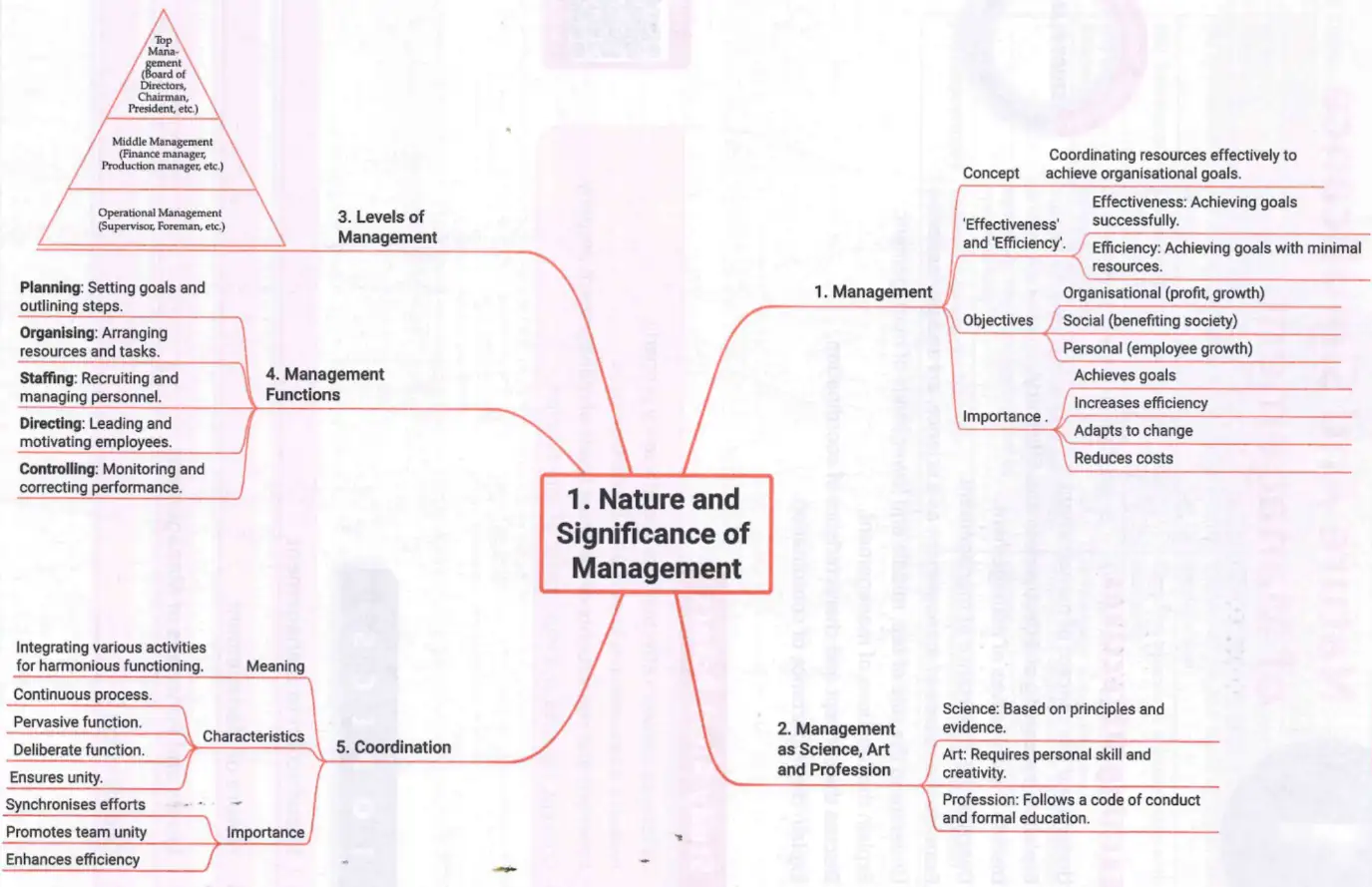
Concept Explanation: Management is the process of planning, organising, staffing, directing, and controlling the resources of an enterprise efficiently and effectively to achieve organisational goals.
Key Definitions / Features:
- Effectiveness vs Efficiency: Effectiveness means doing the right things (focus on end results), while efficiency means doing things the right way (minimum cost and resources).
- Characteristics of Management:
- Goal-Oriented Process: Integrates efforts to achieve goals.
- Dynamic: Adapts to changing business environment.
- Intangible: Cannot be seen but its effects are visible.
- Group Activity: Involves coordinated efforts of people.
- All Pervasive: Present in all organisations and departments.
- Multi-dimensional: Manages work, people, and operations.
- Continuous Process: Involves ongoing functions like planning, organising, staffing, directing, and controlling.
Objectives of Management:
- Social Objectives: Create economic value for society.
- Organisational Objectives: Efficient use of resources for survival, profit, and growth.
- Personal Objectives: Align personal goals with organisational goals.
Importance of Management:
- Helps achieve group goals by providing direction.
- Increases efficiency by reducing costs and improving productivity.
- Creates a dynamic organisation adaptable to change.
- Helps individuals achieve personal objectives.
- Contributes to societal development through employment and quality products.
Illustrative Example: Management is 10% work and 90% people, emphasizing the importance of human coordination.
Practice Set:
- Level 1 – Easy: Define management and explain the difference between effectiveness and efficiency.
- Level 2 – Moderate: List and explain any four characteristics of management.
- Level 3 – Challenging: Discuss the importance of management in achieving organisational and personal objectives.
Answer Key:
- Management is the process of planning, organising, staffing, directing, and controlling resources to achieve goals.
- Effectiveness is doing the right things; efficiency is doing things right with minimum resources.
- Characteristics include goal-oriented, dynamic, intangible, group activity, all pervasive, multi-dimensional, and continuous process.
- Management helps achieve group goals, increases efficiency, creates dynamic organisations, helps personal goals, and develops society.
Quick Reference: Management = Planning + Organising + Staffing + Directing + Controlling
Glossary:
- Effectiveness: Achieving desired results.
- Efficiency: Optimal use of resources.
- Goal-Oriented: Focused on achieving objectives.
Nature of Management
Concept Explanation: Management is considered an art, a science, and a profession, each with distinct features.
Management as an Art: It involves skillful and personal application of knowledge, requiring creativity and practice.
- Personalised application
- Based on practice and creativity
- Existence of theoretical knowledge
Management as a Science: It is a systematised body of knowledge based on principles derived from experiments, with universal validity but requires adaptation to situations.
- Systematised knowledge
- Principles based on experiments
- Universal validity
- Social science dealing with human behaviour
Management as a Profession: It is an occupation regulated by recognised bodies, requiring formal qualifications and ethical conduct.
- Well-defined body of knowledge
- Professional association
- Restricted entry
- Ethical code of conduct
- Service motive
Management is on the path to becoming a full-fledged profession.
Practice Set:
- Level 1 – Easy: Define management as an art and list its features.
- Level 2 – Moderate: Explain why management is considered a science.
- Level 3 – Challenging: Discuss the features that qualify management as a profession and its current status.
Answer Key:
- Management as an art involves personal skill and creativity.
- As a science, it has systematised knowledge and universal principles but requires adaptation.
- As a profession, it has a body of knowledge, associations, ethical codes, but is not yet fully established.
Quick Reference: Management = Art + Science + Profession
Glossary:
- Art: Skillful application of knowledge.
- Science: Systematised knowledge based on principles.
- Profession: Occupation with formal qualifications and ethics.
Levels and Functions of Management
Concept Explanation: Management is structured into three levels, each with distinct roles and responsibilities, and performs five key functions.
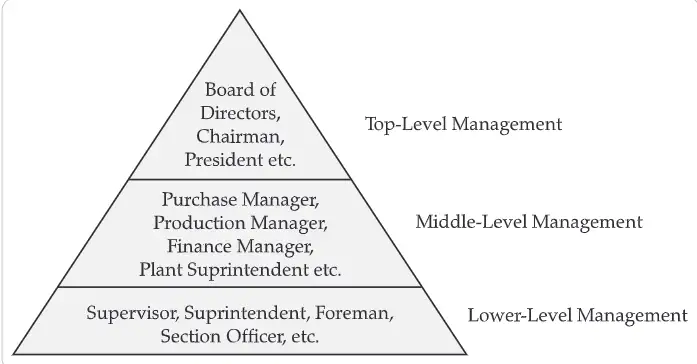
Levels of Management:
- Top-Level Management: Board of Directors, Chairman, Managing Directors, Chief Executives responsible for overall welfare and survival.
- Middle-Level Management: Departmental Heads like Finance Manager, Production Manager; link between top and lower levels.
- Lower/Supervisory/Operational-Level Management: Foremen, Supervisors who directly oversee workers and daily operations.
Functions of Management:
- Planning: Deciding in advance what, when, how, and who will do tasks.
- Organising: Assigning duties, grouping tasks, establishing authority, and allocating resources.
- Staffing: Finding the right person for the right job.
- Directing: Supervising, motivating, leading, and communicating with subordinates.
- Controlling: Setting performance standards, measuring actual performance, and taking corrective actions.
Illustrative Examples:
- Top-Level: CEO setting corporate strategy and global representation.
- Middle-Level: Regional sales manager coordinating sales objectives and supervising store managers.
- Lower-Level: Factory supervisor managing daily shop floor activities and workers.
Practice Set:
- Level 1 – Easy: Name the three levels of management and their main roles.
- Level 2 – Moderate: Explain the five functions of management with examples.
- Level 3 – Challenging: Discuss how the levels of management coordinate to achieve organisational goals.
Answer Key:
- Levels: Top (strategic decisions), Middle (departmental coordination), Lower (supervision).
- Functions: Planning, organising, staffing, directing, controlling as defined above.
- Coordination among levels ensures smooth implementation of plans and achievement of goals.
Quick Reference: Levels: Top → Middle → Lower; Functions: Plan → Organise → Staff → Direct → Control
Glossary:
- Planning: Preparing for future actions.
- Organising: Structuring resources and tasks.
- Directing: Leading and motivating employees.
Coordination
Concept Explanation: Coordination is the process by which a manager synchronises activities of different departments to achieve common organisational goals. It binds all management functions.
Nature/Features of Coordination:
- All pervasive: Present in all departments and levels.
- Integrates group efforts for unity.
- Continuous process throughout management functions.
- Ensures unity of action.
- Responsibility of all managers.
- Deliberate function requiring conscious effort.
Importance of Coordination:
- Functional Differentiation: Links independent departments for unified action.
- Growth in Size: Integrates individual and organisational goals as organisation expands.
- Specialisation: Harmonises efforts of specialists to avoid conflicts.
Coordination in Management Functions:
- Planning: Align organisational and departmental plans.
- Organising: Balance authority, responsibility, and accountability.
- Staffing: Match job requirements with personnel qualities.
- Directing: Coordinate supervision, motivation, and leadership.
- Controlling: Ensure actual results meet expected standards.
Coordination at Different Levels:
- Top Level: Integrate organisational activities for goals.
- Middle Level: Coordinate efforts of sections and sub-sections.
- Lower Level: Coordinate worker activities for work progress.
Practice Set:
- Level 1 – Easy: Define coordination and list its features.
- Level 2 – Moderate: Explain the importance of coordination in growing organisations.
- Level 3 – Challenging: Discuss how coordination is essential in each management function.
Answer Key:
- Coordination is synchronising activities to achieve common goals.
- Features include being pervasive, continuous, integrative, and a managerial responsibility.
- Importance includes linking departments, managing growth, and harmonising specialists.
- Coordination ensures alignment in planning, organising, staffing, directing, and controlling.
Quick Reference: Coordination = Integration + Unity + Continuous Effort
Glossary:
- Coordination: Harmonising activities for common goals.
- Functional Differentiation: Independent departmental functions.
- Unity of Action: Working together effectively.