CLASS 12-COMMERCE . BUSINESS STUDIES . BUSINESS STUDIES PART II . FINANCIAL MANAGEMENT
Chapter 9 : Financial Management
Ch 9
BUSINESS STUDIES
CLASS 12-COMMERCE
Financial Management: Concept, Objective, Role and Financial Decisions
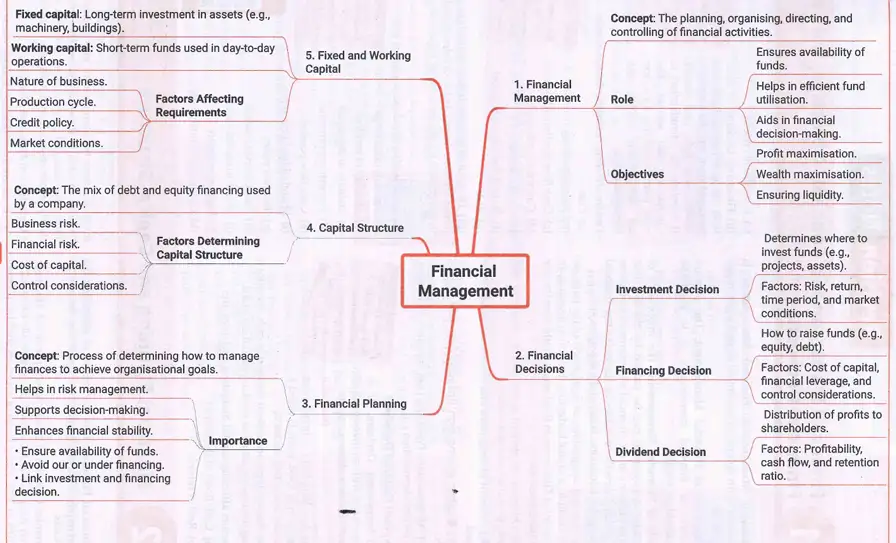
Concept Explanation: Financial Management involves the planning, organizing, directing, and controlling of financial activities such as procurement and utilization of funds of the enterprise. It ensures optimal use of financial resources to achieve the objectives of the business.
Key Definitions / Features:
- Financial Management: Concerned with optimal procurement and usage of finance.
- Objectives: Primary objective is to maximise shareholders’ wealth.
- Role: Affects all financial statements and decisions including size and composition of fixed assets, current assets, long-term and short-term funds, and financing mix.
- Types of Financial Decisions:
- Investment Decision: Allocation of funds to different assets. Includes capital budgeting (long-term) and working capital decisions (short-term).
- Financing Decision: Determining the sources and amount of funds to be raised from debt and equity.
- Dividend Decision: Deciding the portion of profits to be distributed as dividends and retained for reinvestment.
Illustrative Examples:
- Capital budgeting decision: Investing ₹100 crores in fixed assets increases the fixed asset block.
- Working capital decision: Managing cash, inventory, and receivables for daily operations.
Practice Set:
- Level 1 – Easy: Define financial management and list its objectives.
- Level 2 – Moderate: Explain the role of financial management with examples.
- Level 3 – Challenging: Discuss the factors affecting financing decisions in a company.
Answer Key:
- Financial management is the process of planning, organizing, directing, and controlling financial activities to maximize shareholders’ wealth.
- Objectives include profit maximization, wealth maximization, and ensuring liquidity.
- Role examples: Capital budgeting affects fixed assets; financing decisions affect debt and equity mix.
- Factors affecting financing decisions: cost, flotation costs, cash flow, control considerations, capital market conditions, risk, etc.
Quick Reference:
- Investment Decision = Allocation of funds
- Financing Decision = Raising funds
- Dividend Decision = Distribution of profits
Glossary:
- Capital Budgeting: Long-term investment decision process.
- Working Capital: Funds for day-to-day operations.
- Dividend: Portion of profit distributed to shareholders.
Financial Planning and Capital Structure
Concept Explanation: Financial Planning is the process of estimating the fund requirements of a business and determining the sources of funds. Capital Structure refers to the mix of owner’s equity and borrowed funds used to finance the business.
Key Definitions / Features:
- Financial Planning: Ensures availability of funds when required and avoids unnecessary resource raising.
- Objectives: To prepare for future challenges, avoid surprises, coordinate business functions, eliminate waste, link present with future, and facilitate financial control.
- Capital Structure: The proportion of debt and equity in total capital, measured by debt-equity ratio or debt to total capital ratio.
- Trading on Equity: Using fixed financial charges like interest on debt to increase returns to equity shareholders.
- Factors Determining Capital Structure: Cash flow, interest coverage ratio, debt service coverage ratio, ROI, cost of debt and equity, tax rate, flotation costs, risk, flexibility, control, regulatory framework, stock market conditions, and peer company structures.
Illustrative Examples:
- Preparing alternative financial plans for different sales growth scenarios (10%, 20%, 30%) to manage expenses and investments accordingly.
- Calculating debt-equity ratio to assess financial leverage.
Practice Set:
- Level 1 – Easy: Define financial planning and list its objectives.
- Level 2 – Moderate: Explain the concept of capital structure and factors affecting it.
- Level 3 – Challenging: Analyze the impact of trading on equity on shareholders’ returns.
Answer Key:
- Financial planning estimates fund requirements and sources to ensure smooth operations.
- Capital structure is the mix of debt and equity; factors include cost, risk, control, and market conditions.
- Trading on equity increases profit for equity shareholders by using debt with fixed interest charges.
Quick Reference:
- Financial Planning = Estimating funds + sources
- Capital Structure = Debt + Equity mix
- Trading on Equity = Using debt to increase equity returns
Glossary:
- Debt-Equity Ratio: Ratio of borrowed funds to owner’s funds.
- Interest Coverage Ratio: Ability to pay interest from earnings.
- Return on Investment (ROI): Profitability measure of investments.
Fixed and Working Capital and Techniques
Concept Explanation: Fixed Capital refers to funds invested in long-term assets like land, buildings, and machinery. Working Capital is the amount invested in current assets required for daily operations.
Key Definitions / Features:
- Fixed Capital: Long-term investment with features such as large fund requirement, risk, irreversibility, and impact on growth.
- Factors Affecting Fixed Capital Requirement: Nature of business, scale, technology, growth prospects, diversification, financing options, and collaborations.
- Working Capital: Current Assets minus Current Liabilities; funds for day-to-day expenses like wages, raw materials, and creditor payments.
- Factors Affecting Working Capital Requirement: Nature and scale of business, business cycle, seasonal factors, production cycle, credit terms, operating efficiency, availability of raw materials, competition, inflation, and growth prospects.
Illustrative Examples:
- Fixed capital investment in machinery for manufacturing.
- Working capital management for a trading firm requiring more cash and inventory.
Practice Set:
- Level 1 – Easy: Define fixed capital and working capital.
- Level 2 – Moderate: List factors affecting working capital requirements.
- Level 3 – Challenging: Explain how diversification and collaborations influence fixed capital needs.
Answer Key:
- Fixed capital is investment in long-term assets; working capital is funds for daily operations.
- Working capital factors include business nature, scale, credit terms, and seasonal variations.
- Diversification expands business scope increasing fixed capital; collaborations may share capital requirements.
Quick Reference:
- Fixed Capital = Long-term assets investment
- Working Capital = Current Assets - Current Liabilities
- Factors = Business nature, scale, cycle, credit, efficiency
Glossary:
- Diversification: Expanding into new markets or products.
- Collaborations: Partnership or teamwork to achieve common goals.
- Creditors: Entities lending money expecting repayment.