CLASS 12-COMMERCE . BUSINESS STUDIES . BUSINESS STUDIES PART I . DIRECTING
Chapter 7 : DIRECTING
Ch 7
BUSINESS STUDIES
CLASS 12-COMMERCE
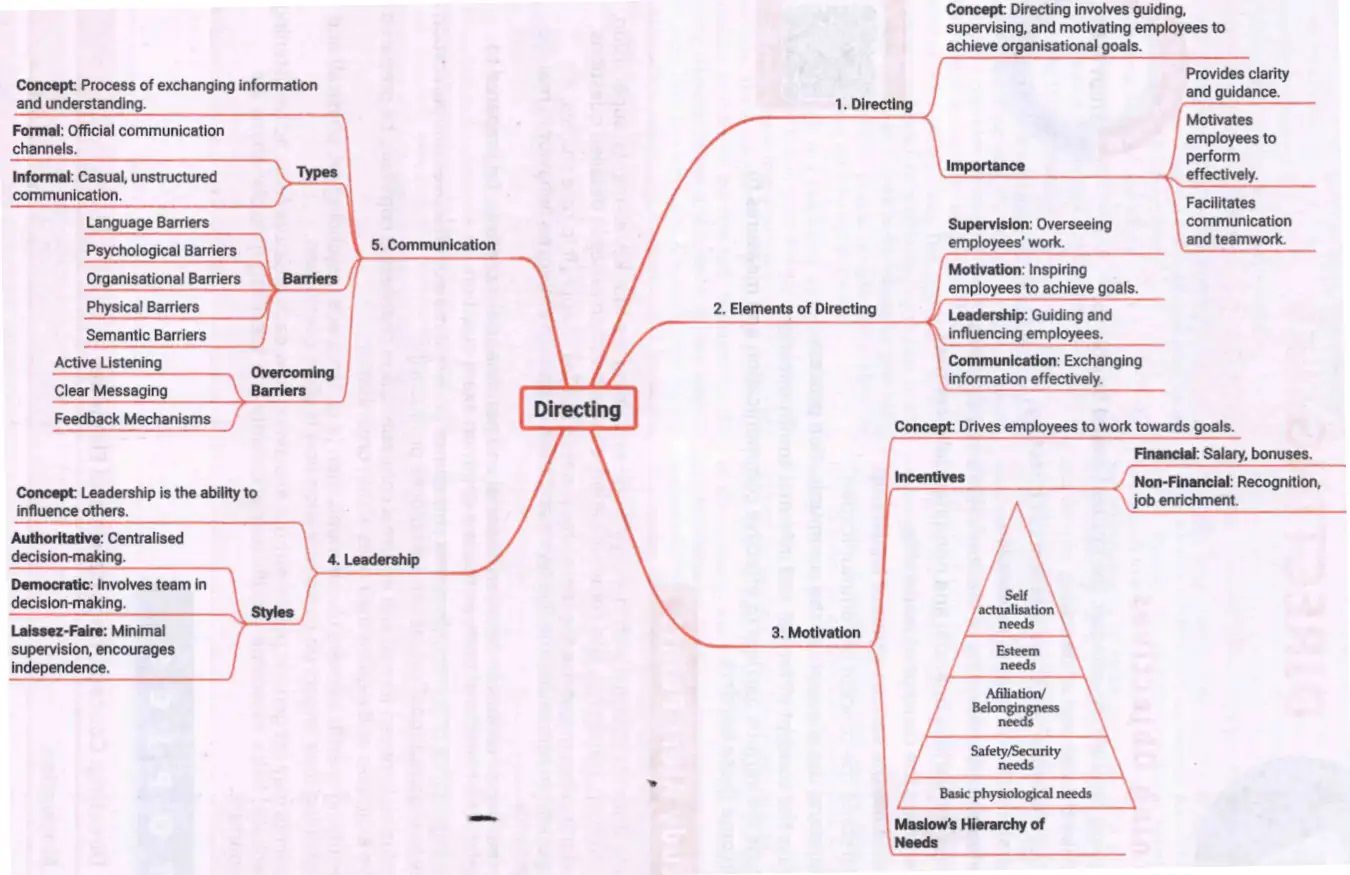
Directing: Concept, Importance and Elements
Concept Explanation: Directing is the process of instructing, guiding, counselling, motivating, and leading people in an organisation to achieve its objectives. It involves giving instructions and guiding people in doing work effectively.
Importance of Directing:
- Helps to initiate action: Directing motivates people to start working towards organisational goals.
Example: A supervisor guiding subordinates and clarifying doubts helps workers achieve their targets. - Integrates efforts: It coordinates individual efforts so that all contribute to organisational performance.
- Guides employees to realise their potential: Through motivation and leadership, directing helps employees develop their capabilities.
- Facilitates organisational change: Effective directing reduces resistance and promotes cooperation during changes.
Example: A manager introducing a new accounting system can motivate and train staff to accept the change. - Brings stability and balance: It fosters cooperation and commitment, balancing activities and departments within the organisation.
Elements of Directing:
- Motivation: The process of encouraging subordinates to act in a desired manner to achieve organisational goals.
- Leadership: Influencing people to voluntarily strive towards organisational objectives.
- Communication: The exchange of ideas, views, facts, and feelings to create common understanding.
Practice Set
- Level 1 – Easy: Define directing and explain its importance in an organisation.
- Level 2 – Moderate: Explain how directing helps in facilitating organisational change with an example.
- Level 3 – Challenging: Discuss the elements of directing and their interrelationship in achieving organisational goals.
Answer Key
1. Directing is guiding and motivating employees to achieve organisational objectives. It initiates action, integrates efforts, guides employees, facilitates change, and brings stability.
2. Directing reduces resistance to change by motivating employees and providing leadership and communication, e.g., training staff for a new system.
3. Motivation encourages action, leadership influences behaviour, and communication ensures understanding; together they ensure effective directing.
Quick Reference
- Directing = Guiding + Motivating + Leading + Communicating
- Importance: Initiates action, integrates efforts, realises potential, facilitates change, brings stability
- Elements: Motivation, Leadership, Communication
Glossary
- Directing: Guiding and motivating employees to achieve goals.
- Motivation: Encouraging desired behaviour.
- Leadership: Influencing people voluntarily.
- Communication: Exchange of information for understanding.
Motivation
Concept Explanation: Motivation is the process of making subordinates act in a desired manner to achieve organisational goals. It is an internal feeling that produces goal-directed behaviour and can be positive or negative.
Features of Motivation:
- Internal feeling driving behaviour.
Example: Desire for a motorbike or social reputation. - Produces goal-directed behaviour.
Example: Promotion motivates improved performance. - Can be positive (rewards) or negative (penalties).
- Complex psychological process.
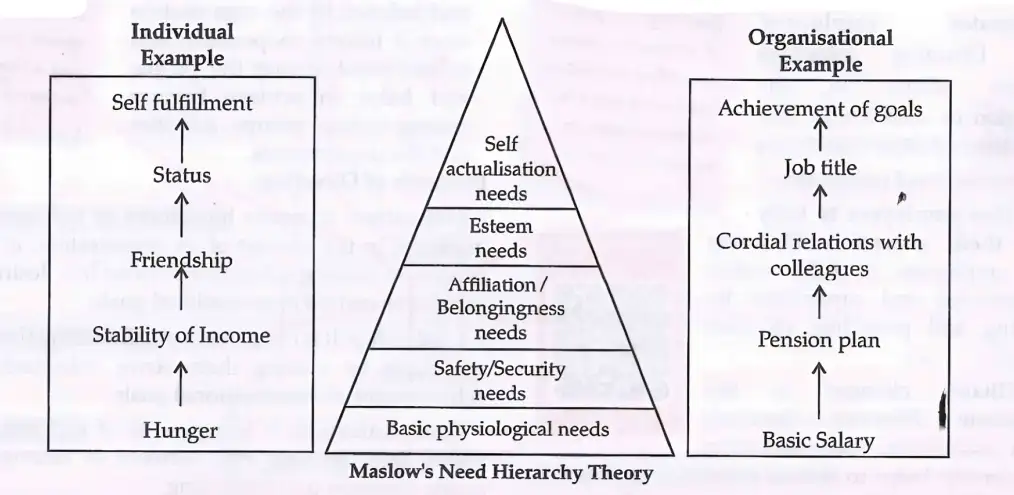
Maslow’s Need Hierarchy Theory of Motivation: Abraham Maslow categorised human needs into five levels:
- Basic Physiological Needs: Food, shelter, clothing.
- Safety Needs: Protection from danger, job security.
- Affiliation/Belonging Needs: Social acceptance, friendship.
- Esteem Needs: Self-respect, status.
- Self-actualisation Needs: Personal growth, fulfilment.
This theory helps managers identify unsatisfied employee needs to motivate them effectively.
Types of Incentives:
- Financial Incentives: Monetary rewards such as pay, bonuses, profit sharing, stock options, retirement benefits, and perquisites.
- Non-Financial Incentives: Psychological and social rewards like status, organisational climate, career advancement, job enrichment, recognition, job security, participation, and empowerment.
Mnemonics for Maslow’s Theory: Play Some Act for entertainment or Sleep
P: Physiological
S: Safety
A: Affiliation
E: Esteem
S: Self-actualisation
Practice Set
- Level 1 – Easy: List and explain the five levels of Maslow’s Need Hierarchy.
- Level 2 – Moderate: Differentiate between financial and non-financial incentives with examples.
- Level 3 – Challenging: Explain how Maslow’s theory can be applied to motivate employees in an organisation.
Answer Key
1. Maslow’s five levels: Physiological, Safety, Affiliation, Esteem, Self-actualisation needs.
2. Financial incentives are monetary rewards (e.g., salary, bonus); non-financial are psychological rewards (e.g., recognition, job security).
3. Managers identify unmet needs of employees and provide appropriate incentives to motivate them according to their level in the hierarchy.
Quick Reference
- Motivation = Internal drive to act
- Maslow’s Needs: Physiological → Safety → Affiliation → Esteem → Self-actualisation
- Incentives: Financial and Non-Financial
Glossary
- Motivation: Process of encouraging desired behaviour.
- Financial Incentives: Monetary rewards.
- Non-Financial Incentives: Psychological and social rewards.
- Maslow’s Theory: Hierarchy of human needs.
Leadership
Concept Explanation: Leadership is the process of influencing people to voluntarily strive towards achieving organisational goals.
Features of Leadership:
- Process of influencing behaviour.
- Brings behavioural changes.
- Interpersonal relationship between leader and followers.
- Continuous process.
- Exercised to achieve common goals.
Leadership Styles:
- Authoritative/Autocratic: Leader centralises decision-making and exercises full control.
- Democratic/Participative: Leader consults subordinates and encourages suggestions.
- Free Rein/Laissez-Faire: Leader delegates decision-making and gives freedom to subordinates.
Practice Set
- Level 1 – Easy: Define leadership and list its features.
- Level 2 – Moderate: Compare autocratic and democratic leadership styles.
- Level 3 – Challenging: Discuss the advantages and disadvantages of free rein leadership style.
Answer Key
1. Leadership is influencing people to achieve goals; features include influencing behaviour, interpersonal relations, continuous process.
2. Autocratic: Centralised control, quick decisions; Democratic: Participative, encourages suggestions.
3. Free rein allows creativity and freedom but may lead to lack of direction and coordination.
Quick Reference
- Leadership = Influencing behaviour voluntarily
- Styles: Autocratic, Democratic, Free Rein
Glossary
- Leadership: Influencing people to achieve goals.
- Autocratic: Centralised control.
- Democratic: Participative decision-making.
- Free Rein: Delegated authority.
Communication
Concept Explanation: Communication is the process of exchanging ideas, views, facts, and feelings between people to create common understanding.
Elements of Communication:
- Sender: The person who conveys the message.
- Message: The subject matter being communicated.
- Encoding: Converting the message into symbols or language.
- Media: The channel through which the message is transmitted.
- Decoding: Translating the encoded message into understandable form.
- Receiver: The person who receives the message.
- Feedback: The receiver’s response to the sender.
- Noise: Any hindrance that distorts the communication process.
Channels of Communication:
- Formal Communication: Official communication through prescribed channels.
- Informal Communication: Unofficial communication arising from social interactions.
Example: Workers chatting about rumours in the canteen.
Barriers to Effective Communication:
- Semantic Barriers: Problems in encoding/decoding such as badly expressed messages, ambiguous symbols, faulty translation, unclarified assumptions, technical jargon, body language misinterpretation.
Example: Misunderstanding "Take care of our guest" due to unclear instructions. - Psychological Barriers: Mental states like premature evaluation, lack of attention, poor retention, distrust.
- Organisational Barriers: Structure, authority, rules that restrict communication.
Example: Highly centralised organisations discourage free communication. - Personal Barriers: Attitudes such as fear of challenge, lack of confidence, unwillingness to communicate, lack of incentives.
Example: No reward for suggestions leads to reluctance in sharing ideas.
Measures to Improve Communication Effectiveness:
- Clarify ideas before communicating.
- Communicate according to receiver’s needs.
- Consult others before communication.
- Be aware of language, tone, and content.
- Convey helpful and valuable information.
- Ensure proper feedback.
- Communicate for present and future.
- Follow up communications.
- Be a good listener.
Mnemonics:
- Communication Barriers: Pray Please
P: Semantic
O: Organisational
P: Personal
P: Psychological - Elements of Communication: Some Make Easy Money but you Do Right For Nothing
S: Sender
M: Message
E: Encoding
M: Media
D: Decoding
R: Receiver
F: Feedback
N: Noise
Practice Set
- Level 1 – Easy: Define communication and list its elements.
- Level 2 – Moderate: Differentiate between formal and informal communication with examples.
- Level 3 – Challenging: Explain the barriers to effective communication and suggest measures to overcome them.
Answer Key
1. Communication is exchanging ideas to create understanding; elements include sender, message, encoding, media, decoding, receiver, feedback, noise.
2. Formal communication is official (e.g., memos); informal is unofficial (e.g., casual talks).
3. Barriers include semantic, psychological, organisational, personal; overcome by clarifying ideas, feedback, good listening, appropriate language.
Quick Reference
- Communication = Exchange of ideas for understanding
- Elements: Sender, Message, Encoding, Media, Decoding, Receiver, Feedback, Noise
- Barriers: Semantic, Psychological, Organisational, Personal
Glossary
- Communication: Process of exchanging information.
- Semantic Barriers: Meaning-related obstacles.
- Psychological Barriers: Mental state obstacles.
- Organisational Barriers: Structural obstacles.
- Personal Barriers: Attitudinal obstacles.