CLASS 12-COMMERCE . BUSINESS STUDIES . BUSINESS STUDIES PART I . CONTROLLING
Chapter 8 : CONTROLLING
Ch 8
BUSINESS STUDIES
CLASS 12-COMMERCE
Controlling
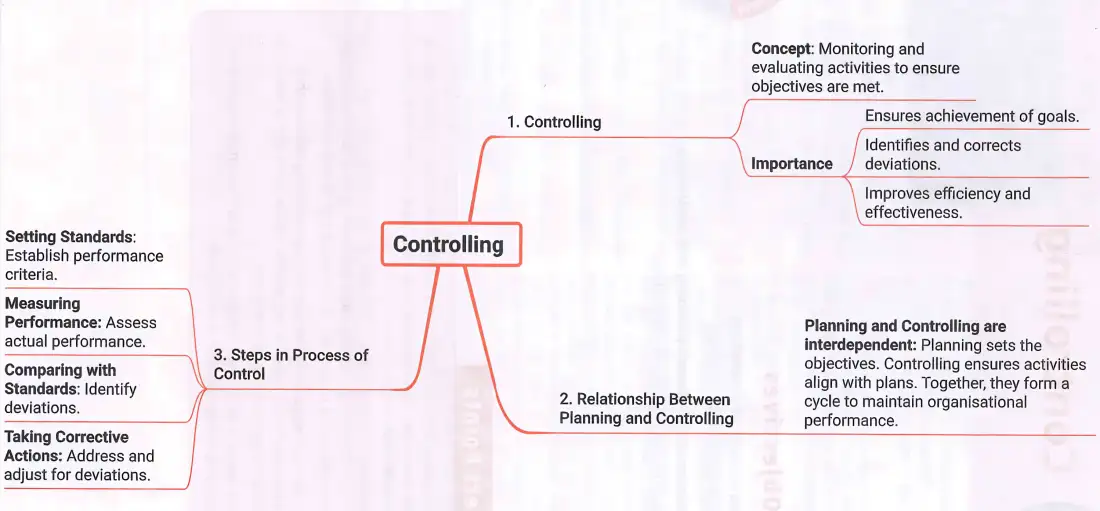
Concept Explanation: Controlling is a fundamental function of management that involves monitoring and checking activities to ensure that organisational goals are achieved as per the plans. It goes beyond mere supervision by ensuring that all activities align with the planned objectives, thereby facilitating corrective actions when deviations occur.
Key Definitions / Features:
- Goal-Oriented: Controlling ensures that resources are used effectively to achieve organisational goals.
- Pervasive Function: It is performed at all levels of management and in all types of organisations.
- Continuous Process: Controlling is an ongoing process that brings the management cycle back to planning.
Illustrative Example: A manufacturing company sets a standard to produce 1000 units per day. Controlling involves measuring actual production daily, comparing it with the standard, and taking corrective action if production falls short.
Practice Set:
- Level 1 – Easy: Define controlling and list its key features.
- Level 2 – Moderate: Explain how controlling helps in achieving organisational goals with an example.
- Level 3 – Challenging: Discuss the continuous nature of controlling and its impact on the management cycle.
Answer Key:
Controlling is the process of ensuring that activities are performed as per plans to achieve organisational goals. Its key features include being goal-oriented, pervasive, and continuous. For example, in a factory, controlling ensures production targets are met by monitoring output and taking corrective actions.
Quick Reference: Controlling = Monitoring + Corrective Action + Alignment with Plans.
Glossary:
- Controlling: Management function to ensure activities conform to plans.
- Standards: Benchmarks set for performance measurement.
- Deviation: Difference between actual performance and standards.
Importance of Controlling
Concept Explanation: Controlling is vital for the success of any organisation as it helps in achieving goals, improving efficiency, and maintaining discipline.
Key Points:
- Helps in accomplishing organisational goals by ensuring activities are on track.
- Judges the accuracy of standards set during planning.
- Ensures efficient use of resources, reducing wastage and errors.
- Improves employee motivation by providing feedback and recognition.
- Maintains order and discipline within the organisation.
- Facilitates coordination among different departments and activities.
Illustrative Example: A sales manager uses controlling to monitor sales targets and motivates the team by recognizing top performers, thus improving overall sales.
Practice Set:
- Level 1 – Easy: List three benefits of controlling.
- Level 2 – Moderate: Explain how controlling helps in improving employee motivation.
- Level 3 – Challenging: Discuss the role of controlling in resource optimisation with examples.
Answer Key:
Controlling helps achieve goals, ensures efficient resource use, and improves motivation by providing feedback. For example, monitoring production reduces wastage and motivates workers to meet targets.
Quick Reference: Importance of Controlling = Goal Achievement + Resource Efficiency + Motivation + Discipline.
Glossary:
- Motivation: Encouragement to perform better.
- Efficiency: Optimal use of resources.
- Discipline: Adherence to rules and standards.
Relationship between Planning and Controlling
Concept Explanation: Planning and controlling are interrelated and interdependent functions of management. Planning sets the standards and prescribes actions, while controlling evaluates performance against these standards and facilitates corrective measures.
Key Points:
- Interrelated and Interdependent: Effective planning makes controlling easier; controlling provides feedback to improve future planning.
- Prescriptive vs Evaluative: Planning prescribes what should be done; controlling evaluates what has been done.
- Backward and Forward Looking: Planning uses past data to prepare for the future; controlling evaluates past performance to improve future actions.
Illustrative Example: A company plans to increase production by 10%. Controlling monitors actual production and reports deviations, which helps in revising future plans.
Practice Set:
- Level 1 – Easy: Explain how planning and controlling are interdependent.
- Level 2 – Moderate: Differentiate between planning and controlling with examples.
- Level 3 – Challenging: Discuss how controlling improves future planning.
Answer Key:
Planning sets goals and standards; controlling measures actual performance and provides feedback. For example, controlling deviations in sales helps in making better sales plans.
Quick Reference: Planning = Setting Standards; Controlling = Measuring & Correcting.
Glossary:
- Planning: Deciding future course of action.
- Controlling: Monitoring and correcting activities.
- Feedback: Information used to improve processes.
Controlling Process
Concept Explanation: The controlling process consists of sequential steps that ensure organisational activities conform to plans. It involves setting standards, measuring performance, comparing results, analysing deviations, and taking corrective actions.
Steps of Controlling Process:
- Setting Performance Standards: Establishing criteria such as cost, revenue, production units, or time for tasks.
- Measurement of Actual Performance: Collecting data through observation, reports, or sample checks.
- Comparing Actual Performance with Standards: Identifying deviations between actual and desired results.
- Analysing Deviations: Using techniques like critical point control and management by exception to understand causes.
- Taking Corrective Action: Implementing measures such as training employees or replacing machinery to rectify deviations.
Illustrative Examples:
- Standard: Produce 500 units/day; Actual: 450 units/day; Deviation: 50 units short.
- Corrective Action: Provide additional training to workers to improve productivity.
Mnemonic to Remember Steps: Such a Mischievous CAT
- S: Setting performance standards
- M: Measurement of actual performance
- C: Comparison of actual performance with standards
- A: Analysis of deviations
- T: Taking corrective action
Practice Set:
- Level 1 – Easy: List the steps of the controlling process.
- Level 2 – Moderate: Explain the importance of analysing deviations with an example.
- Level 3 – Challenging: Describe corrective actions that can be taken when performance deviates from standards.
Answer Key:
The controlling process includes setting standards, measuring performance, comparing results, analysing deviations, and taking corrective actions. For example, if production is below standard, analysing causes helps decide corrective measures like training.
Quick Reference: Controlling Process = Set Standards → Measure → Compare → Analyse → Correct.
Glossary:
- Standards: Benchmarks for performance.
- Deviation: Difference between actual and standard performance.
- Corrective Action: Steps to fix deviations.