CLASS 12-COMMERCE . ACCOUNTANCY . COMPANY ACCOUNTS AND ANALYSIS OF FINANCIAL ACCOUNTS . FINANCIAL STATEMENTS-OF-A-COMPANY
Chapter 3 : Financial Statements of a Company
Ch 3
ACCOUNTANCY
CLASS 12-COMMERCE
Financial Statements
Financial statements are the end products of the accounting process which reveal the financial results of a specified period and the financial position as on a particular date. These statements include the Statement of Profit and Loss and the Balance Sheet. The basic objective of these statements is to provide information required for decision-making by the management as well as other outsiders interested in the affairs of the undertaking. As per Section 129 Schedule III to the Companies Act, 2013, these statements must be prepared every year.
Key Definitions / Features:
- Statement of Profit and Loss: Shows the company's revenue, expenses, and profit or loss for a financial year.
- Balance Sheet: Shows the financial position of the company on a particular date, listing assets, liabilities, and equity.
Examples: A company preparing its annual financial statements to present to shareholders and regulatory authorities.
Practice Set:
- Level 1: Define financial statements and list their main components.
- Level 2: Explain the objective of financial statements as per Companies Act, 2013.
- Level 3: Discuss the importance of financial statements for different stakeholders.
Answer Key:
Financial statements are reports prepared at the end of an accounting period to show the financial performance and position of a company. They include the Statement of Profit and Loss and the Balance Sheet. Their objective is to provide useful information for decision-making to management and external users, as mandated by the Companies Act, 2013.
Quick Reference: Financial Statements = Statement of Profit & Loss + Balance Sheet; Objective = Decision-making information.
Glossary: Financial Statements: Reports showing financial results and position; Statement of Profit and Loss: Income and expenses summary; Balance Sheet: Snapshot of assets and liabilities.
Nature of Financial Statements
The nature of financial statements is characterized by the following:
- First record facts in monetary form.
- Application of accounting conventions.
- Application of accounting postulates.
- Dependency on personal opinions and judgments.
Explanation: Financial statements convert business transactions into monetary terms, following accepted accounting principles and conventions. However, some elements depend on management's judgments and estimates.
Practice Set:
- Level 1: List the four characteristics of financial statements.
- Level 2: Explain why personal judgments affect financial statements.
- Level 3: Discuss how accounting conventions influence the preparation of financial statements.
Answer Key:
Financial statements record facts in monetary terms, apply accounting conventions and postulates, and depend on personal judgments for estimates and valuations, which may affect the reported figures.
Quick Reference: Monetary facts + Accounting principles + Judgments = Financial Statements.
Glossary: Accounting Conventions: Accepted practices; Accounting Postulates: Basic assumptions; Judgments: Estimates made by management.
Uses of Financial Statements
Financial statements serve multiple purposes for various stakeholders:
- Report of stewardship to owners and management.
- Basis for fiscal policy formulation.
- Determination of legality of dividends.
- Guide for dividend decisions.
- Basis for granting credit by lenders.
- Information for prospective investors.
- Guide to value of existing investments.
- Aid to government supervision and regulation.
- Basis for price or rate regulation.
- Basis for taxation.
Practice Set:
- Level 1: Name five uses of financial statements.
- Level 2: Explain how financial statements help creditors.
- Level 3: Discuss the role of financial statements in government supervision.
Answer Key:
Financial statements provide information for stewardship, credit decisions, dividend legality, investment evaluation, government regulation, and taxation, among other uses.
Quick Reference: Stewardship, Credit, Investment, Regulation, Taxation.
Glossary: Stewardship: Management accountability; Dividend: Profit distribution; Credit: Lending decisions.
Importance of Financial Statements
Financial statements are important to various parties as follows:
- Management: Helps evaluate efficiency and plan for improvement.
- Creditors: Assess current solvency using ratios like current ratio and liquid ratio.
- Bankers: Analyze financial viability and earning status for loan security.
- Investors: Evaluate security of investment, long-term solvency, and future prospects.
- Government: Assess tax liability, compliance with laws, and economic conditions.
- Trade Associations: Provide assistance and develop standards based on financial data.
- Stock Exchange: Judge financial position for pricing securities.
Practice Set:
- Level 1: Identify three users of financial statements and their interests.
- Level 2: Explain how investors use financial statements.
- Level 3: Discuss the importance of financial statements for bankers.
Answer Key:
Financial statements assist management in planning, creditors in assessing solvency, bankers in loan decisions, investors in evaluating security and prospects, government in taxation and regulation, trade associations in member support, and stock exchanges in pricing securities.
Quick Reference: Users: Management, Creditors, Bankers, Investors, Government.
Glossary: Solvency: Ability to meet debts; Liquidity Ratios: Measures of short-term financial health.
Components of Financial Statements
Financial statements mainly consist of:
- Statement of Profit and Loss: Summarizes revenue and expenses to show net profit or loss.
- Balance Sheet: Shows financial position listing equity, liabilities, and assets as of a specific date.
- Cash Flow Statement: Shows inflows and outflows of cash during a period.
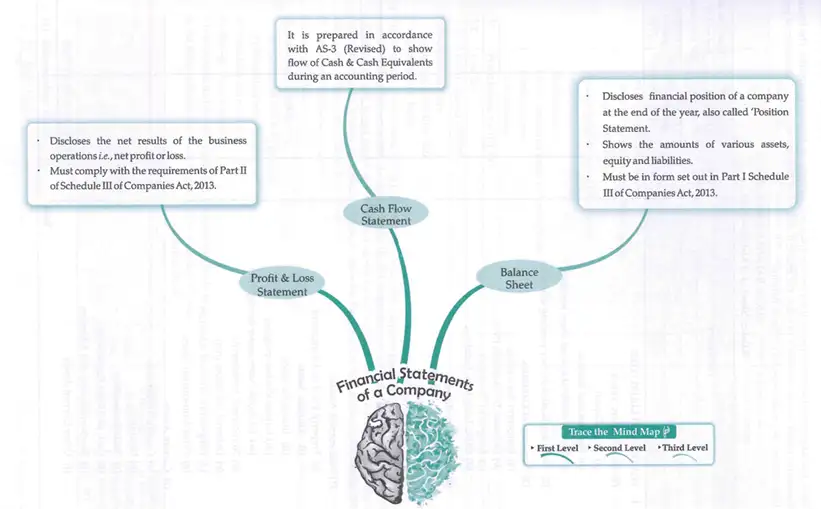
Explanation: The Statement of Profit and Loss shows operational results; the Balance Sheet shows financial position; the Cash Flow Statement shows liquidity and cash management.
Practice Set:
- Level 1: Name the three main financial statements.
- Level 2: Describe the purpose of the Cash Flow Statement.
- Level 3: Explain how the Balance Sheet and Profit & Loss Statement are related.
Answer Key:
The three main financial statements are the Statement of Profit and Loss, Balance Sheet, and Cash Flow Statement. The Cash Flow Statement shows cash movements, while the Balance Sheet and Profit & Loss Statement show financial position and performance respectively.
Quick Reference: Profit & Loss = Performance; Balance Sheet = Position; Cash Flow = Liquidity.
Glossary: Cash Flow: Movement of cash; Net Profit: Revenue minus expenses.
Equity and Liabilities Side of Balance Sheet
The Equity and Liabilities side of the Balance Sheet includes:
Shareholders’ Funds:
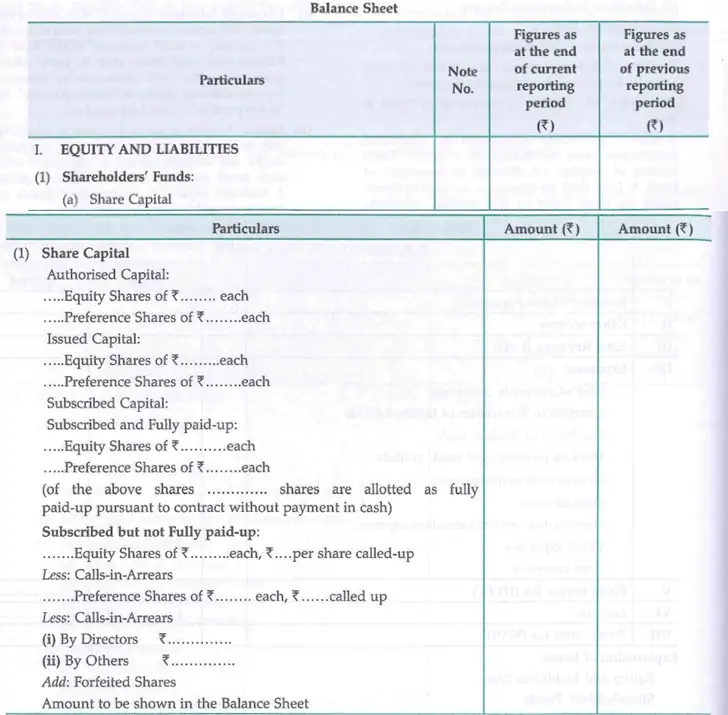
(A) Share Capital: Money raised by issuing shares. It includes:
- Authorised Capital: Maximum shares company can issue.
- Issued Capital: Shares actually issued.
- Subscribed Capital: Shares agreed to be bought by investors.
- Called-up Capital: Amount called from shareholders.
- Paid-up Capital: Amount actually received.
Details must be disclosed as per Schedule III of Companies Act, 2013.
(B) Reserves and Surplus: Amounts set aside from profits for future contingencies and strengthening financial position. Types include:
- Capital Reserve
- Securities Premium Reserve
- Capital Redemption Reserve
- Debenture Redemption Reserve
- Revaluation Reserve
- Share Options Outstanding Account
- Other Reserves (specified)
- Surplus (Balance in Statement of Profit & Loss)
Surplus may have credit or debit balance; debit balance shown as negative under Reserves and Surplus.
Practice Set:
- Level 1: Define Share Capital and list its types.
- Level 2: Explain the purpose of Reserves and Surplus.
- Level 3: Describe the disclosure requirements for Share Capital.
Answer Key:
Share Capital is the money raised by issuing shares, classified into authorised, issued, subscribed, called-up, and paid-up capital. Reserves and Surplus are profits set aside for future needs and strengthening the company. Disclosure of details is mandatory as per Schedule III.
Quick Reference: Share Capital = Funds from shares; Reserves = Retained profits.
Glossary: Authorised Capital: Max shares; Subscribed Capital: Agreed shares; Surplus: Accumulated profit.
Non-current Liabilities
Non-current liabilities are obligations payable after one year. Classified as per Companies Act, 2013 into:
- Long-term Borrowings
- Deferred Tax Liabilities (Net)
- Other Long-term Liabilities
- Long-term Provisions
Details:
(1) Long-term Borrowings: Debts payable after one year, including:
- Loans and Advances: Money owed to lenders like banks.
- Bonds: Debt instruments sold to investors.
- Capital Leases: Lease agreements transferring ownership after lease term.
(2) Deferred Taxes: Taxes payable in future due to timing differences in accounting and tax treatments.
(3) Other Long-term Liabilities: Includes trade payables (amounts payable for goods and services) and other payables like interest or premium on debentures.
(4) Long-term Provisions: Provisions for liabilities expected after 12 months, e.g., employee benefits, warranties.
Practice Set:
- Level 1: List the types of non-current liabilities.
- Level 2: Explain the difference between loans and bonds.
- Level 3: Describe deferred tax liabilities with an example.
Answer Key:
Non-current liabilities include long-term borrowings (loans, bonds, capital leases), deferred tax liabilities, other long-term liabilities (trade payables, other payables), and long-term provisions. Loans are borrowings from banks; bonds are sold to investors. Deferred tax arises from timing differences in accounting.
Quick Reference: Non-current = Payable after 1 year; Borrowings, Taxes, Provisions.
Glossary: Deferred Tax: Future tax liability; Capital Lease: Lease with ownership transfer.
Current Liabilities
Current liabilities are short-term obligations payable within one year or operating cycle. Major categories include:
- Short-term borrowings
- Trade payables
- Other current liabilities
- Short-term provisions
Details:
(1) Short-term borrowings: Amounts drawn from credit lines repayable within 12 months.
(2) Trade payables: Money owed to suppliers, partners, and employees.
(3) Other current liabilities: Unearned income, outstanding expenses, unpaid matured debentures, statutory dues like Provident Fund, GST payable, current maturities of long-term debts.
(4) Short-term provisions: Provisions for liabilities expected within 12 months, e.g., provision for doubtful debts, provision for tax.
Practice Set:
- Level 1: Define current liabilities and list their categories.
- Level 2: Explain the significance of trade payables.
- Level 3: Discuss the treatment of short-term provisions in financial statements.
Answer Key:
Current liabilities are obligations payable within one year, including short-term borrowings, trade payables, other current liabilities, and short-term provisions. Trade payables represent amounts owed to suppliers. Short-term provisions are estimated liabilities expected to be settled within the year.
Quick Reference: Current liabilities = Payable within 1 year.
Glossary: Trade Payables: Amounts owed to suppliers; Provision: Estimated liability.
Assets Side of Balance Sheet
Assets are resources owned by the company. Classified as:
Non-current Assets: Assets held for more than one year, not intended for sale. Examples include investments, property, plant, and equipment.
Property, Plant and Equipment (PPE): Long-lived tangible and intangible assets used in operations.
- Tangible Assets: Physical assets like land, buildings, machinery.
- Intangible Assets: Non-physical assets like patents, trademarks, goodwill.
- Capital Work-in-progress: PPE under construction.
- Intangible Assets under Development: Assets like patents in development.
Non-current Investments: Investments held for long-term, such as bonds and stocks.
Deferred Tax Assets (Net): Tax amounts paid or carried forward but not yet recognized in income statement, reducing future tax liability.
Long-term Loans and Advances: Loans with repayment periods between 3 and 30 years, including capital advances and security deposits.
Other Non-current Assets: Trade receivables realizable beyond operating cycle or 12 months.
Practice Set:
- Level 1: Define non-current assets and give examples.
- Level 2: Differentiate tangible and intangible assets.
- Level 3: Explain deferred tax assets with an example.
Answer Key:
Non-current assets are long-term assets like PPE, investments, deferred tax assets, and long-term loans. Tangible assets have physical form; intangible assets do not. Deferred tax assets arise from timing differences in tax and accounting.
Quick Reference: Assets = Tangible + Intangible + Investments + Loans.
Glossary: PPE: Property, Plant & Equipment; Deferred Tax Asset: Future tax benefit.
Characteristics of Ideal Financial Statements
Ideal financial statements should have the following characteristics:
- True Financial Position: Information must be true and fair, with no withheld data.
- Effective Presentation: Clear, simple, and logical format understandable to all users.
- Brief: Concise presentation for quick understanding.
- Attractive: Important information highlighted for easy reference.
- Comparability: Prepared to allow comparison with previous years and similar businesses.
- Analytical Representation: Data presented to facilitate analysis and interpretation.
Practice Set:
- Level 1: List three characteristics of ideal financial statements.
- Level 2: Explain why comparability is important.
- Level 3: Discuss how effective presentation aids users.
Answer Key:
Ideal financial statements are true and fair, clearly presented, concise, attractive, comparable over time and with other businesses, and facilitate analysis.
Quick Reference: True, Clear, Brief, Comparable, Analytical.
Glossary: True and Fair: Accurate representation; Comparability: Ability to compare data.