CLASS 12-COMMERCE . ACCOUNTANCY . COMPANY ACCOUNTS AND ANALYSIS OF FINANCIAL ACCOUNTS . ACCOUNTING RATIOS
Chapter 5 : Accounting Ratios
Ch 5
ACCOUNTANCY
CLASS 12-COMMERCE
Accounting Ratios
Accounting ratios are numerical relationships derived from financial statements that express the arithmetic relation between various accounting variables. They help in analyzing the financial health and performance of a business by comparing different financial figures.
Key Definitions:
- Accounting Ratios: Ratios based on financial statements expressing relationships between accounting variables.
- Ratio Analysis: According to Myres, "Ratio analysis of financial statements is the study of relationship among various financial factors in a business as disclosed by a single set of statements and a study of trends of these factors as shown in a series of statements."
Example: If a company has current assets of ₹1,00,000 and current liabilities of ₹50,000, the current ratio is 2:1, indicating good short-term financial health.
Practice Set:
- Level 1: Define accounting ratios and explain their importance.
- Level 2: Explain the concept of ratio analysis with an example.
- Level 3: Discuss how ratio analysis can help identify problem areas in a business.
Answer Key:
- Accounting ratios are tools to analyze financial statements by expressing relationships between variables.
- Ratio analysis studies relationships among financial factors to assess business performance.
- It helps locate weak areas requiring attention by comparing ratios over time.
Quick Reference: Accounting Ratios → Financial relationships → Business analysis → Decision making.
Glossary:
- Accounting Ratios: Numerical relationships from financial data.
- Ratio Analysis: Study of financial relationships and trends.
Objectives of Ratio Analysis
Ratio analysis serves multiple objectives that assist in evaluating the financial performance and position of a business.
Key Objectives:
- Identify Problem Areas: Locate weak or inefficient areas needing attention.
- Measure Profitability: Analyze gross profit, net profit, and expenses to assess profitability changes.
- Ascertain Operational Efficiency: Evaluate operating activity ratios to improve efficiency.
- Assess Business Solvency: Use solvency ratios to understand the ability to meet long-term debts.
- Gauge Financial Position: Liquidity and solvency ratios measure short-term and long-term financial health.
- Facilitate Comparative Analysis: Compare current and past performance and with other firms in the industry.
Example: A declining current ratio over years may indicate liquidity problems requiring corrective action.
Practice Set:
- Level 1: List the objectives of ratio analysis.
- Level 2: Explain how ratio analysis helps in assessing business solvency.
- Level 3: Discuss the importance of comparative analysis in ratio analysis.
Answer Key:
- Objectives include identifying problems, measuring profitability, assessing efficiency, solvency, financial position, and comparative analysis.
- Solvency ratios highlight the ability to meet long-term debts, indicating financial stability.
- Comparative analysis helps understand performance trends and industry standing.
Quick Reference: Objectives → Problem identification → Profitability → Efficiency → Solvency → Comparison.
Glossary:
- Solvency: Ability to meet long-term obligations.
- Liquidity: Ability to meet short-term obligations.
Advantages of Ratio Analysis
Ratio analysis offers several benefits that aid management, investors, and other stakeholders in decision-making.
Key Advantages:
- Helps in understanding the efficacy of decisions.
- Simplifies complex financial figures and establishes relationships.
- Facilitates comparative analysis over time and between firms.
- Identifies problem areas requiring attention.
- Enables SWOT (Strengths, Weaknesses, Opportunities, Threats) analysis.
Example: By comparing profitability ratios with industry averages, a company can identify its competitive position.
Practice Set:
- Level 1: State any three advantages of ratio analysis.
- Level 2: Explain how ratio analysis simplifies financial data.
- Level 3: Discuss the role of ratio analysis in SWOT analysis.
Answer Key:
- Advantages include decision understanding, simplification, comparison, problem identification, and SWOT analysis.
- It converts complex data into understandable ratios showing relationships.
- SWOT analysis uses ratios to identify strengths and weaknesses.
Quick Reference: Advantages → Decision making → Simplification → Comparison → SWOT.
Glossary:
- SWOT Analysis: Strategic tool to assess strengths, weaknesses, opportunities, and threats.
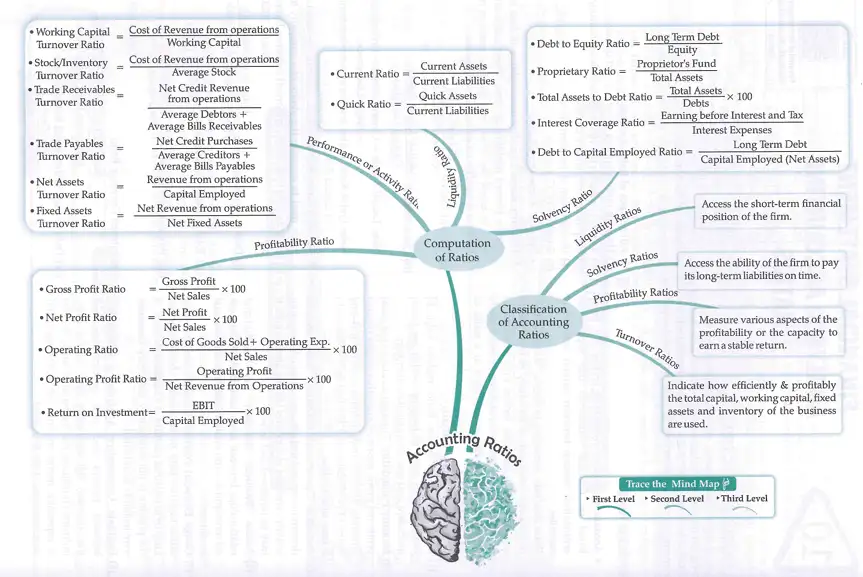
Types of Accounting Ratios
Accounting ratios are classified into four main types based on their purpose and the aspect of financial performance they measure.
1. Liquidity Ratios: Measure the ability to pay short-term liabilities.
- Current Ratio = Current Assets / Current Liabilities
- Quick Ratio (Acid-Test Ratio) = Liquid Assets / Current Liabilities
Note: Liquid Assets = Current Assets - Inventories - Prepaid Expenses
2. Solvency Ratios: Measure the ability to meet long-term debts.
- Debt to Equity Ratio = Long-term Debts / Shareholders' Funds
- Total Assets to Debt Ratio = Total Assets / Long-term Debts
- Proprietary Ratio = Shareholders' Funds / Total Assets
- Interest Coverage Ratio = Net Profit before Interest and Tax / Interest on Long-term Loans
- Debt to Capital Employed Ratio = Total Debt / Capital Employed
3. Performance/Activity/Turnover Ratios: Indicate how efficiently assets and liabilities are used.
- Inventory Turnover Ratio = Cost of Revenue from Operations / Average Inventory
- Trade Receivables Turnover Ratio = Net Credit Revenue from Operations / Average Trade Receivables
- Trade Payables Turnover Ratio = Net Credit Purchases / Average Trade Payables
- Working Capital Turnover Ratio = Net Revenue from Operations / Working Capital
- Net Assets or Capital Employed Turnover Ratio = Revenue from Operations / Capital Employed
- Fixed Assets Turnover Ratio = Net Revenue from Operations / Net Fixed Assets
4. Profitability Ratios: Measure the company's ability to generate profits.
- Gross Profit Ratio = (Gross Profit / Net Revenue from Operations) × 100
- Net Profit Ratio = (Net Profit / Revenue from Operations) × 100
- Return on Capital Employed (ROCE) = (Net Profit before Interest and Tax / Capital Employed) × 100
- Operating Ratio = (Operating Cost / Revenue from Operations) × 100
- Operating Profit Ratio = (Operating Profit / Revenue from Operations) × 100
Note: Operating Profit = Revenue from Operations - Operating Cost
Note: Operating Ratio + Operating Profit Ratio = 100%
Example 1:
Calculate the Liquid Ratio given:
Current liabilities = ₹50,000
Current assets = ₹80,000
Inventories = ₹20,000
Advance tax = ₹5,000
Prepaid expenses = ₹5,000
Solution:
Liquid Assets = Current Assets - (Inventories + Prepaid Expenses + Advance Tax)
= ₹80,000 - (₹20,000 + ₹5,000 + ₹5,000) = ₹50,000
Liquid Ratio = Liquid Assets / Current Liabilities = 50,000 / 50,000 = 1:1
Example 2:
Debt-equity ratio of X Ltd. is 0.5:1. Analyze the effect of:
(i) Further issue of equity shares
(ii) Cash received from debtors
(iii) Redemption of debentures
Solution:
(i) Issue of equity shares increases shareholders' funds, reducing debt-equity ratio.
(ii) Cash from debtors does not affect long-term debts or equity, so ratio remains unchanged.
(iii) Redemption of debentures reduces long-term debt, decreasing debt-equity ratio.
Practice Set:
- Level 1: Define liquidity ratio and write formulas for current and quick ratios.
- Level 2: Calculate the debt to equity ratio given long-term debts and shareholders' funds.
- Level 3: Explain the significance of turnover ratios in assessing operational efficiency.
Answer Key:
- Liquidity ratio measures short-term solvency; Current Ratio = Current Assets / Current Liabilities; Quick Ratio = Liquid Assets / Current Liabilities.
- Debt to Equity Ratio = Long-term Debts / Shareholders' Funds.
- Turnover ratios indicate how efficiently assets and liabilities are managed to generate sales.
Quick Reference: Types → Liquidity → Solvency → Turnover → Profitability.
Glossary:
- Liquidity Ratio: Measures ability to pay short-term debts.
- Solvency Ratio: Measures ability to pay long-term debts.
- Turnover Ratio: Measures efficiency in asset utilization.
- Profitability Ratio: Measures profit generation capability.
- Capital Employed: Total assets minus current liabilities or shareholder funds plus non-current liabilities.