CLASS 12-COMMERCE . ACCOUNTANCY . COMPANY ACCOUNTS AND ANALYSIS OF FINANCIAL ACCOUNTS . ACCOUNTING FOR-SHARE-CAPITAL
Chapter 1 : Accounting for Share Capital
Ch 1
ACCOUNTANCY
CLASS 12-COMMERCE
Company and Its Features
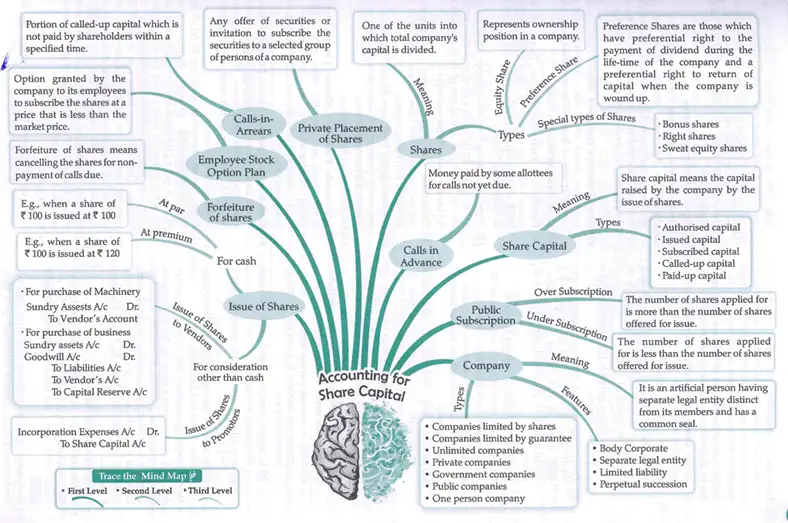
A company is an association of persons who contribute money or money's worth to a common inventory and use it for a common purpose. It is an artificial person having a corporate legal entity distinct from its members (shareholders) and has a common seal used for its signature. The company has special features distinguishing it from other forms of organization.
- Body is Corporate: A company is formed according to the provisions of law enforced from time to time. In India, companies are generally formed and registered under Companies Law, except banking and insurance companies which have separate laws.
- Separate Legal Entity: A company has a legal entity distinct from its members. It can hold and deal with property, enter into contracts, and open bank accounts in its own name.
- Limited Liability: The liability of members is limited to the unpaid amount on shares held by them. For companies limited by guarantee, liability is limited to the guarantee amount in case of winding up.
- Perpetual Succession: The company continues to exist irrespective of changes in membership. Death, insanity, or insolvency of members does not affect the company's existence.
- Common Seal: The company cannot sign by itself; it uses a common seal as its official signature. Documents without the common seal are not binding.
- Transferability of Shares: Shares of a public limited company are freely transferable without company or member consent, subject to the Articles of Association.
- May Sue or be Sued: A company can enter contracts and enforce rights in its own name.
Kinds of Companies: Companies are classified based on liability and number of members.
- Based on Liability:
- Companies Limited by Shares: Liability limited to nominal value of shares held (Joint Stock Company).
- Companies Limited by Guarantee: Liability limited to guarantee amount on winding up.
- Unlimited Companies: Members have unlimited liability; creditors can claim dues from members. Rare in India.
- Based on Number of Members:
- Public Company: Not a private company, minimum paid-up capital ₹5 lakh or more, not a subsidiary of a private company.
- Private Company: Minimum paid-up capital ₹1 lakh or more, restricts share transfer, limits members to 200 (excluding employees), prohibits public invitation for shares or deposits.
- One Person Company (OPC): Company with only one member, Indian citizen resident in India, cannot carry non-banking financial activities, paid-up capital not exceeding ₹50 lakh, turnover not exceeding ₹2 crore.
Shares and Classes of Shares
Share: As per Section 2(84) of the Companies Act, 2013, a share is a unit of share capital of a company. Capital is divided into shares of various denominations such as ₹100, ₹50, ₹10, ₹5, or ₹1.
Classes of Shares:
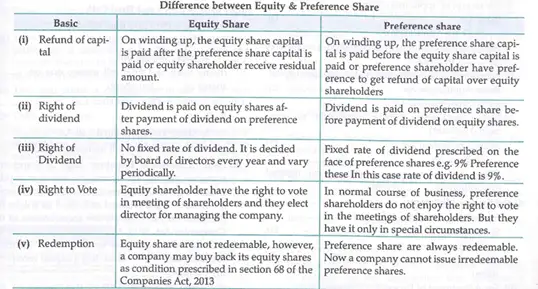
- Preference Shares: Carry preferential rights:
- Preferential right to fixed dividend before equity shareholders.
- Preferential right to repayment of capital on winding up before equity shareholders.
- Types of Preference Shares:
- On Arrears of Dividend:
- Cumulative Preference Shares: Right to receive arrears of dividend before equity dividend.
- Non-Cumulative Preference Shares: No right to arrears of dividend.
- On Share in Profits:
- Participating Preference Shares: Share in surplus profits after equity dividend.
- Non-Participating Preference Shares: Only fixed dividend, no share in surplus profits.
- On Convertibility:
- Convertible Preference Shares: Can be converted into equity shares.
- Non-Convertible Preference Shares: Cannot be converted.
- On Redemption:
- Redeemable Preference Shares: Repayable after fixed period or earlier at company option.
- Irredeemable Preference Shares: No maturity date; not permitted under Companies Act, 2013.
- On Arrears of Dividend:
- Equity Shares: Shares other than preference shares. Carry maximum risk and reward. Dividend is variable and depends on profits. Equity shareholders have voting rights.
Share Capital and Its Types
Share Capital: Capital raised by issuing shares.
Types of Share Capital:
- Authorised Capital: Maximum capital company can raise as per Memorandum of Association.
- Issued Capital: Portion of authorised capital issued to public.
- Unissued Capital: Portion of authorised capital not issued.
- Subscribed Capital: Portion of issued capital subscribed by public.
- Allotted Capital: Capital allotted to applicants; not exceeding issued or applied capital.
- Called-up Capital: Portion of allotted capital called for payment.
- Uncalled Capital: Portion of allotted capital not called for payment.
- Paid-up Capital: Portion of called-up capital actually paid by shareholders.
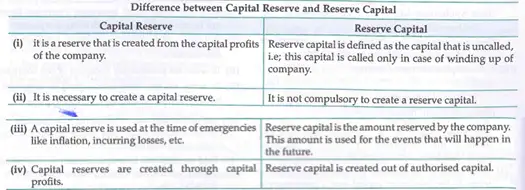
- Reserve Capital: Portion of subscribed capital not called up during lifetime; called up on liquidation by special resolution.
Other Terms:
- Private Placement: Sale of shares or bonds to pre-selected investors instead of open market.
- Employee Stock Option Plan (ESOP): Right given to employees to buy shares at a set price.
- Sweat Equity: Ownership interest given as compensation for hard work.
- Rights Issue: Invitation to existing shareholders to buy additional shares at discount.
Issue of Shares and Accounting Treatment
Shares can be issued in installments: application, allotment, first call, second call, final call. Full amount can also be called at application.
Steps in Share Issue:
- Issue of Prospectus
- Receipt of Applications
- Allotment of Shares
Accounting Treatment for Issue of Shares for Cash:
a. Issue of Shares at Par:
| At Application: |
| Bank A/c Dr. To Share Application A/c (Being application money received on shares) |
| Share Application A/c Dr. To Share Capital A/c (Being application money transferred to share capital) |
| Share Application A/c Dr. To Bank A/c (Being application money returned on rejected applications) |
| At Allotment: |
| Share Allotment A/c Dr. To Share Capital A/c (Being allotment due on shares) |
| Share Application A/c Dr. To Share Allotment A/c (Being excess application money adjusted against allotment) |
| Bank A/c Dr. To Share Allotment A/c (Being allotment money received) |
| At First Call: |
| Share First Call A/c Dr. To Share Capital A/c (Being first call money due) |
| Bank A/c Dr. To Share First Call A/c (Being first call money received) |
| At Second Call: |
| Share Second Call A/c Dr. To Share Capital A/c (Being second call money due) |
| Bank A/c Dr. To Share Second Call A/c (Being second call money received) |
| At Third and Final Call: |
| Share Third and Final Call A/c Dr. To Share Capital A/c (Being third and final call money due) |
| Bank A/c Dr. To Share Third and Final Call A/c (Being third and final call money received) |
b. Issue of Shares at Premium: Shares issued above face value. Premium credited to Securities Premium Reserve Account, a capital receipt.
Uses of Securities Premium Reserve (Section 52(2)):
- Issue fully paid bonus shares
- Write off preliminary expenses
- Write off commission or expenses on issue of shares/debentures
- Pay premium on redemption of preference shares or debentures
- Buy-back of equity shares and other securities
Journal Entries for Issue with Premium:
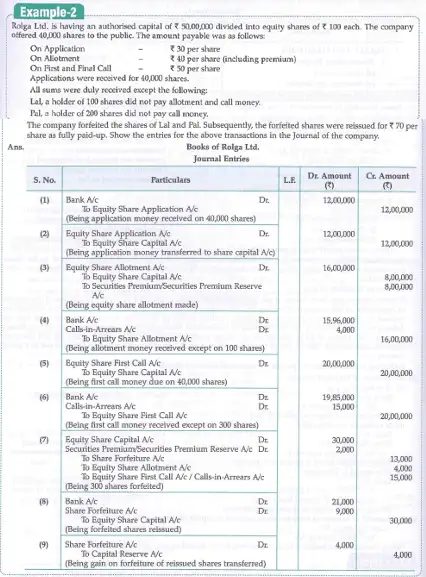
(1) For allotment due with premium:
Share Allotment A/c Dr.
To Share Capital A/c
To Securities Premium Reserve A/c
(Being amount due on share allotment with premium)
(2) For receipt of allotment money:
Bank A/c Dr.
To Share Allotment A/c
(Being share allotment money received)
Oversubscription and Under-subscription of Shares
Under-subscription: When shares applied for are less than shares offered. Minimum 90% application required or issue becomes void as per SEBI.
Oversubscription: When shares applied for exceed shares offered.
Options to deal with oversubscription:
- Full allotment to some applicants, reject others.
- Pro-rata allotment based on ratio of shares to be allotted to shares applied for.
- Combination of above two methods.
Calls-in-Advance and Calls-in-Arrears
Calls-in-Advance: Payment received before calls are made, authorized by Articles. Interest may be paid up to 12% per annum.
Journal Entries:
(1) Receipt of calls-in-advance:
Bank A/c Dr.
To Calls-in-Advance A/c
(Being amount received in advance)
(2) Adjustment of calls-in-advance:
Calls-in-Advance A/c Dr.
To Share Call A/c
(Being calls-in-advance adjusted against call)
Calls-in-Arrears: Unpaid calls after due date. Separate account may be opened.
Journal Entries:
(1) Unpaid on allotment:
Calls-in-Arrears A/c Dr.
To Share Allotment A/c
(Being amount unpaid on allotment)
(2) Unpaid on calls:
Calls-in-Arrears A/c Dr.
To Share Calls A/c
(Being amount unpaid on calls)
Issue of Shares for Consideration Other Than Cash
Shares may be issued for non-cash consideration such as assets or services. Number of shares issued = Amount payable / Issue price per share.
Cases:
(A) Issue to Promoters:
Incorporation Expenses A/c Dr.
To Share Capital A/c
(Being fully paid shares issued to promoters)
(B) Issue to Vendors:
(i) Purchase of assets on credit:
Sundry Assets A/c Dr.
To Vendor's A/c
(Being assets purchased on credit)
Purchase of business:
Sundry Assets A/c Dr.
Goodwill A/c Dr.
To Liabilities A/c
To Vendor's A/c
To Capital Reserve A/c
(Being business purchased)
(ii) Issuing shares to vendor:
At par:
Vendor's A/c Dr.
To Share Capital A/c
(Being fully paid shares issued to vendor)
At premium:
Vendor's A/c Dr.
To Share Capital A/c
To Securities Premium Reserve A/c
(Being shares issued to vendor at premium)
Forfeiture and Reissue of Shares
Forfeiture of Shares: When a member fails to pay allotment or calls within time, company may forfeit shares.
Accounting Treatment:
(1) Forfeiture of shares issued at par:
Share Capital A/c Dr. (called up amount)
To Share Allotment A/c (unpaid allotment)
To Share Calls A/c (unpaid calls)
To Shares Forfeiture A/c (amount received)
(2) Forfeiture of shares issued at premium:
(a) If premium not received:
Share Capital A/c Dr. (called up less premium)
Securities Premium Reserve A/c Dr. (premium called up)
To Share Allotment A/c
To Share Calls A/c
To Shares Forfeiture A/c (amount received)
(b) If premium received:
Share Capital A/c Dr. (called up amount)
To Share Allotment A/c
To Share Calls A/c
To Shares Forfeiture A/c (amount received less premium)
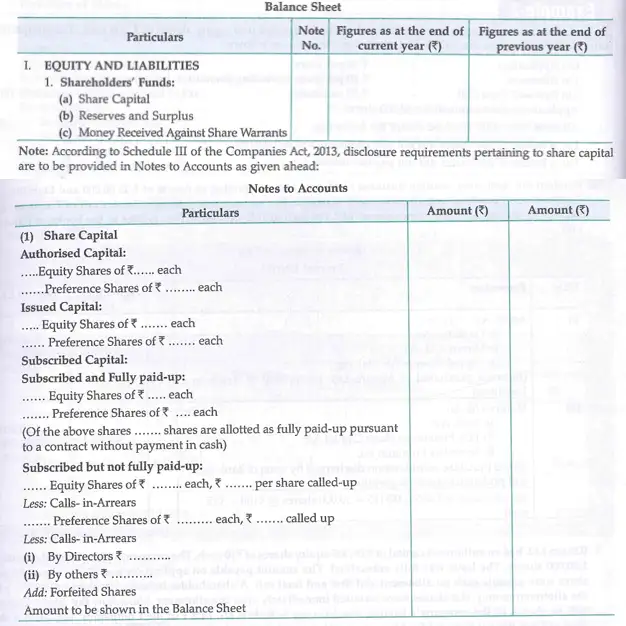
Balance in Shares Forfeiture Account is added to capital under 'Subscribed Share Capital' in Notes to Accounts.
Reissue of Forfeited Shares: May be reissued at par, premium, or discount. Discount on reissue debited to Shares Forfeiture Account. Balance transferred to Capital Reserve.
Journal Entries:
(1) Reissue at par:
Bank A/c Dr.
To Share Capital A/c
(Being forfeited shares reissued at par)
Reissue at discount:
Bank A/c Dr.
Shares Forfeiture A/c Dr.
To Share Capital A/c
(Being forfeited shares reissued at discount)
Reissue at premium:
Bank A/c Dr.
To Share Capital A/c
To Securities Premium Reserve A/c
(Being forfeited shares reissued at premium)
(2) Transfer balance of forfeited shares to capital reserve:
Shares Forfeiture A/c Dr.
To Capital Reserve A/c
(Being balance transferred to capital reserve)
Disclosure of Share Capital in Balance Sheet
As per Schedule III of Companies Act, 2013, share capital is disclosed under Shareholders' Funds in the Equity and Liabilities section of the Balance Sheet. Notes to Accounts provide details of types of shares, their face value, number of shares issued, paid-up, forfeited, and calls in arrears or advance.
Key Terms
- Share Premium: Amount received by company over and above face value of shares.
- Securities Premium Reserve: Capital reserve created from share premium, used for specified purposes under law.