CLASS 11-PCM . PHYSICS . PHYSICS PART I . LAWS OF-MOTION
Chapter 4 : LAWS OF MOTION
Ch 4
PHYSICS
CLASS 11-PCM
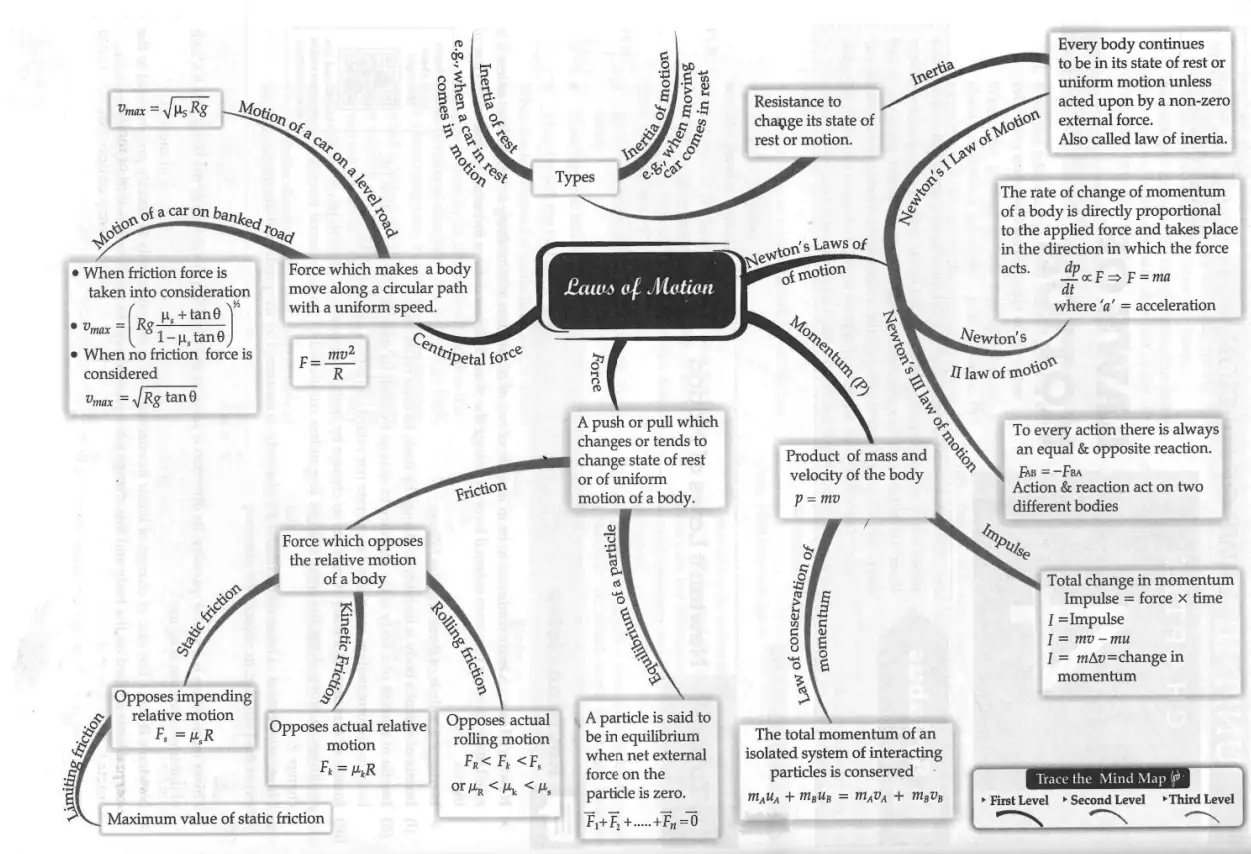
Newton's Laws
Newton's First Law
A body continues to be in its state of rest or of uniform motion along a straight line, unless it is acted upon by some non-zero external force to change the state. This law defines forces and is also called the law of inertia.
Types of Inertia
- Inertia of rest: The inability of a body to change its state of rest on its own.
- Inertia of motion: The inability of a body to change its state of uniform motion on its own; a body in uniform motion cannot accelerate or retard by itself and comes to rest only due to external forces.
- Inertia of direction: The inability of a body to change its direction of motion on its own; a body continues to move along the same straight line unless compelled by an external force to change it.
Linear Momentum
Linear momentum (p) of a body is the product of its mass (m) and velocity (v), expressed as p = m v. It is a vector quantity, having the same direction as the velocity. The SI unit of linear momentum is kilogram meter per second (kg m s−1).
Newton's Second Law
The rate of change of linear momentum of a body is directly proportional to the external force applied on it, and this change occurs in the direction of the applied force. Mathematically,
F ∝ dp/dt
or
F = dp/dt = m dv/dt = m a
where a is the acceleration of the body. This law is commonly written as F = m a.
Newton's Third Law
For every action, there is an equal and opposite reaction. The action and reaction forces act on different bodies and hence do not cancel each other.
Mathematically,
FAB = − FBA
where FAB is the force exerted on body A by body B, and FBA is the force exerted on body B by body A.
Principle of Conservation of Linear Momentum
In an isolated system, the vector sum of the linear momentum of all bodies remains constant, unaffected by their mutual interactions.
p = m1 v1 + m2 v2 + ... + mn vn = M vc.m. = constant
where M is the total mass and vc.m. is the velocity of the center of mass.
Rocket Propulsion
Rocket propulsion is based on the conservation of linear momentum and Newton's third law.
Let:
- M0 = Initial mass of the rocket
- ΔM/Δt = Rate of ejection of fuel
- M = Mass of rocket at any instant
- v = Relative velocity of ejected gases with respect to the rocket
Then, thrust on the rocket in absence of gravity is given by:
Thrust = (ΔM/Δt) × v
Acceleration of the rocket in absence of gravity:
a = (ΔM/Δt) × (v / M)
In presence of gravity, force and acceleration are:
F = (ΔM/Δt) × v − M g
a = (ΔM/Δt) × (v / M) − g
Solved Examples
Example 1: A body of mass 5 kg is moving with a velocity of 10 m/s. Calculate its linear momentum.
Solution:
Given, mass m = 5 kg, velocity v = 10 m/s
Linear momentum, p = m × v = 5 × 10 = 50 kg m/s
Answer: The linear momentum of the body is 50 kg m/s.
Example 2: A force of 20 N acts on a body of mass 4 kg. Calculate the acceleration produced.
Solution:
Given, force F = 20 N, mass m = 4 kg
Using Newton's second law, F = m a
Acceleration, a = F / m = 20 / 4 = 5 m/s2
Answer: The acceleration produced is 5 m/s2.
Practice Set
- Level 1: Define inertia and state its types.
- Level 2: Explain Newton's second law of motion with its mathematical expression.
- Level 3: A force of 50 N acts on a body of mass 10 kg. Calculate the acceleration produced and the change in momentum in 4 seconds.
Answer Key
Level 1: Inertia is the property of a body to resist change in its state of rest or uniform motion. Types: inertia of rest, inertia of motion, inertia of direction.
Level 2: Newton's second law states that the rate of change of momentum of a body is proportional to the applied force and occurs in the direction of the force. Mathematically, F = dp/dt = m a.
Level 3: Given F = 50 N, m = 10 kg
Acceleration, a = F/m = 50/10 = 5 m/s2
Change in momentum, Δp = F × time = 50 × 4 = 200 kg m/s
Friction and Circular Motion
Equilibrium of Concurrent Forces
Equilibrium occurs when the net external force on a particle is zero.
For concurrent forces F1, F2, F3, ..., the condition for equilibrium is:
F1 + F2 + F3 + ... = 0
Friction
Friction is the force opposing motion when one body moves or tries to move over another. It arises due to interlocking of surface irregularities and atomic forces at contact points.
Types of Friction
- Internal friction: Occurs between layers of a liquid; also called viscosity.
- External friction: Occurs between two solid bodies in contact; also called contact friction. It includes:
- Static friction: Opposes the start of motion.
- Limiting friction: Maximum static friction before motion starts.
- Kinetic friction: Opposes motion during sliding.
- Rolling friction: Opposes motion during rolling.
Laws of Limiting Friction
- The force of limiting friction is directly proportional to the normal reaction.
- Its direction is opposite to the direction of motion or intended motion.
- It is independent of the area of contact.
- It depends on the nature of the surfaces in contact.
Coefficient of Limiting Friction
Defined as the ratio of limiting friction force (F) to the normal reaction (R):
μ = F / R
Motion of Car on Banked Road
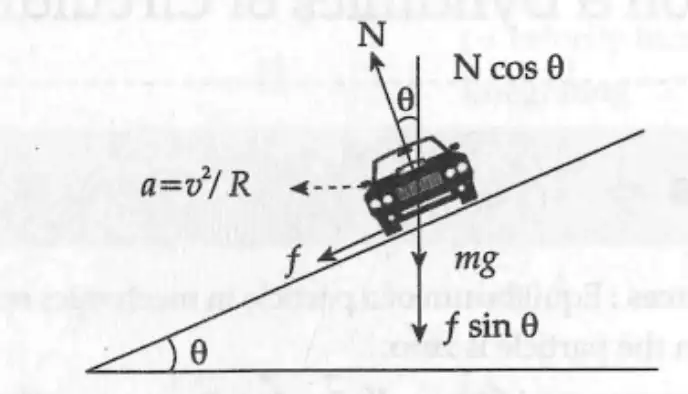
When a car moves on a curved banked road, centripetal force and friction act to keep it on the path.
Maximum speed on a flat road with friction:
Vmax = √(μs R g)
Maximum speed on a banked road with friction:
Vmax = √[ (R g (μs + tan θ)) / (1 − μs tan θ) ]
For frictionless banked road (μs = 0):
Vmax = √(R g tan θ)
Key Terms
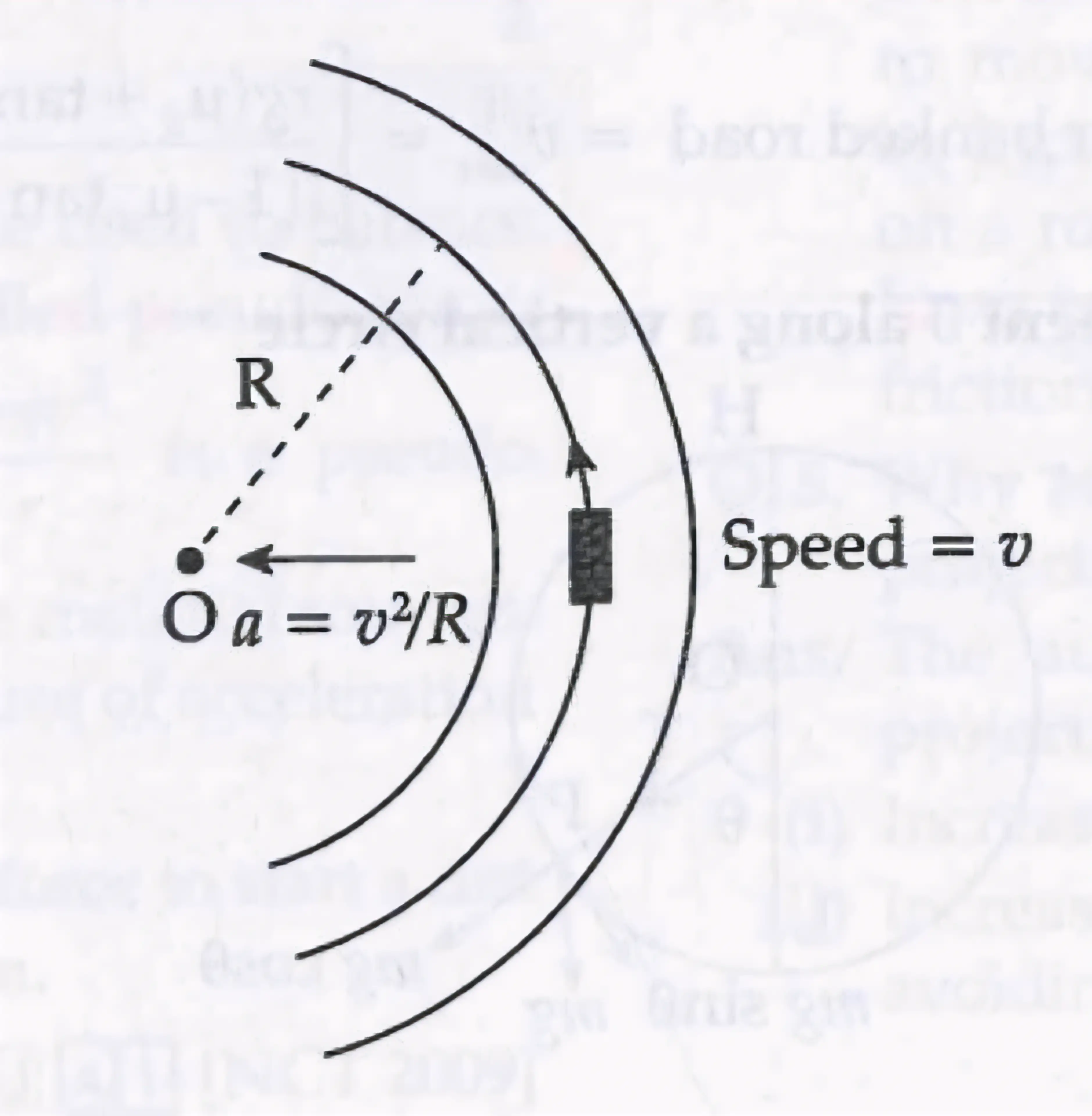
- Centripetal force: Force required to keep a body moving in a circle, directed towards the center.
- Angle of friction (θ): Angle between the resultant of friction and normal reaction and the normal reaction itself. tan θ = μ
- Angle of repose: Maximum angle of inclination at which a body remains in limiting equilibrium.
- Centrifugal force: Apparent force acting outward on a body moving in a circle, due to inertia.
Key Formulae
- tan θ = μ
- μ = F / R = tan θ
- Centripetal force = m v² / r = m r ω² = m r (2πν)²
- tan θ = v² / r g
- tan θ = h / √(b² − h²) = v² / r g
- Maximum speed on banked road: vmax = √[ r g (μs + tan θ) / (1 − μs tan θ) ]
Vertical Circular Motion
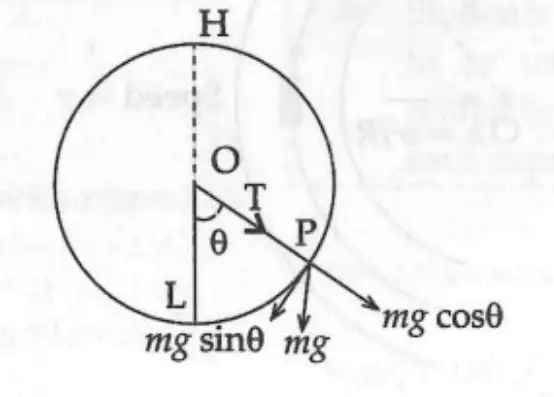
At any angular displacement θ along a vertical circle, the tension T in the string is:
T = (m v² / r) + m g cos θ
At the lowest point (θ = 0°):
TL = (m vL² / r) + m g
At the highest point (θ = 180°):
TH = (m vH² / r) − m g
Minimum velocity at highest point:
vH = √(g r)
Minimum velocity at lowest point:
vL = √(5 g r)
At θ = 90°:
v = √(3 g r)
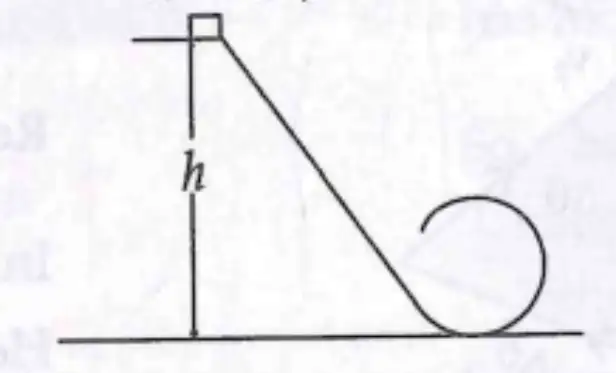
Height required for looping the vertical loop:
h = 5 r / 2
Solved Examples
Example 1: Calculate the maximum speed of a car on a flat road with coefficient of friction 0.4, radius 50 m, and g = 9.8 m/s².
Solution:
Vmax = √(μ R g) = √(0.4 × 50 × 9.8) = √196 = 14 m/s
Answer: The maximum speed is 14 m/s.
Example 2: Find the tension at the lowest point of a vertical circle for a 2 kg mass moving at 10 m/s with radius 5 m. Take g = 9.8 m/s².
Solution:
TL = (m v² / r) + m g = (2 × 10² / 5) + 2 × 9.8 = (2 × 100 / 5) + 19.6 = 40 + 19.6 = 59.6 N
Answer: The tension at the lowest point is 59.6 N.
Practice Set
- Level 1: Define friction and list its types.
- Level 2: State the laws of limiting friction.
- Level 3: Calculate the maximum speed of a car on a banked road with radius 100 m, coefficient of friction 0.3, and bank angle 15°.
Answer Key
Level 1: Friction is the force opposing motion between two surfaces. Types: internal (viscosity) and external (static, limiting, kinetic, rolling).
Level 2: Laws of limiting friction: proportional to normal reaction, opposite to motion, independent of contact area, depends on surface nature.
Level 3: Given R=100 m, μ=0.3, θ=15°
Vmax = √[ (R g (μ + tan θ)) / (1 − μ tan θ) ]
Calculate tan 15° ≈ 0.2679
Vmax = √[ 100 × 9.8 × (0.3 + 0.2679) / (1 − 0.3 × 0.2679) ]
Vmax = √[ 980 × 0.5679 / (1 − 0.0804) ] = √[ 556.54 / 0.9196 ] = √605.1 ≈ 24.6 m/s
Quick Reference Table
- Newton's First Law: Law of inertia; a body remains at rest or in uniform motion unless acted upon by an external force.
- Newton's Second Law: Force equals mass times acceleration, F = m a.
- Newton's Third Law: For every action, there is an equal and opposite reaction.
- Linear Momentum: p = m v, vector quantity with SI unit kg m s−1.
- Impulse: Impulse = Force × Time = m (v − u).
- Friction: Force opposing motion; types include static, limiting, kinetic, rolling.
- Centripetal Force: Force required to keep a body moving in a circle, directed towards the center.
- Coefficient of Friction: μ = F / R.
- Angle of Friction: tan θ = μ.
- Maximum speed on banked road: vmax = √[ r g (μ + tan θ) / (1 − μ tan θ) ].
Common Mistakes and Misconceptions
- Confusing inertia with force; inertia is a property, not a force.
- Forgetting that action and reaction forces act on different bodies and do not cancel.
- Assuming friction always opposes motion; static friction opposes the start of motion.
- Mixing up centripetal and centrifugal forces; centripetal force acts towards the center, centrifugal is apparent outward force.
- Neglecting the direction of vectors in momentum and force calculations.
Glossary
- Force: A push or pull that can change the state of motion of a body.
- Inertia: The property of a body to resist change in its motion.
- Momentum: Product of mass and velocity of a body.
- Impulse: Product of force and time during which force acts.
- Friction: Force opposing relative motion between surfaces.
- Centripetal Force: Force directed towards the center of circular motion.
- Coefficient of Friction: Ratio of frictional force to normal force.
- Angle of Repose: Maximum angle at which an object remains at rest on an inclined plane.