CLASS 11-PCM . MATHEMATICS . MATHEMATICS . TRIGONOMETRIC FUNCTIONS
Chapter 3 : Trigonometric Functions
Ch 3
MATHEMATICS
CLASS 11-PCM
Angle Measurement Systems
Angles can be measured using three different systems: Degree, Radian, and Centesimal.
Degree Measure
A right angle is divided into 90 equal parts called degrees (°). Each degree is further divided into 60 minutes (') and each minute into 60 seconds ("). Thus,
- 1° = 60'
- 1' = 60"
Radian Measure
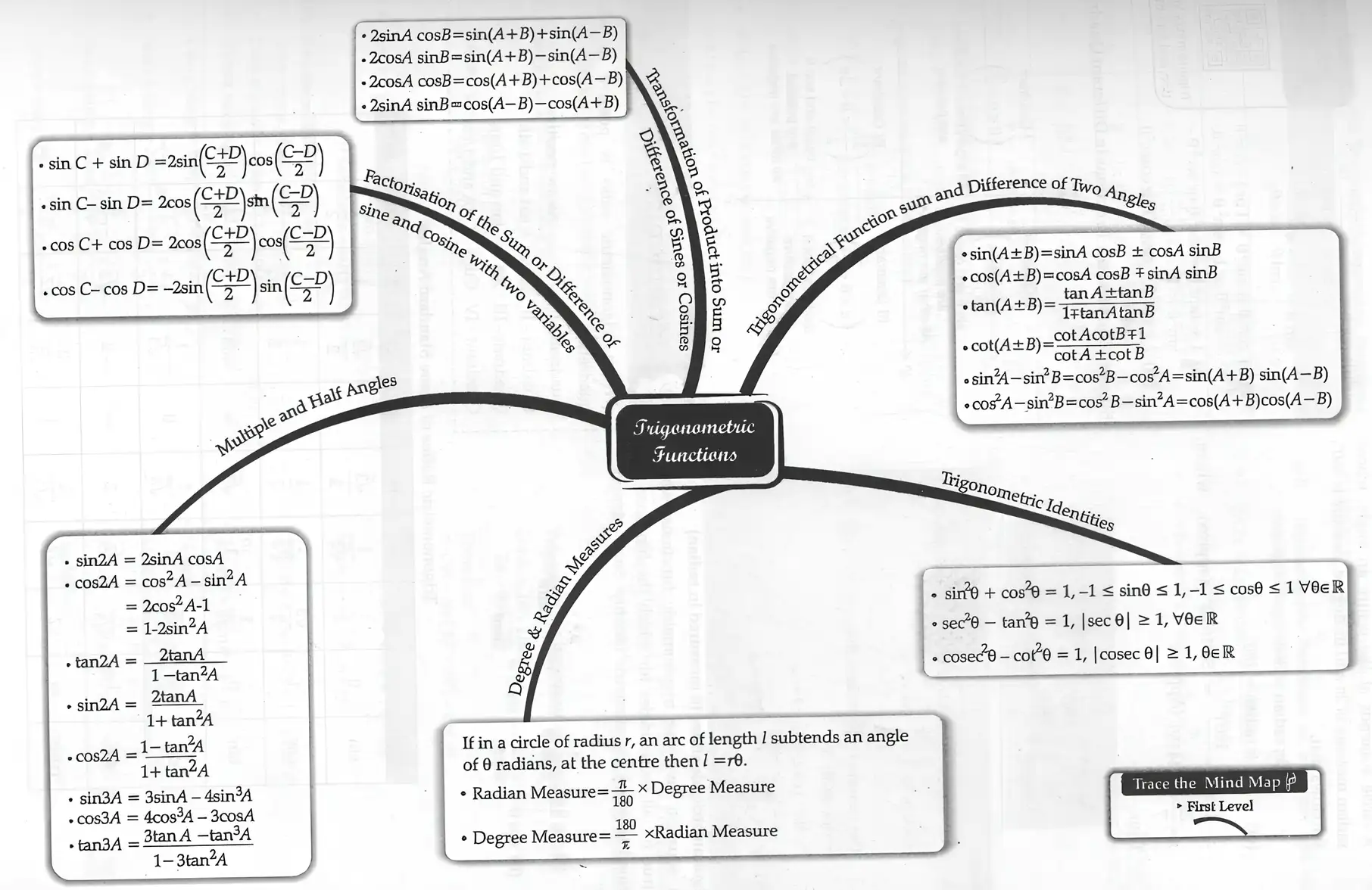
In a circle of radius \(r\), an arc of length \(l\) subtends an angle \(\theta\) radians at the center, given by:
\[ l = r \theta \implies \theta = \frac{l}{r} \]
Centesimal System
A right angle is divided into 100 grades, each grade into 100 minutes, and each minute into 100 seconds:
- 1 right angle = 100 grades
- 1 grade = 100 minutes
- 1 minute = 100 seconds
Relation Between Systems
The relation between degree (D), grade (G), and radian (R) measures is:
\[ \frac{D}{90} = \frac{G}{100} = \frac{2R}{\pi} \]
Since a full circle subtends \(2\pi\) radians or 360°, we have:
\[ 2\pi \text{ radians} = 360^\circ \implies \pi \text{ radians} = 180^\circ \]
Therefore,
- \(1 \text{ rad} = \frac{180^\circ}{\pi} \approx 57^\circ 16' 22''\)
- \(\text{Radian} = \frac{\pi}{180} \times \text{degree measure}\)
- \(\text{Degree} = \frac{180}{\pi} \times \text{radian measure}\)
Note:
- The angle between two consecutive digits on a clock is 30° (\(= \frac{\pi}{6}\) radians).
- The minute hand rotates through 6° in one minute.
- Radian is a constant angle.
- \(1^\circ = \frac{\pi}{180} \text{ rad} = 0.0176 \text{ rad}\)
Basic Trigonometric Identities
Trigonometric identities are equations involving trigonometric functions that hold true for all angles where the functions are defined.
Fundamental Identities
- \( \sin \theta = \frac{1}{\csc \theta} \quad \text{and} \quad \csc \theta = \frac{1}{\sin \theta} \)
- \( \cos \theta = \frac{1}{\sec \theta} \quad \text{and} \quad \sec \theta = \frac{1}{\cos \theta} \)
- \( \cot \theta = \frac{1}{\tan \theta} = \frac{\cos \theta}{\sin \theta} \quad \text{and} \quad \tan \theta = \frac{1}{\cot \theta} = \frac{\sin \theta}{\cos \theta} \)
- \( \cos^2 \theta + \sin^2 \theta = 1 \quad \Rightarrow \quad 1 - \cos^2 \theta = \sin^2 \theta \quad \text{and} \quad 1 - \sin^2 \theta = \cos^2 \theta \)
- \( 1 + \tan^2 \theta = \sec^2 \theta \quad \Rightarrow \quad \sec^2 \theta - \tan^2 \theta = 1 \)
- \( 1 + \cot^2 \theta = \csc^2 \theta \quad \Rightarrow \quad \csc^2 \theta - \cot^2 \theta = 1 \)
Sign of Trigonometric Functions in Different Quadrants
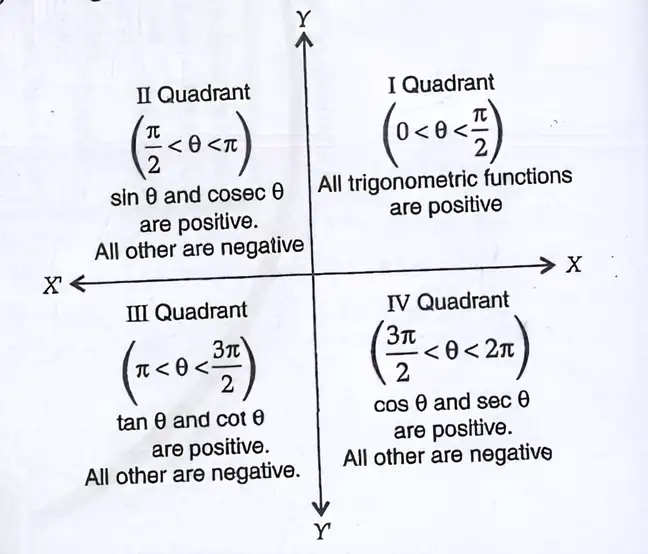
The coordinate plane is divided into four quadrants, each with specific signs for trigonometric functions:
- Quadrant I: \(0 < \theta < \frac{\pi}{2}\) — All functions are positive.
- Quadrant II: \(\frac{\pi}{2} < \theta < \pi\) — Only \(\sin \theta\) and \(\csc \theta\) are positive.
- Quadrant III: \(\pi < \theta < \frac{3\pi}{2}\) — Only \(\tan \theta\) and \(\cot \theta\) are positive.
- Quadrant IV: \(\frac{3\pi}{2} < \theta < 2\pi\) — Only \(\cos \theta\) and \(\sec \theta\) are positive.
Mnemonic to remember positive functions:
- Quadrant I: All
- Quadrant II: Silver (sin and cosec)
- Quadrant III: Tea (tan and cot)
- Quadrant IV: Cups (cos and sec)
Standard Trigonometric Ratios
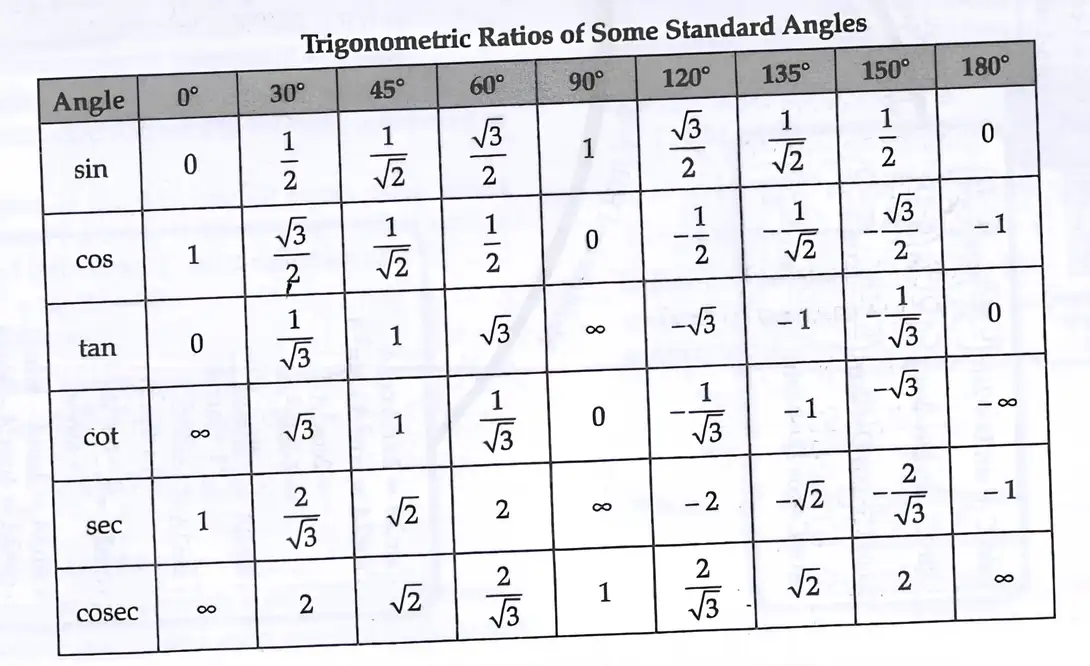
Values of trigonometric functions for standard angles are tabulated below:
Domain and Range of Trigonometric Functions
Compound Angle Formulas
Compound angle formulas express trigonometric functions of sums or differences of angles in terms of functions of individual angles.
Formulas
- \( \sin(x + y) = \sin x \cos y + \cos x \sin y \)
- \( \cos(x + y) = \cos x \cos y - \sin x \sin y \)
- \( \tan(x + y) = \frac{\tan x + \tan y}{1 - \tan x \tan y} \)
- \( \cot(x + y) = \frac{\cot x \cot y - 1}{\cot y + \cot x} \)
- \( \sin(x - y) = \sin x \cos y - \cos x \sin y \)
- \( \cos(x - y) = \cos x \cos y + \sin x \sin y \)
- \( \tan(x - y) = \frac{\tan x - \tan y}{1 + \tan x \tan y} \)
- \( \cot(x - y) = \frac{\cot x \cot y + 1}{\cot y - \cot x} \)
- \( \tan(x + y + z) = \frac{\tan x + \tan y + \tan z - \tan x \tan y \tan z}{1 - \tan x \tan y - \tan y \tan z - \tan z \tan x} \)
Note
- \( \sin(x + y) \sin(x - y) = \sin^2 x - \sin^2 y = \cos^2 y - \cos^2 x \)
- \( \cos(x + y) \cos(x - y) = \cos^2 x - \sin^2 y = \cos^2 y - \sin^2 x \)
Transformation Formulas
Transformation formulas convert sums or differences of sines and cosines into products, and vice versa.
- \( 2 \sin x \cos y = \sin(x + y) + \sin(x - y) \)
- \( 2 \cos x \sin y = \sin(x + y) - \sin(x - y) \)
- \( 2 \cos x \cos y = \cos(x + y) + \cos(x - y) \quad [x > y] \)
- \( 2 \sin x \sin y = \cos(x - y) - \cos(x + y) \)
- \( \sin x + \sin y = 2 \sin \left( \frac{x + y}{2} \right) \cos \left( \frac{x - y}{2} \right) \)
- \( \sin x - \sin y = 2 \cos \left( \frac{x + y}{2} \right) \sin \left( \frac{x - y}{2} \right) \)
- \( \cos x + \cos y = 2 \cos \left( \frac{x + y}{2} \right) \cos \left( \frac{x - y}{2} \right) \)
- \( \cos x - \cos y = -2 \sin \left( \frac{x + y}{2} \right) \sin \left( \frac{x - y}{2} \right) \)
Multiple and Half Angle Formulas
These formulas express trigonometric functions of multiple or half angles in terms of functions of the original angle.
Multiple Angle Formulas
- \( \sin 2x = 2 \sin x \cos x = \frac{2 \tan x}{1 + \tan^2 x} \)
- \( \cos 2x = \cos^2 x - \sin^2 x = 2 \cos^2 x - 1 = 1 - 2 \sin^2 x = \frac{1 - \tan^2 x}{1 + \tan^2 x} \)
- \( \tan 2x = \frac{2 \tan x}{1 - \tan^2 x} \)
- \( \sin 3x = 3 \sin x - 4 \sin^3 x \)
- \( \cos 3x = 4 \cos^3 x - 3 \cos x \)
- \( \tan 3x = \frac{3 \tan x - \tan^3 x}{1 - 3 \tan^2 x} \)
Half Angle Formulas
- \( \sin \frac{A}{2} = \pm \sqrt{ \frac{1 - \cos A}{2} } \)
- \( \cos \frac{A}{2} = \pm \sqrt{ \frac{1 + \cos A}{2} } \)
- \( \tan \frac{A}{2} = \pm \sqrt{ \frac{1 - \cos A}{1 + \cos A} } \)
The sign depends on the quadrant in which \( \frac{A}{2} \) lies.
Trigonometric Functions of 18 Degrees
Let \( \theta = 18^\circ \). Using multiple angle formulas, we derive \( \sin 18^\circ \) and \( \cos 18^\circ \).
Since \( 2\theta = 90^\circ - 3\theta \),
\[ \sin 2\theta = \sin(90^\circ - 3\theta) = \cos 3\theta \]
Using the triple angle formula for cosine,
\[ \sin 2\theta = 4 \cos^3 \theta - 3 \cos \theta \]
Express \( \sin 2\theta \) in terms of \( \sin \theta \):
\[ 2 \sin \theta = 4 \cos^2 \theta - 3 = 4(1 - \sin^2 \theta) - 3 = 4 - 4 \sin^2 \theta - 3 = 1 - 4 \sin^2 \theta \]
Rearranged as a quadratic in \( \sin \theta \):
\[ 4 \sin^2 \theta + 2 \sin \theta - 1 = 0 \]
Solving for \( \sin \theta \):
\[ \sin \theta = \frac{-2 \pm \sqrt{4 + 16}}{8} = \frac{-1 \pm \sqrt{5}}{4} \]
Since \( \sin 18^\circ > 0 \),
\[ \sin 18^\circ = \frac{\sqrt{5} - 1}{4} \]
Calculate \( \cos 18^\circ \):
\[ \cos 18^\circ = \sqrt{1 - \sin^2 18^\circ} = \sqrt{1 - \left( \frac{\sqrt{5} - 1}{4} \right)^2} = \sqrt{ \frac{10 + 2 \sqrt{5}}{16} } = \sqrt{ \frac{10 + 2 \sqrt{5}}{4} } \]
Using \( \cos 36^\circ = 1 - 2 \sin^2 18^\circ \),
\[ \cos 36^\circ = 1 - 2 \left( \frac{\sqrt{5} - 1}{4} \right)^2 = 1 - \frac{6 - 2 \sqrt{5}}{8} = \frac{2 + 2 \sqrt{5}}{8} = \frac{\sqrt{5} + 1}{4} \]
Calculate \( \sin 36^\circ \):
\[ \sin 36^\circ = \sqrt{1 - \cos^2 36^\circ} = \sqrt{1 - \left( \frac{\sqrt{5} + 1}{4} \right)^2} = \sqrt{ \frac{10 - 2 \sqrt{5}}{16} } \]