CLASS 11-PCM . CHEMISTRY . CHEMISTRY PART II . ORGANIC CHEMISTRY-SOME-BASIC-PRINCIPLES-AND-TECHNIQUE
Chapter 8 : Organic Chemistry – Some Basic Principles And Technique
Ch 8
CHEMISTRY
CLASS 11-PCM
Introduction
Organic compounds are primarily composed of carbon and hydrogen atoms, including hydrocarbons and their derivatives. The study of these compounds is known as organic chemistry. Historically, organic chemistry was defined as the chemistry of substances found in living organisms, but this definition expanded after the synthesis of urea in the laboratory by F. Wöhler in 1828, disproving the vital force theory.
Organic compounds exhibit diverse physical states such as gases, liquids, and solids. They are generally covalent, resulting in low melting and boiling points, solubility in organic solvents, volatility, inflammability, and lack of electrical conductivity due to absence of free ions. They often possess distinct colors and odors.
The vast number of organic compounds arises mainly due to carbon's unique properties: catenation (ability to form chains and rings), tetravalency (forming four bonds), and small atomic size, which contributes to the stability of organic molecules.
Carbon atoms can form single, double, and triple bonds with bond lengths and angles varying accordingly: sp³ hybridized carbon has bond angles of 109°28′, sp² has 120°, and sp has 180°. Bond lengths decrease and bond strength increases from single to triple bonds.
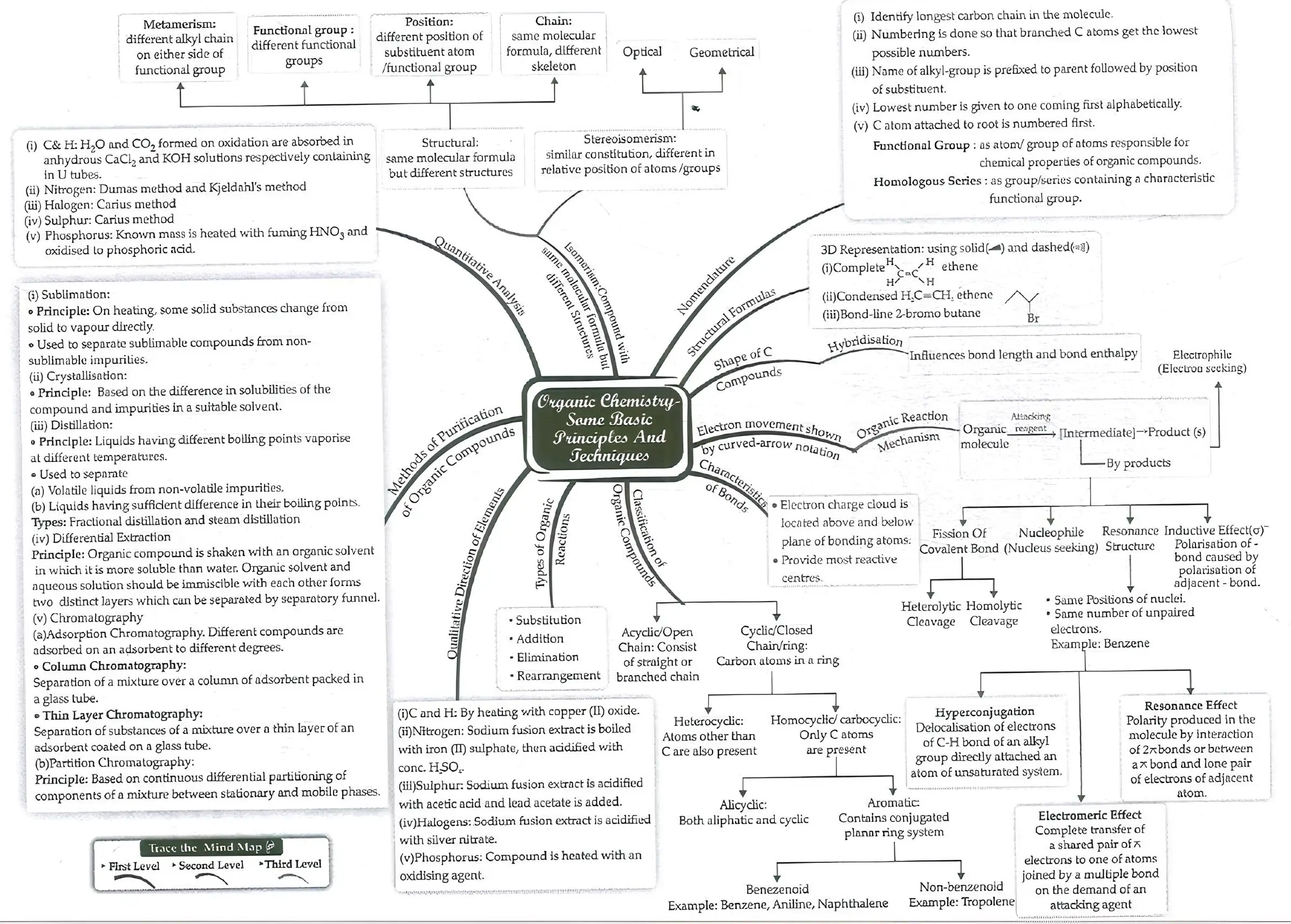
A detailed mind map organizes the basic principles and techniques of organic chemistry, including nomenclature, reaction types, classification, purification methods, quantitative analysis, isomerism, and special molecular effects such as resonance and hyperconjugation.
Carbon forms straight, branched, and ring structures, contributing to the diversity of organic compounds.
Solved Examples
Example 1: Explain why carbon forms a large number of compounds.
Solution: Carbon exhibits catenation, the ability to form chains and rings by bonding with other carbon atoms. It is tetravalent, allowing it to form four bonds with other atoms. Its small atomic size leads to strong covalent bonds and stable compounds. These properties enable carbon to form a vast variety of organic compounds.
Example 2: What are the bond angles in sp³, sp², and sp hybridized carbon atoms?
Solution: The bond angles are approximately 109°28′ for sp³ hybridized carbon, 120° for sp² hybridized carbon, and 180° for sp hybridized carbon.
Practice Set
- Level 1: Define organic compounds and state one property of organic compounds.
- Level 2: Explain the term catenation and its significance in organic chemistry.
- Level 3: Compare the bond lengths and bond strengths of C–C, C=C, and C≡C bonds.
Answer Key
- Level 1: Organic compounds are compounds mainly composed of carbon and hydrogen. One property is that they are generally volatile and inflammable.
- Level 2: Catenation is the ability of an element to form bonds with atoms of the same element, forming chains or rings. Carbon shows maximum catenation, leading to a large number of organic compounds.
- Level 3: Bond lengths decrease from C–C (1.54 Å) to C=C (1.34 Å) to C≡C (1.20 Å). Bond strength increases in the order C–C < C=C < C≡C.
Classification
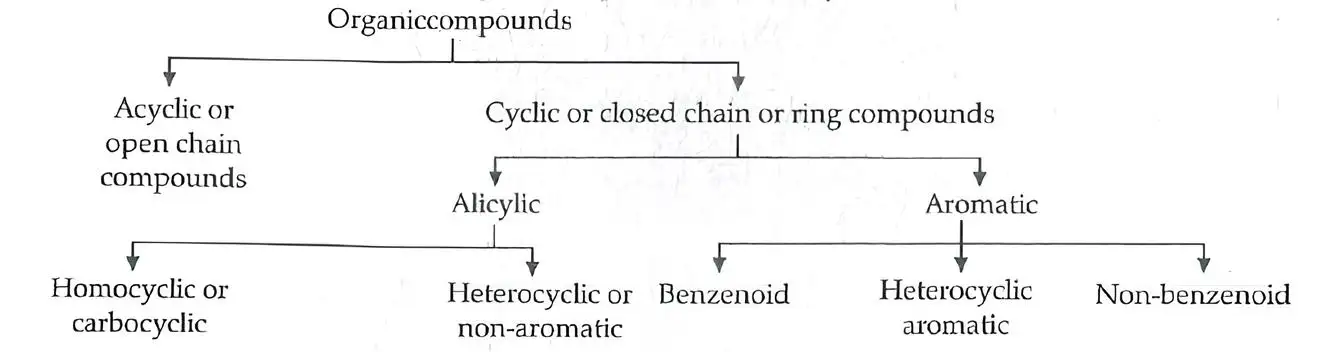
Organic compounds are broadly classified into acyclic (open chain) and cyclic (closed ring) compounds. Cyclic compounds are further divided into alicyclic (non-aromatic rings) and aromatic compounds. Alicyclic compounds include homocyclic (carbocyclic) rings composed only of carbon atoms and heterocyclic rings containing other elements.
This classification helps in understanding the structural diversity and properties of organic compounds.
The three-dimensional structure of organic molecules can be represented using wedge-and-dash notation, where solid wedges indicate bonds coming out of the plane towards the observer, and dashed wedges indicate bonds going away from the observer.
Functional groups are specific atoms or groups of atoms (e.g., –COOH, –CHO) responsible for the characteristic chemical properties of organic molecules. Double and triple bonds also act as functional groups.
Homologous series are families of structurally similar organic compounds with the same functional group, showing gradation in physical properties and similarity in chemical properties. Adjacent members differ by a –CH₂ group.
Solved Examples
Example 1: Classify the following compounds: benzene, cyclohexane, and pentane.
Solution: Benzene is an aromatic cyclic compound. Cyclohexane is an alicyclic (homocyclic) cyclic compound. Pentane is an acyclic (open chain) compound.
Example 2: What is a functional group? Give two examples.
Solution: A functional group is an atom or group of atoms responsible for the chemical properties of a molecule. Examples include –OH (hydroxyl group) and –COOH (carboxyl group).
Practice Set
- Level 1: Define homologous series.
- Level 2: Explain the difference between alicyclic and aromatic compounds.
- Level 3: Describe the wedge-and-dash representation of organic molecules.
Answer Key
- Level 1: Homologous series is a family of organic compounds with the same functional group and similar chemical properties, differing by –CH₂ group between members.
- Level 2: Alicyclic compounds are non-aromatic rings, while aromatic compounds contain benzene-like rings with special stability.
- Level 3: Wedge-and-dash notation uses solid wedges to show bonds coming out of the plane towards the observer and dashed wedges for bonds going away from the observer.
Nomenclature
Before the IUPAC system, organic compounds were named based on their source or common names. The IUPAC system standardizes naming with three parts: word root, suffix, and prefix.
The word root indicates the number of carbon atoms in the longest chain. The suffix has two types: primary suffix indicating the type of bond (single, double, triple) and secondary suffix representing the functional group.
Prefixes are of two types: primary prefixes like 'cyclo' for cyclic compounds, and secondary prefixes for substituent functional groups such as fluoro, chloro, bromo, nitro, methyl, and methoxy.
When naming compounds with functional groups, the longest chain containing the functional group is numbered to give the functional group the lowest possible number. In polyfunctional compounds, the principal functional group is selected based on a priority order, for example: –COOH > –SO₃H > –COOR > –COCl > –CONH₂ > –CN > –CHO > >C=O > –OH > –NH₂ > >C=C< > –C≡C–.
This table lists various classes of organic compounds, their functional groups, IUPAC prefixes and suffixes, and examples, aiding systematic naming and classification.
Mnemonics help remember concepts such as functional group priority, carbon chain names, and bond enthalpy order.
Solved Examples
Example 1: Name the compound with the formula CH₃CH₂CH₂OH using IUPAC nomenclature.
Solution: The longest chain has three carbon atoms (prop-), and the functional group is –OH (alcohol), so the suffix is -ol. The compound is named propan-1-ol.
Example 2: What is the prefix used for a cyclic compound?
Solution: The prefix 'cyclo' is used to indicate cyclic compounds.
Practice Set
- Level 1: What is a functional group?
- Level 2: Explain the difference between primary and secondary suffixes in IUPAC nomenclature.
- Level 3: Name the compound with the formula CH₃CH=CH₂.
Answer Key
- Level 1: A functional group is an atom or group of atoms responsible for the chemical properties of a molecule.
- Level 2: Primary suffix indicates the type of bond; secondary suffix represents the functional group.
- Level 3: The compound is named propene (prop- root, -ene suffix for double bond).
Isomerism
Isomers are compounds with the same molecular formula but different physical and chemical properties due to differences in structure or spatial arrangement.
Structural isomerism involves different arrangements of atoms and includes chain isomerism (different carbon skeletons), position isomerism (different positions of substituents or functional groups), functional isomerism (different functional groups), and metamerism (different alkyl groups on either side of a functional group).
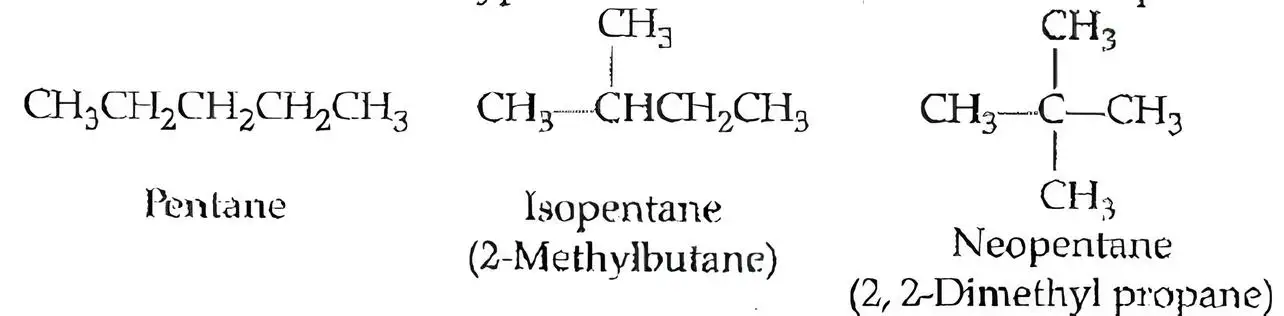
Examples of chain isomers of pentane illustrate different carbon skeletons.
Position isomers of propanol show different locations of the hydroxyl group.
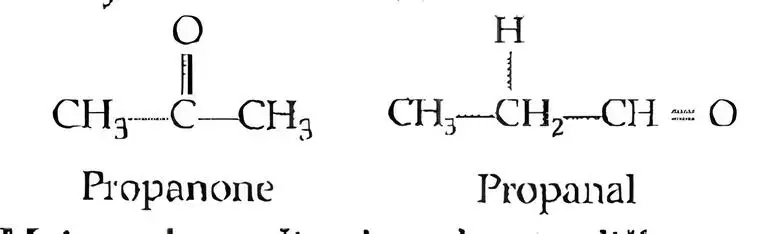
Functional isomers such as propanone (a ketone) and propanal (an aldehyde) differ in functional groups despite the same molecular formula.
Stereoisomerism involves compounds with the same connectivity but different spatial arrangements, including geometrical (cis-trans) and optical isomerism (non-superimposable mirror images called enantiomers).
Key terms include aliphatic compounds (straight or branched chains), alicyclic compounds (ring structures), and functional groups (atoms or groups responsible for chemical properties).
Solved Examples
Example 1: Differentiate between chain isomerism and position isomerism.
Solution: Chain isomerism occurs when compounds have the same molecular formula but different carbon skeletons. Position isomerism occurs when compounds have the same molecular formula but differ in the position of a substituent or functional group.
Example 2: What is optical isomerism?
Solution: Optical isomerism is a type of stereoisomerism where compounds have non-superimposable mirror images called enantiomers, differing in spatial arrangement but having the same connectivity.
Practice Set
- Level 1: Define isomerism.
- Level 2: List the types of structural isomerism.
- Level 3: Explain the difference between geometrical and optical isomerism.
Answer Key
- Level 1: Isomerism is the phenomenon where compounds have the same molecular formula but different structures or properties.
- Level 2: Types of structural isomerism include chain, position, functional group, and metamerism.
- Level 3: Geometrical isomerism differs in the spatial arrangement around a double bond; optical isomerism involves non-superimposable mirror images.
Reaction Mechanism
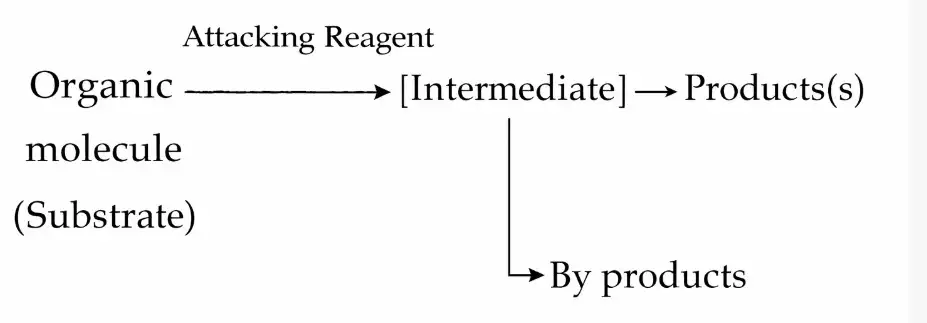
Organic reactions proceed through a sequence of steps involving electron movement, bond breaking, and bond formation, collectively called the reaction mechanism.
Bond cleavage can occur by homolytic fission, producing free radicals with unpaired electrons, or heterolytic fission, producing ions such as carbocations (positively charged carbon species) and carbanions (negatively charged carbon species).
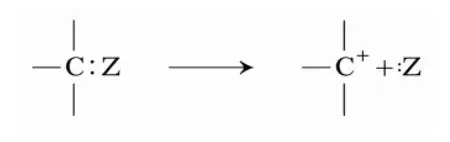
Free radical stability increases from primary to tertiary due to alkyl group effects.
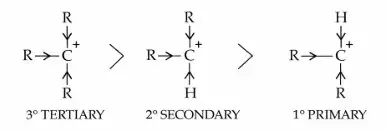
Carbocation stability also increases from primary to tertiary due to inductive effects.
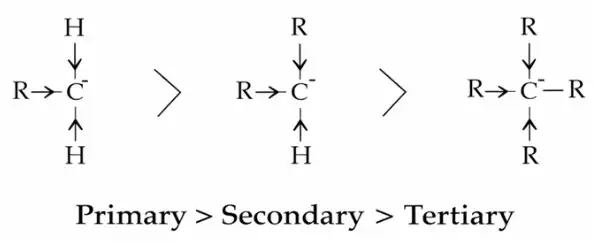
Carbanions are sp³ hybridized with pyramidal shape, and their stability decreases from primary to tertiary due to inductive effects.
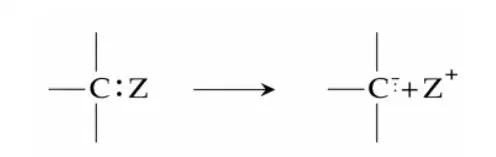
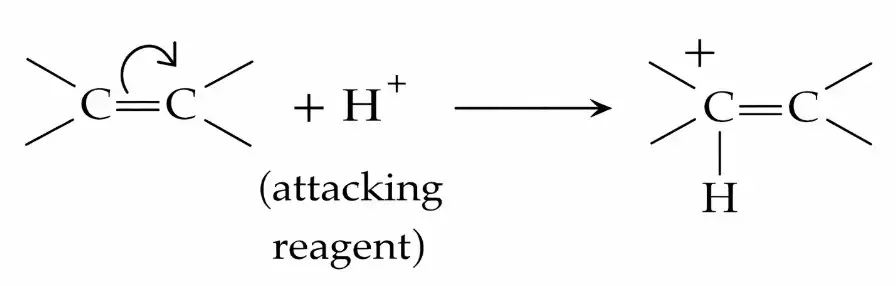
Electrophiles are electron-seeking reagents, while nucleophiles are electron-donating reagents.
Electron displacement effects in covalent bonds include inductive effect, electromeric effect, resonance (mesomeric) effect, and hyperconjugation.
Inductive effect involves electron displacement along a carbon chain due to electronegativity differences, with groups exhibiting +I (electron releasing) or –I (electron withdrawing) effects.
Electromeric effect is a temporary electron shift in multiple bonds upon attack by reagents, classified as positive (+E) or negative (–E) depending on electron movement direction.
Resonance effect involves electron delocalization through π-bonds or lone pairs, with groups showing positive (+R) or negative (–R) resonance effects.
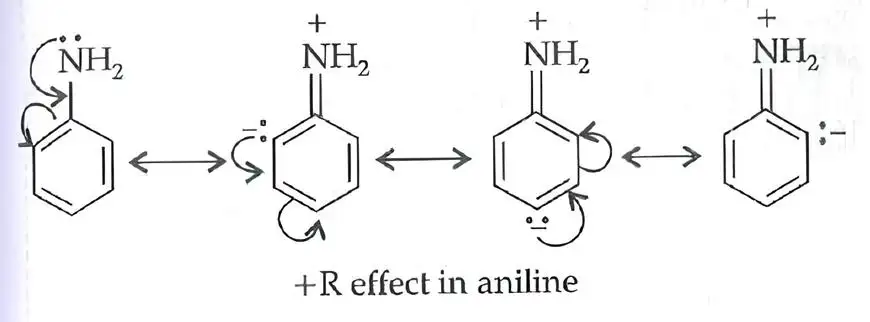
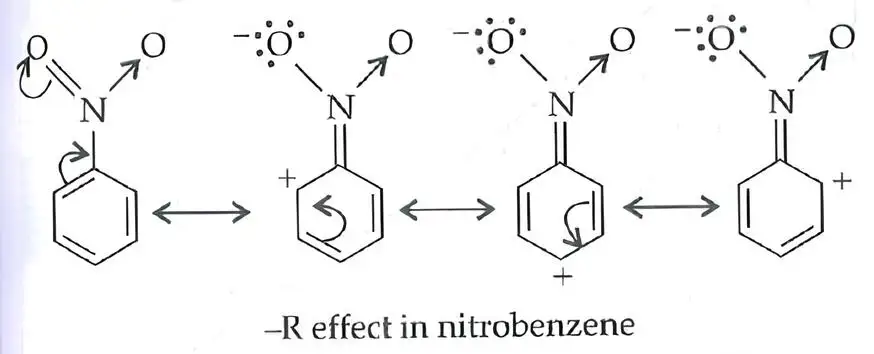
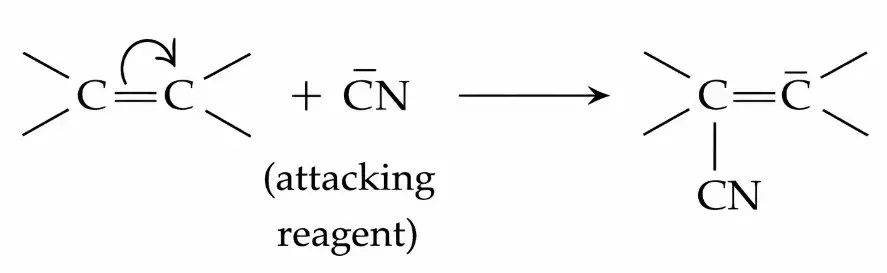
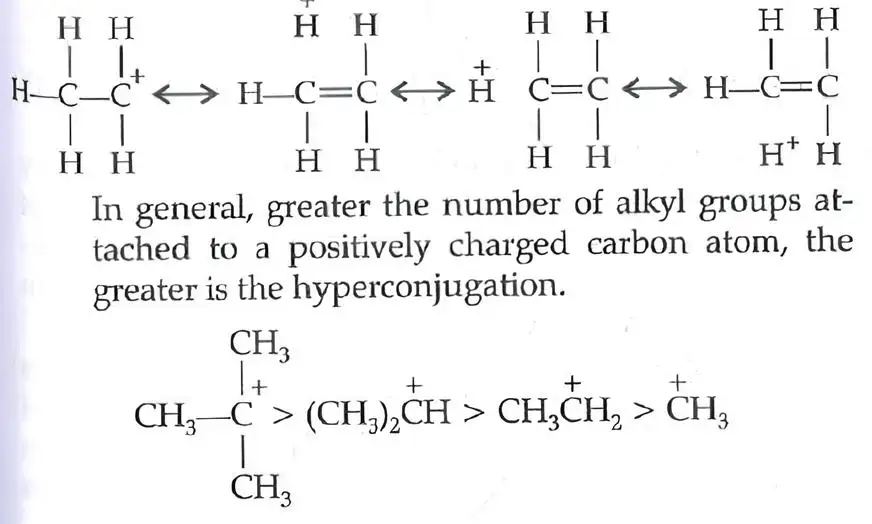
Hyperconjugation is the delocalization of σ electrons of C–H bonds adjacent to unsaturated systems or atoms with unshared p orbitals, stabilizing carbocations.
Types of organic reactions include substitution, addition, elimination, and rearrangement reactions.
Substitution reactions involve replacing an atom or group with another, addition reactions combine two molecules into one, elimination reactions remove atoms or groups to form unsaturation, and rearrangement reactions involve migration of atoms within a molecule.
Organic reactions can be ionic (heterolytic cleavage) or free radical (homolytic cleavage) in nature.
Solved Examples
Example 1: Differentiate between homolytic and heterolytic cleavage.
Solution: Homolytic cleavage splits a bond so that each atom gets one electron, forming free radicals. Heterolytic cleavage splits a bond so that one atom gets both electrons, forming ions (carbocations and carbanions).
Example 2: What is the inductive effect?
Solution: The inductive effect is the electron displacement along a carbon chain due to electronegativity differences, causing partial charges on atoms.
Practice Set
- Level 1: Define electrophile and nucleophile.
- Level 2: Explain the difference between homolytic and heterolytic bond cleavage.
- Level 3: Describe the resonance effect and give examples of groups showing +R and –R effects.
Answer Key
- Level 1: Electrophiles are electron-seeking reagents; nucleophiles are electron-donating reagents.
- Level 2: Homolytic cleavage produces free radicals by splitting electrons equally; heterolytic cleavage produces ions by one atom taking both electrons.
- Level 3: Resonance effect is electron delocalization through π-bonds or lone pairs. +R groups include –NH₂, –OH; –R groups include –NO₂, –COOH.
Purification
Organic compounds can be purified by various methods including sublimation, crystallization, distillation, differential extraction, and chromatography.
Sublimation is used for solids that vaporize without melting. Crystallization separates solids based on solubility differences. Distillation separates liquids based on boiling points, with techniques such as fractional distillation, reduced pressure distillation, and steam distillation.
Differential extraction separates compounds based on solubility differences between immiscible solvents. Chromatography separates mixture components based on their distribution between stationary and mobile phases, including adsorption chromatography (column and thin layer chromatography) and partition chromatography (paper chromatography).
Solved Examples
Example 1: What is fractional distillation and where is it used?
Solution: Fractional distillation separates liquids with close boiling points by passing vapors through a fractionating column, allowing better separation. It is used in petroleum refining to separate crude oil fractions.
Example 2: Explain the principle of chromatography.
Solution: Chromatography separates components of a mixture based on their different affinities between a stationary phase and a mobile phase, leading to separation as components move at different rates.
Practice Set
- Level 1: Define sublimation.
- Level 2: Describe the difference between adsorption and partition chromatography.
- Level 3: Explain steam distillation and its application.
Answer Key
- Level 1: Sublimation is the process where a solid changes directly to vapor without becoming liquid.
- Level 2: Adsorption chromatography separates based on adsorption to a solid stationary phase; partition chromatography separates based on solubility between two liquid phases.
- Level 3: Steam distillation purifies steam-volatile compounds immiscible with water by boiling the mixture; used for essential oils.
Qualitative Analysis
Organic compounds are analyzed qualitatively to detect elements such as carbon, hydrogen, nitrogen, sulfur, halogens, and phosphorus.
Carbon and hydrogen are detected by heating with cupric oxide, producing carbon dioxide and water, which are identified by lime water and anhydrous copper sulfate tests respectively.
Lassaigne’s test detects nitrogen, sulfur, halogens, and phosphorus by fusing the organic compound with sodium to convert covalent elements into ionic forms, followed by specific tests for each element.
Tests for nitrogen involve formation of Prussian blue color, sulfur tests include lead sulfide precipitate and sodium nitroprusside test, halogens are detected by silver halide precipitates, and phosphorus by formation of ammonium phosphomolybdate or magnesium pyrophosphate.
Solved Examples
Example 1: How is nitrogen detected in an organic compound?
Solution: Nitrogen is detected by fusing the compound with sodium, then treating the extract with ferrous sulfate and acid. The formation of Prussian blue color confirms nitrogen presence.
Example 2: What indicates the presence of sulfur in Lassaigne’s test?
Solution: A black precipitate of lead sulfide or violet color with sodium nitroprusside indicates sulfur presence.
Practice Set
- Level 1: What is Lassaigne’s test used for?
- Level 2: Describe the test for halogens in organic compounds.
- Level 3: Explain how phosphorus is detected qualitatively.
Answer Key
- Level 1: Lassaigne’s test detects nitrogen, sulfur, halogens, and phosphorus in organic compounds.
- Level 2: Halogens are detected by acidifying sodium fusion extract with nitric acid and adding silver nitrate to form characteristic silver halide precipitates.
- Level 3: Phosphorus is detected by oxidizing to phosphoric acid, then precipitating as ammonium phosphomolybdate or magnesium pyrophosphate, which are identified by color or weight.
Quantitative Analysis
Quantitative analysis determines the percentage composition of elements in organic compounds.
Carbon and hydrogen estimation involves combustion of a known mass of compound in excess oxygen and copper(II) oxide, producing carbon dioxide and water. The masses of these products are measured to calculate percentages.
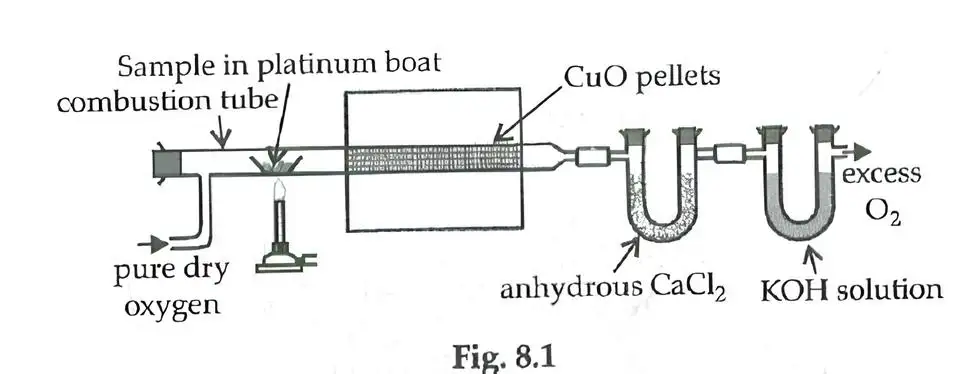
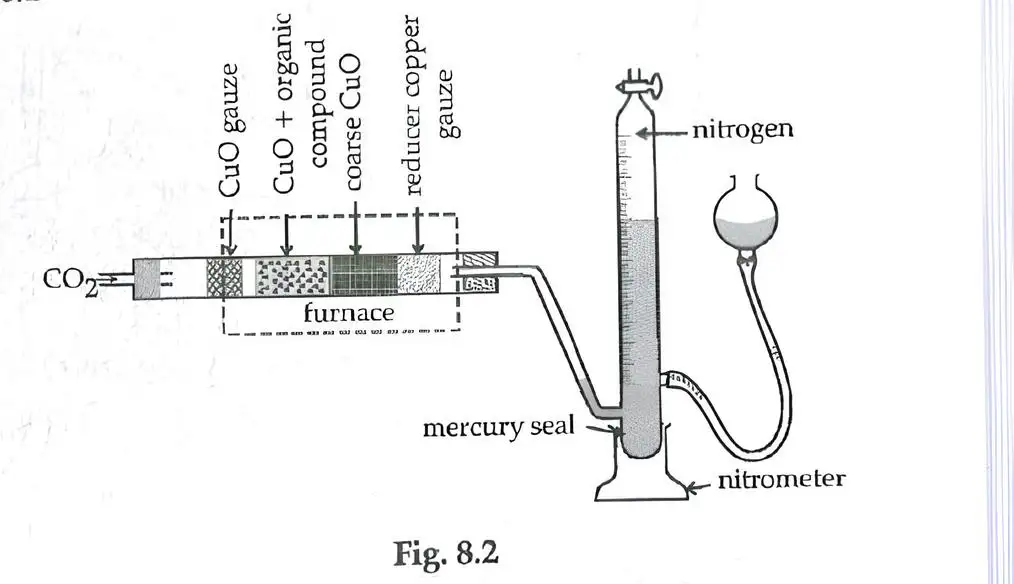
Formulas for percentage calculation are:
Percentage of carbon = (12 × mass of CO₂ × 100) / (44 × mass of compound)
Percentage of hydrogen = (2 × mass of H₂O × 100) / (18 × mass of compound)
Estimation of nitrogen can be done by Dumas method, where nitrogen gas is collected after heating with copper oxide, or Kjeldahl’s method, involving digestion with sulfuric acid and titration of liberated ammonia.
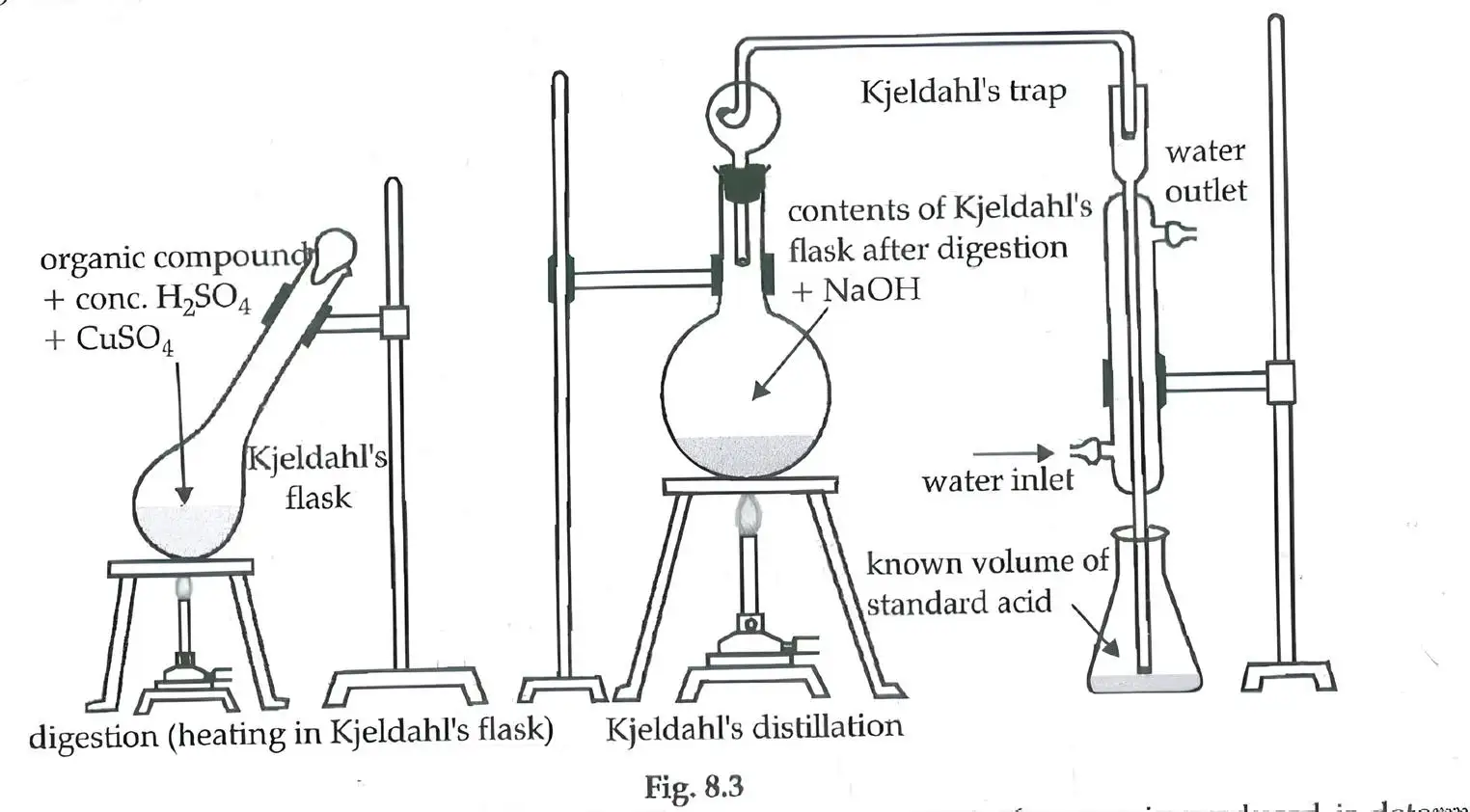
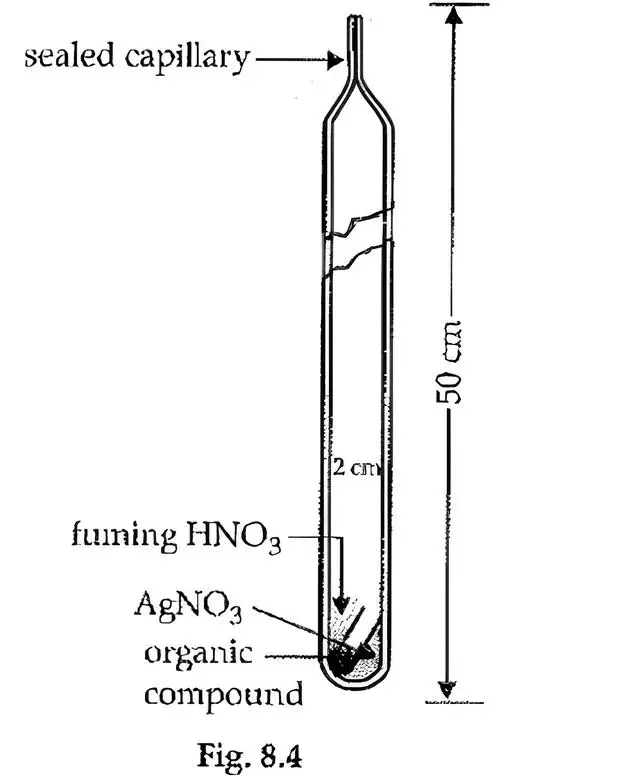
Halogens are estimated by Carius method, heating the compound with fuming nitric acid and silver nitrate, forming silver halides which are weighed.
Sulfur estimation involves oxidation to sulfuric acid and precipitation as barium sulfate, which is weighed.
Phosphorus estimation involves oxidation to phosphoric acid and precipitation as ammonium phosphomolybdate or magnesium pyrophosphate, followed by weighing.
Oxygen estimation is done by decomposing the compound in nitrogen stream, converting oxygen to carbon monoxide and then to carbon dioxide, measuring the amount produced.
Key terms include adsorption chromatography and mixed melting point, which help ascertain purity of organic compounds.
Purity is confirmed by physical constants such as melting point, boiling point, specific gravity, refractive index, and viscosity.
Mnemonics assist in remembering purification methods: Sublimation, Crystallisation, Distillation, Differential Extraction, Chromatography.
Solved Examples
Example 1: Calculate the percentage of carbon in an organic compound if 0.88 g of CO₂ is produced from 1 g of the compound.
Solution: Percentage of carbon = (12 × 0.88 × 100) / (44 × 1) = 24%
Example 2: Describe the Kjeldahl method for nitrogen estimation.
Solution: The organic compound is digested with concentrated sulfuric acid and catalyst to convert nitrogen to ammonium sulfate. After neutralization and distillation, ammonia is collected in acid and titrated to find nitrogen content.
Practice Set
- Level 1: What is the purpose of quantitative analysis in organic chemistry?
- Level 2: Explain the principle of the Carius method for halogen estimation.
- Level 3: How is oxygen estimated in an organic compound?
Answer Key
- Level 1: Quantitative analysis determines the percentage composition of elements in organic compounds.
- Level 2: The Carius method involves heating the compound with fuming nitric acid and silver nitrate to form silver halides, which are weighed to estimate halogens.
- Level 3: Oxygen is estimated by decomposing the compound in nitrogen stream, converting oxygen to CO and then CO₂, and measuring the amount of CO₂ produced.