CLASS 11-PCB . PHYSICS . PHYSICS PART I . WORK ENERGY-AND-POWER
Chapter 5 : WORK, ENERGY AND POWER
Ch 5
PHYSICS
CLASS 11-PCB
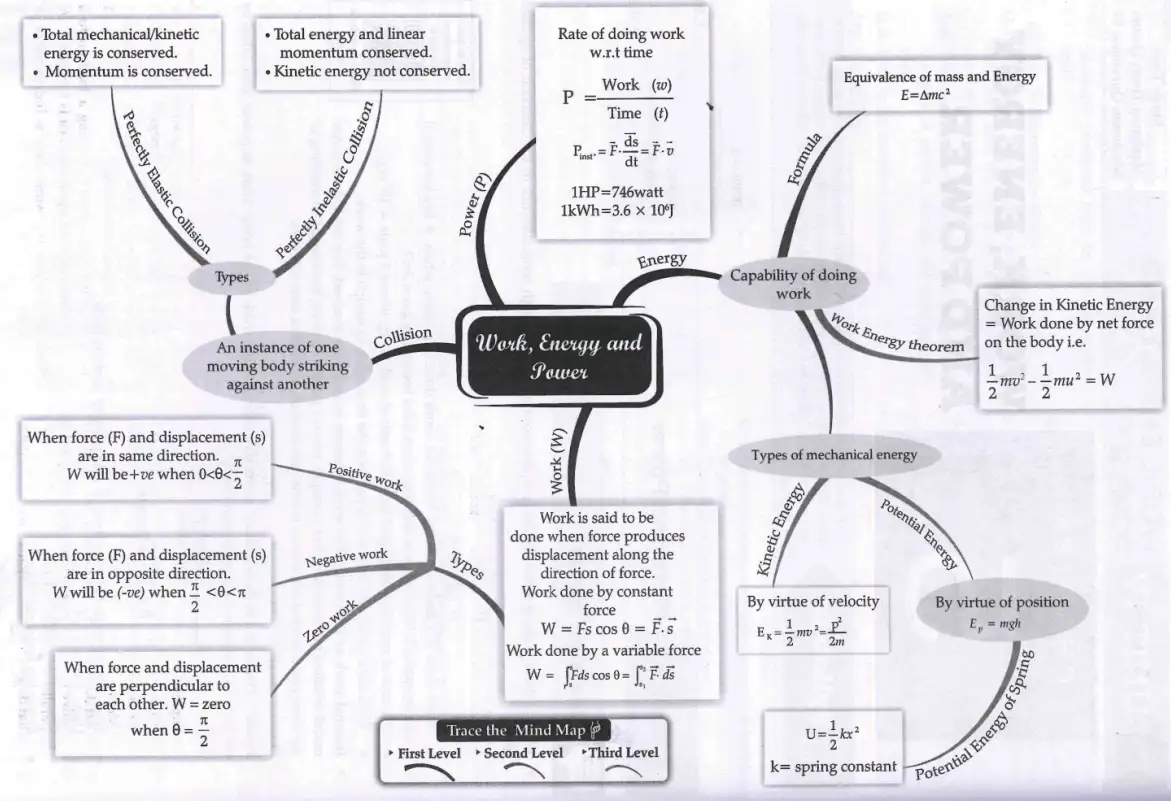
Work and Power
Definition of Work
Work is said to be done when a force causes displacement of a body in the direction of the applied force. Mathematically, work done \( W \) is given by the dot product of force \( \vec{F} \) and displacement \( \vec{s} \):
\[ W = \vec{F} \cdot \vec{s} = Fs \cos \theta \]
where \( \theta \) is the angle between the force and displacement vectors.
Properties of Work
- Work is a scalar quantity.
- Work done is positive when \( 0 \leq \theta < \frac{\pi}{2} \).
- Work done is negative when \( \frac{\pi}{2} < \theta \leq \frac{3\pi}{2} \).
- Work done is zero when force is perpendicular to displacement (\( \theta = 90^\circ \)).
- SI unit of work is joule (J), where 1 joule = 1 newton meter (N·m).
- CGS unit of work is erg, where 1 joule = 107 erg.
- Work done does not depend on the time taken to do the work.
Internal Work or Zero Work
Internal work refers to work done within the body, such as muscle strain, which does not result in displacement. For example, a person standing still carrying a load does zero external work but experiences internal work causing fatigue.
Dimensions of Work
Work has dimensions \( [ML^2T^{-2}] \).
Definition of Power
Power is the rate at which work is done. It measures how quickly work is performed.
Mathematically,
\[ P = \frac{\text{Work done}}{\text{Time taken}} = \frac{W}{t} \]
Alternatively, power can be expressed as the dot product of force and velocity:
\[ P = \vec{F} \cdot \vec{v} = Fv \cos \theta \]
where \( \theta \) is the angle between force and velocity vectors.
Properties of Power
- Power is a scalar quantity.
- SI unit of power is watt (W), where 1 watt = 1 joule per second (J/s).
- Dimensions of power are \( [ML^2T^{-3}] \).
Solved Examples
Example 1: Calculating Work Done
A force of 10 N is applied to move a box 5 m along the direction of the force. Calculate the work done.
Solution:
Given: \( F = 10 \text{ N}, s = 5 \text{ m}, \theta = 0^\circ \)
Work done, \( W = Fs \cos \theta = 10 \times 5 \times \cos 0^\circ = 50 \text{ J} \)
Example 2: Calculating Power
A machine does 200 J of work in 10 seconds. Find the power of the machine.
Solution:
Given: \( W = 200 \text{ J}, t = 10 \text{ s} \)
Power, \( P = \frac{W}{t} = \frac{200}{10} = 20 \text{ W} \)
Practice Set
- Level 1: Define work done and state its SI unit.
- Level 2: A force of 15 N acts at an angle of 60° to the displacement of 4 m. Calculate the work done.
- Level 3: A motor lifts a 50 kg load to a height of 10 m in 20 seconds. Calculate the power developed by the motor. (Take \( g = 9.8 \text{ m/s}^2 \))
Answer Key
- Level 1: Work done is the product of force and displacement in the direction of force. SI unit is joule (J).
- Level 2: Work done \( W = Fs \cos \theta = 15 \times 4 \times \cos 60^\circ = 15 \times 4 \times 0.5 = 30 \text{ J} \).
- Level 3: Work done \( W = mgh = 50 \times 9.8 \times 10 = 4900 \text{ J} \). Power \( P = \frac{W}{t} = \frac{4900}{20} = 245 \text{ W} \).
Energy and Collision
Definition of Energy
Energy is the capacity of a body to do work. It is a scalar quantity and has the same units and dimensions as work.
Units of Energy
- 1 calorie = 4.2 joules
- 1 kilowatt hour (kWh) = 3.6 × 10⁶ joules
- 1 electron volt (eV) = 1.6 × 10⁻¹⁹ joules
Work-Energy Theorem
The work done by the net force on a body is equal to the change in its kinetic energy:
\[ W = K_f - K_i \]
where \( K_f \) and \( K_i \) are the final and initial kinetic energies respectively.
Types of Collisions
When two bodies collide, they exchange energy and momentum. Collisions are classified as:
- Perfectly Elastic Collision: Total kinetic energy before and after collision remains the same. Example: collisions between atomic particles.
- Perfectly Inelastic Collision: Kinetic energy is not conserved; bodies stick together after collision. Linear momentum and total energy are conserved.
Key Terms
- Kinetic Energy (K.E.): Energy due to motion, always positive. \( K.E. = \frac{1}{2} mv^2 \)
- Potential Energy (P.E.): Energy due to position, can be positive or negative. \( P.E. = mgh \)
- Gravitational Potential Energy: Energy due to position relative to Earth’s center.
- Potential Energy of Spring: Energy stored due to compression or extension of a spring.
- Internal Energy: Energy due to molecular configuration.
- Coefficient of Restitution (e): Ratio of relative velocity after collision to that before collision.
Important Formulas
- \( K.E. = \frac{1}{2} mv^2 \)
- \( P.E. = mgh \)
- Velocity from height: \( v = \sqrt{2gh} \)
- Force in spring: \( F = -kx \)
- Mass-energy equivalence: \( E = mc^2 \)
- Coefficient of restitution: \( e = \frac{v_2 - v_1}{u_2 - u_1} \)
Elastic Collision in One Dimension
Velocities after collision:
\[ v_1 = \frac{m_1 - m_2}{m_1 + m_2} u_1 + \frac{2m_2}{m_1 + m_2} u_2 \]
\[ v_2 = \frac{2m_1}{m_1 + m_2} u_1 + \frac{m_2 - m_1}{m_1 + m_2} u_2 \]
Inelastic Collision in One Dimension
If \( u_2 = 0 \), velocity after collision:
\[ v = \frac{m_1 u_1}{m_1 + m_2} \]
Loss in Kinetic Energy
\[ \text{Loss in K.E.} = \frac{m_1 m_2 u_1^2}{2(m_1 + m_2)} \]
Solved Examples
Example 1: Calculating Kinetic Energy
A 2 kg object moves with a velocity of 3 m/s. Find its kinetic energy.
Solution:
\( K.E. = \frac{1}{2} mv^2 = \frac{1}{2} \times 2 \times 3^2 = 9 \text{ J} \)
Example 2: Coefficient of Restitution
Two bodies collide with velocities before collision \( u_1 = 5 \text{ m/s} \), \( u_2 = 2 \text{ m/s} \) and after collision \( v_1 = 3 \text{ m/s} \), \( v_2 = 4 \text{ m/s} \). Calculate the coefficient of restitution.
Solution:
\( e = \frac{v_2 - v_1}{u_1 - u_2} = \frac{4 - 3}{5 - 2} = \frac{1}{3} \approx 0.33 \)
Practice Set
- Level 1: Define kinetic energy and potential energy.
- Level 2: Calculate the potential energy of a 10 kg object raised to a height of 5 m. (Take \( g = 9.8 \text{ m/s}^2 \))
- Level 3: Two bodies of masses 3 kg and 2 kg move towards each other with velocities 4 m/s and 3 m/s respectively. They collide perfectly inelastically. Find their velocity after collision and the loss in kinetic energy.
Answer Key
- Level 1: Kinetic energy is the energy due to motion of a body. Potential energy is the energy due to position or configuration of a body.
- Level 2: \( P.E. = mgh = 10 \times 9.8 \times 5 = 490 \text{ J} \).
- Level 3: Velocity after collision \( v = \frac{m_1 u_1 + m_2 u_2}{m_1 + m_2} = \frac{3 \times 4 + 2 \times (-3)}{3 + 2} = \frac{12 - 6}{5} = 1.2 \text{ m/s} \) (direction of 3 kg mass).
Initial K.E. = \( \frac{1}{2} \times 3 \times 4^2 + \frac{1}{2} \times 2 \times 3^2 = 24 + 9 = 33 \text{ J} \).
Final K.E. = \( \frac{1}{2} \times 5 \times 1.2^2 = 3.6 \text{ J} \).
Loss in K.E. = 33 - 3.6 = 29.4 J.
Quick Reference Table
- Work: Work is done when a force causes displacement of a body in the direction of the force. Formula: W = F s cos \(\theta\). Unit: joule (J).
- Power: Power is the rate of doing work. Formula: P = \frac{W}{t} = F v cos \(\theta\). Unit: watt (W).
- Energy: Capacity to do work. Types include kinetic energy and potential energy. Units same as work.
- Work-Energy Theorem: Work done by net force equals change in kinetic energy: W = K_f - K_i.
- Types of Collisions: Perfectly elastic (kinetic energy conserved) and perfectly inelastic (kinetic energy not conserved, bodies stick together).
- Kinetic Energy: K.E. = \frac{1}{2} m v^2.
- Potential Energy: P.E. = mgh.
- Coefficient of Restitution (e): Ratio of relative velocity after collision to before collision: e = \frac{v_2 - v_1}{u_2 - u_1}.
- Mass-Energy Equivalence: E = mc^2.
Common Mistakes and Misconceptions
- Confusing work done with force applied: Work requires displacement in the direction of force, not just force application.
- Ignoring angle between force and displacement when calculating work; work depends on cos \(\theta\).
- Assuming power depends only on work done, ignoring time factor.
- Mixing up kinetic and potential energy definitions and formulas.
- Forgetting that kinetic energy is always positive, while potential energy can be positive or negative.
- Assuming kinetic energy is conserved in all collisions; it is conserved only in perfectly elastic collisions.
- Misapplying coefficient of restitution formula or confusing velocities before and after collision.
- Neglecting units and dimensions when calculating work, power, or energy.
Glossary
- Work: The product of force and displacement in the direction of the force.
- Power: The rate at which work is done.
- Energy: The capacity to do work.
- Kinetic Energy: Energy possessed by a body due to its motion.
- Potential Energy: Energy possessed by a body due to its position or configuration.
- Work-Energy Theorem: The work done by net force equals the change in kinetic energy.
- Perfectly Elastic Collision: Collision where kinetic energy is conserved.
- Perfectly Inelastic Collision: Collision where bodies stick together and kinetic energy is not conserved.
- Coefficient of Restitution: Ratio of relative velocity of separation to relative velocity of approach in a collision.
- Mass-Energy Equivalence: Principle stating mass can be converted into energy, expressed as E = mc^2.