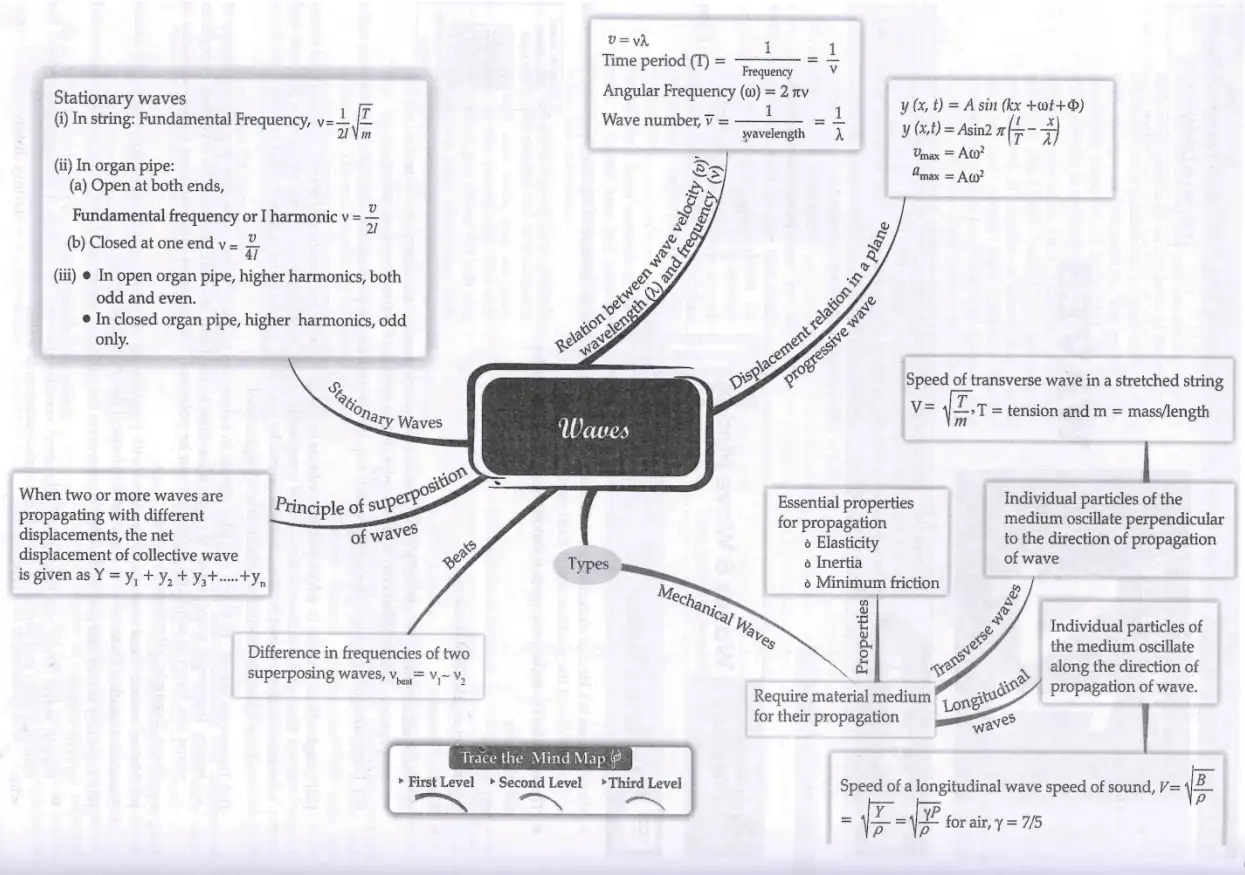
Waves Wave Motion
Wave Motion
Wave motion is a disturbance that travels through a medium due to repeated periodic vibrations of the particles of the medium about their mean position.
Medium Properties
The medium for wave propagation must have the following properties:
- Elasticity
- Inertia
- Minimum frictional resistance
Kinds of Waves
Waves are classified as follows:
- Mechanical Waves: Require a material medium for propagation. Examples include sound waves, waves on water surface, and waves on strings.
- Electromagnetic Waves: Do not require a medium for propagation. Examples include light waves and radio waves.
- Longitudinal Waves: Particles vibrate in the direction of wave propagation. These waves travel as compressions and rarefactions involving changes in pressure and volume. They require elasticity of volume. Example: Sound waves in air.
- Transverse Waves: Particles vibrate perpendicular to the direction of wave propagation. These waves travel as crests and troughs involving changes in shape. They require elasticity of shape. Example: Vibrations in strings.
- Matter Waves: Associated with constituents of matter such as electrons, protons, neutrons, atoms, and molecules, arising in quantum mechanics.
- Capillary Waves and Gravity Waves: Waves on the surface of water. Capillary waves have short wavelengths and are restored by surface tension. Gravity waves have longer wavelengths and are restored by gravity.
Laplace Correction
Sound waves in gases propagate adiabatically rather than isothermally because:
- Velocity of sound in gas is large.
- Gases are poor conductors of heat.
The velocity of sound in a gas is given by:
\[ v = \sqrt{\frac{B_a}{\rho}} \]
where \( B_a = \gamma P \) is the adiabatic bulk modulus, \( \rho \) is the density of the gas, and \( \gamma \) is the adiabatic index.
Parameters Related to Wave Motion
- Displacement: Distance of a particle from its mean position.
- Amplitude: Maximum displacement from equilibrium.
- Wavelength (\( \lambda \)): Distance between two consecutive points vibrating in the same phase.
- Angular Wave Number (\( k \)): Number of waves per unit length multiplied by \( 2\pi \).
- Frequency (\( \nu \)): Number of complete wavelengths passing a point per second.
- Time Period (\( T \)): Time taken for one complete vibration.
- Particle Velocity (\( u \)): Velocity of the particle executing simple harmonic motion, \( u = \frac{dx}{dt} \).
- Wave Velocity (\( v \)): Velocity at which disturbance travels through the medium, related by \( v = \nu \lambda = \frac{\lambda}{T} \).
- Phase: Quantity indicating the relative position of particles or waves in terms of angle, time, or distance.
Wave Equations
Longitudinal wave displacement:
\[ x = a \sin(\omega t \pm kx) \]
Transverse wave displacement:
\[ y = a \sin(\omega t \pm kz) \]
Particle velocity and wave velocity relation:
\[ u(x,t) = -v \frac{d}{dx} y(x,t) \]
Particle acceleration:
\[ a(x,t) = -\omega^2 y \]
Plane Progressive Wave
- Standard equation: \( y = r \sin \left( \frac{2\pi t}{T} - \frac{2\pi x}{\lambda} \right) \) or \( y = r \cos \left( \frac{2\pi t}{T} - \frac{2\pi x}{\lambda} \right) \)
- Angular frequency: \( \omega = \frac{2\pi}{T} \)
- Propagation constant: \( k = \frac{2\pi}{\lambda} \)
- Wave velocity: \( v = \nu \lambda = \frac{\lambda}{T} \)
- Particle velocity: \( u = \frac{dy}{dt} \), maximum \( u_{max} = r \omega \)
- Particle acceleration: \( a = \frac{d^2 y}{dt^2} \), maximum \( a_{max} = -\omega^2 r \)
- Phase: \( \phi = kx - \omega t + \varphi \)
Mnemonics for Wave Types
Teacher Punished Lazy Dog
- T - Transverse wave
- P - Perpendicular to direction of propagation
- L - Longitudinal wave
- D - Direction of propagation
If particles oscillate perpendicular to wave propagation, the wave is transverse; if along the direction, it is longitudinal.
Superposition Principle
Principle of Superposition
When two or more waves meet at a point, the resultant displacement is the algebraic sum of the individual displacements:
\[ y = y_1 + y_2 + \cdots + y_n \]
Related Phenomena
- Stationary Waves: Formed by superposition of two identical waves traveling in opposite directions, appearing stationary.
- Beats: Occur when two sound waves of nearly equal frequencies superimpose, causing periodic variations in intensity.
- Interference: When two waves of the same frequency travel simultaneously, resulting in points of constructive and destructive interference.
Laws of Vibrations of Stretched Strings
Fundamental frequency of a stretched string:
\[ \nu = \frac{1}{2L} \sqrt{\frac{T}{m}} = \frac{1}{L} \sqrt{\frac{T}{\pi \rho}} \]
- Law of Length: \( \nu \propto \frac{1}{L} \)
- Law of Tension: \( \nu \propto \sqrt{T} \)
- Law of Mass: \( \nu \propto \frac{1}{\sqrt{m}} \)
- Law of Diameter: \( \nu \propto \frac{1}{D} \)
- Law of Density: \( \nu \propto \frac{1}{\sqrt{\rho}} \)
Vibration of Air Columns
Closed Organ Pipe: Closed at one end and open at the other. Stationary longitudinal waves form with wavelengths and frequencies given by:
\[ \lambda = \frac{4L}{2m - 1} \]
\[ \nu = \frac{v}{4L} (2m - 1) \]
where \( m = 1, 2, 3, \ldots \)
Open Organ Pipe: Open at both ends. Stationary longitudinal waves form with:
\[ \lambda = \frac{2L}{m} \]
\[ \nu = \frac{v}{2L} m \]
where \( m = 1, 2, 3, \ldots \)