CLASS 11-PCB . PHYSICS . PHYSICS PART II . THERMODYNAMICS
Chapter 11 : Thermodynamics
Ch 11
PHYSICS
CLASS 11-PCB
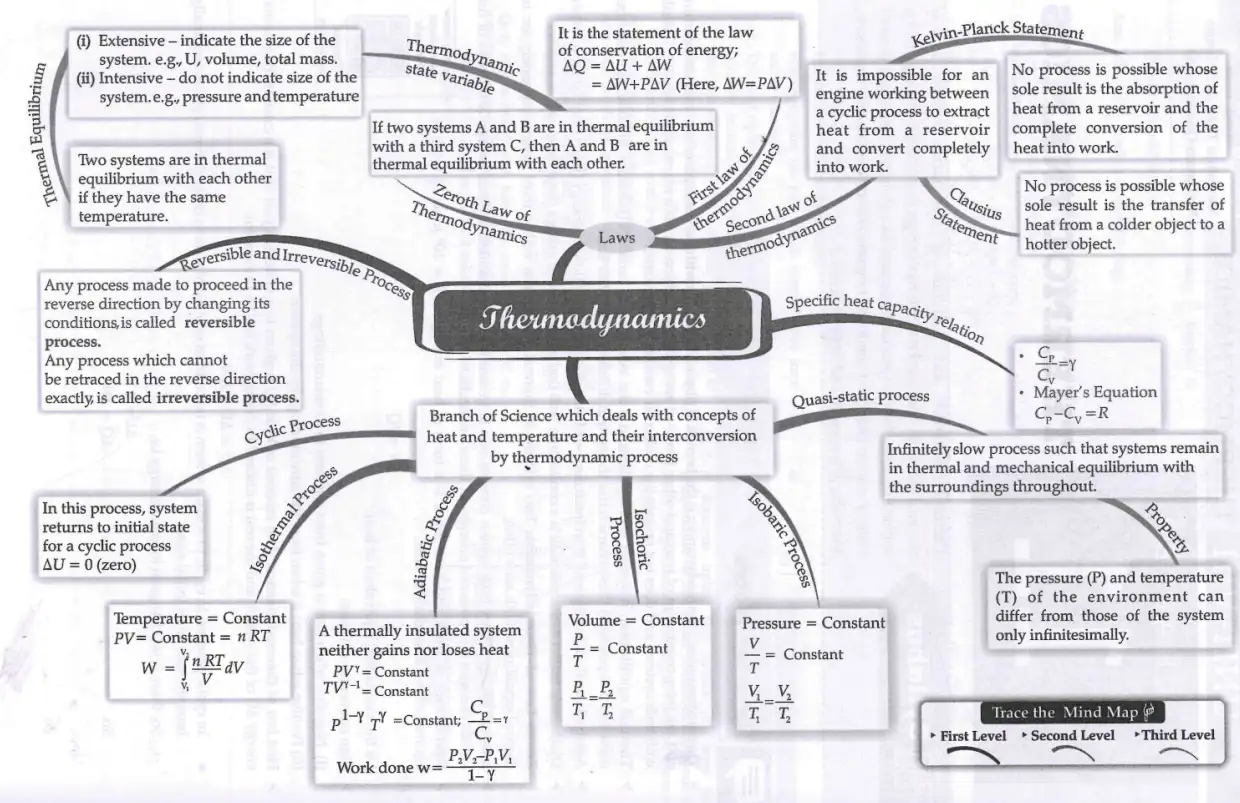
Thermodynamics
Definition and Scope
Thermodynamics is the branch of physics that deals with the concepts of heat and temperature and the inter-conversion of heat and other forms of energy. It is a macroscopic science that studies bulk systems without considering the molecular constitution of matter.
Thermal Equilibrium
A system is said to be in thermal equilibrium if its macroscopic variables such as pressure, volume, temperature, mass, and composition remain constant over time.
Types of Walls
Adiabatic wall: An insulating wall that does not allow the transfer of heat energy between systems.
Diathermic wall: A conducting wall that allows heat energy to flow between systems.
Zeroth Law of Thermodynamics
If two systems are each in thermal equilibrium with a third system, then they are in thermal equilibrium with each other.
Internal Energy
Internal energy of a system is the sum of the kinetic and potential energies of all the molecules in the system.
Equivalence of Work and Heat
Work is a form of energy equivalent to heat. The mechanical equivalent of heat is given by:
W = JQ
where J = 4.18 × 10³ J/kcal is the mechanical equivalent of heat.
Sign Convention of Heat
- Heat is negative when it is given out by the system to the surroundings.
- Heat is positive when it is absorbed by the system from the surroundings.
First Law of Thermodynamics
The first law states that when an amount of heat ΔQ is supplied to a system, part of it increases the internal energy ΔU and the rest is used to do work ΔW by the system:
ΔQ = ΔU + ΔW
Special Cases of First Law
Cyclic Process: The system returns to its initial state, so ΔU = 0 and hence ΔQ = ΔW.
Isobaric Process: Pressure remains constant. Work done is ΔW = PΔV, so ΔQ = ΔU + PΔV.
Isochoric Process: Volume remains constant. No work is done (ΔW = 0), so ΔQ = ΔU.
Isothermal Process: Temperature remains constant. For ideal gases, ΔU = 0, so ΔQ = ΔW.
Adiabatic Process: No heat exchange (ΔQ = 0), so ΔU = -ΔW.
Thermodynamic Processes
Isothermal Process: Temperature remains constant. Requires perfectly conducting walls and slow changes. Obeys Boyle's law: PV = constant.
Adiabatic Process: No heat exchange. Requires perfectly insulating walls and sudden changes. Obeys Poisson's law: PV^γ = constant.
Isobaric Process: Pressure remains constant. Heat absorbed changes internal energy and does work.
Isochoric Process: Volume remains constant. Heat absorbed changes internal energy only.
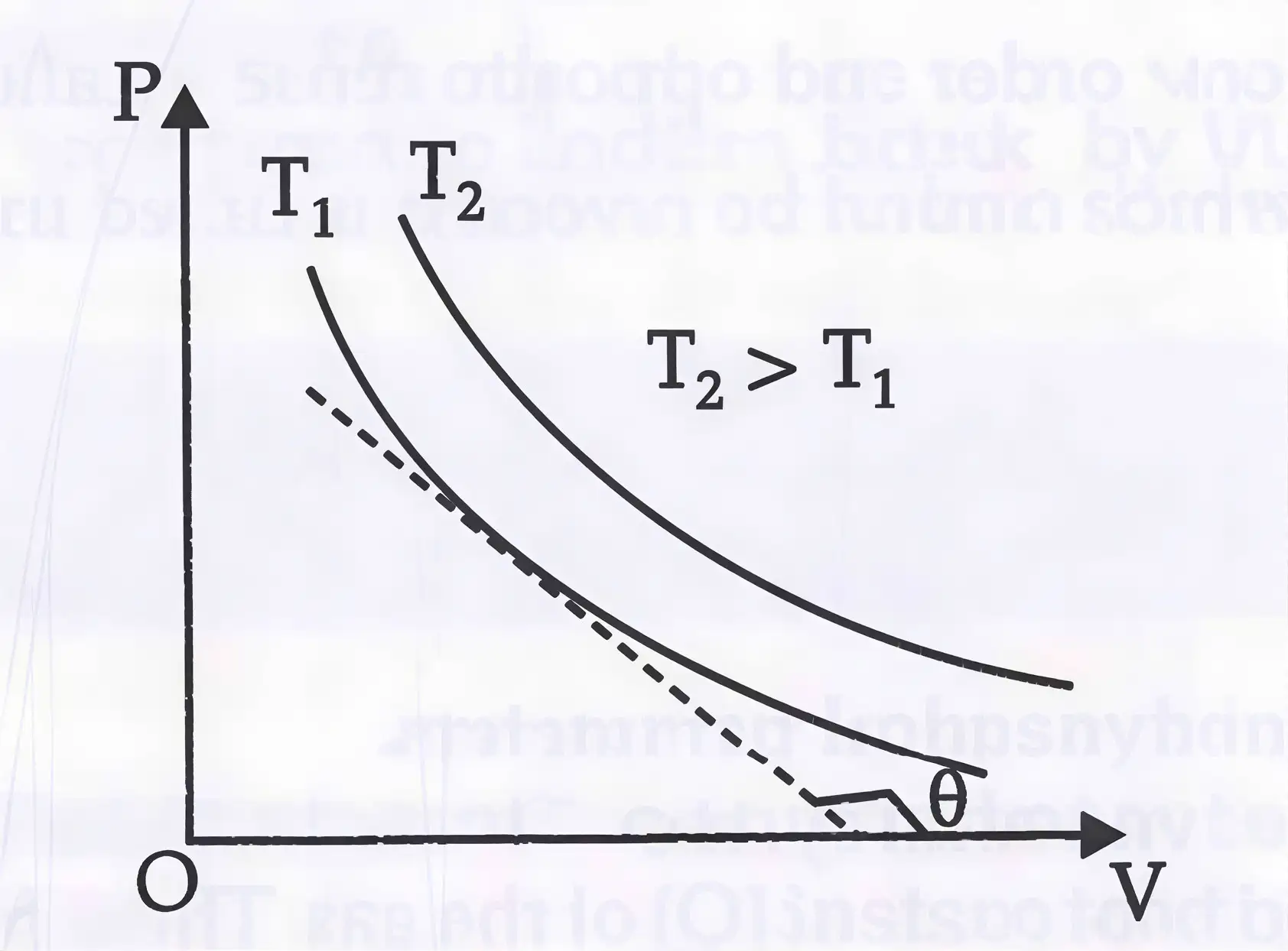
Work Done in Processes
Work done is the area under the pressure-volume curve.
For the same expansion, work done in isothermal process is greater than in adiabatic process.
For the same compression, work done in adiabatic process is greater than in isothermal process.
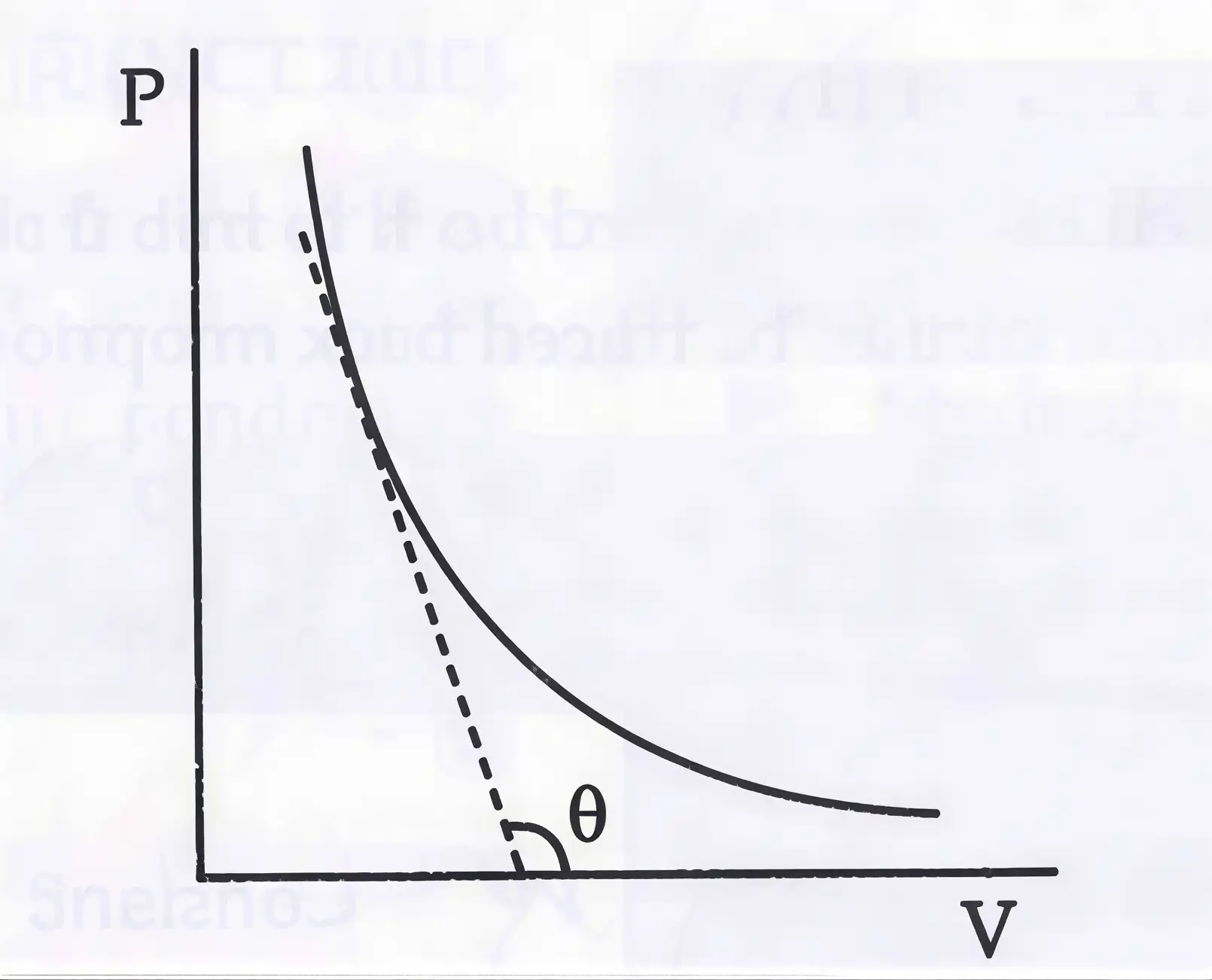
Second Law of Thermodynamics
Kelvin–Planck Statement: No process is possible whose sole result is the absorption of heat from a reservoir and complete conversion of that heat into work.
Clausius Statement: No process is possible whose sole result is the transfer of heat from a colder to a hotter body without work done.
Reversible and Irreversible Processes
Reversible Process: A process that can be reversed exactly, retracing all changes in the opposite order.
Irreversible Process: A process that cannot be reversed to restore the system and surroundings to their original states.
Solved Examples
Example 1: Calculate the work done by 1 mole of an ideal gas during an isothermal expansion from volume V₁ = 2 L to V₂ = 5 L at temperature T = 300 K. (R = 8.314 J/mol·K)
Solution:
For isothermal process, work done is given by:
\[ W = nRT \ln \frac{V_2}{V_1} \]
Substituting values:
\[ W = 1 \times 8.314 \times 300 \times \ln \frac{5}{2} \]
\[ \ln \frac{5}{2} = \ln 2.5 = 0.9163 \]
\[ W = 8.314 \times 300 \times 0.9163 = 2285.5 \text{ J} \]
Therefore, work done by the gas is 2285.5 Joules.
Example 2: In an adiabatic process, the pressure of a gas changes from 5 × 10⁵ Pa to 2 × 10⁵ Pa and volume changes from 0.02 m³ to 0.05 m³. Calculate the work done if γ = 1.4.
Solution:
Work done in adiabatic process is:
\[ W = \frac{1}{1 - \gamma} (P_2 V_2 - P_1 V_1) \]
Substituting values:
\[ W = \frac{1}{1 - 1.4} (2 \times 10^5 \times 0.05 - 5 \times 10^5 \times 0.02) \]
\[ W = \frac{1}{-0.4} (10000 - 10000) = 0 \]
Since the terms inside the bracket are equal, work done is zero in this case.
Practice Set
Conceptual Questions:
- Level 1: What is the difference between an adiabatic and an isothermal process?
- Level 2: Explain the significance of the Zeroth Law of Thermodynamics in temperature measurement.
Application-based Question:
- Level 3: A gas undergoes an isobaric expansion at 2 atm from 1 L to 3 L. Calculate the work done by the gas in joules. (1 atm = 1.013 × 10⁵ Pa)
Answer Key
Conceptual Questions:
- Level 1: An adiabatic process involves no heat exchange with surroundings, while an isothermal process occurs at constant temperature with heat exchange.
- Level 2: The Zeroth Law establishes that if two systems are each in thermal equilibrium with a third system, they are in equilibrium with each other, allowing temperature to be a measurable and transitive property.
Application-based Question:
Given: P = 2 atm = 2 × 1.013 × 10⁵ Pa = 2.026 × 10⁵ Pa, V₁ = 1 L = 1 × 10⁻³ m³, V₂ = 3 L = 3 × 10⁻³ m³
Work done,
\[ W = P \Delta V = 2.026 \times 10^5 \times (3 - 1) \times 10^{-3} = 2.026 \times 10^5 \times 2 \times 10^{-3} = 405.2 \text{ J} \]
Therefore, work done by the gas is 405.2 Joules.
Quick Reference Table
Key Laws and Formulas:
- Zeroth Law: Thermal equilibrium transitivity.
- First Law: ΔQ = ΔU + ΔW
- Isothermal process: PV = constant
- Adiabatic process: PV^γ = constant
- Work done in isothermal: \( W = nRT \ln \frac{V_2}{V_1} \)
- Work done in adiabatic: \( W = \frac{1}{1 - \gamma} (P_2 V_2 - P_1 V_1) \)
Common Mistakes and Misconceptions
- Confusing adiabatic and isothermal processes: Adiabatic involves no heat exchange, isothermal involves constant temperature with heat exchange.
- Assuming internal energy changes in isothermal processes for ideal gases (it remains constant).
- Ignoring sign conventions for heat and work.
- Mixing up the conditions for reversible and irreversible processes.
Glossary
- Thermodynamic System: A defined quantity of matter or region in space under study.
- Internal Energy: Total kinetic and potential energy of molecules in a system.
- Adiabatic Process: Process with no heat exchange.
- Isothermal Process: Process at constant temperature.
- Isobaric Process: Process at constant pressure.
- Isochoric Process: Process at constant volume.
- Reversible Process: Process that can be reversed without net change.
- Irreversible Process: Process that cannot be reversed exactly.