CLASS 11-PCB . PHYSICS . PHYSICS PART II . THERMAL PROPERTIES-OF-MATTER
Chapter 10 : Thermal Properties Of Matter
Ch 10
PHYSICS
CLASS 11-PCB
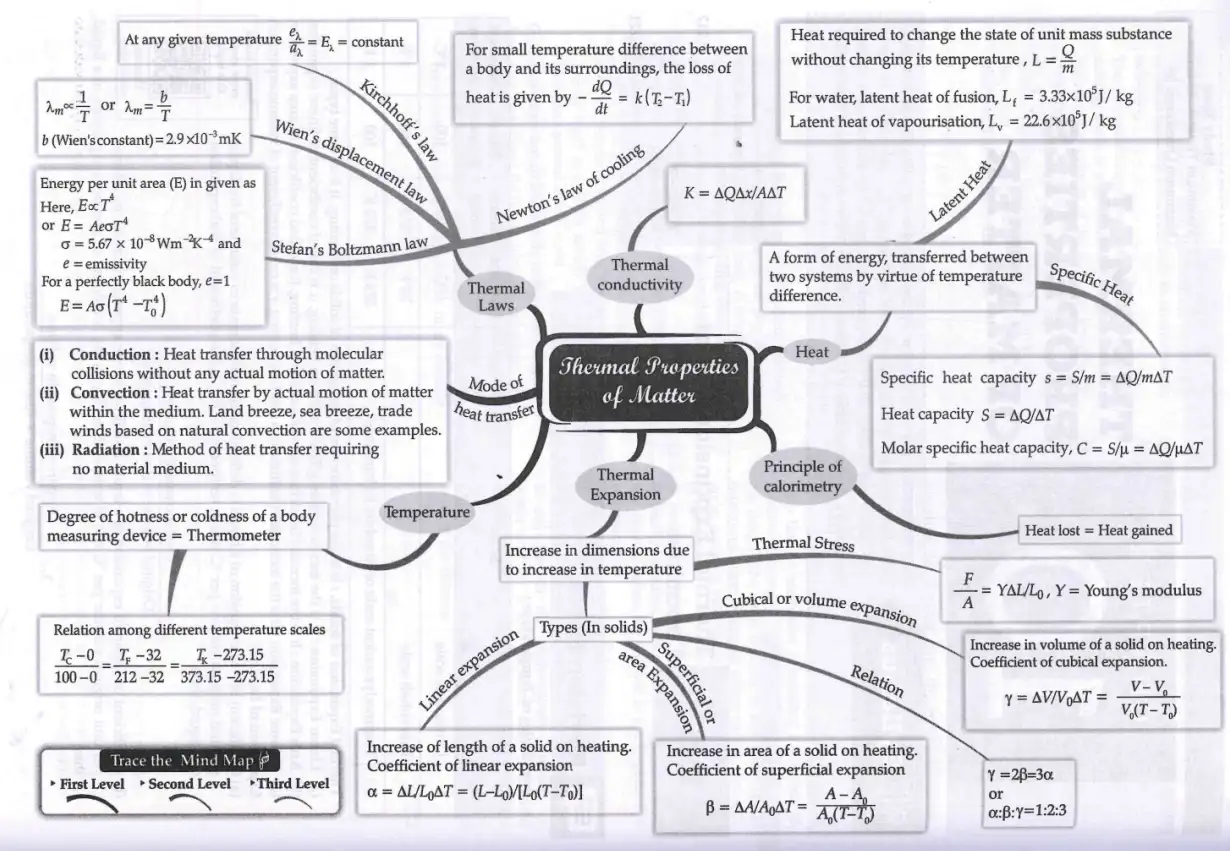
Thermal Expansion Heat Capacities
Temperature Scales
Temperature is measured using different scales: Celsius (Centigrade), Fahrenheit, and Kelvin (Absolute scale). The Celsius scale sets the freezing point of water at 0°C and boiling point at 100°C, divided into 100 equal parts. The Fahrenheit scale sets freezing at 32°F and boiling at 212°F, divided into 180 parts. The Kelvin scale sets freezing at 273 K and boiling at 373 K, also divided into 100 parts. These scales correspond to the same physical points but use different units.
Thermal Expansion of Solids
When solids are heated, they expand. This expansion occurs in three ways:
- Linear Expansion: Increase in length. The coefficient of linear expansion (α) quantifies this change.
- Area Expansion: Increase in surface area. The coefficient of area expansion (β) quantifies this change.
- Volume Expansion: Increase in volume. The coefficient of volume expansion (γ) quantifies this change.
Expansion of Liquids
Liquids also expand on heating, characterized by two coefficients:
- Coefficient of Real Expansion (γᵣ): The actual increase in volume per unit original volume per degree Celsius rise.
- Coefficient of Apparent Expansion (γₐ): The apparent increase in volume per unit original volume per degree Celsius rise, not accounting for the expansion of the container.
The relation between these coefficients is given by γᵣ = γₐ + γg, where γg is the coefficient of expansion of the container.
Key Terms
- Heat: Energy that produces warmth, present as translational, rotational, and vibrational energy of atoms and molecules.
- Temperature: Measure of hotness or coldness determining heat flow direction.
- Anomalous Expansion of Water: Water decreases in volume when heated from 0°C to 4°C.
- Specific Heat: Heat required to raise temperature of unit mass by 1°C.
- Molar Specific Heat: Heat required to raise temperature of one mole by 1°C.
- Heat Capacity: Heat required to raise temperature of entire body by 1°C or 1 K.
- Water Equivalent: Mass of water absorbing same heat as the body for the same temperature change.
- Change of State: Conversion between states of matter.
- Latent Heat: Heat required to change state of unit mass at constant temperature.
Key Formulae
- Relation between Celsius and Fahrenheit: C / 5 = (F − 32) / 9
- Kelvin and Celsius: TK = t°C + 273
- Coefficient of linear expansion: α = ΔL / (L ΔT)
- Coefficient of area expansion: β = ΔS / (S ΔT)
- Coefficient of volume expansion: γ = ΔV / (V ΔT)
- Relations: β = 2α, γ = 3α
- Specific heat: ΔQ = m s ΔT
- Molar specific heat: C = M × s
- Latent heat: ΔQ = M L
- Specific heat of gases: Cp − Cv = R
Solved Examples
Example 1: A metal rod of length 1 m is heated from 20°C to 120°C. If the coefficient of linear expansion is 1.2 × 10⁻⁵ /°C, find the increase in length.
Solution:
Given: L = 1 m, ΔT = 120°C − 20°C = 100°C, α = 1.2 × 10⁻⁵ /°C
Increase in length, ΔL = α × L × ΔT = 1.2 × 10−5 × 1 × 100 = 0.0012 m = 1.2 mm
Example 2: Calculate the volume expansion of a cube of side 10 cm heated from 25°C to 75°C. The coefficient of linear expansion is 2 × 10⁻⁵ /°C.
Solution:
Initial volume, V = (10 cm)3 = 1000 cm3
ΔT = 75°C − 25°C = 50°C
Coefficient of volume expansion, γ = 3α = 3 × 2 × 10−5 = 6 × 10⁻⁵ /°C
Volume increase, ΔV = γ × V × ΔT = 6 × 10−5 × 1000 × 50 = 3 cm3
Practice Set
- Level 1: Define coefficient of linear expansion.
- Level 1: What is anomalous expansion of water?
- Level 2: A rod of length 2 m expands by 0.4 mm on heating. Calculate the coefficient of linear expansion if temperature change is 50°C.
- Level 3: A cube of side 5 cm is heated from 30°C to 80°C. Calculate the increase in volume if the coefficient of linear expansion is 1.5 × 10⁻⁵ /°C.
Answer Key
- Level 1: Coefficient of linear expansion is the fractional increase in length per unit length per degree rise in temperature.
- Level 1: Anomalous expansion of water is the decrease in volume of water when heated from 0°C to 4°C.
- Level 2: ΔL = 0.4 mm = 0.0004 m, L = 2 m, ΔT = 50°C
α = ΔL / (L ΔT) = 0.0004 / (2 × 50) = 4 × 10⁻⁶ /°C - Level 3: Initial volume V = (5 cm)3 = 125 cm3
ΔT = 80°C − 30°C = 50°C
γ = 3α = 3 × 1.5 × 10−5 = 4.5 × 10⁻⁵ /°C
ΔV = γ × V × ΔT = 4.5 × 10−5 × 125 × 50 = 0.28125 cm3
Heat Transfer
Thermal Conductivity
Thermal conductivity is the property of a material to conduct heat. The coefficient of thermal conductivity (K) is defined as the rate of heat flow per unit area per unit temperature gradient across the material in steady state. It depends on the nature of the material.
Mathematically,
K = (ΔQ × Δx) / (ΔT × A × Δt)
where ΔQ is heat transferred, Δx is thickness, ΔT is temperature difference, A is area, and Δt is time.
Thermal Resistance
Thermal resistance (Rth) is analogous to electrical resistance and is given by the ratio of temperature difference to the rate of heat flow:
Rth = (T1 − T2) / (dQ/dt) = Δx / (K A)
Emissive Power and Emissivity
The total emissive power (e') of a body at a temperature is the total thermal energy emitted per unit time per unit area for all wavelengths.
Emissivity (ε) is the ratio of emissive power of the body to that of a perfect black body at the same temperature:
ε = e / E
Kirchhoff’s Law
At a given temperature and wavelength, the ratio of spectral emissive power to spectral absorptive power is constant and equals the spectral emissive power of a perfect black body. Good emitters are good absorbers.
Wien’s Law
The wavelength (λm) at which the energy emitted by a perfect black body is maximum is inversely proportional to its absolute temperature (T):
λm = b / T
where b = 2.898 × 10⁻³ mK (Wien's constant).
Newton’s Law of Cooling
The rate of heat loss of a body is proportional to the temperature difference between the body and its surroundings when the difference is small (~30°C):
− dQ/dt = K (θ − θ0)
Stefan’s Law
The total energy emitted per second per unit area by a perfect black body is proportional to the fourth power of its absolute temperature:
E = σ T⁴
where σ = 5.67 × 10⁻⁸ W m−2 K−4 (Stefan’s constant).
If the body is not perfect black, with emissivity ε, then total energy emitted is:
Q = ε A t σ T⁴
Stefan–Boltzmann Law
The net radiation emitted per unit area per second by a body at temperature T surrounded by enclosure at T0 is:
E' = σ (T⁴ − T0⁴)
For non-perfect black bodies:
Q' = ε A t σ (T⁴ − T0⁴)
Modes of Heat Transfer
- Conduction: Transfer of heat through direct molecular collisions without movement of the material.
- Convection: Transfer of heat by actual movement of fluid or gas.
- Radiation: Transfer of heat through electromagnetic waves without requiring a medium.
Key Terms
- Perfectly Black Body: Absorbs all incident radiation and emits radiation of all wavelengths.
Key Formulae
- Rate of conduction: ΔQ / Δt = K A (ΔT / Δx)
- Thermal resistance: Rth = (T1 − T2) / (dQ/dt)
- Emissive power: e' = ∫₀^∞ eλ dλ
- Emissivity: ε = e / E
Solved Examples
Example 1: A metal plate of area 0.5 m² and thickness 0.01 m has a thermal conductivity of 200 W/m·K. If one side is at 100°C and the other at 0°C, find the rate of heat conduction.
Solution:
Given: A = 0.5 m², Δx = 0.01 m, K = 200 W/m·K, ΔT = 100°C − 0°C = 100 K
Rate of heat conduction, ΔQ/Δt = K A (ΔT / Δx) = 200 × 0.5 × (100 / 0.01) = 1,000,000 W
Example 2: Calculate the wavelength of maximum emission for a black body at 6000 K.
Solution:
Using Wien’s law: λm = b / T = 2.898 × 10⁻³ / 6000 = 4.83 × 10⁻⁷ m = 483 nm
Practice Set
- Level 1: Define thermal conductivity.
- Level 1: What is a perfectly black body?
- Level 2: Calculate the thermal resistance of a wall 0.2 m thick with area 10 m² and thermal conductivity 0.5 W/m·K.
- Level 3: A black body at 5000 K emits radiation. Calculate the wavelength of maximum emission.
Answer Key
- Level 1: Thermal conductivity is the rate of heat flow per unit area per unit temperature gradient through a material.
- Level 1: A perfectly black body absorbs all incident radiation and emits radiation of all wavelengths.
- Level 2: Rth = Δx / (K A) = 0.2 / (0.5 × 10) = 0.04 K/W
- Level 3: λm = b / T = 2.898 × 10⁻³ / 5000 = 5.796 × 10⁻⁷ m = 579.6 nm
Quick Reference Table
Temperature Scales: Celsius, Fahrenheit, Kelvin
Thermal Expansion Coefficients: α (linear), β (area), γ (volume)
Relations: β = 2α, γ = 3α
Heat Transfer Modes: Conduction, Convection, Radiation
Thermal Conductivity Formula: ΔQ/Δt = K A (ΔT / Δx)
Thermal Resistance: Rth = Δx / (K A)
Stefan-Boltzmann Law: E = σ T⁴
Wien’s Law: λm = b / T
Common Mistakes and Misconceptions
- Confusing temperature scales and their zero points.
- Assuming volume expansion coefficient equals linear expansion coefficient.
- Ignoring the expansion of the container when measuring liquid expansion.
- Mixing up heat and temperature concepts.
- Forgetting that conduction requires a medium, while radiation does not.
Glossary
- Coefficient of Linear Expansion (α): Fractional change in length per degree temperature change.
- Coefficient of Area Expansion (β): Fractional change in surface area per degree temperature change.
- Coefficient of Volume Expansion (γ): Fractional change in volume per degree temperature change.
- Thermal Conductivity (K): Material property indicating ability to conduct heat.
- Emissivity (ε): Ratio of radiation emitted by a body to that emitted by a perfect black body.
- Latent Heat: Heat required for change of state without temperature change.