CLASS 11-PCB . PHYSICS . PHYSICS PART I . SYSTEMS OF-PARTICLES-AND-ROTATIONAL-MOTION
Chapter 6 : SYSTEMS OF PARTICLES AND ROTATIONAL MOTION
Ch 6
PHYSICS
CLASS 11-PCB
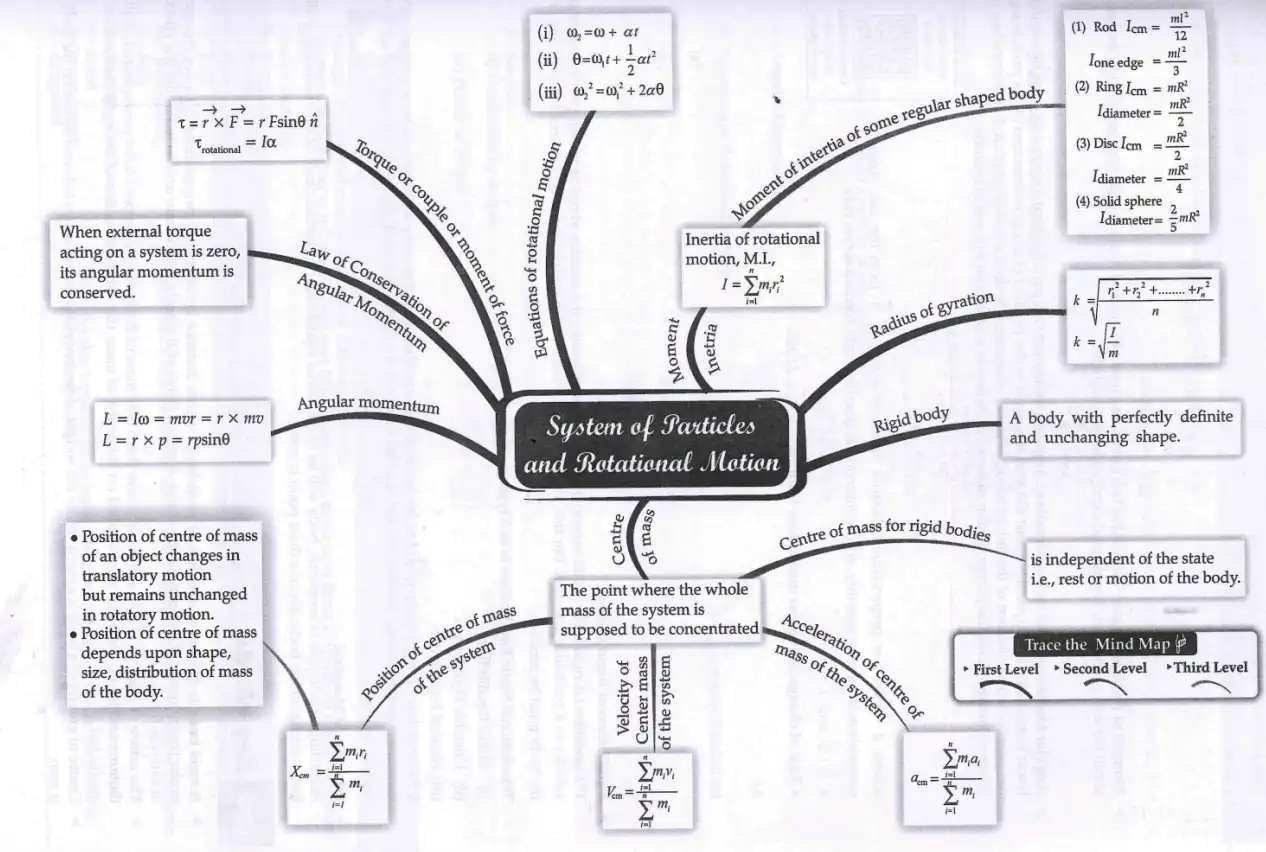
Centre of Mass and Motion of Rotational Particles
Kinds of Motion of Rigid Body
The motion of a rigid body can be classified into three main types based on how its particles move:
- Pure Translational Motion: All particles of the body move with the same velocity in a straight line at a given instant. Example: A car moving along a straight road.
- Pure Rotational Motion: The body rotates about a fixed axis. Each particle moves in a circle perpendicular to the axis, with the center on the axis. Example: A potter's wheel spinning.
- Combination of Translational and Rotational Motion: The body exhibits both translation and rotation simultaneously, typically when it is free to move and rotate. Example: A rolling wheel of a vehicle.
Pure Translational Motion
In pure translational motion, all the particles of a rigid body move together with the same velocity at a particular instant of time. An example is a car moving in a straight line.
Pure Rotational Motion
In pure rotational motion, a rigid body rotates about a fixed axis. Every particle of the body moves in a circle lying in a plane perpendicular to the axis, with the center of the circle on the axis. An example is a potter's wheel.
Combination of Translational and Rotational Motion
This motion occurs when a rigid body is not fixed or pivoted. The body exhibits both translational and rotational motion simultaneously. An example is a vehicle's wheel rolling on the road.
Center of Mass of a Two-Particle System
The position vector of the centre of mass (C.M.) of a two-particle system is defined such that the product of the total mass and the position vector of the C.M. equals the sum of the products of the masses and their respective position vectors:
\[ \mathbf{r} = \frac{m_1 \mathbf{r}_1 + m_2 \mathbf{r}_2}{m_1 + m_2} \]
Momentum Conservation
The total linear momentum \( \mathbf{p} \) of a system of particles is equal to the product of the total mass \( M \) and the velocity \( \mathbf{v} \) of its centre of mass:
\[ \mathbf{p} = M \mathbf{v} = \sum_{i=1}^n m_i \mathbf{v}_i \]
Differentiating with respect to time gives:
\[ \frac{d\mathbf{p}}{dt} = M \frac{d\mathbf{v}}{dt} = M \mathbf{a} = \mathbf{F}_{\text{ext}} \]
where \( \mathbf{F}_{\text{ext}} \) is the net external force acting on the system.
For an isolated system where \( \mathbf{F}_{\text{ext}} = 0 \), the total momentum remains constant:
\[ \frac{d\mathbf{p}}{dt} = 0 \implies \mathbf{p} = \text{constant} \implies M \mathbf{v} = \text{constant} \]
Moment of Force or Torque
Torque \( \boldsymbol{\tau} \) is the moment of force and measures the turning effect of a force about an axis of rotation. It is given by the vector cross product:
\[ \boldsymbol{\tau} = \mathbf{r} \times \mathbf{F} \]
Angular Momentum and Its Conservation
The angular momentum \( \mathbf{L} \) of a particle about a given axis is the moment of its linear momentum about that axis:
\[ \mathbf{L} = \mathbf{r} \times \mathbf{p} = r p \sin \phi = d \times p \]
where \( d = r \sin \phi \) is the perpendicular distance of the line of action of \( \mathbf{p} \) from the axis. The direction of \( \mathbf{L} \) is given by the right-hand screw rule.
The rate of change of angular momentum equals the torque:
\[ \boldsymbol{\tau} = \frac{d\mathbf{L}}{dt} = \boldsymbol{\tau}_{\text{ext}} \]
For an isolated system with no external torque, \( \boldsymbol{\tau}_{\text{ext}} = 0 \), so angular momentum is conserved:
\[ \frac{d\mathbf{L}}{dt} = 0 \implies \mathbf{L} = \text{constant} \]
Equilibrium of Rigid Bodies
Equilibrium of rigid bodies is the state in which a body remains at rest or moves with constant velocity without any change in its rotational or translational motion. It requires the fulfillment of two main conditions:
- Translational Equilibrium: The net external force acting on the body must be zero, ensuring no linear acceleration.
- Rotational Equilibrium: The net external torque acting on the body must be zero, ensuring no angular acceleration.
When both these conditions are satisfied, the rigid body is said to be in complete mechanical equilibrium.
First Condition (Translational Equilibrium)
A rigid body is in translational equilibrium if it remains at rest or moves with constant velocity. This requires the net external force acting on the body to be zero:
\( \sum \mathbf{F}_i = 0 \)
Types of Translational Equilibrium
- Stable Equilibrium: When displaced, the body tends to return to its original position.
- Unstable Equilibrium: When displaced, the body moves further away from its original position.
- Neutral Equilibrium: When displaced, the body remains in the new position without returning or moving further away.
Second Condition (Rotational Equilibrium)
A rigid body is in rotational equilibrium if it does not rotate or rotates with constant angular velocity. This requires the net external torque acting on the body to be zero:
\( \sum \boldsymbol{\tau}_i = 0 \)
Principle of Moments
A body is in rotational equilibrium if the algebraic sum of the moments of all forces about any fixed point is zero.
First Condition (Translational Equilibrium)
A rigid body is in translational equilibrium if it remains at rest or moves with constant velocity. The net external force must be zero:
\[ \sum \mathbf{F}_i = 0 \]
Types of Translational Static Equilibrium
- Stable equilibrium
- Unstable equilibrium
- Neutral equilibrium
Second Condition (Rotational Equilibrium)
A rigid body is in rotational equilibrium if it does not rotate or rotates with constant angular velocity. The net external torque must be zero:
\[ \sum \boldsymbol{\tau}_i = 0 \]
Principle of Moments
A body is in rotational equilibrium if the algebraic sum of the moments of all forces about a fixed point is zero.
Key Definitions
- Rigid Body: A system of particles where the distance between any two particles remains constant under external forces.
- Centre of Mass: The point where the entire mass of the body can be considered to be concentrated without affecting the motion.
- Centre of Gravity: The point where the weight of the body acts and the total gravitational torque is zero.
Key Formulae
Position Vector of Centre of Mass for n-Particle System:
\( \mathbf{r} = \frac{\sum_{i=1}^n m_i \mathbf{r}_i}{M} \), where \( M = \sum_{i=1}^n m_i \)
For Two-Particle System:
\( \mathbf{r} = \frac{m_1 \mathbf{r}_1 + m_2 \mathbf{r}_2}{m_1 + m_2} \)
Coordinates of Centre of Mass:
\( x = \frac{m_1 x_1 + m_2 x_2}{m_1 + m_2} \), \( y = \frac{m_1 y_1 + m_2 y_2}{m_1 + m_2} \), \( z = \frac{m_1 z_1 + m_2 z_2}{m_1 + m_2} \)
Velocity of Centre of Mass for Two Particles:
\( \mathbf{v}_{CM} = \frac{m_1 \mathbf{v}_1 + m_2 \mathbf{v}_2}{m_1 + m_2} \)
Angular Momentum:
\( \mathbf{L} = \mathbf{r} \times m \mathbf{v} \)
Equations of Rotational Motion:
- Angular displacement: \( \theta = \omega_i t + \frac{1}{2} \alpha t^2 \)
- Linear velocity: \( v = r \omega \)
- Angular velocity: \( \omega = 2 \pi \nu = \frac{2 \pi}{T} \)
- Linear acceleration: \( a = r \alpha \)
- Centripetal acceleration: \( a_c = \frac{v^2}{r} = r \omega^2 \)
Torque:
\( \boldsymbol{\tau} = \mathbf{r} \times \mathbf{F} \)
Work Done by Torque:
\( dW = \tau d\theta \)
Power of Torque:
\( P = \frac{dW}{dt} = \tau \frac{d\theta}{dt} = \tau \omega \)
Position Vector of Centre of Mass for n-Particle System
\( \mathbf{r} = \frac{\sum_{i=1}^n m_i \mathbf{r}_i}{M} \), where \( M = \sum_{i=1}^n m_i \)
For Two-Particle System
\( \mathbf{r} = \frac{m_1 \mathbf{r}_1 + m_2 \mathbf{r}_2}{m_1 + m_2} \)
Coordinates of Centre of Mass
\( x = \frac{m_1 x_1 + m_2 x_2}{m_1 + m_2} \), \( y = \frac{m_1 y_1 + m_2 y_2}{m_1 + m_2} \), \( z = \frac{m_1 z_1 + m_2 z_2}{m_1 + m_2} \)
Velocity of Centre of Mass for Two Particles
\( \mathbf{v}_{CM} = \frac{m_1 \mathbf{v}_1 + m_2 \mathbf{v}_2}{m_1 + m_2} \)
Angular Momentum
\( \mathbf{L} = \mathbf{r} \times m \mathbf{v} \)
Equations of Rotational Motion
- Angular displacement: \( \theta = \omega_i t + \frac{1}{2} \alpha t^2 \)
- Linear velocity: \( v = r \omega \)
- Angular velocity: \( \omega = 2 \pi \nu = \frac{2 \pi}{T} \)
- Linear acceleration: \( a = r \alpha \)
- Centripetal acceleration: \( a_c = \frac{v^2}{r} = r \omega^2 \)
Torque
\( \boldsymbol{\tau} = \mathbf{r} \times \mathbf{F} \)
Work Done by Torque
\( dW = \tau d\theta \)
Power of Torque
\( P = \frac{dW}{dt} = \tau \frac{d\theta}{dt} = \tau \omega \)
Position Vector of Centre of Mass for n-Particle System
\[ \mathbf{r} = \frac{\sum_{i=1}^n m_i \mathbf{r}_i}{M} \quad \text{where} \quad M = \sum_{i=1}^n m_i \]
For Two-Particle System
\[ \mathbf{r} = \frac{m_1 \mathbf{r}_1 + m_2 \mathbf{r}_2}{m_1 + m_2} \]
Coordinates of Centre of Mass
\[ x = \frac{m_1 x_1 + m_2 x_2}{m_1 + m_2}, \quad y = \frac{m_1 y_1 + m_2 y_2}{m_1 + m_2}, \quad z = \frac{m_1 z_1 + m_2 z_2}{m_1 + m_2} \]
Velocity of Centre of Mass for Two Particles
\[ \mathbf{v}_{\text{CM}} = \frac{m_1 \mathbf{v}_1 + m_2 \mathbf{v}_2}{m_1 + m_2} \]
Angular Momentum
\[ \mathbf{L} = \mathbf{r} \times m \mathbf{v} \]
Equations of Rotational Motion
- Angular displacement: \( \theta = \omega_i t + \frac{1}{2} \alpha t^2 \)
- Linear velocity: \( v = r \omega \)
- Angular velocity: \( \omega = 2 \pi \nu = \frac{2 \pi}{T} \)
- Linear acceleration: \( a = r \alpha \)
- Centripetal acceleration: \( a_c = \frac{v^2}{r} = r \omega^2 \)
Torque
\[ \boldsymbol{\tau} = \mathbf{r} \times \mathbf{F} \]
Work Done by Torque
\[ dW = \tau d\theta \]
Power of Torque
\[ P = \frac{dW}{dt} = \tau \frac{d\theta}{dt} = \tau \omega \]
Mnemonics for Centre of Mass Positions
R S Das in a Cinema hall met Chiranjeet mall area and Ram Chandran behind Central door.
- R – Ring
- S – Sphere
- D – Disc
- C – Centre
Ring, sphere, and disc have centres of mass at their respective centres.
- C – Cylinder
- m – mid-point
- a – Axis
Cylinders have centres of mass at the mid-point on their respective axes.
- R – Rectangular lamina
- c – cube
- c – cross-point
- d – diagonal
Rectangular lamina and cube have centres of mass at the cross point of their respective diagonals.
Solved Examples
Example 1: Find the position of the centre of mass of two particles of masses 3 kg and 5 kg located at positions 2 m and 6 m on the x-axis.
Solution:
Using the formula for two-particle system:
\[ x_{CM} = \frac{m_1 x_1 + m_2 x_2}{m_1 + m_2} = \frac{3 \times 2 + 5 \times 6}{3 + 5} = \frac{6 + 30}{8} = \frac{36}{8} = 4.5 \text{ m} \]
The centre of mass is at 4.5 m on the x-axis.
Example 2: A rigid body rotates about a fixed axis with an angular velocity of 10 rad/s. Calculate the linear velocity of a particle located 0.5 m from the axis.
Solution:
Using the relation \( v = r \omega \):
\[ v = 0.5 \times 10 = 5 \text{ m/s} \]
The linear velocity of the particle is 5 m/s.
Practice Set
- Level 1 (Easy): Define centre of mass and explain its significance in the motion of a rigid body.
- Level 2 (Moderate): A system consists of two particles of masses 4 kg and 6 kg located at points (2,0,0) m and (0,3,0) m respectively. Find the coordinates of the centre of mass.
- Level 3 (Challenging): A rigid body is rotating about a fixed axis with an angular velocity of 15 rad/s. Calculate the linear velocity and centripetal acceleration of a particle located 0.4 m from the axis.
Answer Key
Level 1: The centre of mass is the point where the entire mass of the body can be considered to be concentrated. It simplifies the analysis of motion because the motion of the body can be described as if all mass were concentrated at this point.
Level 2: Coordinates of centre of mass:
\[ x = \frac{4 \times 2 + 6 \times 0}{4 + 6} = \frac{8}{10} = 0.8 \text{ m} \]
\[ y = \frac{4 \times 0 + 6 \times 3}{10} = \frac{18}{10} = 1.8 \text{ m} \]
\[ z = 0 \text{ (since both particles lie in xy-plane)} \]
So, centre of mass is at (0.8, 1.8, 0) m.
Level 3:
Linear velocity \( v = r \omega = 0.4 \times 15 = 6 \text{ m/s} \)
Centripetal acceleration \( a_c = \frac{v^2}{r} = \frac{6^2}{0.4} = \frac{36}{0.4} = 90 \text{ m/s}^2 \)
Moment of Inertia and Radius of Gyration
Principle of Conservation of Angular Momentum
When no external torque acts on a system of particles, the total angular momentum remains constant:
\[ \mathbf{L} = \sum_{i=1}^n \mathbf{L}_i = \text{constant} \]
Laws of Rotational Motion
First Law: A rigid body continues in its state of rest or uniform rotation about a fixed axis unless acted upon by an external torque.
Second Law: The rate of change of angular momentum of a body about an axis is directly proportional to the external torque applied and occurs in the direction of the torque, mathematically expressed as \( \boldsymbol{\tau} = \frac{d\mathbf{L}}{dt} \).
Third Law: For every action torque exerted by one body on another, there is an equal and opposite reaction torque exerted by the second body on the first.
First Law
A body remains at rest or in uniform rotation about a given axis unless acted upon by an external torque.
Second Law
The rate of change of angular momentum of a body about an axis is directly proportional to the external torque applied and occurs in the direction of the torque:
\( \boldsymbol{\tau} = \frac{d\mathbf{L}}{dt} \)
Third Law
When a rigid body A exerts a torque on another rigid body B, body B exerts an equal and opposite torque on body A.
First Law
A body remains at rest or in uniform rotation about a given axis unless acted upon by an external torque.
Second Law
The rate of change of angular momentum of a body about an axis is directly proportional to the external torque applied:
\[ \boldsymbol{\tau} = \frac{d\mathbf{L}}{dt} \]
Third Law
When a rigid body A exerts a torque on another rigid body B, body B exerts an equal and opposite torque on body A.
Moment of Inertia
Moment of inertia \( I \) of a body about an axis is the property that resists change in its rotational motion. For a particle:
\[ I = m r^2 \]
It is a scalar quantity with SI unit \( \mathrm{kg \cdot m^2} \).
Radius of Gyration
The radius of gyration \( K \) is the distance from the axis at which the entire mass of the body can be assumed to be concentrated to have the same moment of inertia:
\[ K = \sqrt{\frac{\sum m_i r_i^2}{M}} \]
Kinetic Energy of Rotation
The kinetic energy of a rotating body is:
\[ KE = \frac{1}{2} I \omega^2 \]
Key Formulae for Moment of Inertia
- Circular ring (about center, perpendicular to plane): \( I = M R^2 \)
- Circular disc (about center, perpendicular to plane): \( I = \frac{1}{2} M R^2 \)
- Annular disc (outer radius \( R \), inner radius \( r \)): \( I = \frac{1}{2} M (R^2 + r^2) \)
- Thin rod (axis perpendicular at mid-point): \( I = \frac{M l^2}{12} \)
- Solid cylinder (about axis): \( I = \frac{1}{2} M R^2 \)
- Hollow cylinder (about axis): \( I = M R^2 \)
- Solid sphere (about diameter): \( I = \frac{2}{5} M R^2 \)
- Hollow sphere (thin shell, about diameter): \( I = \frac{2}{3} M R^2 \)
- Uniform rectangular lamina (axis through C.G. perpendicular to plane): \( I = \frac{M (l^2 + b^2)}{12} \)
- Elliptical disc (axis through C.G. perpendicular to plane): \( I = \frac{M}{4} (a^2 + b^2) \)
- Uniform cone (axis from vertex to center of base): \( I = \frac{3}{10} M R^2 \)
- Triangular lamina:
- About base: \( I_1 = \frac{M h^2}{6} \)
- About height: \( I_2 = \frac{M b^2}{6} \)
- About hypotenuse: \( I_3 = \frac{M b^2 h^2}{6 (b^2 + h^2)} \)
Angular Momentum and Torque Relation
\[ L = I \omega \]
\[ \tau = I \alpha = \frac{dL}{dt} \]
From Conservation of Angular Momentum
\[ \frac{I_1}{I_2} = \frac{\tau_1}{\tau_2} \]
Radius of Gyration Formula
\[ K = \sqrt{\frac{r_1^2 + r_2^2 + \cdots + r_n^2}{n}} \]
where \( r_i \) are perpendicular distances of particles from the axis and \( n \) is the number of particles.
Solved Examples
Example 1: Calculate the moment of inertia of a solid sphere of mass 2 kg and radius 0.5 m about its diameter.
Solution:
Using the formula:
\[ I = \frac{2}{5} M R^2 = \frac{2}{5} \times 2 \times (0.5)^2 = \frac{4}{5} \times 0.25 = 0.2 \ \mathrm{kg \cdot m^2} \]
The moment of inertia is 0.2 kg·m².
Example 2: A solid cylinder of mass 3 kg and radius 0.4 m rotates with angular velocity 10 rad/s. Calculate its kinetic energy of rotation.
Solution:
Moment of inertia of solid cylinder:
\[ I = \frac{1}{2} M R^2 = \frac{1}{2} \times 3 \times (0.4)^2 = 0.24 \ \mathrm{kg \cdot m^2} \]
Kinetic energy:
\[ KE = \frac{1}{2} I \omega^2 = \frac{1}{2} \times 0.24 \times 10^2 = 0.12 \times 100 = 12 \ \mathrm{J} \]
Practice Set
- Level 1 (Easy): Define moment of inertia and state its SI unit.
- Level 2 (Moderate): Calculate the moment of inertia of a thin rod of length 1.2 m and mass 2 kg about an axis perpendicular to the rod through its center.
- Level 3 (Challenging): A solid sphere and a solid cylinder have the same mass and radius. Which has greater moment of inertia about their respective axes? Calculate the ratio of their moments of inertia.
Answer Key
Level 1: Moment of inertia is the property of a body that resists change in its rotational motion about an axis. Its SI unit is kilogram meter squared (\( \mathrm{kg \cdot m^2} \)).
Level 2:
Moment of inertia of thin rod about center:
\[ I = \frac{M l^2}{12} = \frac{2 \times (1.2)^2}{12} = \frac{2 \times 1.44}{12} = 0.24 \ \mathrm{kg \cdot m^2} \]
Level 3:
Moment of inertia of solid sphere:
\[ I_{sphere} = \frac{2}{5} M R^2 \]
Moment of inertia of solid cylinder:
\[ I_{cylinder} = \frac{1}{2} M R^2 \]
Ratio:
\[ \frac{I_{sphere}}{I_{cylinder}} = \frac{\frac{2}{5} M R^2}{\frac{1}{2} M R^2} = \frac{2/5}{1/2} = \frac{2}{5} \times \frac{2}{1} = \frac{4}{5} = 0.8 \]
The solid cylinder has a greater moment of inertia. The sphere's moment of inertia is 0.8 times that of the cylinder.
Quick Reference Table
Centre of Mass
- \( \mathbf{r} = \frac{\sum m_i \mathbf{r}_i}{\sum m_i} \)
- Velocity of C.M.: \( \mathbf{v}_{CM} = \frac{\sum m_i \mathbf{v}_i}{\sum m_i} \)
Torque
- \( \boldsymbol{\tau} = \mathbf{r} \times \mathbf{F} \)
- Work done: \( dW = \tau d\theta \)
- Power: \( P = \tau \omega \)
Angular Momentum
- \( \mathbf{L} = \mathbf{r} \times m \mathbf{v} \)
- Relation: \( \boldsymbol{\tau} = \frac{d\mathbf{L}}{dt} \)
- Conservation: \( \mathbf{L} = \text{constant} \) if \( \boldsymbol{\tau}_{ext} = 0 \)
Moment of Inertia (Selected)
- Circular ring: \( I = M R^2 \)
- Circular disc: \( I = \frac{1}{2} M R^2 \)
- Thin rod (center): \( I = \frac{M l^2}{12} \)
- Solid sphere: \( I = \frac{2}{5} M R^2 \)
- Hollow sphere: \( I = \frac{2}{3} M R^2 \)
Rotational Motion Equations
- \( \theta = \omega_i t + \frac{1}{2} \alpha t^2 \)
- \( v = r \omega \)
- \( a = r \alpha \)
- \( a_c = \frac{v^2}{r} = r \omega^2 \)
Common Mistakes and Misconceptions
- Confusing centre of mass with centre of gravity; they coincide only in uniform gravitational fields.
- Assuming moment of inertia depends only on mass, ignoring distribution of mass relative to axis.
- Forgetting that torque is a vector and depends on the direction of force and position vector.
- Mixing up translational and rotational equilibrium conditions.
- Neglecting external torques when applying conservation of angular momentum.
Glossary
- Rigid Body: A body with fixed shape and size, where distances between particles do not change.
- Centre of Mass: The point representing the average position of mass in a system.
- Torque: A measure of the turning effect of a force about an axis.
- Angular Momentum: The rotational equivalent of linear momentum, dependent on moment of inertia and angular velocity.
- Moment of Inertia: A scalar measure of an object's resistance to changes in its rotational motion.
- Radius of Gyration: The distance from the axis at which the entire mass can be assumed to be concentrated to produce the same moment of inertia.
- Rotational Equilibrium: Condition where net torque on a body is zero, so angular velocity is constant.