CLASS 11-PCB . PHYSICS . PHYSICS PART II . OSCILLATIONS
Chapter 13 : Oscillations
Ch 13
PHYSICS
CLASS 11-PCB
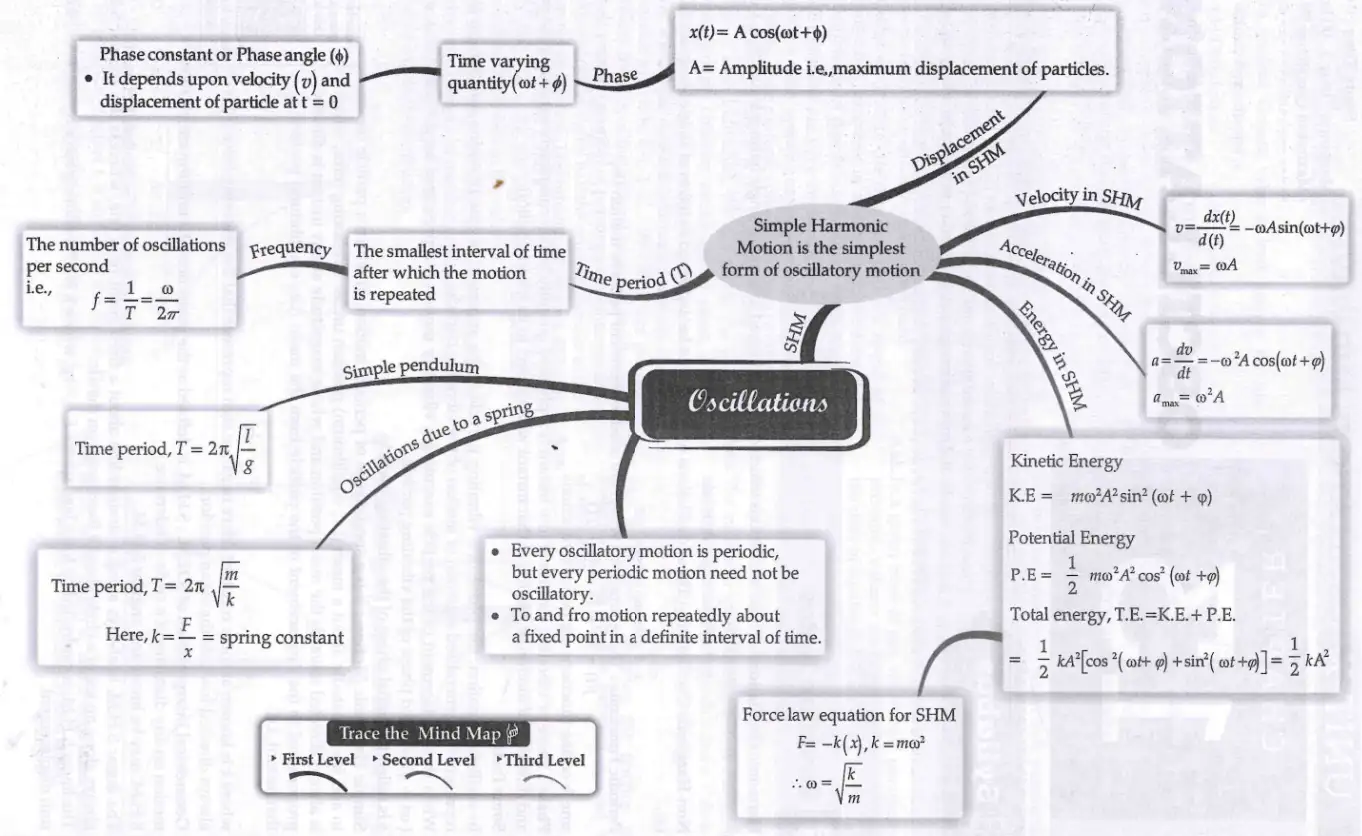
Harmonic Oscillations
Definition and Mathematical Representation
Harmonic oscillations are oscillations that can be expressed using a single harmonic function such as sine or cosine. The displacement of a particle undergoing harmonic oscillation can be written as:
y = a \sin \omega t or y = a \cos \omega t
Periodic Nature
These oscillations repeat themselves after a fixed interval of time, making them periodic functions. The sine and cosine functions used to describe harmonic oscillations are periodic with period T.
Phase of Oscillation
The phase of a vibrating particle at any instant is a quantity that fully describes its position and direction of motion relative to the mean position. For a displacement given by y = a \sin (\omega t + \phi), the term (\omega t + \phi) is called the phase, where \phi is the initial phase.
Solved Examples
Example 1: A particle executes simple harmonic motion with displacement y = 5 \sin (10t + \pi/6) cm. Find the displacement at t = 0.2 s.
Solution:
Given: a = 5 cm, \omega = 10 rad/s, \phi = \pi/6, t = 0.2 s
Displacement, y = 5 \sin (10 \times 0.2 + \pi/6) = 5 \sin (2 + \pi/6)
Calculate the angle in radians: 2 + \pi/6 ≈ 2 + 0.5236 = 2.5236 rad
y = 5 \times \sin 2.5236 ≈ 5 \times 0.579 = 2.895 cm
Therefore, the displacement at t = 0.2 s is approximately 2.895 cm.
Practice Set
- Level 1: Define harmonic oscillation and write its general mathematical expression.
- Level 2: Explain the significance of phase and initial phase in harmonic oscillations.
- Level 3: A particle executes harmonic motion with displacement y = 3 \cos (5t + \pi/4). Calculate the displacement at t = 0.1 s.
Answer Key
- Level 1: Harmonic oscillations are oscillations that can be expressed as a single sine or cosine function. The general expression is y = a \sin \omega t or y = a \cos \omega t.
- Level 2: The phase (\omega t + \phi) determines the position and direction of the particle at any instant. The initial phase \phi is the phase at time t = 0, indicating the starting position of the oscillation.
- Level 3: y = 3 \cos (5 \times 0.1 + \pi/4) = 3 \cos (0.5 + 0.7854) = 3 \cos 1.2854 ≈ 3 \times 0.28 = 0.84 units.
Simple Harmonic Motion
Definition and Restoring Force
Simple Harmonic Motion (S.H.M.) is a special type of periodic motion where a particle moves back and forth about a mean (equilibrium) position under a restoring force. This force is always directed towards the mean position and is proportional to the displacement from it:
F = -ky
Here, k is the force constant, and the negative sign indicates the force acts opposite to displacement.
Geometrical Interpretation
S.H.M. can be viewed as the projection of uniform circular motion on a diameter of the circle. It can be linear or angular:
- Linear S.H.M. occurs along a straight line about a fixed point.
- Angular S.H.M. occurs along an arc of a circle about a fixed point.
Characteristics of S.H.M.
- Displacement: Distance from mean position at any instant.
- Velocity: Rate of change of displacement.
- Amplitude: Maximum displacement from mean position.
- Acceleration: Rate of change of velocity.
- Time Period: Time taken to complete one oscillation.
Solved Examples
Example 2: A particle of mass 0.5 kg executes S.H.M. with amplitude 0.1 m and force constant k = 20 N/m. Find the time period of oscillation.
Solution:
Time period, T = 2\pi \sqrt{m/k} = 2\pi \sqrt{0.5/20} = 2\pi \sqrt{0.025} = 2\pi \times 0.1581 = 0.994 s
Therefore, the time period is approximately 0.994 seconds.
Practice Set
- Level 1: State the force law governing simple harmonic motion.
- Level 2: Describe the difference between linear and angular S.H.M.
- Level 3: Calculate the force constant for a particle of mass 2 kg oscillating with angular frequency 5 rad/s.
Answer Key
- Level 1: The restoring force in S.H.M. is F = -ky, where k is the force constant.
- Level 2: Linear S.H.M. occurs along a straight line, while angular S.H.M. occurs along an arc of a circle.
- Level 3: k = m \omega^2 = 2 \times 5^2 = 2 \times 25 = 50 N/m.
Simple Pendulum
Definition and Description
A simple pendulum consists of a heavy point mass suspended by a weightless, inextensible, and flexible string from a rigid support. It oscillates freely about the point of suspension.
Time Period Formula
The time period of a simple pendulum is given by:
T = 2\pi \sqrt{\frac{l}{g}}
where l is the length of the pendulum and g is the acceleration due to gravity.
Solved Examples
Example 3: Calculate the time period of a simple pendulum of length 1 m. Take g = 9.8 m/s².
Solution:
T = 2\pi \sqrt{1/9.8} = 2\pi \times 0.319 = 2.006 s
The time period is approximately 2.006 seconds.
Practice Set
- Level 1: What is a simple pendulum?
- Level 2: Derive the formula for the time period of a simple pendulum.
- Level 3: If the length of a pendulum is quadrupled, how does its time period change?
Answer Key
- Level 1: A simple pendulum is a heavy point mass suspended by a weightless string that oscillates about a fixed point.
- Level 2: The time period T = 2\pi \sqrt{l/g} is derived by equating restoring torque and angular acceleration and solving the differential equation of motion.
- Level 3: Time period T is proportional to \sqrt{l}, so if length is quadrupled, T becomes 2 times the original.
Energy in Simple Harmonic Motion
Types of Energy
A particle executing S.H.M. possesses two types of energy:
- Potential Energy (U): Energy due to displacement from mean position, given by U = \frac{1}{2} m \omega^2 y^2.
- Kinetic Energy (K): Energy due to velocity, given by K = \frac{1}{2} m \omega^2 (a^2 - y^2).
Total Energy
The total mechanical energy E remains constant and is the sum of kinetic and potential energies:
E = \frac{1}{2} m \omega^2 a^2
Solved Examples
Example 4: A particle of mass 0.2 kg oscillates with amplitude 0.05 m and angular frequency 10 rad/s. Calculate its total energy.
Solution:
E = \frac{1}{2} m \omega^2 a^2 = 0.5 \times 0.2 \times 10^2 \times 0.05^2 = 0.1 \times 100 \times 0.0025 = 0.025 J
The total energy of the particle is 0.025 joules.
Practice Set
- Level 1: What are the two types of energy in S.H.M.?
- Level 2: Write the expression for potential energy in S.H.M.
- Level 3: Calculate the kinetic energy of a particle in S.H.M. at displacement y = 0.02 m, given m = 0.1 kg, \omega = 20 rad/s, and amplitude a = 0.05 m.
Answer Key
- Level 1: Potential energy and kinetic energy.
- Level 2: U = \frac{1}{2} m \omega^2 y^2.
- Level 3: K = \frac{1}{2} m \omega^2 (a^2 - y^2) = 0.5 \times 0.1 \times 20^2 \times (0.05^2 - 0.02^2) = 0.05 \times 400 \times (0.0025 - 0.0004) = 20 \times 0.0021 = 0.042 J.
Quick Reference Table
- Harmonic Oscillations: Oscillations described by a single sine or cosine function, with displacement y = a \sin \omega t or y = a \cos \omega t.
- Simple Harmonic Motion (S.H.M.): Periodic motion where restoring force F = -ky acts towards mean position, proportional to displacement.
- Force Constant (k): Proportionality constant in restoring force, units: N/m.
- Angular Frequency (\omega): \( \omega = 2\pi \nu = \sqrt{k/m} \), units: rad/s.
- Time Period (T): Time for one complete oscillation, \( T = \frac{2\pi}{\omega} = 2\pi \sqrt{\frac{m}{k}} \), units: seconds.
- Frequency (\nu): Number of oscillations per second, \( \nu = \frac{1}{T} \), units: Hz.
- Displacement (y): Distance from mean position at any instant.
- Velocity (v): Rate of change of displacement, \( v = \omega \sqrt{A^2 - y^2} \).
- Acceleration (a): Rate of change of velocity, \( a = -\omega^2 y \).
- Simple Pendulum Time Period: \( T = 2\pi \sqrt{\frac{l}{g}} \), where l is length and g is acceleration due to gravity.
- Energy in S.H.M.: Total energy \( E = \frac{1}{2} m \omega^2 A^2 \), sum of kinetic and potential energies.
Common Mistakes and Misconceptions
- Confusing Phase and Initial Phase: Phase \( (\omega t + \phi) \) changes with time, while initial phase \( \phi \) is constant at t=0.
- Ignoring Negative Sign in Restoring Force: The negative sign in \( F = -ky \) indicates direction towards mean position; neglecting it leads to incorrect force direction.
- Mixing Linear and Angular S.H.M.: Linear S.H.M. involves displacement along a line, angular S.H.M. involves angular displacement; formulas differ accordingly.
- Incorrect Use of Time Period Formula: Using \( T = 2\pi \sqrt{l/g} \) for systems other than simple pendulum is wrong.
- Assuming Energy Changes in S.H.M.: Total mechanical energy remains constant in ideal S.H.M.; only kinetic and potential energies interchange.
- Misinterpreting Amplitude: Amplitude is maximum displacement, not the displacement at any instant.
- Confusing Frequency and Angular Frequency: Frequency is in Hz, angular frequency in rad/s; \( \omega = 2\pi \nu \).
Glossary
- Amplitude (A): Maximum displacement from the mean position in oscillatory motion.
- Angular Frequency (\omega): Rate of change of phase, \( \omega = 2\pi \nu \), measured in radians per second.
- Displacement (y): Distance of the particle from the mean position at any instant.
- Force Constant (k): Constant of proportionality in restoring force, units N/m.
- Frequency (\nu): Number of oscillations per second, measured in hertz (Hz).
- Initial Phase (\phi): Phase of oscillation at time t = 0.
- Mean Position: The equilibrium position about which the particle oscillates.
- Phase: The argument of sine or cosine function representing oscillation, \( \omega t + \phi \).
- Restoring Force: Force that always acts towards the mean position, proportional to displacement.
- Simple Harmonic Motion (S.H.M.): Periodic motion with restoring force proportional to displacement and directed towards mean position.
- Time Period (T): Time taken to complete one full oscillation, measured in seconds.
- Velocity (v): Rate of change of displacement with time in oscillatory motion.
- Potential Energy (U): Energy stored due to displacement in S.H.M., \( U = \frac{1}{2} m \omega^2 y^2 \).
- Kinetic Energy (K): Energy due to motion in S.H.M., \( K = \frac{1}{2} m \omega^2 (A^2 - y^2) \).
- Total Energy (E): Sum of kinetic and potential energy in S.H.M., constant \( E = \frac{1}{2} m \omega^2 A^2 \).
- Simple Pendulum: A mass suspended by a string that oscillates under gravity, exhibiting S.H.M. for small angles.