CLASS 11-PCB . PHYSICS . PHYSICS PART I . MOTION IN-A-STRAIGHT-LINE
Chapter 2 : MOTION IN A STRAIGHT LINE
Ch 2
PHYSICS
CLASS 11-PCB
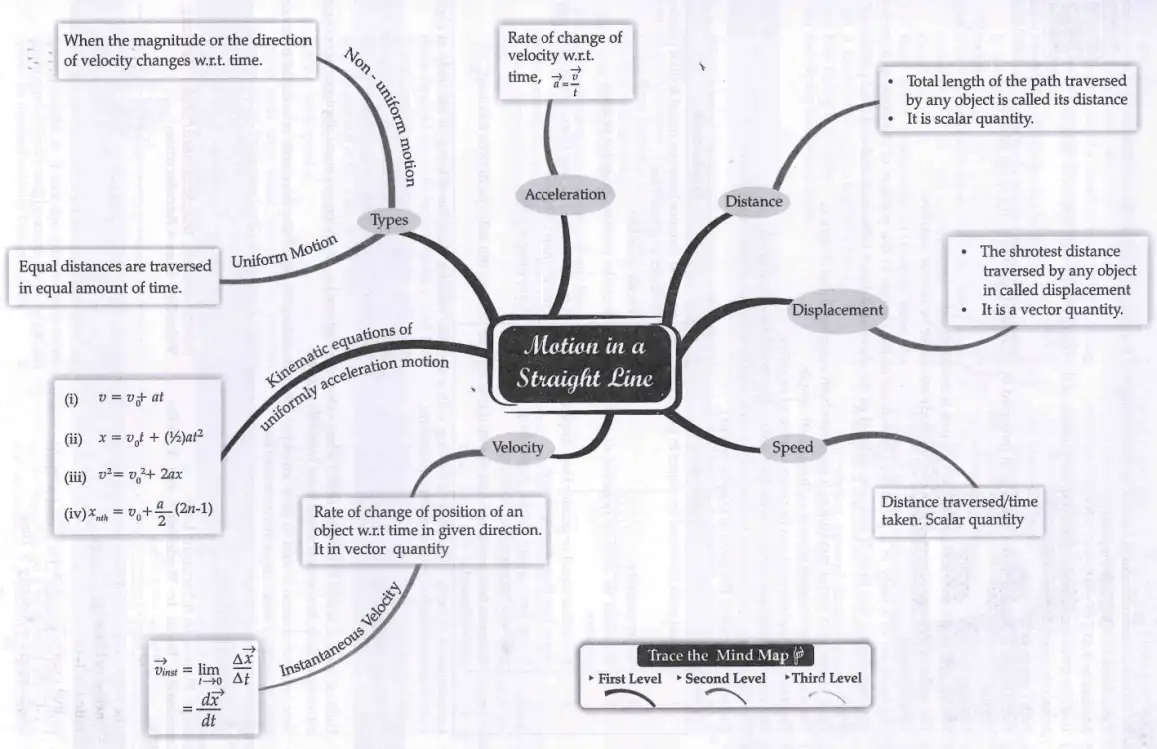
Motion Velocity
Rest and Motion
An object or a particle is said to be in the state of rest when it does not change its position with time with respect to the same reference point. Depending on the observer's position, rest can be absolute or relative.
An object is said to be in motion when it changes its position with time with respect to the same reference point. Motion can be linear, circular, oscillatory, or vibratory.
Types of Motion
Linear Motion: Motion along a straight line. Every particle of the body moves along parallel straight lines covering the same distance in the same time.
Circular Motion: Motion along a circular path. All particles move along concentric circles.
Oscillatory Motion: Back and forth motion about a fixed point in a definite interval of time. If the amplitude is very small, it is called vibratory motion.
Dimensional Motion
One-Dimensional Motion: Motion along a straight line or well-defined path.
Two-Dimensional Motion: Motion where two coordinates change with time.
Three-Dimensional Motion: Motion where all three coordinates change with time.
Distance and Displacement
Distance: Actual path length traversed by the body. It is a scalar quantity and always positive or zero. SI unit is metre.
Displacement: Shortest distance between initial and final positions in a particular direction. It is a vector quantity and can be positive, negative, or zero. Its magnitude is never greater than the distance.
Difference Between Distance and Displacement
Distance is the total path length traveled, scalar in nature, always positive or zero, and depends on the path taken. Displacement is the shortest path between two points, vector in nature, can be positive, negative, or zero, and independent of the path.
Instantaneous Velocity
The velocity of a body at a given instant of time when the velocity is variable. It is the derivative of displacement with respect to time.
Solved Examples
Example 1: A car moves along a straight road covering 100 m in 5 seconds. Calculate its average speed.
Solution: Distance = 100 m, Time = 5 s
Average speed = Distance / Time = 100 m / 5 s = 20 m/s
Example 2: A particle moves from point A to B, 50 m east, then to point C, 40 m west. Find the displacement.
Solution: Displacement = Final position - Initial position = 50 m east - 40 m west = 10 m east
Example 3: A body moves with uniform velocity of 10 m/s for 8 seconds. Find the distance covered.
Solution: Distance = Speed × Time = 10 m/s × 8 s = 80 m
Practice Set
- Level 1: Define rest and motion with examples.
- Level 2: Differentiate between distance and displacement with suitable examples.
- Level 3: A person walks 30 m north, then 40 m east. Calculate the total distance and displacement.
Answer Key
Level 1: Rest is when an object does not change position with time relative to a reference point; motion is when it changes position. Example: A book on a table is at rest; a moving car is in motion.
Level 2: Distance is total path length (scalar), displacement is shortest path with direction (vector). Example: Walking 5 m forward and 3 m back, distance = 8 m, displacement = 2 m forward.
Level 3: Total distance = 30 m + 40 m = 70 m. Displacement = √(30² + 40²) = 50 m northeast.
Uniformly Accelerated Motion
Acceleration and Types
Acceleration is the rate of change of velocity with time. It is a vector quantity with SI unit m/s².
Types of acceleration:
- Uniform acceleration: Velocity changes by equal amounts in equal time intervals.
- Variable acceleration: Velocity changes by unequal amounts in equal time intervals.
- Average acceleration: Total change in velocity divided by total time.
- Instantaneous acceleration: Acceleration at a specific instant, derivative of velocity with respect to time.
Equations of Motion
Let u = initial velocity, v = velocity after time t, a = acceleration, s = displacement, n = nth second.
For uniformly accelerated motion:
- v = u + at
- s = ut + ½ at²
- v² = u² + 2as
- sₙ = u + (a/2)(2n − 1)
For retarded motion (a negative acceleration):
- v = u − at
- s = ut − ½ at²
- v² = u² − 2as
- sₙ = u − (a/2)(2n − 1)
For free fall under gravity (a = g):
- v = u + gt
- h = ut + ½ gt²
- v² = u² + 2gh
- hₙ = u + (g/2)(2n − 1)
For upward motion against gravity (a = -g):
- v = u − gt
- h = ut − ½ gt²
- v² = u² − 2gh
- hₙ = u − (g/2)(2n − 1)
Maximum Height and Time
Maximum height attained: h_max = u² / (2g)
Time to reach maximum height: t = u / g
Total time for up and down: T = 2u / g
Initial velocity to reach height h: u = √(2gh)
Solved Examples
Example 1: A body starts from rest and accelerates uniformly at 5 m/s² for 4 seconds. Find the final velocity and distance covered.
Solution:
Given: u = 0, a = 5 m/s², t = 4 s
Final velocity, v = u + at = 0 + 5 × 4 = 20 m/s
Distance, s = ut + ½ at² = 0 + ½ × 5 × 16 = 40 m
Example 2: A body is thrown vertically upwards with velocity 20 m/s. Calculate the maximum height reached and time taken to reach it. (Take g = 10 m/s²)
Solution:
u = 20 m/s, g = 10 m/s²
Maximum height, h_max = u² / (2g) = 400 / 20 = 20 m
Time to reach max height, t = u / g = 20 / 10 = 2 s
Example 3: A car moving at 30 m/s applies brakes and comes to rest in 5 seconds. Find acceleration and distance covered during this time.
Solution:
u = 30 m/s, v = 0, t = 5 s
Acceleration, a = (v - u) / t = (0 - 30) / 5 = -6 m/s² (retardation)
Distance, s = ut + ½ at² = 30 × 5 + ½ × (-6) × 25 = 150 - 75 = 75 m
Practice Set
- Level 1: Define acceleration and state its SI unit.
- Level 2: A body accelerates uniformly from 10 m/s to 30 m/s in 5 seconds. Find acceleration and distance covered.
- Level 3: A ball is thrown vertically upwards with velocity 15 m/s. Calculate the time taken to reach maximum height and total time in air. (g = 10 m/s²)
Answer Key
Level 1: Acceleration is the rate of change of velocity with time. SI unit is meter per second squared (m/s²).
Level 2: u = 10 m/s, v = 30 m/s, t = 5 s
a = (v - u)/t = (30 - 10)/5 = 4 m/s²
s = ut + ½ at² = 10 × 5 + ½ × 4 × 25 = 50 + 50 = 100 m
Level 3: u = 15 m/s, g = 10 m/s²
Time to max height, t = u / g = 15 / 10 = 1.5 s
Total time in air, T = 2t = 3 s
Quick Reference Table
Motion and Velocity
- Rest: An object is at rest if it does not change its position with time relative to a reference point.
- Motion: An object is in motion if it changes its position with time relative to a reference point.
- Types of Motion: Linear (straight line), Circular (rotatory), Oscillatory (back and forth), Vibratory (small amplitude oscillations).
- Distance: Total path length covered by the object; scalar quantity; unit: metre (m).
- Displacement: Shortest distance between initial and final positions; vector quantity; unit: metre (m).
- Speed: Distance traveled per unit time; scalar quantity.
- Velocity: Displacement per unit time; vector quantity.
- Acceleration: Rate of change of velocity with time; vector quantity; unit: m/s².
- Uniform Motion: Motion with constant velocity.
- Non-uniform Motion: Motion with changing velocity.
- Equations of Uniformly Accelerated Motion:
- v = u + at
- s = ut + ½ at²
- v² = u² + 2as
- sₙ = u + (a/2)(2n − 1)
- Where u = initial velocity, v = final velocity, a = acceleration, t = time, s = displacement, sₙ = displacement in nth second.
Units and Dimensions
- Distance and displacement: metre (m)
- Velocity: metre per second (m/s)
- Acceleration: metre per second squared (m/s²)
Common Mistakes and Misconceptions
- Confusing distance with displacement: Distance is the total path length, while displacement is the shortest straight line between initial and final positions.
- Assuming velocity and speed are the same: Speed is scalar, velocity is vector and includes direction.
- Ignoring direction in vector quantities: Displacement and velocity have direction; neglecting this leads to incorrect conclusions.
- Misinterpreting acceleration sign: Negative acceleration (retardation) means velocity decreases, not necessarily that the object is moving backward.
- Using equations of motion without uniform acceleration: The standard equations apply only when acceleration is constant.
- Confusing instantaneous velocity with average velocity: Instantaneous velocity is at a specific time, average velocity is over an interval.
- Assuming displacement can be greater than distance: Displacement magnitude is always less than or equal to distance.
- Forgetting units in calculations: Always use SI units (metre, second, m/s, m/s²) to avoid errors.
Glossary
- Acceleration: Rate of change of velocity with time; vector quantity; SI unit m/s².
- Displacement: Shortest distance between initial and final positions; vector quantity; unit metre (m).
- Distance: Total path length covered by an object; scalar quantity; unit metre (m).
- Instantaneous Velocity: Velocity of an object at a specific instant of time.
- Motion: Change in position of an object with respect to time and reference point.
- Rest: State of an object when it does not change its position with time relative to a reference point.
- Retardation: Negative acceleration; decrease in velocity over time.
- Speed: Distance traveled per unit time; scalar quantity.
- Uniform Acceleration: Acceleration that remains constant over time.
- Uniform Motion: Motion with constant velocity; equal displacements in equal time intervals.
- Velocity: Displacement per unit time; vector quantity.
- Velocity-Time Graph: Graph showing how velocity changes with time; slope represents acceleration.