CLASS 11-PCB . PHYSICS . PHYSICS PART I . MOTION IN-A-PLANE
Chapter 3 : MOTION IN A PLANE
Ch 3
PHYSICS
CLASS 11-PCB
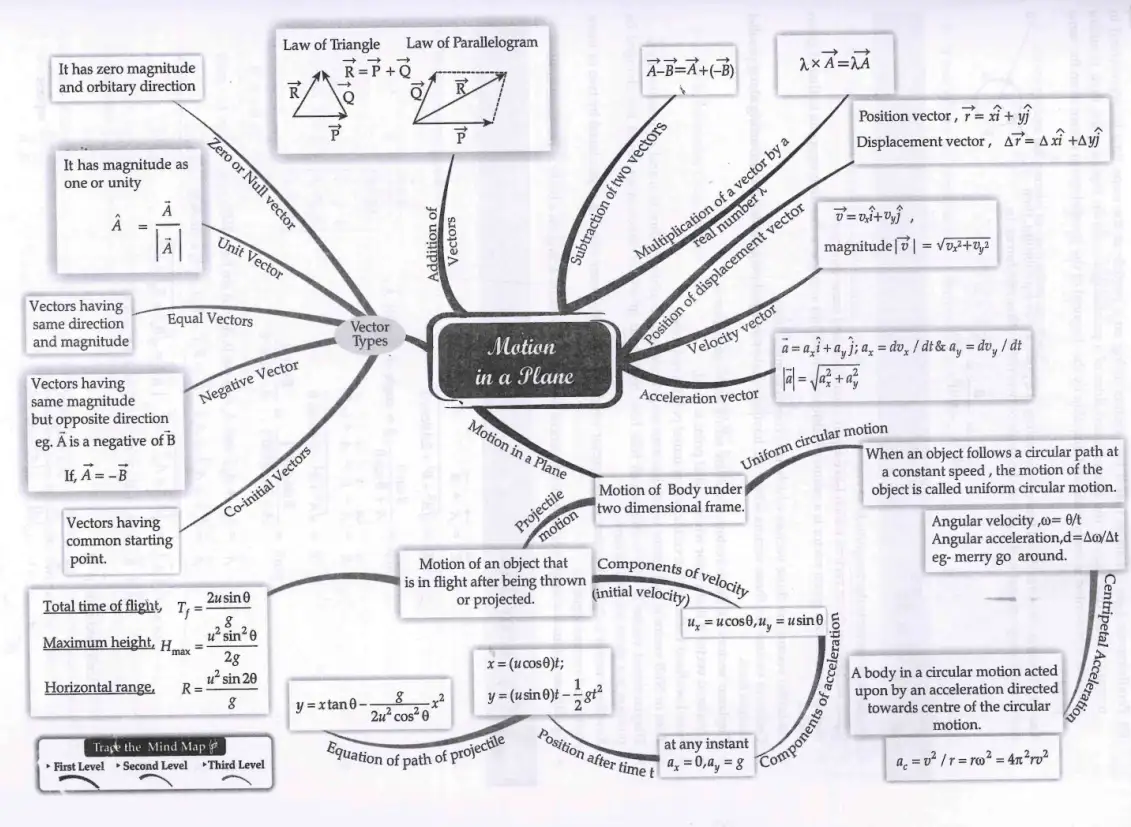
Scalar and Vector Quantities
Scalar Quantities
A scalar quantity is a physical quantity that has only magnitude and no direction. Examples include mass, temperature, speed, and time. Scalars are described completely by a numerical value and appropriate units.
Vector Quantities
A vector quantity is a physical quantity that has both magnitude and direction. Vectors follow the laws of vector addition. Examples include displacement, velocity, acceleration, and force.
Unit Vectors
A unit vector is a vector of magnitude one and indicates direction. For a vector \( \vec{A} \), its unit vector \( \hat{A} \) is given by \( \hat{A} = \frac{\vec{A}}{|\vec{A}|} \). In Cartesian coordinates, the unit vectors along the x, y, and z axes are \( \hat{i} \), \( \hat{j} \), and \( \hat{k} \) respectively.
Polar and Axial Vectors
Polar vectors have linear directional effects, such as force and linear velocity. Axial vectors, or rotational vectors, represent rotational effects and are directed along the axis of rotation according to the right-hand screw rule. Examples include angular velocity and torque.
Vector Addition Laws
General Law: Vectors are added by placing the tail of each subsequent vector at the head of the previous one. The resultant vector is drawn from the tail of the first vector to the head of the last vector.
Triangle Law: If two vectors are represented by two sides of a triangle taken in order, their resultant is represented by the third side taken in the opposite order.
Parallelogram Law: If two vectors are represented by adjacent sides of a parallelogram, their resultant is represented by the diagonal of the parallelogram from the same point.
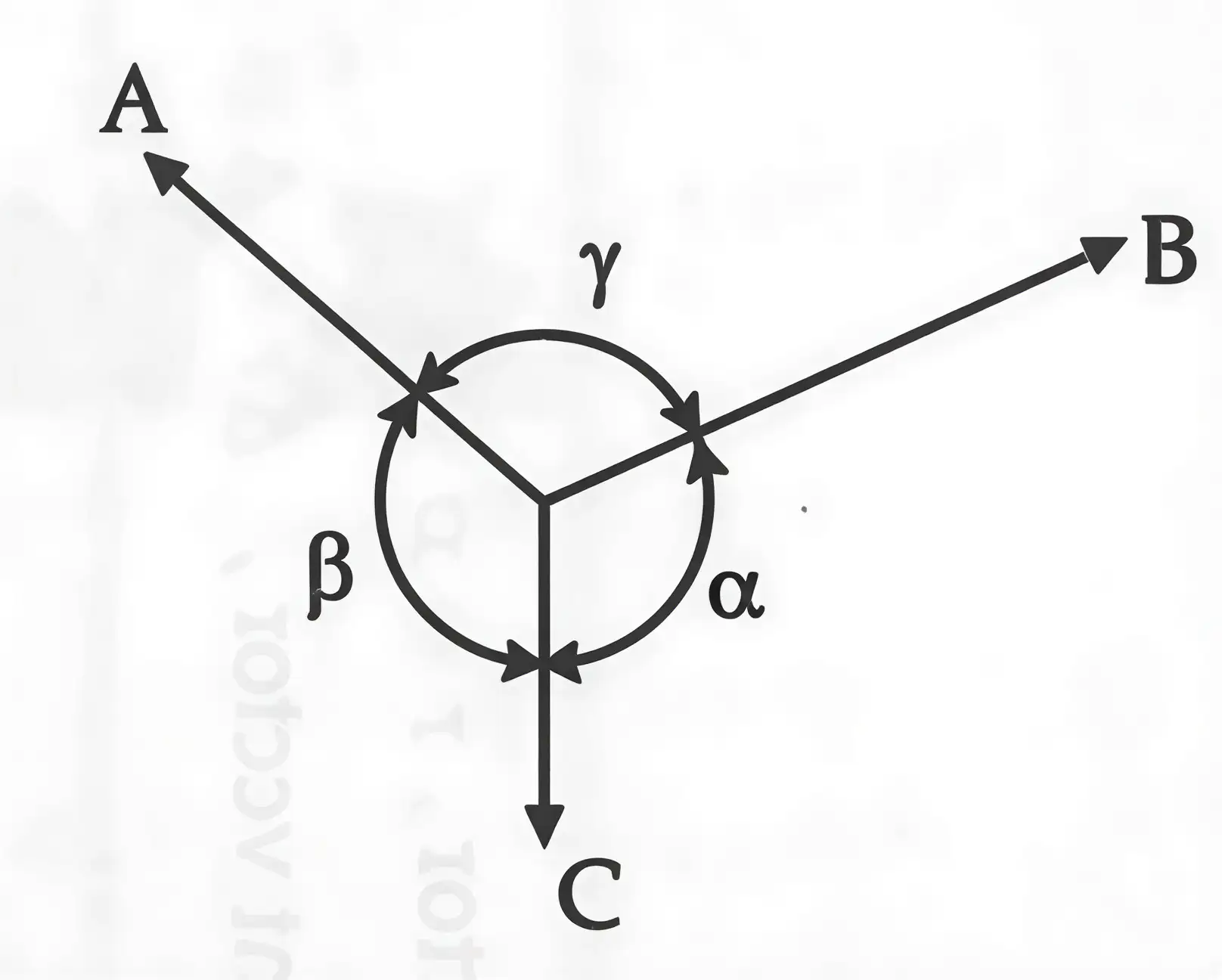
Lami's Theorem
If three forces acting at a point are in equilibrium, each force is proportional to the sine of the angle between the other two forces:
\( \frac{A}{\sin \alpha} = \frac{B}{\sin \beta} = \frac{C}{\sin \gamma} \)
Key Vector Concepts
- Modulus of a vector is its magnitude.
- Equal vectors have the same magnitude and direction.
- Negative vector has the same magnitude but opposite direction.
- Co-initial vectors share the same initial point.
- Collinear vectors lie along parallel lines.
- Coplanar vectors lie in the same plane.
- Localized vector has a fixed initial point.
- Non-localized vector has a variable initial point.
- Zero vector has zero magnitude and arbitrary direction.
- Displacement vector indicates change in position.
- Resultant vector produces the same effect as multiple vectors combined.
- Equilibrant vector balances other vectors acting on a body.
Vector Operations and Formulas
For vectors \( \vec{A} \) and \( \vec{B} \) with angle \( \theta \) between them:
Resultant vector magnitude:
\( R = \sqrt{A^2 + B^2 + 2AB \cos \theta} \)
Angle of resultant with \( \vec{A} \):
\( \tan \beta = \frac{B \sin \theta}{A + B \cos \theta} \)
Vector subtraction:
\( \vec{R} = \vec{A} - \vec{B} = \vec{A} + (-\vec{B}) \)
Magnitude of difference:
\( R = \sqrt{A^2 + B^2 - 2AB \cos \theta} \)
Components of vector \( \vec{A} \) in 2D:
\( \vec{A} = A_x \hat{i} + A_y \hat{j} \), where \( A_x = A \cos \theta \), \( A_y = A \sin \theta \)
In 3D:
\( \vec{A} = A_x \hat{i} + A_y \hat{j} + A_z \hat{k} \)
Vector addition in components:
\( \vec{A} + \vec{B} = (A_x + B_x) \hat{i} + (A_y + B_y) \hat{j} + (A_z + B_z) \hat{k} \)
Unit vector:
\( \hat{A} = \frac{\vec{A}}{|\vec{A}|} = \frac{A_x \hat{i} + A_y \hat{j} + A_z \hat{k}}{\sqrt{A_x^2 + A_y^2 + A_z^2}} \)
Dot product:
\( \vec{A} \cdot \vec{B} = AB \cos \theta = \vec{B} \cdot \vec{A} \)
If vectors are parallel (\( \theta = 0^\circ \)):
\( \vec{A} \cdot \vec{B} = AB \)
If vectors are perpendicular (\( \theta = 90^\circ \)):
\( \vec{A} \cdot \vec{B} = 0 \)
Cross product:
\( \vec{A} \times \vec{B} = AB \sin \theta \hat{n} \), where \( \hat{n} \) is a unit vector perpendicular to both \( \vec{A} \) and \( \vec{B} \)
Properties:
\( \vec{A} \times \vec{B} = - \vec{B} \times \vec{A} \)
If vectors are parallel:
\( \vec{A} \times \vec{B} = 0 \)
If vectors are perpendicular:
\( |\vec{A} \times \vec{B}| = AB \)
Cross product of unit vectors:
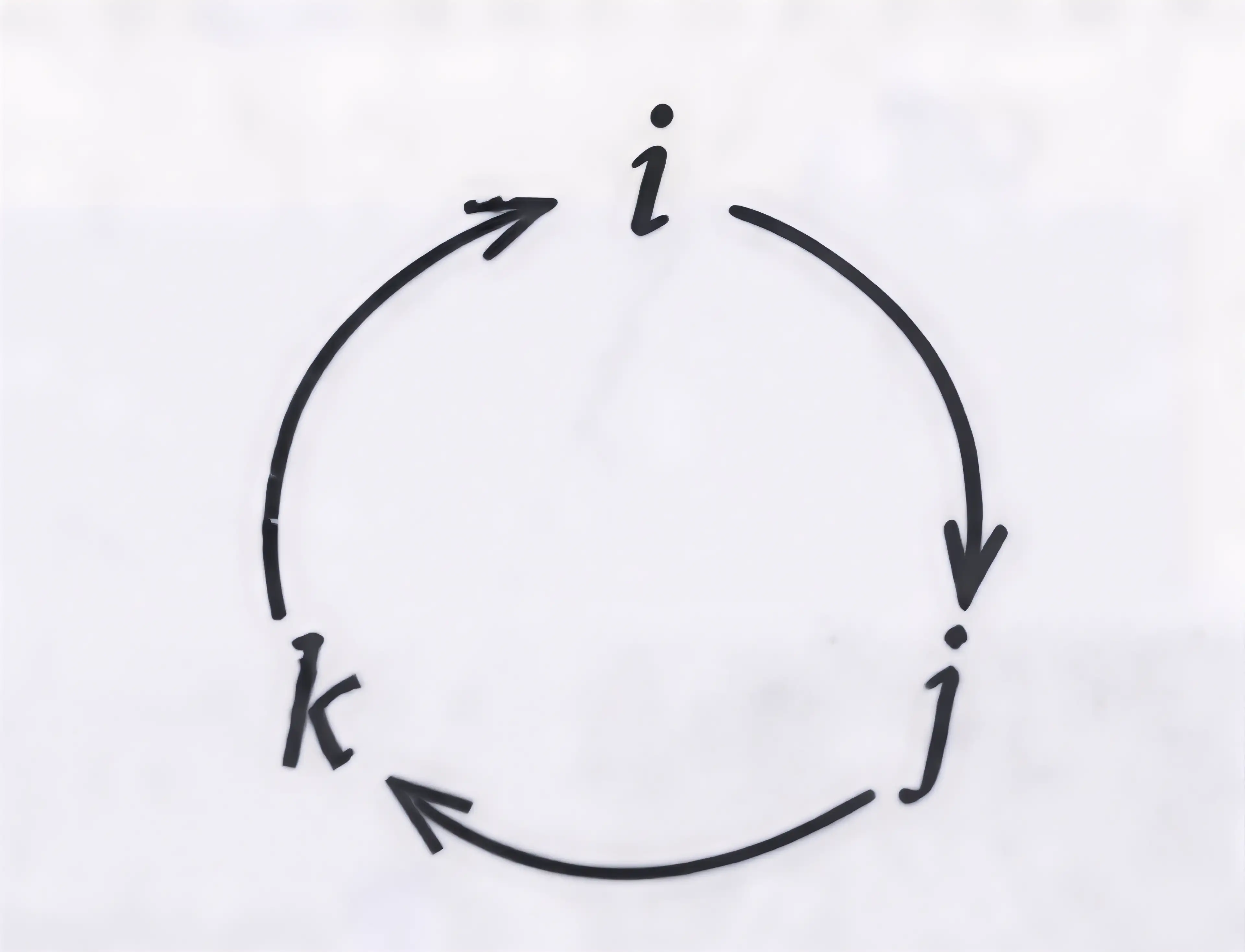
\( \hat{i} \times \hat{j} = \hat{k}, \hat{j} \times \hat{k} = \hat{i}, \hat{k} \times \hat{i} = \hat{j} \)
Reverse order:
\( \hat{i} \times \hat{k} = -\hat{j}, \hat{k} \times \hat{j} = -\hat{i}, \hat{j} \times \hat{i} = -\hat{k} \)
Area of triangle formed by vectors:
\( \text{Area} = \frac{1}{2} |\vec{A} \times \vec{B}| \)
Area of parallelogram formed by vectors:
\( \text{Area} = |\vec{A} \times \vec{B}| \)
Unit vector perpendicular to both \( \vec{A} \) and \( \vec{B} \):
\( \hat{n} = \frac{\vec{A} \times \vec{B}}{|\vec{A} \times \vec{B}|} \)
Determinant form of cross product:
\( \vec{A} \times \vec{B} = \begin{vmatrix} \hat{i} & \hat{j} & \hat{k} \\ A_x & A_y & A_z \\ B_x & B_y & B_z \end{vmatrix} \)
If \( \vec{A} + \vec{B} + \vec{C} = \vec{0} \), then:
\( \vec{A} \times \vec{B} = \vec{B} \times \vec{C} = \vec{C} \times \vec{A} \)
Relations involving angle \( \theta \):
\( \sin \theta = \frac{|\vec{A} \times \vec{B}|}{|\vec{A}||\vec{B}|} \),
\( \cos \theta = \frac{\vec{A} \cdot \vec{B}}{|\vec{A}||\vec{B}|} \),
\( \tan \theta = \frac{|\vec{A} \times \vec{B}|}{\vec{A} \cdot \vec{B}} \)
Solved Examples
Example 1: Find the resultant of two vectors \( \vec{A} = 3\hat{i} + 4\hat{j} \) and \( \vec{B} = 2\hat{i} + \hat{j} \).
Solution:
Adding components:
\( \vec{R} = (3 + 2)\hat{i} + (4 + 1)\hat{j} = 5\hat{i} + 5\hat{j} \)
Magnitude:
\( R = \sqrt{5^2 + 5^2} = \sqrt{50} = 5\sqrt{2} \)
Direction angle with x-axis:
\( \theta = \tan^{-1} \left( \frac{5}{5} \right) = 45^\circ \)
Example 2: Calculate the dot product of \( \vec{A} = 4\hat{i} - 3\hat{j} + 2\hat{k} \) and \( \vec{B} = -\hat{i} + 5\hat{j} + 6\hat{k} \).
Solution:
Dot product:
\( \vec{A} \cdot \vec{B} = (4)(-1) + (-3)(5) + (2)(6) = -4 - 15 + 12 = -7 \)
Practice Set
Conceptual Questions
- Explain the difference between scalar and vector quantities with examples.
- What is a unit vector? Why is it important in vector analysis?
Application-based Question
- Two vectors \( \vec{A} \) and \( \vec{B} \) have magnitudes 5 and 7 units respectively, and the angle between them is 60°. Find the magnitude and direction of their resultant vector.
Answer Key
Conceptual Questions
- Scalar quantities have only magnitude (e.g., mass, temperature), while vector quantities have both magnitude and direction (e.g., velocity, force).
- A unit vector has magnitude 1 and indicates direction. It is used to specify directions in vector operations.
Application-based Question
Given:
\( A = 5 \), \( B = 7 \), \( \theta = 60^\circ \)
Magnitude of resultant:
\( R = \sqrt{5^2 + 7^2 + 2 \times 5 \times 7 \times \cos 60^\circ} = \sqrt{25 + 49 + 35} = \sqrt{109} \approx 10.44 \)
Direction:
\( \tan \beta = \frac{7 \sin 60^\circ}{5 + 7 \cos 60^\circ} = \frac{7 \times 0.866}{5 + 7 \times 0.5} = \frac{6.062}{8.5} = 0.713 \)
\( \beta = \tan^{-1}(0.713) \approx 35.5^\circ \)
Projectile Motion
Definition and Components
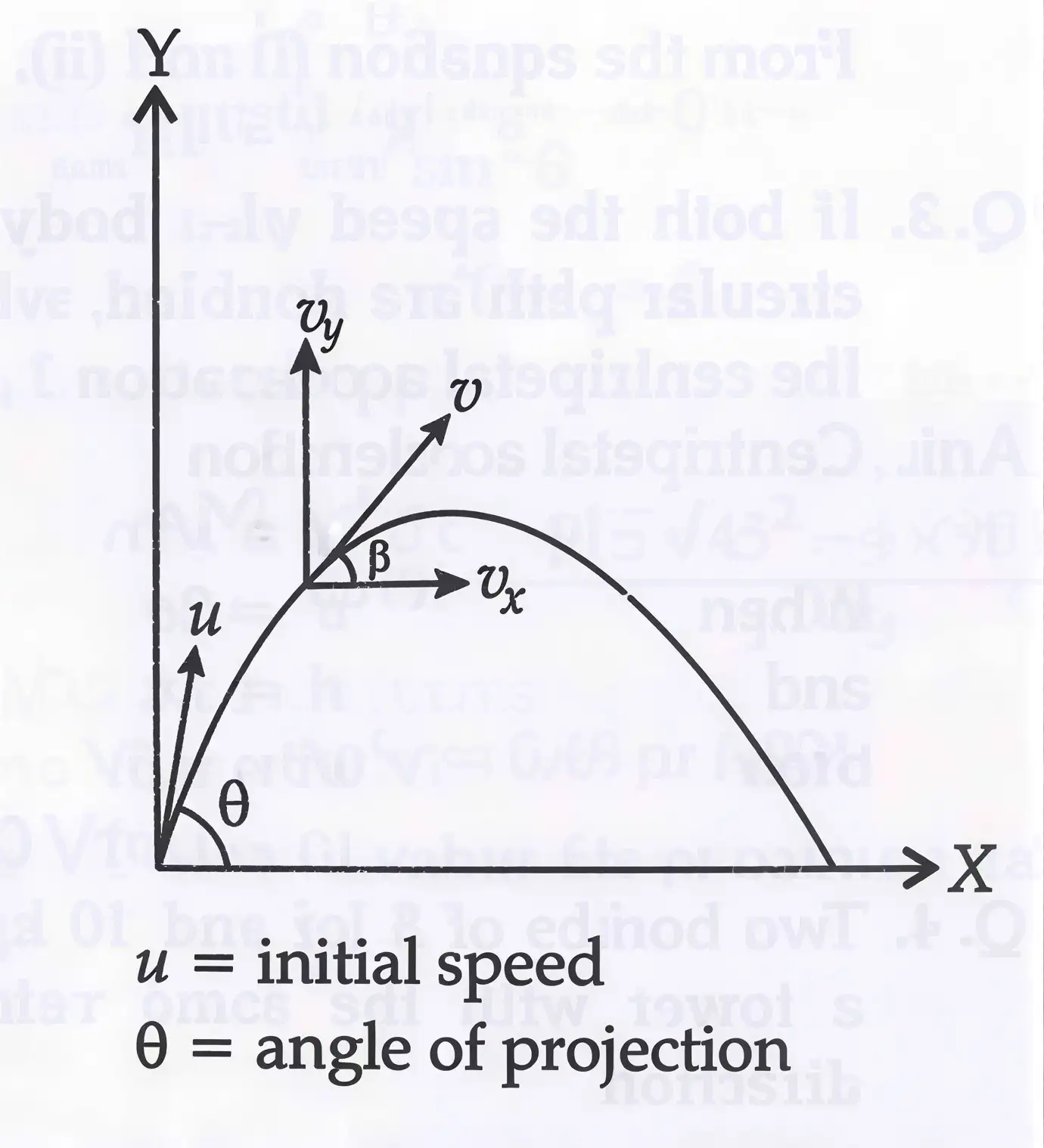
A projectile is a body thrown with an initial velocity at an angle to the horizontal and moves under the influence of gravity alone. Its path is called the trajectory. The motion can be analyzed as two independent components: horizontal motion with constant velocity and vertical motion with constant acceleration due to gravity.
Key Characteristics
The horizontal component causes the body to move forward, while the vertical component causes it to rise and fall. The combination results in a curved path.
Centripetal Force in Circular Motion
Centripetal force is the force that keeps a body moving in a circular path, directed towards the center of the circle. It does no work as it acts perpendicular to the motion.
Angular Quantities
Angular displacement: The angle swept by the radius vector in a given time.
Angular velocity: Rate of change of angular displacement.
Angular acceleration: Rate of change of angular velocity.
Uniform circular motion: Motion in a circle at constant speed.
Equations of Motion
Along X-axis:
\( v_x = u_x + a_x t \),
\( x = x_0 + u_x t + \frac{1}{2} a_x t^2 \)
Along Y-axis:
\( v_y = u_y + a_y t \),
\( y = y_0 + u_y t + \frac{1}{2} a_y t^2 \)
Velocity at any instant:
\( v = \sqrt{v_x^2 + v_y^2} \),
\( \tan \beta = \frac{v_y}{v_x} \)
Projectile Motion Formulas
Time of flight:
\( T = \frac{2 u \sin \theta}{g} \)
Maximum height:
\( h = \frac{u^2 \sin^2 \theta}{2g} \)
Horizontal range:
\( R = \frac{u^2 \sin 2\theta}{g} \)
Maximum range occurs at \( \theta = 45^\circ \):
\( R_{max} = \frac{u^2}{g} \)
Range is the same for angles \( \theta \) and \( 90^\circ - \theta \).
Circular Motion Formulas
Angular velocity:
\( \omega = \frac{\theta}{t} = 2 \pi \nu = \frac{2 \pi}{T} \)
Centripetal acceleration:
\( a_c = \omega^2 r = \omega v = \frac{v^2}{r} \)
Tangential acceleration:
\( a_T = r \alpha \)
Solved Examples
Example 1: A projectile is launched with speed 20 m/s at an angle of 30° to the horizontal. Calculate the time of flight, maximum height, and horizontal range. (Take \( g = 10 \text{ m/s}^2 \))
Solution:
Given:
\( u = 20 \text{ m/s}, \theta = 30^\circ, g = 10 \text{ m/s}^2 \)
Time of flight:
\( T = \frac{2 u \sin \theta}{g} = \frac{2 \times 20 \times 0.5}{10} = 2 \text{ s} \)
Maximum height:
\( h = \frac{u^2 \sin^2 \theta}{2g} = \frac{400 \times 0.25}{20} = 5 \text{ m} \)
Horizontal range:
\( R = \frac{u^2 \sin 2\theta}{g} = \frac{400 \times \sin 60^\circ}{10} = \frac{400 \times 0.866}{10} = 34.64 \text{ m} \)
Practice Set
Conceptual Questions
- Explain why the horizontal component of velocity remains constant in projectile motion.
- What is centripetal force and why does it not do work on a body in circular motion?
Application-based Question
- A projectile is fired with an initial velocity of 25 m/s at an angle of 60°. Calculate its maximum height and time of flight. (Use \( g = 9.8 \text{ m/s}^2 \))
Answer Key
Conceptual Questions
- The horizontal component of velocity remains constant because there is no acceleration in the horizontal direction (ignoring air resistance).
- Centripetal force acts towards the center of the circular path, perpendicular to the velocity, so it changes direction but not speed, hence does no work.
Application-based Question
Given:
\( u = 25 \text{ m/s}, \theta = 60^\circ, g = 9.8 \text{ m/s}^2 \)
Maximum height:
\( h = \frac{u^2 \sin^2 \theta}{2g} = \frac{625 \times (0.866)^2}{2 \times 9.8} = \frac{625 \times 0.75}{19.6} = 23.9 \text{ m} \)
Time of flight:
\( T = \frac{2 u \sin \theta}{g} = \frac{2 \times 25 \times 0.866}{9.8} = 4.42 \text{ s} \)
Quick Reference Table
- Scalar Quantity: A physical quantity with magnitude only, e.g., mass, temperature, speed.
- Vector Quantity: A physical quantity with magnitude and direction, e.g., displacement, velocity, force.
- Unit Vector: A vector of magnitude one indicating direction, e.g., \( \hat{i}, \hat{j}, \hat{k} \).
- Polar Vector: Vector with linear directional effect, e.g., force, velocity.
- Axial Vector: Vector representing rotational effect, e.g., torque, angular velocity.
- Vector Addition Laws: General law, Triangle law, Parallelogram law for combining vectors.
- Lami's Theorem: Relation between three forces in equilibrium: \( \frac{A}{\sin \alpha} = \frac{B}{\sin \beta} = \frac{C}{\sin \gamma} \).
- Vector Operations: Addition, subtraction, dot product, cross product with formulas and properties.
- Projectile Motion Formulas: Time of flight, maximum height, horizontal range with initial velocity and angle.
- Circular Motion Formulas: Angular velocity, centripetal acceleration, tangential acceleration.
Common Mistakes and Misconceptions
- Confusing Scalars and Vectors: Remember scalars have no direction; vectors have both magnitude and direction.
- Ignoring Direction in Vector Addition: Always consider vector directions when adding or subtracting.
- Incorrect Use of Unit Vectors: Unit vectors must have magnitude one; do not confuse with any vector.
- Misapplying Lami's Theorem: It applies only when three forces are in equilibrium acting at a point.
- Forgetting Components in Projectile Motion: Treat horizontal and vertical motions separately with correct acceleration assumptions.
- Assuming Centripetal Force Does Work: Centripetal force acts perpendicular to motion and does no work.
- Mixing Up Dot and Cross Products: Dot product results in scalar; cross product results in vector perpendicular to both.
- Incorrect Angle Use in Formulas: Ensure angles are measured correctly between vectors for trigonometric calculations.
Glossary
- Scalar Quantity: Quantity with magnitude only.
- Vector Quantity: Quantity with magnitude and direction.
- Unit Vector: Vector of magnitude one indicating direction.
- Polar Vector: Vector representing linear effect.
- Axial Vector: Vector representing rotational effect.
- Resultant Vector: Single vector equivalent to multiple vectors combined.
- Equilibrant Vector: Vector that balances other vectors acting on a body.
- Displacement Vector: Vector showing change in position.
- Dot Product: Scalar product of two vectors, \( \vec{A} \cdot \vec{B} = AB \cos \theta \).
- Cross Product: Vector product of two vectors, \( \vec{A} \times \vec{B} = AB \sin \theta \hat{n} \).
- Projectile: Body thrown with initial velocity moving under gravity alone.
- Trajectory: Path followed by a projectile.
- Centripetal Force: Force directed towards center causing circular motion.
- Angular Velocity: Rate of change of angular displacement.
- Angular Acceleration: Rate of change of angular velocity.