CLASS 11-PCB . PHYSICS . PHYSICS PART II . MECHANICAL PROPERTIES-OF-SOLIDS
Chapter 8 : Mechanical Properties Of Solids
Ch 8
PHYSICS
CLASS 11-PCB
Elastic Behaviour of Solids
Stress and its Types
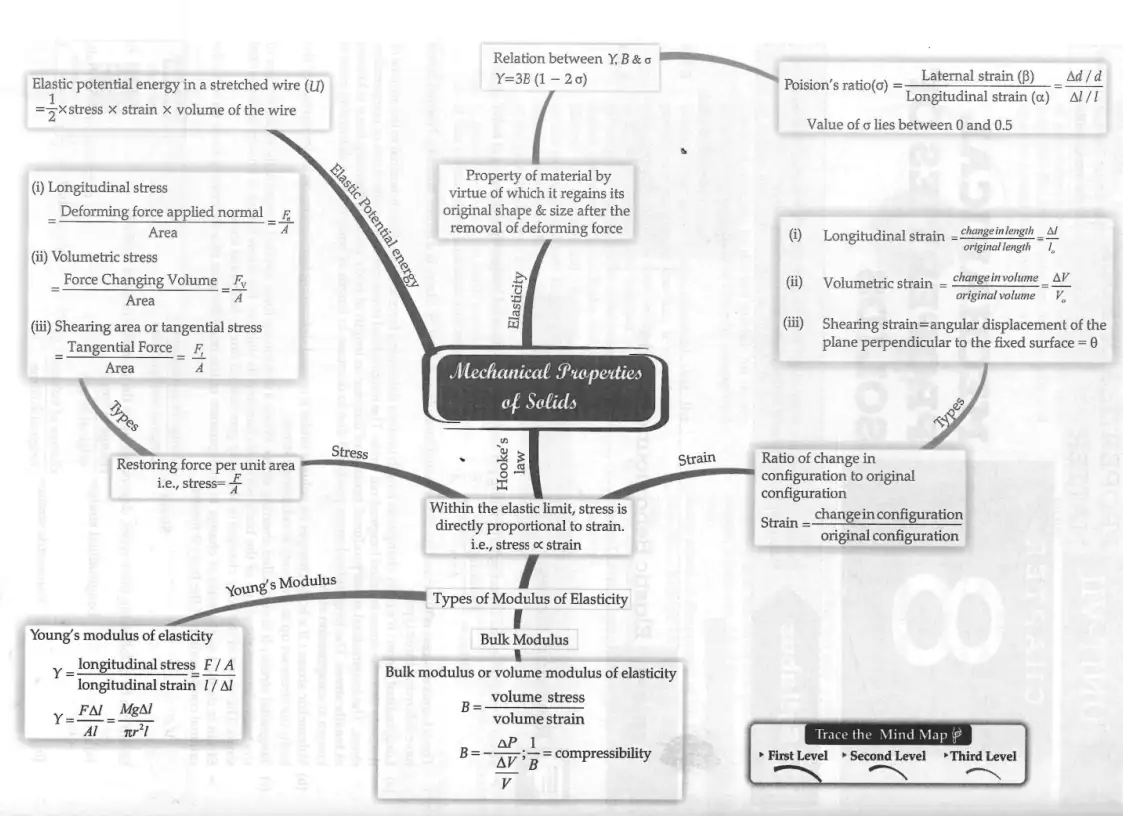
Stress is defined as the restoring force acting per unit area of a deformed body. Mathematically, stress = restoring force / area = F / A. The SI unit of stress is newton per square meter (N m−2) and its dimensional formula is [ML−1T−2]. Stress is a tensor quantity and normal stress has three types:
- Longitudinal stress: Stress normal to the surface causing change in length. It can be tensile (increase in length) or compressive (decrease in length).
- Volumetric stress: Stress causing change in volume under normal force acting on all surfaces.
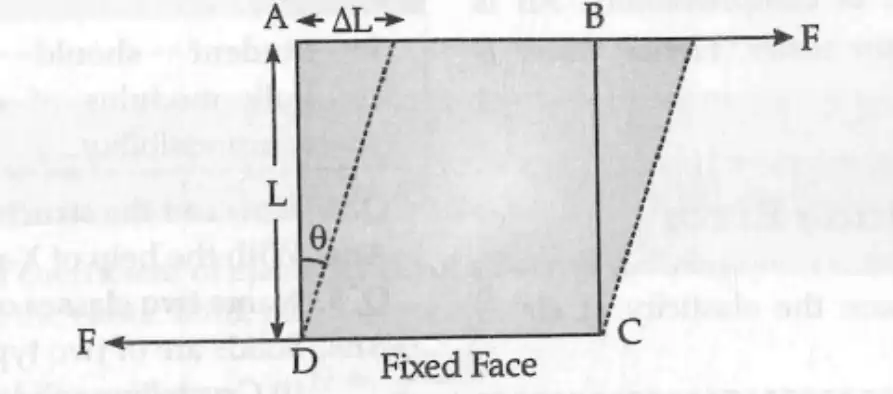
- Tangential stress (Shearing stress): Stress due to force applied tangentially, causing change in shape without volume change.
Strain and its Types
Strain is the ratio of change in configuration of a body due to deforming force to its original configuration. It is dimensionless and has no units.
- Longitudinal strain: Change in length / Original length = Δl / l
- Volumetric strain: Change in volume / Original volume = ΔV / V
- Shearing strain: When force is applied parallel to surface, causing shape change without volume change. Defined as the angle θ through which a vertical line rotates under tangential force, θ = ΔL / L, where ΔL is displacement and L is perpendicular distance from fixed surface.
Hooke's Law
Within the elastic limit, stress is directly proportional to strain, i.e., Stress ∝ Strain.
Key Terms
- Deforming force: Force that changes the configuration of a body.
- Elasticity: Property of a body to regain original shape after removal of deforming force.
- Perfectly elastic body: Regains original form completely, e.g., quartz.
- Plastic body: Does not regain original form after deforming force removal, e.g., putty.
- Elastic limit: Maximum deforming force up to which body regains original form completely.
Key Formulae
- Normal stress, S = F / A
- Breaking force = Breaking stress × Area
- Longitudinal strain = Δl / l
- Volumetric strain = ΔV / V
- Shearing strain, θ = ΔL / L
Solved Examples
Example 1: A wire of length 2 m and cross-sectional area 1 mm2 is stretched by a force of 10 N. Calculate the longitudinal stress and strain if the extension produced is 0.5 mm.
Solution:
Given: Length, l = 2 m = 2000 mm; Area, A = 1 mm2; Force, F = 10 N; Extension, Δl = 0.5 mm
Longitudinal stress, S = F / A = 10 N / 1 mm2 = 10 N/mm2
Longitudinal strain = Δl / l = 0.5 mm / 2000 mm = 0.00025
Thus, stress = 10 N/mm2, strain = 0.00025 (dimensionless).
Practice Set
- Level 1: Define stress and strain. What are their SI units?
- Level 2: Explain the difference between longitudinal stress and tangential stress.
- Level 3: A wire of length 1.5 m and cross-sectional area 2 mm2 is stretched by a force of 20 N. If the extension produced is 0.3 mm, calculate the longitudinal stress and strain.
Answer Key
- Level 1: Stress is force per unit area (N/m2), strain is change in length/original length (dimensionless).
- Level 2: Longitudinal stress acts normal to surface causing length change; tangential stress acts parallel causing shape change without volume change.
- Level 3: Stress = 20 N / 2 mm2 = 10 N/mm2; Strain = 0.3 mm / 1500 mm = 0.0002.
Modulus of Elasticity
Definition and Types
Modulus of elasticity (E) is the ratio of stress to corresponding strain within the elastic limit, E = Stress / Strain.
Types of modulus of elasticity:
- Young's modulus (Y): Ratio of longitudinal stress to longitudinal strain, Y = (F / A) / (Δl / l) = (F / A) × (l / Δl). It measures stiffness of solid materials.
- Bulk modulus (K): Ratio of volume stress to volumetric strain, K = − (P V) / ΔV. It applies to solids, liquids, and gases.
- Modulus of rigidity (η): Ratio of tangential stress to shearing strain, η = (F / A) / θ = F / (Aθ). It applies to solids only.
Poisson's Ratio
Poisson's ratio (σ) is the ratio of lateral strain to longitudinal strain, σ = (ΔD / D) / (Δl / l) = − (ΔD · l) / (D · Δl). Its practical value lies between 0 and 0.5.
Key Terms
- Compressibility: Reciprocal of bulk modulus, c = 1 / K = − ΔV / (P V).
- Elastic fatigue: Loss of strength due to repeated alternating strains.
- Yield strength: Maximum stress a material can sustain without permanent deformation.
Key Formulae
- Young’s modulus, Y = Fℓ / (AΔℓ)
- Bulk modulus, K = − (F / A) / (ΔV / V) = − P V / ΔV
- Modulus of rigidity, η = Fℓ / (AΔℓ)
- Poisson’s ratio, σ = − (ΔD / D) / (Δℓ / ℓ)
- Relations among elastic constants:
Y = 3K(1 − 2σ)
Y = 2η(1 + σ)
σ = (3K − 2η) / (2η + 6K)
9 / Y = 1 / K + 3 / η - Elastic potential energy, U = ½ × Stress × Strain × Volume
- Elastic potential energy per unit volume, u = ½ × Stress × Strain = ½ Y × (Strain)2
- Work done in stretching wire, W = ½ × Load × Extension
Solved Examples
Example 1: A wire of length 2 m and cross-sectional area 1 mm2 is stretched by a force of 10 N producing an extension of 0.5 mm. Calculate Young's modulus.
Solution:
Given: l = 2 m = 2000 mm, A = 1 mm2, F = 10 N, Δl = 0.5 mm
Young's modulus, Y = (F / A) × (l / Δl) = (10 / 1) × (2000 / 0.5) = 10 × 4000 = 40000 N/mm2 = 4 × 10¹⁰ N/m2
Thus, Young's modulus is 4 × 10¹⁰ pascal.
Practice Set
- Level 1: Define Young's modulus and bulk modulus.
- Level 2: Explain Poisson's ratio and its practical range.
- Level 3: A wire of length 1 m and cross-sectional area 0.5 mm2 is stretched by 5 N force producing an extension of 0.2 mm. Calculate Young's modulus.
Answer Key
- Level 1: Young's modulus is ratio of longitudinal stress to strain; bulk modulus is ratio of volume stress to volumetric strain.
- Level 2: Poisson's ratio is lateral strain divided by longitudinal strain; practical values lie between 0 and 0.5.
- Level 3: Y = (F / A) × (l / Δl) = (5 / 0.5) × (1000 / 0.2) = 10 × 5000 = 50000 N/mm2 = 5 × 10¹⁰ Pa.
Quick Reference Table
- Stress: Force applied per unit area on a body, measured in N/m2.
- Strain: Ratio of change in dimension to original dimension, dimensionless.
- Longitudinal Stress and Strain: Related to change in length of a body.
- Volumetric Stress and Strain: Related to change in volume of a body.
- Shearing Stress and Strain: Related to change in shape without volume change.
- Hooke's Law: Stress is proportional to strain within elastic limit.
- Young's Modulus (Y): Ratio of longitudinal stress to longitudinal strain, indicates stiffness.
- Bulk Modulus (K): Ratio of volume stress to volumetric strain, indicates compressibility.
- Modulus of Rigidity (η): Ratio of tangential stress to shearing strain, indicates rigidity.
- Poisson's Ratio (σ): Ratio of lateral strain to longitudinal strain, typically between 0 and 0.5.
- Elastic Limit: Maximum stress up to which a material regains original shape.
- Elastic Potential Energy: Energy stored in a stretched or compressed body.
- Relations among Elastic Constants: Mathematical relations connecting Y, K, η, and σ.
Common Mistakes and Misconceptions
- Confusing stress with force: Stress is force per unit area, not just force.
- Mixing up strain types: Longitudinal strain changes length, shearing strain changes shape.
- Ignoring elastic limit: Assuming materials always return to original shape beyond elastic limit.
- Incorrect units: Stress has units of N/m2, strain is dimensionless.
- Misinterpreting Poisson's ratio: It cannot be negative beyond -1 or exceed 0.5.
- Applying Hooke's law beyond elastic limit: Stress and strain are proportional only within elastic limit.
- Forgetting that modulus of rigidity applies only to solids, not liquids or gases.
- Confusing bulk modulus with Young's modulus: Bulk modulus relates to volume change, Young's modulus to length change.
Glossary
- Stress: Force per unit area acting on a material.
- Strain: Measure of deformation representing displacement between particles.
- Elasticity: Ability of a material to regain original shape after deformation.
- Elastic Limit: Maximum stress a material can withstand without permanent deformation.
- Hooke's Law: Principle stating stress is proportional to strain within elastic limit.
- Young's Modulus: Measure of stiffness of a solid material.
- Bulk Modulus: Measure of a material's resistance to uniform compression.
- Modulus of Rigidity: Measure of a material's resistance to shear deformation.
- Poisson's Ratio: Ratio of lateral strain to longitudinal strain.
- Elastic Potential Energy: Energy stored in a deformed elastic body.
- Deforming Force: Force causing change in shape or size of a body.
- Perfectly Elastic Body: Material that completely recovers original shape after deformation.
- Plastic Body: Material that does not recover original shape after deformation.
- Compressibility: Reciprocal of bulk modulus, indicating how compressible a material is.
- Elastic Fatigue: Weakening of material due to repeated stress cycles.
- Yield Strength: Maximum stress before permanent deformation occurs.