CLASS 11-PCB . PHYSICS . PHYSICS PART II . MECHANICAL PROPERTIES-OF-FLUIDS
Chapter 9 : Mechanical Properties Of Fluids
Ch 9
PHYSICS
CLASS 11-PCB
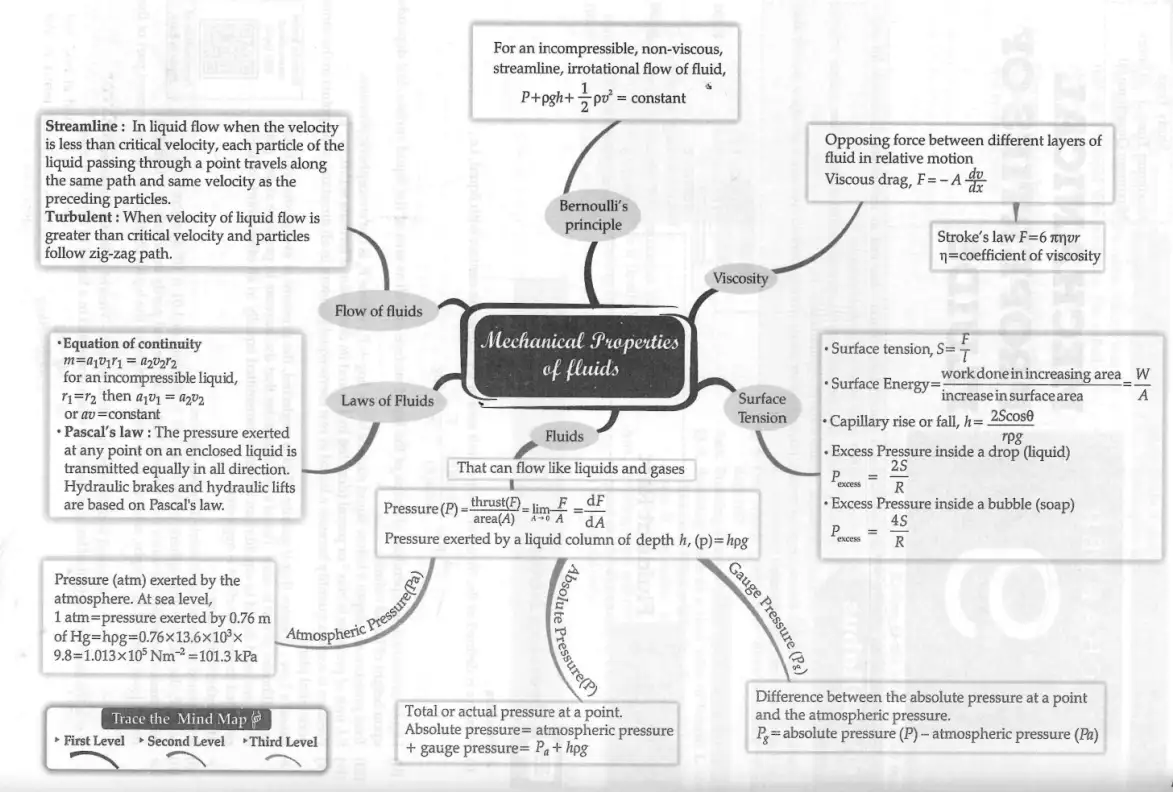
Fluids at Rest
Pressure in Fluids
Pressure is defined as the thrust acting per unit area of the surface in contact with a liquid. Mathematically, pressure (P) is given by:
P = \( \frac{F}{A} \) = h\rho g
where F is the thrust, A is the area, h is the height of the liquid column, \( \rho \) is the density of the liquid, and g is the acceleration due to gravity.
Pressure in a liquid depends on the height of the liquid column and is independent of the shape and area of the liquid surface.
The total pressure at a depth h below the liquid surface is:
P = h\rho g + P_0
where \( P_0 \) is the atmospheric pressure.
The SI unit of pressure is the pascal (Pa), which is equivalent to N/m2. Pressure is a scalar quantity because it acts equally in all directions at a point in a fluid at rest.
Pascal's Law
Pascal's law states that if the effect of gravity is neglected, the pressure at every point in a liquid at rest is the same. Any increase in pressure applied at one point in an enclosed liquid is transmitted equally in all directions throughout the liquid.
Atmospheric Pressure
Atmospheric pressure is the pressure exerted by the weight of the atmosphere. At standard temperature and pressure (STP), atmospheric pressure is approximately 1.01 × 10⁵ N/m2.
Archimedes' Principle
When a body is immersed partly or wholly in a liquid, it experiences an apparent loss in weight equal to the weight of the liquid displaced by the body.
Observed weight = True weight − Weight of liquid displaced
If w is the observed weight of a body of density \( \rho \) immersed in a liquid of density \( \sigma \), then:
w = Mg − mg = Ah\rho g − Ah\sigma g = Ahg(\rho - \sigma) = W(1 - \frac{\sigma}{\rho})
where W is the true weight of the body.
Laws of Flotation
A body floats in a liquid if the weight of the liquid displaced by the immersed part of the body is equal to or greater than the weight of the body.
- If true weight W > weight of liquid displaced w, the body sinks (\( \rho > \sigma \)).
- If W < w, the body floats (\( \rho < \sigma \)).
- If W = w, the body is in equilibrium and floats with its volume just immersed (\( \rho = \sigma \)).
For stable equilibrium, the centre of gravity of the body lies below the metacentre; for unstable equilibrium, it lies above.
Solved Examples
Example 1: Calculate the pressure exerted by a column of water 5 m high. (Density of water = 1000 kg/m3, g = 9.8 m/s2)
Solution:
Pressure, P = h\rho g = 5 × 1000 × 9.8 = 49000 Pa
Example 2: A body of density 8000 kg/m3 is immersed in a liquid of density 1000 kg/m3. Find the apparent weight if the true weight is 100 N.
Solution:
Apparent weight, w = W(1 - \frac{\sigma}{\rho}) = 100 × (1 - \frac{1000}{8000}) = 100 × (1 - 0.125) = 87.5 N
Practice Set
- Level 1: Define pressure and state its SI unit.
- Level 2: Explain Pascal's law with an example.
- Level 3: A cube of side 0.1 m and density 8000 kg/m3 is immersed in water. Calculate the buoyant force acting on it. (Density of water = 1000 kg/m3, g = 9.8 m/s2)
Answer Key
Level 1: Pressure is the thrust per unit area exerted on a surface. Its SI unit is pascal (Pa).
Level 2: Pascal's law states that pressure applied to an enclosed fluid is transmitted equally in all directions. Example: Hydraulic lift.
Level 3: Volume of cube = (0.1)3 = 0.001 m3
Weight of water displaced = volume × density × g = 0.001 × 1000 × 9.8 = 9.8 N
Buoyant force = 9.8 N
Surface Energy and Surface Tension
Surface Tension
Surface tension is the property of a liquid by which its free surface behaves like a stretched elastic membrane, tending to minimize its surface area.
It is defined as the force acting per unit length on a line drawn tangentially on the liquid surface:
S = \( \frac{F}{l} \)
Surface tension is also the work done per unit area to increase the surface area of the liquid:
S = \( \frac{W}{A} \)
Surface tension arises due to molecular forces and has SI unit N/m or J/m2. It is a scalar quantity and does not depend on the surface area.
Surface Energy
Surface energy is the work done against surface tension to create a surface of a given area at constant temperature:
Surface energy = Surface tension × Surface area
Its SI unit is joule (J).
When small drops combine, surface area and energy decrease, releasing energy. When a big drop splits into smaller drops, surface area and energy increase, requiring energy input.
Solved Examples
Example 1: Calculate the surface tension of a liquid if a force of 0.2 N acts on a wire of length 0.1 m placed on its surface.
Solution:
S = F / l = 0.2 / 0.1 = 2 N/m
Example 2: Find the work done to increase the surface area of a liquid by 0.05 m2 if its surface tension is 0.07 N/m.
Solution:
Work done = Surface tension × Increase in area = 0.07 × 0.05 = 0.0035 J
Practice Set
- Level 1: Define surface tension and state its SI unit.
- Level 2: Explain why surface tension is a scalar quantity.
- Level 3: Calculate the excess pressure inside a soap bubble of radius 0.01 m if surface tension is 0.072 N/m.
Answer Key
Level 1: Surface tension is the force per unit length acting tangentially on the surface of a liquid. SI unit is N/m.
Level 2: Surface tension is scalar because it has magnitude but no specific direction; it acts along the surface.
Level 3: Excess pressure, P = \( \frac{4S}{r} \) = 4 × 0.072 / 0.01 = 28.8 Pa
Viscosity and Bernoulli's Theorem
Viscosity
Viscosity is the property of a fluid that offers resistance to flow due to internal friction between layers of the fluid.
Viscous force acting tangentially on a layer of fluid is given by Newton's formula:
F = ±ηA \( \frac{dv}{dx} \)
where η is the coefficient of viscosity, A is the area, and \( \frac{dv}{dx} \) is the velocity gradient.
Bernoulli's Theorem
Bernoulli's theorem states that for an incompressible, non-viscous fluid in steady flow, the total energy per unit volume remains constant:
P + \rho gh + \frac{1}{2} \rho v^2 = constant
where P is pressure energy, \( \rho gh \) is potential energy per unit volume, and \( \frac{1}{2} \rho v^2 \) is kinetic energy per unit volume.
Torricelli's Theorem
Velocity of efflux of liquid from an orifice at depth h below the free surface is:
v = \( \sqrt{2gh} \)
Solved Examples
Example 1: Calculate the velocity of efflux of water from a hole 4 m below the surface.
Solution:
v = \( \sqrt{2gh} \) = \( \sqrt{2 × 9.8 × 4} \) = 8.85 m/s
Example 2: Find the viscous force acting on a layer of fluid with area 0.5 m2, velocity gradient 10 s−1, and viscosity coefficient 0.1 Pa·s.
Solution:
F = ηA \( \frac{dv}{dx} \) = 0.1 × 0.5 × 10 = 0.5 N
Practice Set
- Level 1: Define viscosity and state its effect on fluid flow.
- Level 2: State Bernoulli's theorem and explain the terms involved.
- Level 3: Calculate the terminal velocity of a sphere of radius 0.001 m and density 2500 kg/m3 falling in a liquid of density 1000 kg/m3 and viscosity 0.001 Pa·s. (g = 9.8 m/s2)
Answer Key
Level 1: Viscosity is the internal friction in a fluid that resists flow.
Level 2: Bernoulli's theorem states that the sum of pressure energy, potential energy, and kinetic energy per unit volume is constant in steady flow.
Level 3: Terminal velocity, v = \( \frac{2r^2(\rho - \sigma)g}{9\eta} \) = \( \frac{2 × (0.001)^2 × (2500 - 1000) × 9.8}{9 × 0.001} \) = 3.27 m/s
Quick Reference Table
Pressure: P = h\rho g + P_0 (Pa)
Pascal's Law: Pressure applied is transmitted equally.
Archimedes' Principle: Buoyant force = weight of displaced liquid.
Surface Tension: S = F / l (N/m)
Bernoulli's Theorem: P + \rho gh + \frac{1}{2} \rho v^2 = constant
Viscosity: F = ηA \( \frac{dv}{dx} \)
Terminal Velocity: v = \( \frac{2r^2(\rho - \sigma)g}{9\eta} \)
Common Mistakes and Misconceptions
1. Confusing pressure with force; pressure is force per unit area.
2. Assuming pressure depends on the shape or area of the liquid surface.
3. Forgetting to add atmospheric pressure when calculating total pressure.
4. Misinterpreting surface tension as a force rather than force per unit length.
5. Neglecting viscosity in fluid flow problems where it is significant.
6. Applying Bernoulli's theorem to viscous or compressible fluids incorrectly.
Glossary
Pressure: Force exerted per unit area.
Pascal's Law: Pressure transmission in fluids.
Buoyancy: Upward force on immersed body.
Surface Tension: Force per unit length on liquid surface.
Viscosity: Fluid's resistance to flow.
Bernoulli's Theorem: Conservation of energy in fluid flow.
Terminal Velocity: Constant velocity of falling object in fluid.