CLASS 11-PCB . PHYSICS . PHYSICS PART II . KINETIC THEORY
Chapter 12 : Kinetic Theory
Ch 12
PHYSICS
CLASS 11-PCB
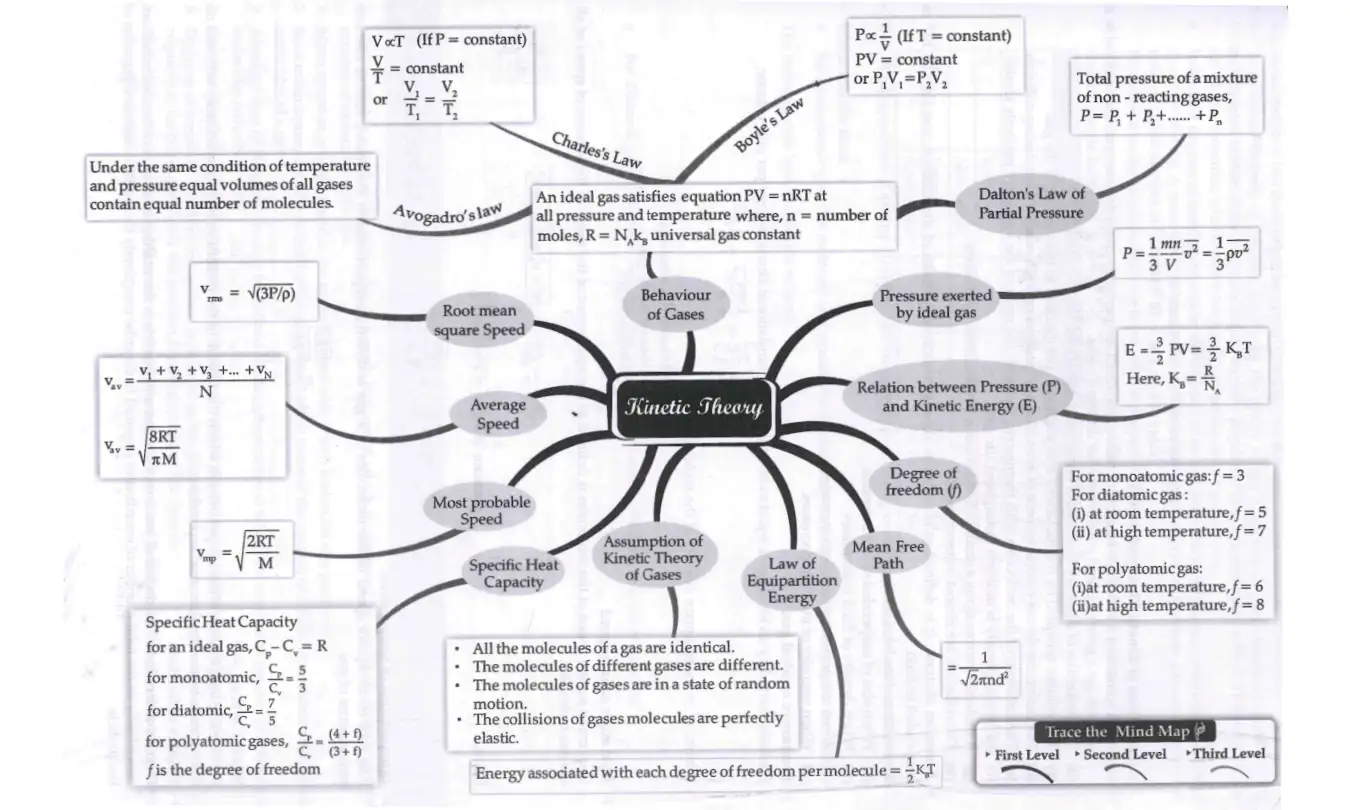
Ideal Gases
Characteristics of Ideal Gases
Ideal gases strictly obey gas laws such as Boyle's law and Charles' law. The size and volume of gas molecules are considered negligible. There are no forces of attraction or repulsion between the molecules, and collisions between molecules are perfectly elastic.
Equation of State
The equation of state for an ideal gas combines Boyle's and Charles' laws and is given by:
\( P V = n k_B T \)
where \( P \) is pressure, \( V \) is volume, \( n \) is the number of molecules, \( k_B \) is the Boltzmann constant, and \( T \) is the absolute temperature.
For one mole of gas, the equation becomes:
\( P V = R T \)
where \( R \) is the universal gas constant.
Assumptions of Kinetic Theory
- A gas consists of a large number of identical molecules modeled as perfectly elastic spheres.
- Molecules are in continuous, rapid, and random motion.
- The volume of molecules is negligible compared to the gas volume.
- No intermolecular forces except during collisions.
- Collisions are perfectly elastic.
- Molecular density is uniform throughout the gas.
- Molecules move in straight lines between collisions.
- Collisions are instantaneous.
Brownian Motion
Brownian motion is the continuous zig-zag movement of microscopic particles suspended in a fluid, caused by collisions with fluid molecules. It increases with larger particle size, lower fluid density, higher temperature, and lower viscosity.
Solved Examples
Example 1: Calculate the pressure exerted by 2 moles of an ideal gas at 300 K occupying a volume of 0.05 m³.
Solution:
Given: \( n = 2 \) moles, \( T = 300 \) K, \( V = 0.05 \) m³, \( R = 8.31 \) J/mol·K
Using the ideal gas equation:
\( P V = n R T \)
\( P = \frac{n R T}{V} = \frac{2 \times 8.31 \times 300}{0.05} = 99,720 \) Pa
Therefore, the pressure is 99,720 Pa or 99.72 kPa.
Practice Set
- Level 1: What are the main assumptions of the kinetic theory of gases?
- Level 2: Explain why collisions between gas molecules are considered perfectly elastic.
- Level 3: Calculate the pressure exerted by 1 mole of an ideal gas at 273 K occupying 22.4 liters.
Answer Key
- Level 1: Assumptions include large number of identical molecules, random motion, negligible volume, no intermolecular forces, perfectly elastic collisions, uniform density, straight-line motion between collisions, and instantaneous collisions.
- Level 2: Collisions are perfectly elastic because kinetic energy is conserved during collisions; no energy is lost as heat or deformation.
- Level 3: Using \( P V = n R T \), \( V = 22.4 \) liters = 0.0224 m³, \( n = 1 \), \( T = 273 \) K, \( R = 8.31 \) J/mol·K,
- \( P = \frac{1 \times 8.31 \times 273}{0.0224} = 101,325 \) Pa or 1 atm.
Pressure and Molecular Speeds
Pressure of an Ideal Gas
Pressure exerted by an ideal gas is due to collisions of molecules with the container walls and is related to the translational kinetic energy per unit volume:
\( P = \frac{2}{3} E = \frac{1}{3} \frac{m n}{V} \overline{v^2} = \frac{1}{3} \rho \overline{v^2} \)
where \( \overline{v^2} \) is the mean square velocity, \( m n \) is the total mass, \( V \) is volume, and \( \rho \) is density.
Root Mean Square Speed
Root mean square (rms) speed is the square root of the mean of the squares of molecular speeds:
\( v_{rms} = \sqrt{\overline{v^2}} = \sqrt{\frac{3 P}{\rho}} \)
It is also related to temperature by:
\( v_{rms} = \sqrt{\frac{3 R T}{M}} \)
where \( M \) is molar mass.
Interpretation of Temperature
The rms speed is proportional to the square root of absolute temperature. At absolute zero (0 K), molecular motion ceases.
Solved Examples
Example 2: Calculate the rms speed of oxygen molecules (molar mass 32 g/mol) at 300 K.
Solution:
Convert molar mass to kg: \( M = 32 \times 10^{-3} \) kg/mol
Given: \( R = 8.31 \) J/mol·K, \( T = 300 \) K
\( v_{rms} = \sqrt{\frac{3 R T}{M}} = \sqrt{\frac{3 \times 8.31 \times 300}{0.032}} \approx 483 \) m/s
Practice Set
- Level 1: Define root mean square speed.
- Level 2: How does rms speed change with temperature?
- Level 3: Calculate the rms speed of nitrogen molecules (molar mass 28 g/mol) at 273 K.
Answer Key
- Level 1: Root mean square speed is the square root of the average of the squares of the speeds of gas molecules.
- Level 2: Rms speed increases with the square root of temperature.
- Level 3: \( M = 28 \times 10^{-3} \) kg/mol, \( T = 273 \) K, \( v_{rms} = \sqrt{\frac{3 \times 8.31 \times 273}{0.028}} \approx 422 \) m/s.
Degrees of Freedom
Definition and Types
Degrees of freedom refer to the number of independent ways a molecule can move or store energy. These include translational, rotational, and vibrational motions.
Translational degrees of freedom correspond to movement along three spatial axes. Rotational degrees depend on molecular shape: monatomic gases have none, linear molecules have two, and non-linear molecules have three. Vibrational degrees arise from internal vibrations of atoms within molecules.
Law of Equipartition of Energy
Each degree of freedom contributes \( \frac{1}{2} k_B T \) energy per molecule at thermal equilibrium.
Molar Specific Heat
For monoatomic gases (3 translational degrees):
\( C_V = \frac{3}{2} R, \quad C_P = C_V + R = \frac{5}{2} R, \quad \gamma = \frac{C_P}{C_V} = \frac{5}{3} \)
For diatomic gases (3 translational + 2 rotational degrees):
\( C_V = \frac{5}{2} R, \quad C_P = \frac{7}{2} R, \quad \gamma = \frac{7}{5} \)
Solved Examples
Example 3: Calculate the molar specific heat at constant volume for a diatomic gas.
Solution:
Diatomic gas has 5 degrees of freedom, so:
\( C_V = \frac{5}{2} R = 2.5 \times 8.31 = 20.775 \) J/mol·K
Practice Set
- Level 1: What are the three types of degrees of freedom?
- Level 2: State the law of equipartition of energy.
- Level 3: Calculate \( \gamma \) for a monoatomic gas.
Answer Key
- Level 1: Translational, rotational, and vibrational degrees of freedom.
- Level 2: Energy is equally distributed among all degrees of freedom, each having \( \frac{1}{2} k_B T \) energy per molecule.
- Level 3: For monoatomic gas, \( \gamma = \frac{C_P}{C_V} = \frac{5/2 R}{3/2 R} = \frac{5}{3} = 1.67 \).
Quick Reference Table
Ideal Gas Equation: \( P V = n R T \)
Boltzmann Constant: \( k_B = 1.38 \times 10^{-23} \) J/K
Universal Gas Constant: \( R = 8.31 \) J/mol·K
Pressure and Kinetic Energy: \( P = \frac{2}{3} E \)
Root Mean Square Speed: \( v_{rms} = \sqrt{\frac{3 R T}{M}} \)
Degrees of Freedom: Monoatomic = 3, Diatomic = 5, Polyatomic varies
Law of Equipartition: Energy per degree of freedom = \( \frac{1}{2} k_B T \)
Common Mistakes and Misconceptions
- Assuming gas molecules have volume; in ideal gases, molecular volume is negligible.
- Confusing average speed with root mean square speed; rms speed is always higher.
- Believing collisions are inelastic; in kinetic theory, collisions are perfectly elastic.
- Misinterpreting absolute zero as a temperature below which molecules move; molecular motion ceases at absolute zero.
- Ignoring rotational and vibrational degrees of freedom in polyatomic gases.
Glossary
- Ideal Gas: A hypothetical gas that perfectly follows gas laws with no intermolecular forces.
- Boltzmann Constant (\( k_B \)): A physical constant relating temperature to energy at molecular scale.
- Root Mean Square Speed: The square root of the average of the squares of molecular speeds.
- Degrees of Freedom: Independent ways in which a molecule can move or store energy.
- Law of Equipartition of Energy: Energy is equally divided among all degrees of freedom.
- Brownian Motion: Random motion of particles suspended in a fluid due to molecular collisions.