CLASS 11-PCB . PHYSICS . PHYSICS PART I . GRAVITATION
Chapter 7 : GRAVITATION
Ch 7
PHYSICS
CLASS 11-PCB
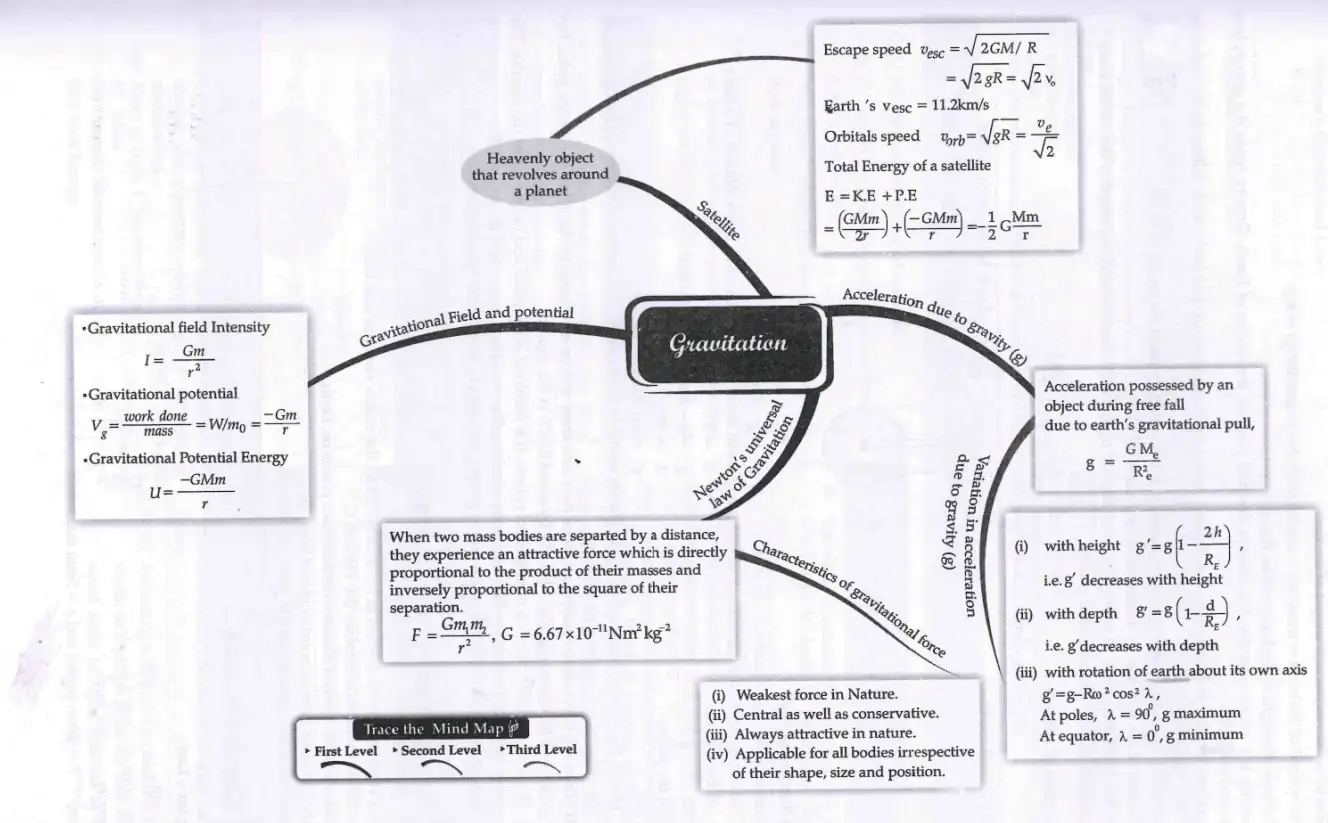
Kepler's Laws
Kepler's First Law (Law of Orbits)
Each planet revolves around the Sun in an elliptical orbit with the Sun located at one focus of the ellipse.
Kepler's Second Law (Law of Areas)
The line joining a planet and the Sun sweeps out equal areas during equal intervals of time, meaning the areal velocity of the planet is constant.
Kepler's Third Law (Law of Periods)
The square of the time period of any planet's revolution around the Sun is proportional to the cube of the semi-major axis of its elliptical orbit.
Mathematically,
T₁² / T₂² = r₁³ / r₂³
Solved Examples
Example 1: If the time period of planet A is 8 years and its distance from the Sun is 4 AU, find the time period of planet B which is 9 AU away from the Sun.
Solution:
Using Kepler's third law,
\( \frac{T_1^2}{T_2^2} = \frac{r_1^3}{r_2^3} \)
Given, \( T_1 = 8 \) years, \( r_1 = 4 \) AU, \( r_2 = 9 \) AU
Substituting,
\( \frac{8^2}{T_2^2} = \frac{4^3}{9^3} \)
\( \frac{64}{T_2^2} = \frac{64}{729} \)
\( T_2^2 = 729 \)
\( T_2 = \sqrt{729} = 27 \) years
Practice Set
- Level 1: State Kepler's first law of planetary motion.
- Level 2: Explain why the areal velocity of a planet is constant according to Kepler's second law.
- Level 3: Two planets have orbital radii 3 AU and 6 AU respectively. Calculate the ratio of their time periods.
Answer Key
- Level 1: Each planet moves around the Sun in an elliptical orbit with the Sun at one focus.
- Level 2: Because the gravitational force provides a central force, the planet sweeps equal areas in equal times, conserving angular momentum.
- Level 3: Using Kepler's third law, \( \frac{T_1^2}{T_2^2} = \frac{r_1^3}{r_2^3} = \frac{3^3}{6^3} = \frac{27}{216} = \frac{1}{8} \). So, \( \frac{T_1}{T_2} = \frac{1}{2} \).
Universal Law of Gravitation
Statement
Every two bodies in the universe attract each other with a force directly proportional to the product of their masses and inversely proportional to the square of the distance between them. The force acts along the line joining their centers.
Mathematical Expression
\( F = G \frac{m_1 m_2}{r^2} \)
Gravitational Constant (G)
G is the universal gravitational constant with value \( 6.67 \times 10^{-11} \, \text{N m}^2 \text{kg}^{-2} \). It represents the force between two 1 kg masses placed 1 meter apart.
Gravity
Gravity is the force exerted by Earth on objects towards its center. It is a vector quantity directed towards Earth's center and is responsible for the weight of objects.
Weight
Weight \( W = mg \), where \( m \) is mass and \( g \) is acceleration due to gravity.
Solved Examples
Example 2: Calculate the gravitational force between two masses of 5 kg and 10 kg placed 2 meters apart.
Solution:
Given, \( m_1 = 5 \) kg, \( m_2 = 10 \) kg, \( r = 2 \) m, \( G = 6.67 \times 10^{-11} \)
\( F = G \frac{m_1 m_2}{r^2} = 6.67 \times 10^{-11} \times \frac{5 \times 10}{2^2} = 6.67 \times 10^{-11} \times \frac{50}{4} = 8.34 \times 10^{-10} \, \text{N} \)
Practice Set
- Level 1: Define the universal law of gravitation.
- Level 2: What is the value and unit of the gravitational constant?
- Level 3: Calculate the force of gravity between two 3 kg masses placed 1 meter apart.
Answer Key
- Level 1: Every two masses attract each other with a force proportional to the product of their masses and inversely proportional to the square of the distance between them.
- Level 2: \( 6.67 \times 10^{-11} \, \text{N m}^2 \text{kg}^{-2} \)
- Level 3: \( F = 6.67 \times 10^{-11} \times \frac{3 \times 3}{1^2} = 6.003 \times 10^{-10} \, \text{N} \)
Acceleration Due to Gravity
Definition
Acceleration due to gravity \( g \) is the acceleration experienced by a body falling freely under Earth's gravitational pull.
Value and Direction
Its standard value near Earth's surface is approximately \( 9.8 \text{ m/s}^2 \) directed towards Earth's center.
Factors Affecting \( g \)
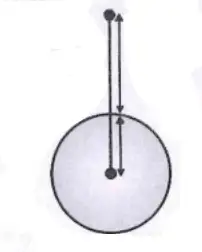
- Altitude: \( g' = g (1 - \frac{2h}{R}) \), where \( h \) is height above Earth’s surface and \( R \) is Earth's radius.
- Depth: \( g' = g (1 - \frac{d}{R}) \), where \( d \) is depth below Earth's surface.
- Earth's Rotation: \( g' = g - R \omega^2 \cos^2 \lambda \), where \( \omega \) is angular velocity and \( \lambda \) is latitude.
- Shape of Earth: Earth is an oblate spheroid, causing variation in \( g \) from equator to poles.
Solved Examples
Example 3: Calculate the acceleration due to gravity at a height of 1000 m above Earth's surface. Given \( g = 9.8 \text{ m/s}^2 \) and Earth's radius \( R = 6.4 \times 10^6 \text{ m} \).
Solution:
Using \( g' = g (1 - \frac{2h}{R}) \),
\( g' = 9.8 \times \left(1 - \frac{2 \times 1000}{6.4 \times 10^6} \right) = 9.8 \times (1 - 0.0003125) = 9.8 \times 0.9996875 = 9.796 \text{ m/s}^2 \)
Practice Set
- Level 1: Define acceleration due to gravity.
- Level 2: How does acceleration due to gravity change with altitude?
- Level 3: Calculate the acceleration due to gravity at a depth of 500 m below Earth's surface. Use \( g = 9.8 \text{ m/s}^2 \) and \( R = 6.4 \times 10^6 \text{ m} \).
Answer Key
- Level 1: It is the acceleration of a freely falling body due to Earth's gravity.
- Level 2: It decreases with increase in altitude.
- Level 3: \( g' = g (1 - \frac{d}{R}) = 9.8 \times (1 - \frac{500}{6.4 \times 10^6}) = 9.8 \times 0.999921875 = 9.799 \text{ m/s}^2 \)
Gravitational Potential Energy and Satellites
Gravitational Potential Energy
It is the work done in bringing a mass from infinity to a point in a gravitational field.
\( U = - \frac{GMm}{r} \)
Escape Velocity
The minimum velocity required to escape Earth's gravitational pull without further propulsion.
\( v_e = \sqrt{\frac{2GM}{R}} = \sqrt{2gR} \)
Satellites
A satellite is a body revolving around a larger body due to gravitational attraction.
Natural Satellites: Moons of planets, e.g., Jupiter's 16 moons.
Artificial Satellites: Man-made satellites like Aryabhatta.
Orbital Speed and Time Period
Orbital speed: \( v = \sqrt{\frac{GM}{R+h}} = R \sqrt{\frac{g}{R+h}} \)
Time period: \( T = 2 \pi \sqrt{\frac{(R+h)^3}{GM}} = 2 \pi \sqrt{\frac{(R+h)^3}{gR^2}} \)
Solved Examples
Example 4: Calculate the escape velocity from Earth. Given \( g = 9.8 \text{ m/s}^2 \) and \( R = 6.4 \times 10^6 \text{ m} \).
Solution:
\( v_e = \sqrt{2gR} = \sqrt{2 \times 9.8 \times 6.4 \times 10^6} = \sqrt{1.2544 \times 10^8} = 11200 \text{ m/s} \)
Practice Set
- Level 1: Define gravitational potential energy.
- Level 2: What is escape velocity?
- Level 3: Calculate the orbital speed of a satellite orbiting at a height of 300 km above Earth. Use \( g = 9.8 \text{ m/s}^2 \) and \( R = 6.4 \times 10^6 \text{ m} \).
Answer Key
- Level 1: Work done in bringing a mass from infinity to a point in a gravitational field.
- Level 2: Minimum velocity needed to escape Earth's gravity without further propulsion.
- Level 3: Height \( h = 300000 \) m, orbital speed \( v = R \sqrt{\frac{g}{R+h}} = 6.4 \times 10^6 \times \sqrt{\frac{9.8}{6.4 \times 10^6 + 3 \times 10^5}} \approx 7.73 \times 10^3 \text{ m/s} \)
Quick Reference Table
Kepler's Laws:
- First Law: Planets move in elliptical orbits with Sun at one focus.
- Second Law: Equal areas are swept in equal times.
- Third Law: \( T^2 \propto r^3 \)
Universal Law of Gravitation: \( F = G \frac{m_1 m_2}{r^2} \), \( G = 6.67 \times 10^{-11} \, \text{N m}^2 \text{kg}^{-2} \)
Acceleration due to gravity: \( g = 9.8 \text{ m/s}^2 \) near Earth's surface.
Escape velocity: \( v_e = \sqrt{2gR} \)
Orbital speed: \( v = \sqrt{\frac{GM}{R+h}} \)
Common Mistakes and Misconceptions
- Confusing mass with weight; mass is constant, weight depends on gravity.
- Assuming gravitational force acts only on Earth; it acts between all masses.
- Believing acceleration due to gravity is same everywhere on Earth; it varies with altitude, depth, and latitude.
- Thinking escape velocity depends on the mass of the object; it depends only on the planet's mass and radius.
Glossary
- Gravitational Constant (G): Universal constant in Newton's law of gravitation.
- Acceleration due to Gravity (g): Acceleration of a freely falling body near Earth's surface.
- Escape Velocity: Minimum velocity to escape gravitational pull.
- Satellite: Body orbiting a larger body due to gravity.
- Areal Velocity: Area swept by radius vector per unit time.