CLASS 11-PCB . CHEMISTRY . CHEMISTRY PART I . THERMODYNAMICS
Chapter 5 : Thermodynamics
Ch 5
CHEMISTRY
CLASS 11-PCB
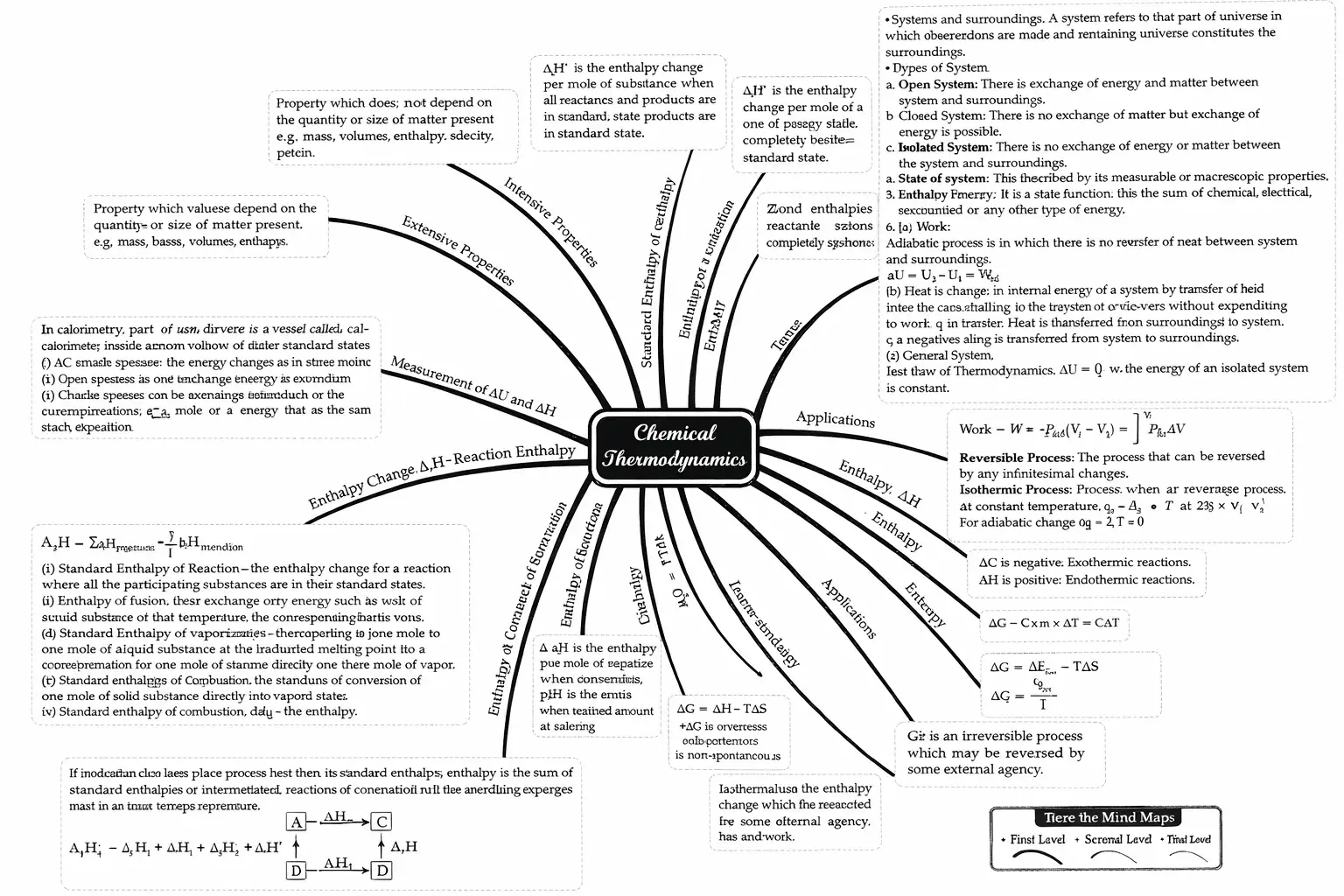
Chemical Thermodynamics
Introduction to Thermodynamics
Chemical thermodynamics is the branch of chemistry that deals with the quantitative study of energy changes, especially the interconversion of various forms of energy and the conversion of energy to work and vice versa during chemical and physical processes.
System and Surroundings
A system is the part of the universe selected for observation, while the surroundings include everything else outside the system. The boundary separates the system from its surroundings.
Types of Systems
- Open system: Can exchange both matter and energy with surroundings.
- Closed system: Can exchange only energy, not matter, with surroundings.
- Isolated system: Cannot exchange matter or energy with surroundings.
State and Properties of a System
The state of a system is defined by its macroscopic properties such as pressure, volume, and temperature. Properties are classified as:
- State functions: Depend only on the initial and final states (e.g., pressure, volume, temperature, enthalpy, internal energy, Gibbs free energy, entropy).
- Path functions: Depend on the path taken during the change (e.g., heat and work).
Thermodynamic Processes
- Isothermal process: Occurs at constant temperature.
- Isobaric process: Occurs at constant pressure.
- Isochoric process: Occurs at constant volume.
- Adiabatic process: No heat exchange with surroundings.
- Reversible process: Can be reversed by an infinitesimal change in conditions.
- Cyclic process: System returns to its initial state after the process.
Heat, Work, and Energy
Heat (q) is energy transferred due to temperature difference. It is positive when absorbed by the system and negative when released.
Work (w) is organized energy transfer. Work done on the system is positive; work done by the system is negative.
Internal energy (U) is the total energy (kinetic + potential) of the system.
Enthalpy (H) is the sum of internal energy and the product of pressure and volume: H = U + pV. It represents the heat content at constant pressure.
First Law of Thermodynamics
The law states that energy can neither be created nor destroyed, only transformed. Mathematically:
\[ \Delta U = q + w \]
where \( \Delta U \) is the change in internal energy, \( q \) is heat exchanged, and \( w \) is work done on the system.
Relation Between Enthalpy and Internal Energy
For gaseous reactions:
\[ \Delta H = \Delta U + \Delta n_g RT \]
where \( \Delta n_g \) is the change in moles of gas, \( R \) is the gas constant, and \( T \) is temperature in Kelvin.
Heat Capacity and Specific Heat
Heat capacity (C) is the heat required to raise the temperature of a system by 1°C.
Specific heat capacity (C_s) is the heat required to raise the temperature of 1 gram of a substance by 1°C.
Heat absorbed or released is given by:
\[ q = m C_s \Delta T \]
Calorimetry
Calorimetry is an experimental technique to measure heat changes during chemical or physical processes using a device called a calorimeter.
Solved Examples
Example 1: Calculating Work Done in Isothermal Expansion
An ideal gas expands isothermally and reversibly from volume 2 L to 5 L at 300 K. Calculate the work done by the gas. (R = 8.314 J/mol·K, n = 1 mol)
Solution:
Work done in isothermal reversible expansion is:
\[ W_{rev} = -nRT \ln \frac{V_f}{V_i} \]
Substituting values:
\[ W_{rev} = -1 \times 8.314 \times 300 \times \ln \frac{5}{2} \]
\[ = -2494.2 \times \ln 2.5 \]
\[ = -2494.2 \times 0.9163 = -2284.5 \text{ J} \]
Work done by the gas is -2284.5 J (work done by the system is negative).
Example 2: Calculating Enthalpy Change
Calculate the enthalpy change for the reaction: H2(g) + I2(g) → 2HI(g) given that \( \Delta U = -10 \text{ kJ} \) and \( \Delta n_g = 0 \) at 298 K.
Solution:
Since \( \Delta n_g = 0 \),
\[ \Delta H = \Delta U + \Delta n_g RT = -10 + 0 = -10 \text{ kJ} \]
Therefore, enthalpy change is -10 kJ.
Practice Set
- Level 1 (Easy): Define an isolated system and give an example.
- Level 2 (Moderate): Explain the difference between state functions and path functions with examples.
- Level 3 (Challenging): Calculate the work done when 2 moles of an ideal gas expand isothermally and reversibly at 350 K from 3 L to 10 L. (R = 8.314 J/mol·K)
Answer Key
- Level 1: An isolated system cannot exchange matter or energy with its surroundings. Example: A perfectly insulated thermos flask.
- Level 2: State functions depend only on the initial and final states (e.g., pressure, volume, temperature), while path functions depend on the path taken (e.g., heat, work).
- Level 3: Work done, \( W = -nRT \ln \frac{V_f}{V_i} = -2 \times 8.314 \times 350 \times \ln \frac{10}{3} \approx -2 \times 8.314 \times 350 \times 1.204 = -7009 \text{ J} \).
Enthalpy Change
Definition and Types
Enthalpy of reaction (\( \Delta_r H \)) is the enthalpy change when reactants convert to products as per stoichiometric coefficients.
Enthalpy of neutralisation (\( \Delta_n H \)) is the enthalpy change when 1 gram equivalent of acid reacts with 1 gram equivalent of base.
Standard enthalpy of fusion (\( \Delta_{fusion} H^\circ \)) is the enthalpy change when 1 mole of solid melts at its melting point.
Standard enthalpy of vaporisation (\( \Delta_{vap} H^\circ \)) is the enthalpy change when 1 mole of liquid vaporizes at its boiling point under standard pressure.
Standard enthalpy of sublimation (\( \Delta_{sub} H^\circ \)) is the enthalpy change when 1 mole of solid sublimes at constant temperature and pressure.
Standard enthalpy of formation (\( \Delta_f H^\circ \)) is the enthalpy change when 1 mole of a compound forms from its elements in their standard states.
Hess's Law
The enthalpy change of a reaction is the same whether it occurs in one step or multiple steps. The total enthalpy change is the sum of enthalpy changes of individual steps.
Applications include determining enthalpies of formation, slow reactions, allotropic transformations, bond energies, and resonance energy.
Other Important Enthalpy Terms
- Standard enthalpy of combustion (\( \Delta_c H^\circ \)): Enthalpy change when 1 mole of substance combusts completely in oxygen. It is always negative.
- Enthalpy of atomisation (\( \Delta_a H^\circ \)): Enthalpy change when 1 mole of substance dissociates into gaseous atoms.
- Bond enthalpy (\( \Delta_{bond} H^\circ \)): Average energy required to break 1 mole of a particular bond in gaseous molecules.
- Enthalpy of solution (\( \Delta_{sol} H^\circ \)): Enthalpy change when 1 mole of solute dissolves in a specified amount of solvent.
- Enthalpy of hydration (\( \Delta_{hyd} H^\circ \)): Enthalpy change when 1 mole of anhydrous salt combines with water molecules.
- Lattice enthalpy (\( \Delta_{latt} H^\circ \)): Enthalpy change when 1 mole of ionic compound dissociates into gaseous ions.
Solved Examples
Example 1: Calculating Enthalpy of Reaction
Given the enthalpies of formation: \( \Delta_f H^\circ (CO_2) = -393.5 \text{ kJ/mol} \), \( \Delta_f H^\circ (CH_4) = -74.8 \text{ kJ/mol} \), calculate the enthalpy change for combustion of methane:
\[ CH_4 + 2O_2 \rightarrow CO_2 + 2H_2O \]
Solution:
Using Hess's law:
\[ \Delta H^\circ = \sum \Delta_f H^\circ (products) - \sum \Delta_f H^\circ (reactants) \]
Assuming \( \Delta_f H^\circ (H_2O) = -285.8 \text{ kJ/mol} \),
\[ \Delta H^\circ = [-393.5 + 2(-285.8)] - [-74.8 + 0] = (-393.5 - 571.6) + 74.8 = -890.3 \text{ kJ} \]
Example 2: Using Hess's Law
Calculate the enthalpy change for the reaction:
\[ C(graphite) + \frac{1}{2} O_2 \rightarrow CO \]
Given:
- \( C(graphite) + O_2 \rightarrow CO_2 \), \( \Delta H = -393.5 \text{ kJ} \)
- \( CO + \frac{1}{2} O_2 \rightarrow CO_2 \), \( \Delta H = -283.0 \text{ kJ} \)
Solution:
Reverse the second reaction:
\[ CO_2 \rightarrow CO + \frac{1}{2} O_2 \], \( \Delta H = +283.0 \text{ kJ} \)
Add to first reaction:
\[ C(graphite) + O_2 + CO_2 \rightarrow CO_2 + CO + \frac{1}{2} O_2 \]
Cancel \( CO_2 \) and \( O_2 \) terms:
\[ C(graphite) + \frac{1}{2} O_2 \rightarrow CO \]
Enthalpy change:
\[ -393.5 + 283.0 = -110.5 \text{ kJ} \]
Practice Set
- Level 1 (Easy): Define enthalpy of fusion and give its unit.
- Level 2 (Moderate): State Hess's law and mention two applications.
- Level 3 (Challenging): Calculate the enthalpy change for the reaction: N2(g) + 3H2(g) → 2NH3(g) given \( \Delta H^\circ_f (NH_3) = -46 \text{ kJ/mol} \), and elements in standard state have zero enthalpy.
Answer Key
- Level 1: Enthalpy of fusion is the enthalpy change when 1 mole of solid melts at its melting point. Unit: kJ/mol.
- Level 2: Hess's law states that the total enthalpy change for a reaction is the same whether it occurs in one step or multiple steps. Applications: determining enthalpies of formation and bond energies.
- Level 3: \( \Delta H = 2 \times (-46) - 0 = -92 \text{ kJ} \).
Spontaneity
Spontaneous Processes
A spontaneous process occurs naturally in a given direction without external influence once initiated.
Entropy (S)
Entropy is a measure of disorder or randomness in an isolated system. For a reversible process at constant temperature:
\[ \Delta S = \frac{q_{rev}}{T} \]
For a spontaneous process, the total entropy change of the universe is positive:
\[ \Delta S_{total} = \Delta S_{system} + \Delta S_{surroundings} > 0 \]
Second Law of Thermodynamics
The entropy of the universe always increases in a spontaneous process.
Third Law of Thermodynamics
At absolute zero (0 K), the entropy of a perfect crystalline substance is zero.
Gibbs Free Energy (G)
Gibbs free energy is the maximum useful work obtainable from a process at constant temperature and pressure. It is given by:
\[ \Delta G = \Delta H - T \Delta S \]
Criteria for spontaneity:
- \( \Delta G < 0 \): Spontaneous process
- \( \Delta G > 0 \): Non-spontaneous process
- \( \Delta G = 0 \): Equilibrium
Relation with equilibrium constant (K):
\[ \Delta G^\circ = -RT \ln K = -2.303 RT \log K \]
Solved Examples
Example 1: Calculating Entropy Change
Calculate the entropy change when 100 J of heat is absorbed reversibly at 400 K.
Solution:
\[ \Delta S = \frac{q_{rev}}{T} = \frac{100}{400} = 0.25 \text{ J/K} \]
Example 2: Gibbs Free Energy and Spontaneity
Given \( \Delta H = -50 \text{ kJ} \), \( \Delta S = -100 \text{ J/K} \), calculate \( \Delta G \) at 300 K and state if the process is spontaneous.
Solution:
Convert entropy to kJ/K: \( -100 \text{ J/K} = -0.1 \text{ kJ/K} \)
\[ \Delta G = \Delta H - T \Delta S = -50 - 300 \times (-0.1) = -50 + 30 = -20 \text{ kJ} \]
Since \( \Delta G < 0 \), the process is spontaneous.
Practice Set
- Level 1 (Easy): Define entropy and state its unit.
- Level 2 (Moderate): State the second law of thermodynamics.
- Level 3 (Challenging): Calculate the Gibbs free energy change for a reaction with \( \Delta H = 40 \text{ kJ} \) and \( \Delta S = 150 \text{ J/K} \) at 350 K. Is the reaction spontaneous?
Answer Key
- Level 1: Entropy is a measure of disorder or randomness. Unit: J/K.
- Level 2: The entropy of the universe always increases in a spontaneous process.
- Level 3: Convert entropy: 150 J/K = 0.15 kJ/K.
\( \Delta G = 40 - 350 \times 0.15 = 40 - 52.5 = -12.5 \text{ kJ} \).
Since \( \Delta G < 0 \), the reaction is spontaneous.
Quick Reference Table
Key Laws and Formulas
- First Law of Thermodynamics: \( \Delta U = q + w \)
- Relation between Enthalpy and Internal Energy: \( \Delta H = \Delta U + \Delta n_g RT \)
- Work done in isothermal reversible expansion: \( W_{rev} = -nRT \ln \frac{V_f}{V_i} \)
- Heat absorbed or released: \( q = m C_s \Delta T \)
- Entropy change: \( \Delta S = \frac{q_{rev}}{T} \)
- Gibbs Free Energy: \( \Delta G = \Delta H - T \Delta S \)
- Relation between Gibbs Free Energy and Equilibrium Constant: \( \Delta G^\circ = -RT \ln K = -2.303 RT \log K \)
Important Terms and Units
- Heat (q): Energy transferred due to temperature difference; unit: Joule (J)
- Work (w): Organized energy transfer; unit: Joule (J)
- Internal Energy (U): Total energy of the system; unit: Joule (J)
- Enthalpy (H): Heat content at constant pressure; unit: Joule (J)
- Entropy (S): Measure of disorder; unit: Joule per Kelvin (J/K)
- Gibbs Free Energy (G): Maximum useful work; unit: Joule (J)
- Heat Capacity (C): Heat required to raise temperature by 1°C; unit: J/°C
- Specific Heat Capacity (C_s): Heat required to raise 1 g by 1°C; unit: J/g°C
Common Mistakes and Misconceptions
Common Mistakes
- Confusing state functions with path functions: State functions depend only on initial and final states, while path functions depend on the process path.
- Sign conventions for heat and work: Heat absorbed by the system is positive; heat released is negative. Work done on the system is positive; work done by the system is negative.
- Misinterpreting spontaneity: A spontaneous process has \( \Delta G < 0 \), not necessarily a fast or immediate reaction.
- Mixing up enthalpy and internal energy: Enthalpy includes pressure-volume work, internal energy does not.
- Ignoring units in calculations: Always use consistent SI units, especially for temperature in Kelvin.
- Assuming all processes are reversible: Real processes are mostly irreversible; reversible processes are idealizations.
Misconceptions
- Entropy always increases: Entropy of the universe increases in spontaneous processes, but entropy of the system can decrease.
- Zero entropy at absolute zero applies to all substances: Only perfect crystalline substances have zero entropy at 0 K.
- Heat and temperature are the same: Heat is energy transfer; temperature is a measure of thermal energy.
- Work done by the system is always positive: Work done by the system is negative according to sign conventions.
Glossary
Key Terms
- System: The part of the universe under study.
- Surroundings: Everything outside the system.
- Boundary: The interface separating system and surroundings.
- Open System: Exchanges both matter and energy with surroundings.
- Closed System: Exchanges only energy, not matter.
- Isolated System: Exchanges neither matter nor energy.
- State Function: Property depending only on initial and final states (e.g., enthalpy, entropy).
- Path Function: Property depending on the path taken (e.g., heat, work).
- Enthalpy (H): Heat content at constant pressure.
- Entropy (S): Measure of disorder or randomness.
- Gibbs Free Energy (G): Maximum useful work obtainable.
- Calorimeter: Device used to measure heat changes.
- Hess's Law: Total enthalpy change is independent of the path.
- Spontaneous Process: Process that occurs naturally without external input.
- Heat Capacity: Heat required to raise temperature by 1°C.
- Specific Heat Capacity: Heat required to raise 1 gram of substance by 1°C.
- Standard State: Reference state of a substance at 1 atm and 298 K.
- Phase Transition: Change of matter from one state to another.