CLASS 11-PCB . CHEMISTRY . CHEMISTRY PART I . STRUCTURE OF-ATOM
Chapter 2 : Structure Of Atom
Ch 2
CHEMISTRY
CLASS 11-PCB
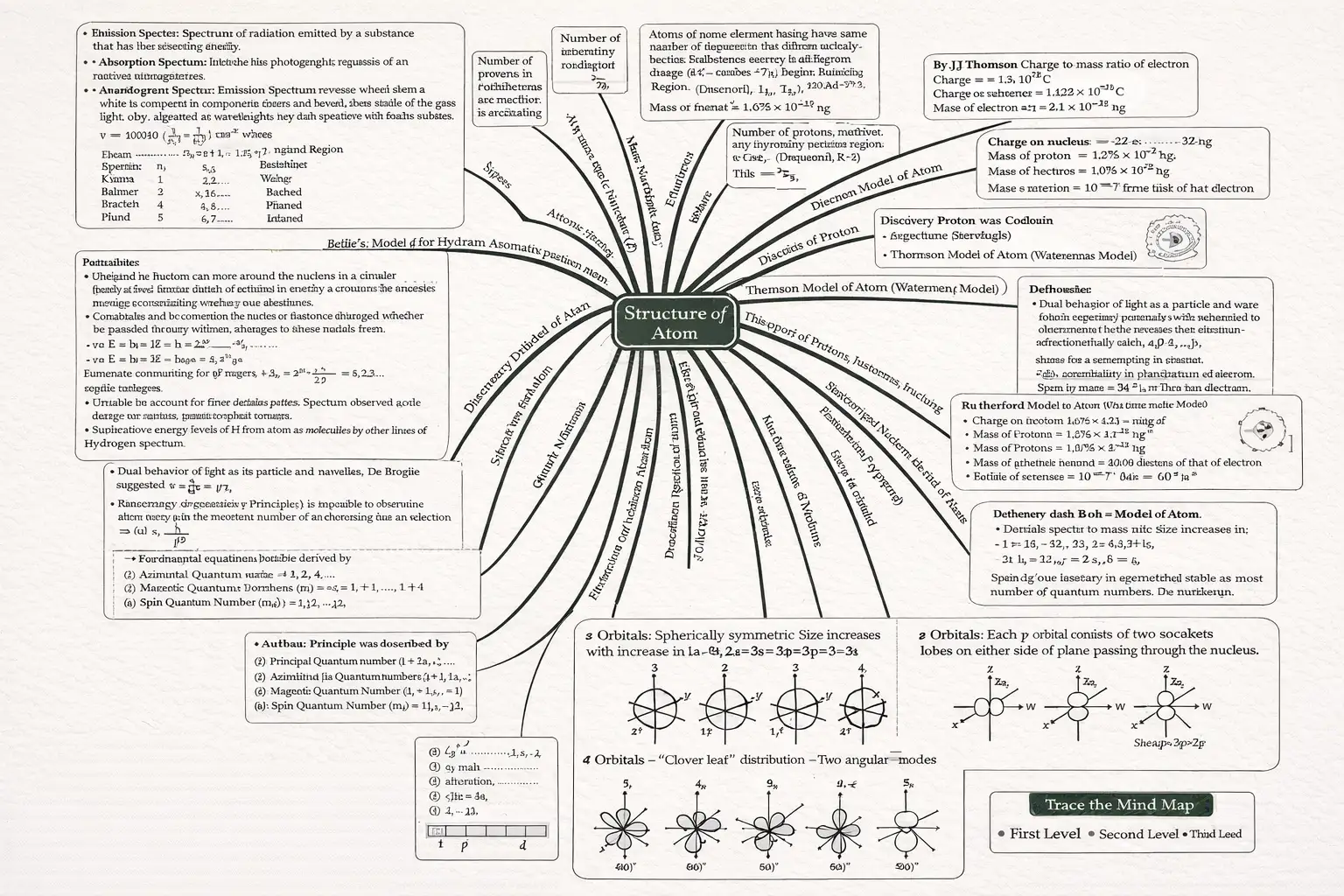
Structure of Atom
Discovery of Electron
In the mid-1850s, scientists like Faraday studied electrical discharge in partially evacuated tubes called cathode ray discharge tubes. These tubes consist of glass containing two thin metal electrodes sealed inside. When a high voltage is applied, electrons are emitted from the cathode and travel towards the anode, forming cathode rays. These rays are invisible but can be observed by their effect on fluorescent materials inside the tube, which glow when struck by the rays. The behavior of cathode rays in electric and magnetic fields showed that they consist of negatively charged particles called electrons.
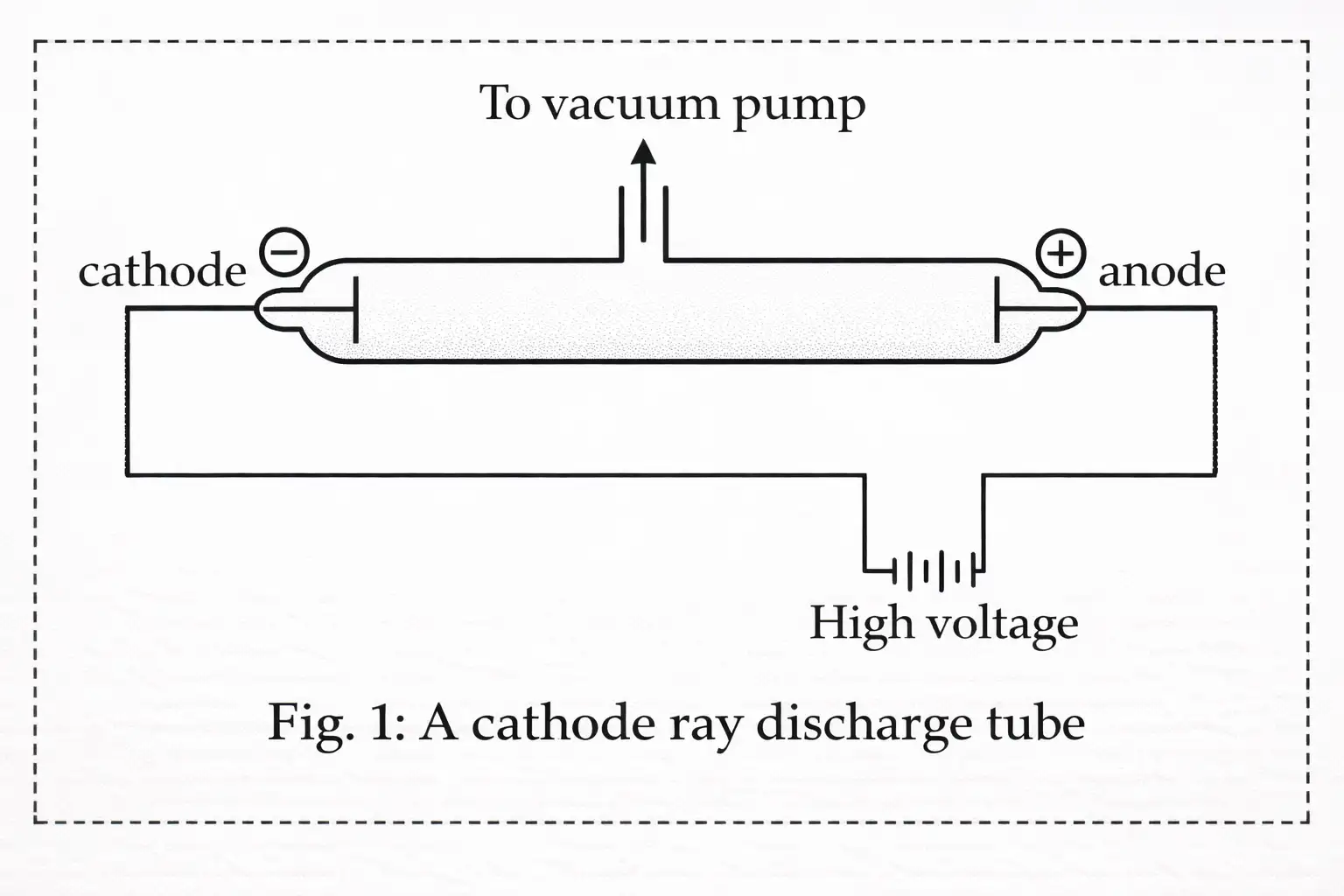
A cathode ray tube consists of a cathode (negative electrode), an anode (positive electrode), a vacuum pump to remove air, and a high voltage power source. Electrons emitted from the cathode travel in straight lines towards the anode, producing cathode rays.
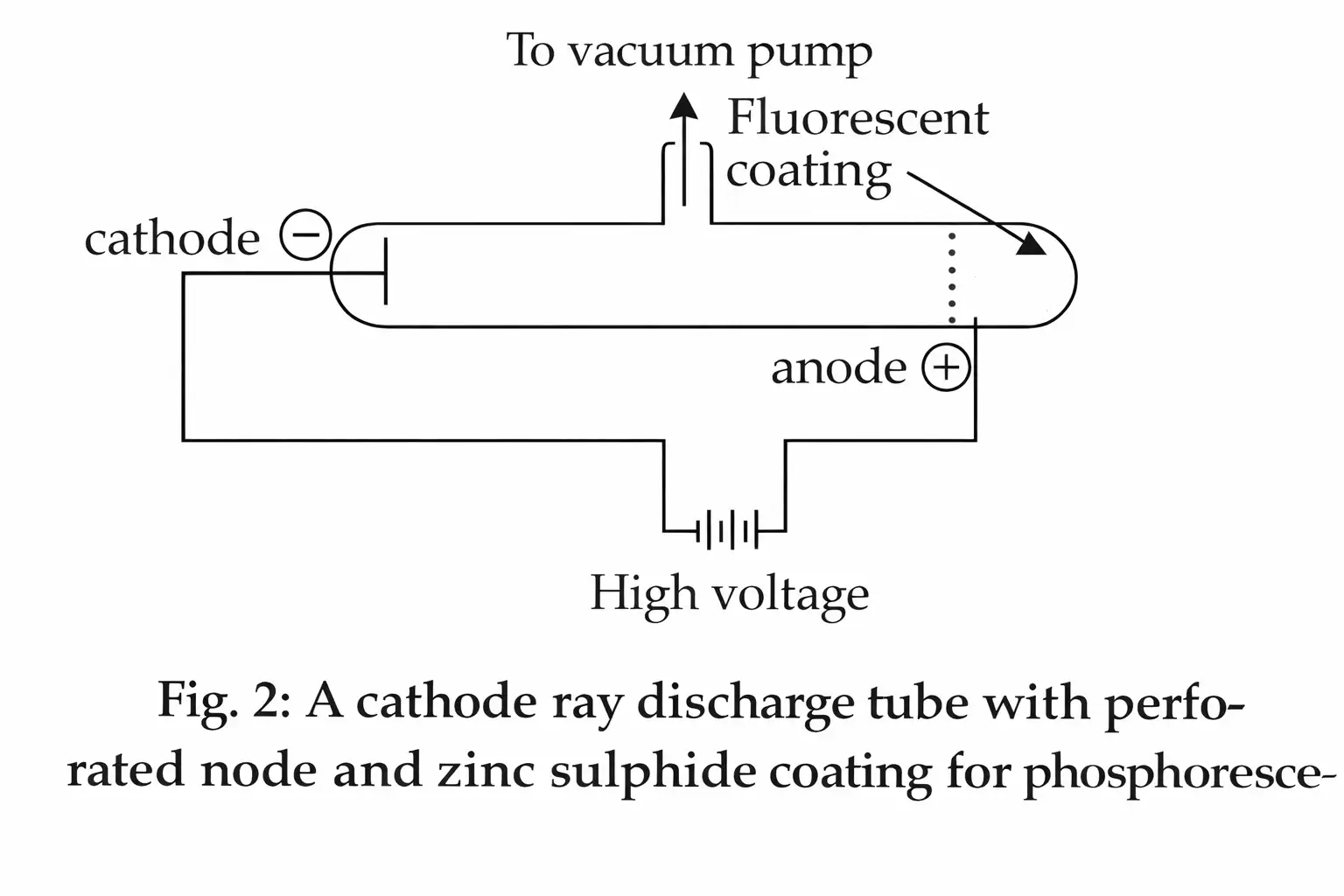
When cathode rays strike the fluorescent coating inside the tube, the coating glows, demonstrating the presence and path of electrons. The rays behave like negatively charged particles and their properties do not depend on the material of the electrodes or the gas inside the tube.
Atomic Models
Several models have been proposed to explain atomic structure:
- Thomson Model: Proposed in 1898, it describes the atom as a sphere of positive charge with electrons embedded like plums in a pudding.
- Rutherford Nuclear Model: Based on gold foil experiments, it concluded that most of the atom is empty space with a small, dense, positively charged nucleus at the center surrounded by electrons moving in circular orbits.
Rutherford's model explained the deflection of alpha particles but could not explain atomic stability or electronic structure.
Fundamental Particles of an Atom
The atom consists of three fundamental particles:
- Electron (e⁻): Negatively charged particle with charge −1.6022 × 10⁻¹⁹ C and very small mass.
- Proton (p⁺): Positively charged particle with charge +1.6022 × 10⁻¹⁹ C and mass approximately 1 atomic mass unit (u).
- Neutron (n⁰): Neutral particle with no charge and mass approximately 1 u.
Electrons and the nucleus are held together by electrostatic forces of attraction.
Atomic Number and Mass Number
Atomic Number (Z): Number of protons in the nucleus, equal to the number of electrons in a neutral atom.
Mass Number (A): Total number of protons and neutrons in the nucleus.
Isotopes: Atoms with the same atomic number but different mass numbers.
Isobars: Atoms with the same mass number but different atomic numbers.
Dual Nature of Electromagnetic Radiation
Electromagnetic radiation exhibits both wave and particle nature.
- Wave Nature: Described by wavelength (λ), frequency (ν), and velocity (c). Electromagnetic waves do not require a medium and can travel in vacuum.
- Particle Nature: Explained by the photoelectric effect where light ejects electrons from metal surfaces, indicating light behaves as particles called photons.
Planck's quantum theory states that energy is emitted or absorbed in discrete packets called quanta, with energy E = hν, where h is Planck's constant.
Atomic Spectra
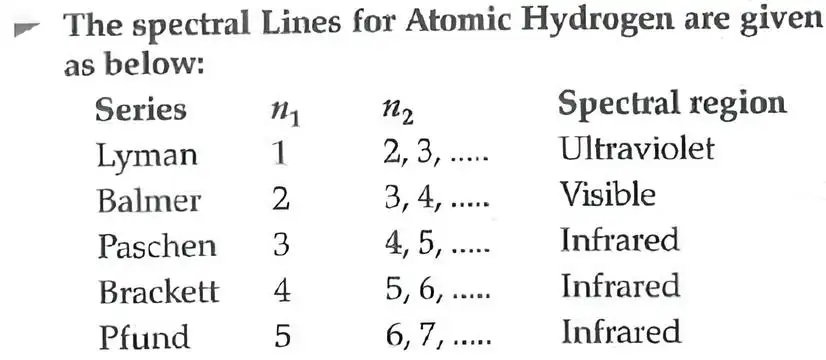
Atoms emit or absorb light at specific wavelengths, producing line spectra unique to each element. The hydrogen atom's spectral lines are described by the Rydberg formula:
ῡ = 109,677 (1/n₁² − 1/n₂²) cm⁻¹
where n₁ and n₂ are integers with n₂ > n₁.
Bohr Model of Atom
Bohr proposed that electrons revolve in fixed circular orbits with quantized energies. Key postulates include:
- Electrons move in definite orbits without radiating energy.
- Each orbit corresponds to a specific energy level.
- Electrons can jump between orbits by absorbing or emitting energy.
- Angular momentum is quantized: mₑvr = n(h/2π), where n = 1, 2, 3,...
Energy of the nth orbit: Eₙ = −R_H / n², where R_H is the Rydberg constant.
Bohr's model explains hydrogen spectra but has limitations such as inability to explain Zeeman effect and molecular bonding.
Solved Examples
Example 1: Calculate the wavelength of light emitted when an electron in a hydrogen atom falls from the n=3 to n=2 energy level.
Solution:
Using Rydberg formula for wave number:
ῡ = 109,677 (1/2² − 1/3²) cm⁻¹ = 109,677 (1/4 − 1/9) = 109,677 (5/36) = 15,243 cm⁻¹
Wavelength λ = 1/ῡ = 1 / 15,243 cm⁻¹ = 6.56 × 10⁻⁵ cm = 656 nm
This corresponds to red light in the visible spectrum.
Example 2: Find the de Broglie wavelength of an electron moving with velocity 3 × 10⁶ m/s. (Mass of electron = 9.11 × 10⁻³¹ kg, Planck's constant h = 6.626 × 10⁻³⁴ Js)
Solution:
λ = h / mv = 6.626 × 10⁻³⁴ / (9.11 × 10⁻³¹ × 3 × 10⁶) = 2.42 × 10⁻¹⁰ m
This wavelength is in the X-ray region.
Practice Set
- Level 1: Define atomic number and mass number.
- Level 2: Explain the photoelectric effect and its significance.
- Level 3: Calculate the radius of the third Bohr orbit for hydrogen. (Given a₀ = 52.9 pm)
Answer Key
- Level 1: Atomic number is the number of protons in the nucleus; mass number is the total number of protons and neutrons.
- Level 2: Photoelectric effect is the emission of electrons from a metal surface when light of suitable frequency falls on it. It demonstrates the particle nature of light.
- Level 3: Radius rₙ = n² a₀ = 3² × 52.9 pm = 9 × 52.9 pm = 476.1 pm.
de-Broglie and Quantum Principles
Dual Behaviour of Matter
Einstein suggested light has both wave and particle nature. de Broglie extended this to matter, proposing particles like electrons also have wave properties. The de Broglie wavelength is given by λ = h / mv.
Heisenberg’s Uncertainty Principle
It is impossible to simultaneously know the exact position and momentum of an electron. Mathematically, Δx × Δpₓ ≥ h / 4π.
Quantum Mechanical Model
Developed by Heisenberg and Schrödinger, this model treats electrons as wave functions (ψ). The probability of finding an electron is given by |ψ|². Exact position and velocity cannot be determined simultaneously; only probabilities can be calculated.
Solved Examples
Example: Calculate the uncertainty in velocity if the uncertainty in position of an electron is 1 × 10⁻¹⁰ m. (Mass of electron = 9.11 × 10⁻³¹ kg, h = 6.626 × 10⁻³⁴ Js)
Solution:
Δx × Δv ≥ h / 4πm
Δv ≥ h / (4π m Δx) = 6.626 × 10⁻³⁴ / (4π × 9.11 × 10⁻³¹ × 1 × 10⁻¹⁰) ≈ 5.8 × 10³ m/s
Practice Set
- Level 1: State de Broglie’s hypothesis.
- Level 2: Explain Heisenberg’s uncertainty principle.
- Level 3: Calculate the de Broglie wavelength of a proton moving at 2 × 10⁶ m/s. (Mass of proton = 1.67 × 10⁻²⁷ kg)
Answer Key
- Level 1: Matter particles have wave properties with wavelength λ = h / mv.
- Level 2: It is impossible to know exact position and momentum of a particle simultaneously.
- Level 3: λ = h / mv = 6.626 × 10⁻³⁴ / (1.67 × 10⁻²⁷ × 2 × 10⁶) = 1.98 × 10⁻¹³ m.
Orbitals and Quantum Numbers
Atomic Orbitals
Atomic orbitals are regions in space where electrons are most likely to be found. They differ in size, shape, and orientation.
Quantum Numbers
Four quantum numbers describe electron states:
- Principal quantum number (n): Energy level and size of orbital (n=1,2,3,...)
- Azimuthal quantum number (l): Shape of orbital (l=0 to n-1)
- Magnetic quantum number (mₗ): Orientation of orbital (mₗ = -l to +l)
- Spin quantum number (mₛ): Electron spin (+½ or -½)
Shapes of Orbitals
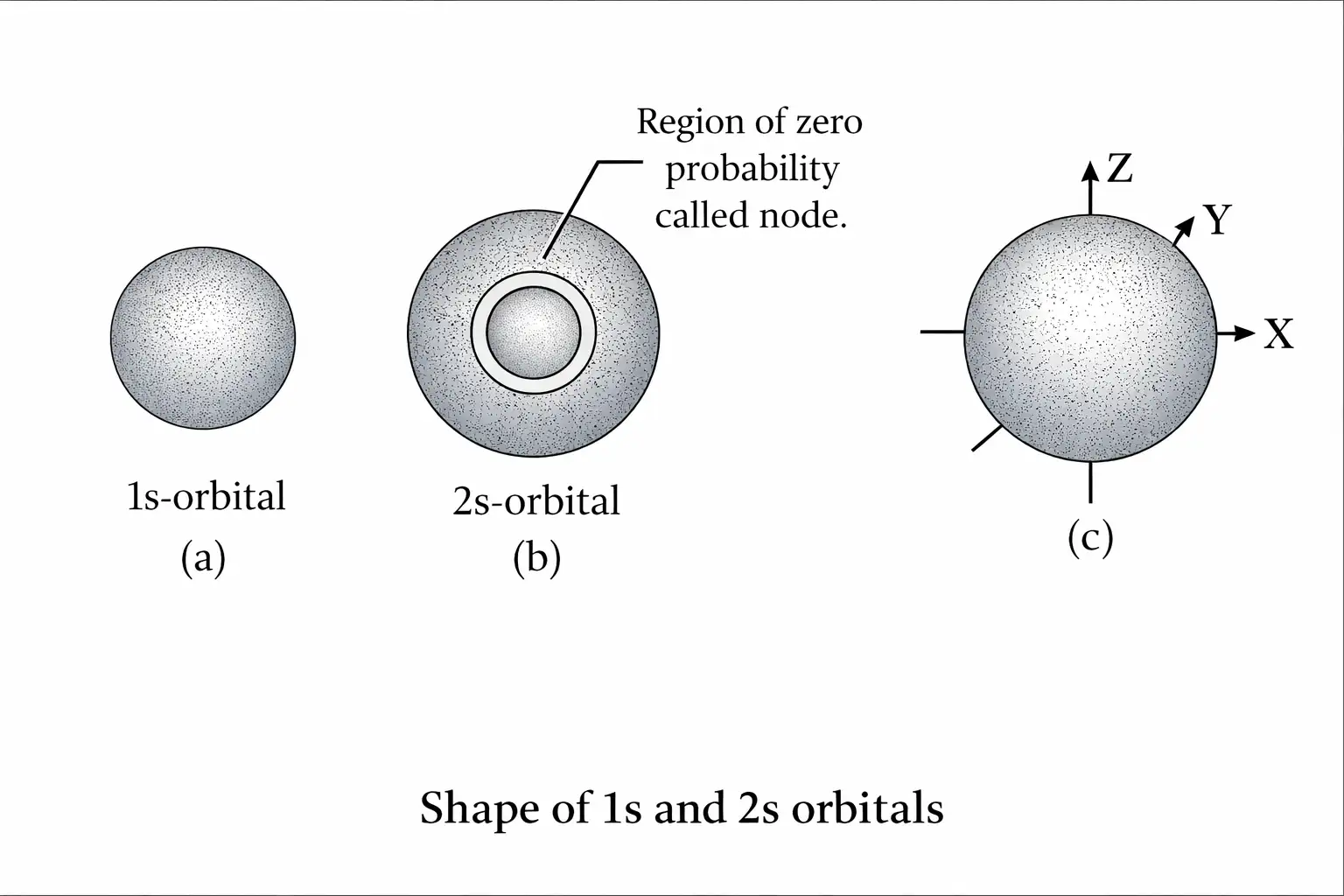
s-orbitals: Spherical shape.
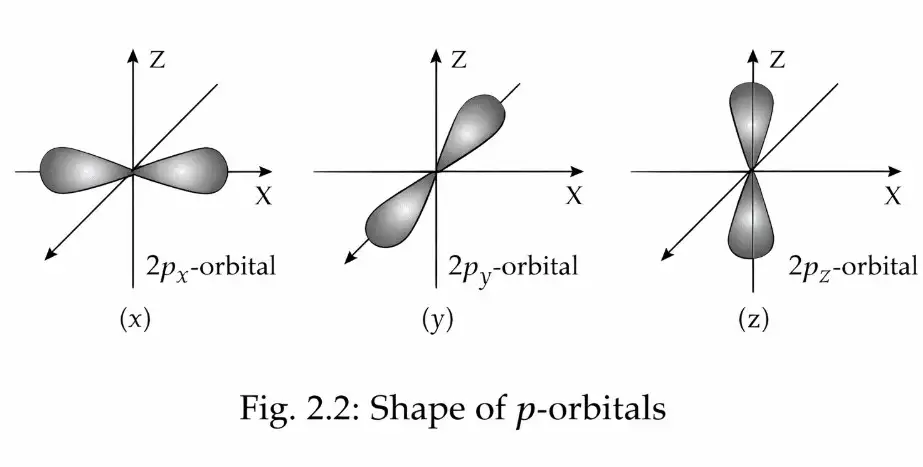
p-orbitals: Dumbbell-shaped with three orientations (pₓ, pᵧ, p_z).
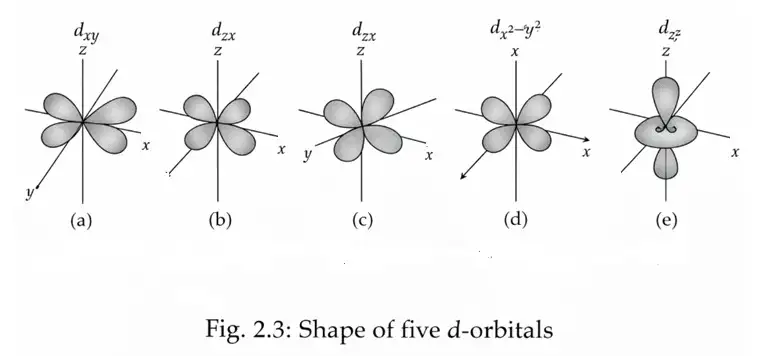
d-orbitals: Five shapes, four cloverleaf-shaped and one donut-shaped.
Electron Configuration Rules
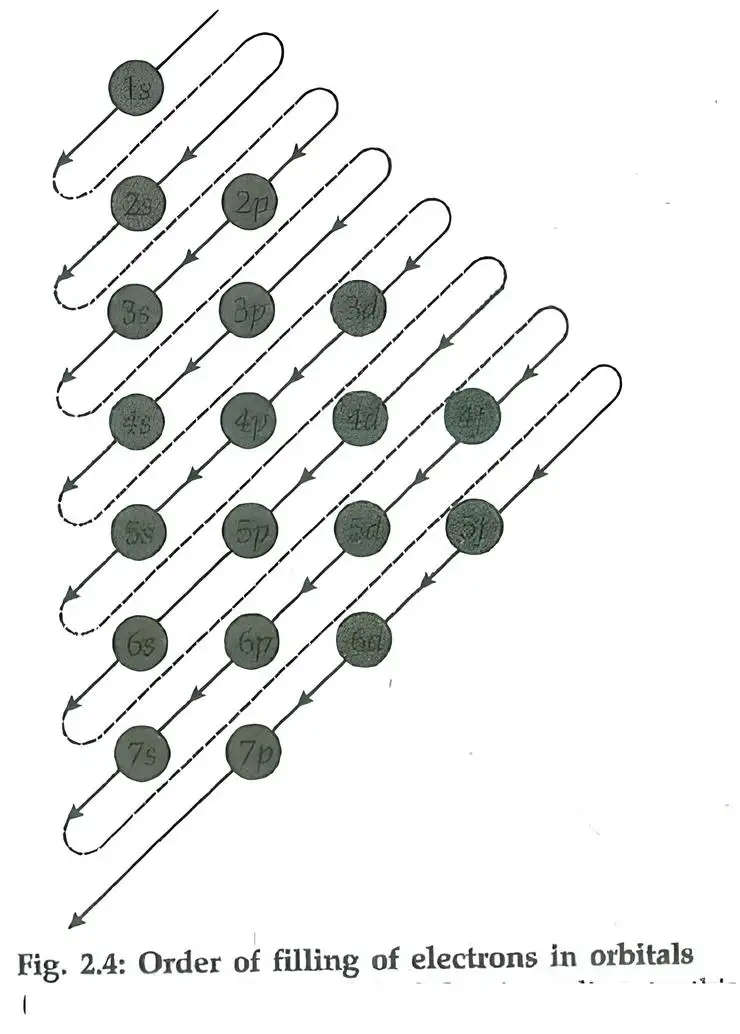
- Aufbau Principle: Electrons fill orbitals from lowest to highest energy.
- Pauli’s Exclusion Principle: No two electrons have the same set of four quantum numbers; maximum two electrons per orbital with opposite spins.
- Hund’s Rule: Electrons occupy degenerate orbitals singly with parallel spins before pairing.
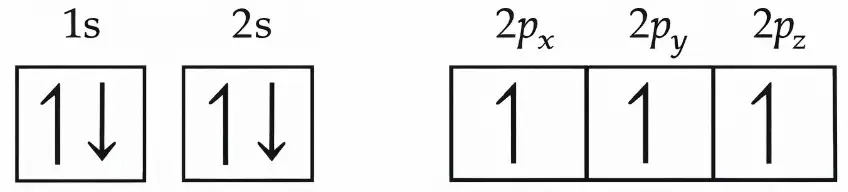
Electronic Configuration
Distribution of electrons in orbitals determines chemical properties. For example:
Cl: 1s² 2s² 2p⁶ 3s² 3p⁵
Cl⁻: 1s² 2s² 2p⁶ 3s² 3p⁶
Mg: 1s² 2s² 2p⁶ 3s²
Mg²⁺: 1s² 2s² 2p⁶
Solved Examples
Example: Write the electronic configuration of nitrogen (atomic number 7).
Solution: 1s² 2s² 2p³
Practice Set
- Level 1: Define principal quantum number.
- Level 2: State Pauli’s exclusion principle.
- Level 3: Write the electronic configuration of oxygen (atomic number 8) and explain Hund’s rule.
Answer Key
- Level 1: Principal quantum number (n) indicates the energy level and size of the orbital.
- Level 2: No two electrons in an atom can have the same set of four quantum numbers.
- Level 3: Oxygen: 1s² 2s² 2p⁴. Hund’s rule states electrons fill degenerate orbitals singly with parallel spins before pairing.
Quick Reference Table
Key Laws and Formulas
- Rydberg Formula for Hydrogen Spectrum: \( \tilde{\nu} = 109,677 \left( \frac{1}{n_1^2} - \frac{1}{n_2^2} \right) \text{ cm}^{-1} \)
- Planck's Quantum Theory: \( E = h \nu \), where \( h = 6.626 \times 10^{-34} \text{ Js} \)
- Bohr's Angular Momentum Quantization: \( m_e v r = n \frac{h}{2\pi} \)
- Energy of Electron in nth Orbit: \( E_n = -R_H \frac{1}{n^2} \), where \( R_H = 2.18 \times 10^{-18} \text{ J} \)
- Radius of nth Bohr Orbit: \( r_n = n^2 a_0 \), where \( a_0 = 52.9 \text{ pm} \)
- de Broglie Wavelength: \( \lambda = \frac{h}{mv} \)
- Heisenberg's Uncertainty Principle: \( \Delta x \times \Delta p_x \geq \frac{h}{4\pi} \)
Important Constants
- Planck's constant, \( h = 6.626 \times 10^{-34} \text{ Js} \)
- Speed of light, \( c = 3.0 \times 10^8 \text{ m/s} \)
- Electron charge, \( e = 1.6022 \times 10^{-19} \text{ C} \)
- Rydberg constant for hydrogen, \( R_H = 2.18 \times 10^{-18} \text{ J} \)
- Bohr radius, \( a_0 = 52.9 \text{ pm} \)
Fundamental Particles Properties
- Electron: Charge = \(-1.6022 \times 10^{-19} \text{ C}\), Mass = \(9.11 \times 10^{-31} \text{ kg}\)
- Proton: Charge = \(+1.6022 \times 10^{-19} \text{ C}\), Mass = \(1.67 \times 10^{-27} \text{ kg}\)
- Neutron: Charge = 0, Mass = \(1.67 \times 10^{-27} \text{ kg}\)
Atomic Structure Terms
- Atomic Number (Z): Number of protons in the nucleus.
- Mass Number (A): Total number of protons and neutrons.
- Isotopes: Atoms with same Z but different A.
- Isobars: Atoms with same A but different Z.
Common Mistakes and Misconceptions
Common Mistakes
- Confusing atomic number (Z) with mass number (A). Atomic number is number of protons; mass number includes neutrons.
- Assuming electrons orbit nucleus like planets; electrons exist in probabilistic orbitals.
- Misinterpreting the photoelectric effect as evidence of wave nature of light; it actually demonstrates particle nature.
- Using Bohr’s model for atoms other than hydrogen; it only accurately explains hydrogen-like atoms.
- Forgetting that the energy levels in Bohr’s model are quantized and not continuous.
- Ignoring the dual nature of electromagnetic radiation and matter when explaining atomic phenomena.
- Assuming all orbitals of a sub-shell have different energies; degenerate orbitals have the same energy in absence of external fields.
- Mixing up the quantum numbers and their significance, especially the magnetic and spin quantum numbers.
Misconceptions
- Electrons do not move in fixed circular orbits as per Bohr’s model; modern quantum mechanics describes orbitals as probability clouds.
- Electrons are not tiny planets orbiting the nucleus but quantum particles with wave-particle duality.
- Photoelectric effect does not occur with any frequency of light; it requires a threshold frequency.
- Energy of photons is not continuous but quantized as per Planck’s theory.
- Atomic spectra are not continuous bands but discrete lines unique to each element.
Glossary
Atomic Terms
- Electron: Negatively charged fundamental particle in atoms.
- Proton: Positively charged particle in the nucleus.
- Neutron: Neutral particle in the nucleus.
- Photon: Quantum of electromagnetic radiation.
- Atomic Number (Z): Number of protons in an atom.
- Mass Number (A): Sum of protons and neutrons.
- Isotopes: Atoms with same atomic number but different mass numbers.
- Isobars: Atoms with same mass number but different atomic numbers.
- Quantum Numbers: Numbers that describe the properties of electrons in atoms (principal, azimuthal, magnetic, spin).
- Orbital: Region in space where there is high probability of finding an electron.
- Photoelectric Effect: Emission of electrons from metal surface when light of suitable frequency falls on it.
- Threshold Frequency: Minimum frequency of light required to eject electrons.
- Planck’s Constant (h): Fundamental constant in quantum mechanics, \(6.626 \times 10^{-34} \text{ Js}\).
- Rydberg Constant (R_H): Constant used in calculating hydrogen spectral lines.
- Bohr Radius (a_0): Radius of the first orbit in hydrogen atom, 52.9 pm.
- de Broglie Wavelength: Wavelength associated with a moving particle.
- Heisenberg’s Uncertainty Principle: Principle stating the impossibility of simultaneously knowing exact position and momentum of a particle.