CLASS 11-PCB . CHEMISTRY . CHEMISTRY PART I . SOME BASIC-CONCEPTS-OF-CHEMISTRY
Chapter 1 : Some Basic Concepts Of Chemistry
Ch 1
CHEMISTRY
CLASS 11-PCB
Nature of Matter
Chemistry and Matter
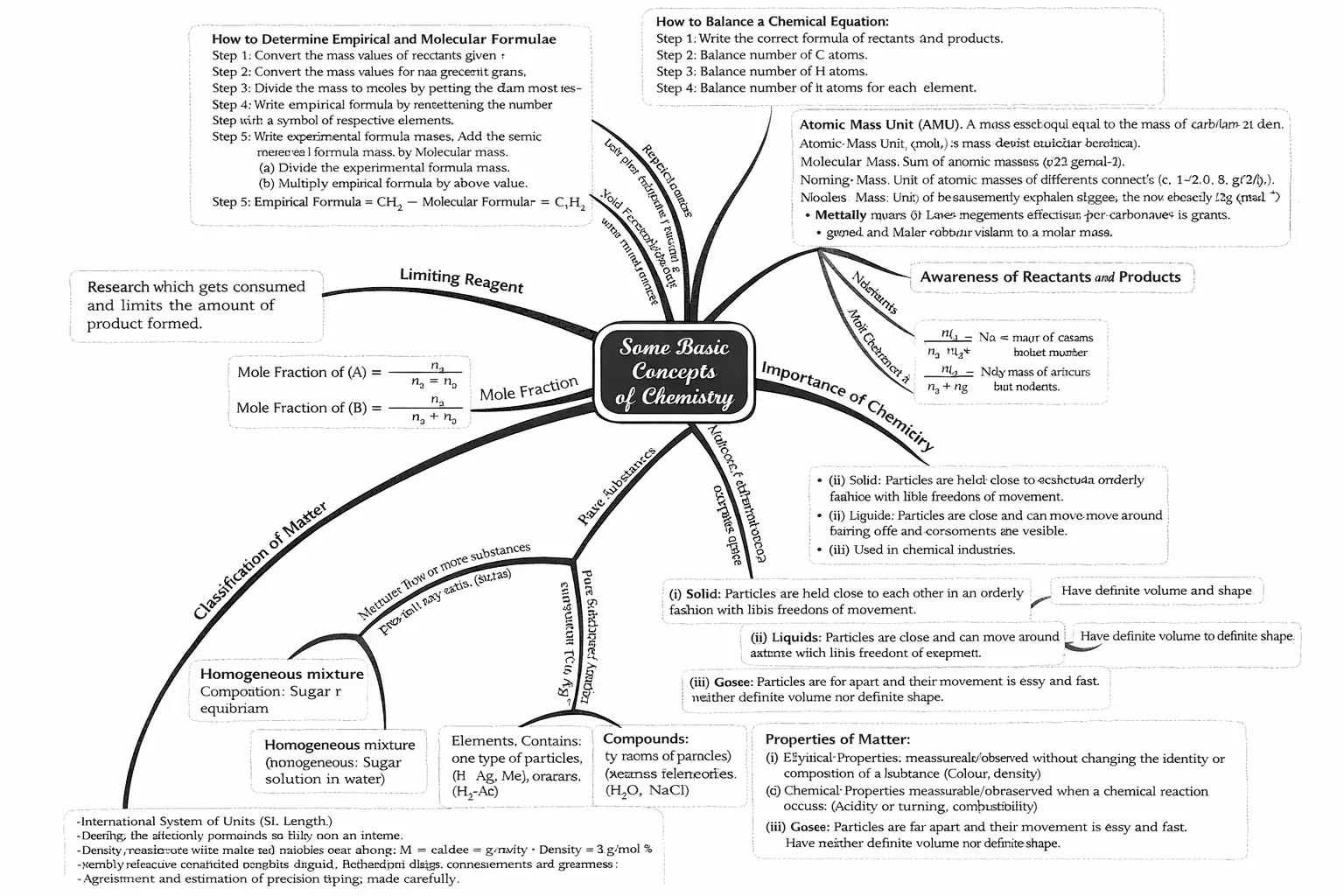
Chemistry is the branch of science that deals with the composition, structure, and properties of matter. Matter is anything that has mass and occupies space.
States of Matter
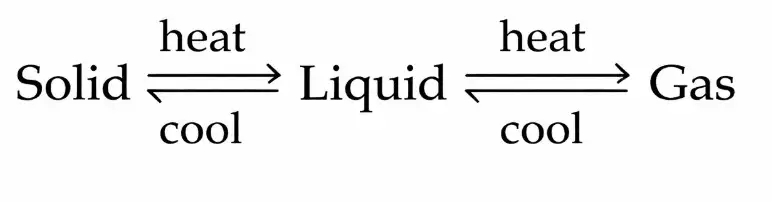
Matter exists mainly in three physical states: solid, liquid, and gas. There are also less common states such as plasma and Bose-Einstein condensate.
Properties of States
Solids have definite volume and shape. Liquids have definite volume but no definite shape. Gases have neither definite volume nor definite shape.
Interconversion of States
The three states of matter can be interconverted by changing temperature and pressure. For example, heating a solid turns it into a liquid (melting), and cooling a gas turns it into a liquid (condensation).
Classification of Matter
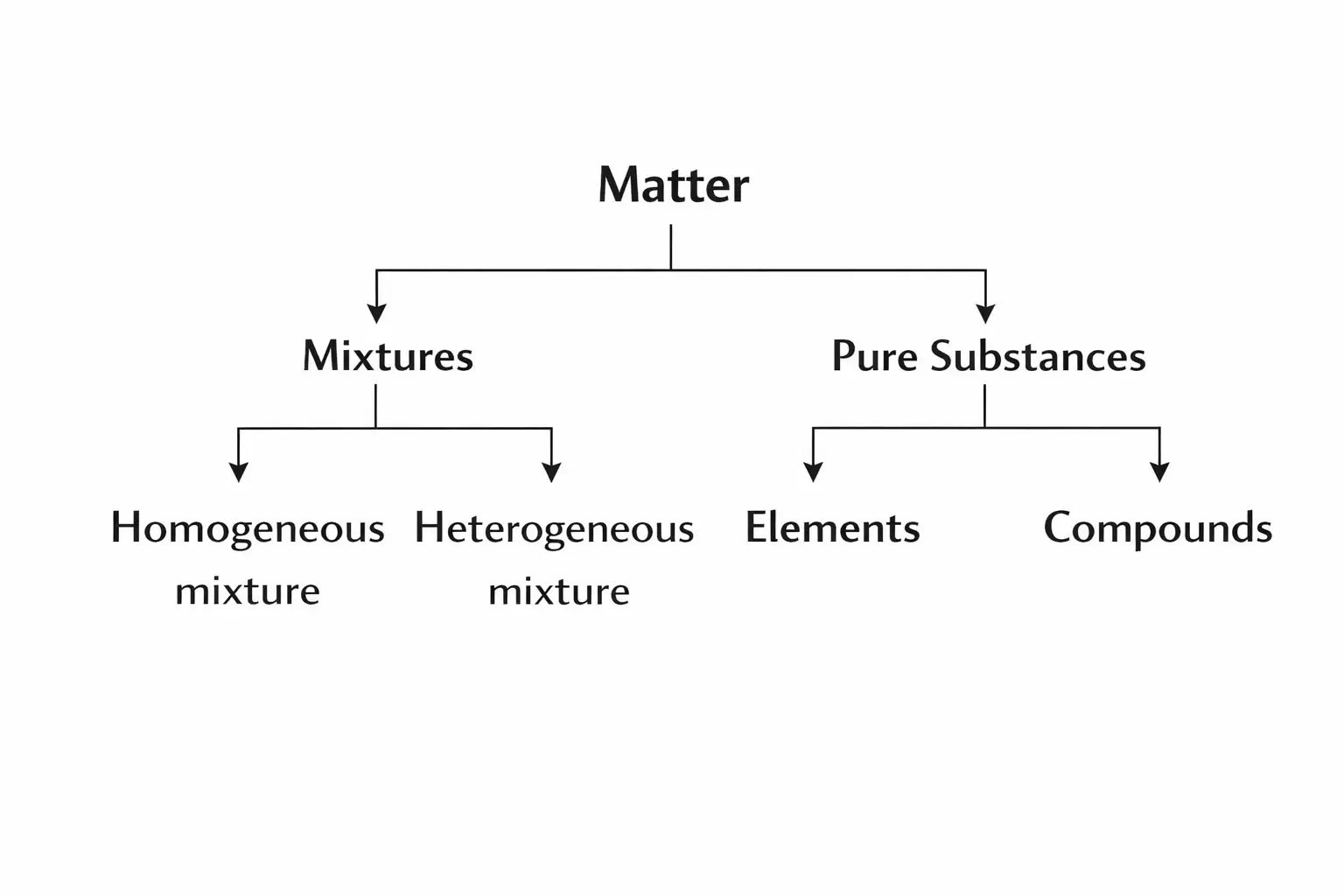
Matter can be classified into mixtures and pure substances. Mixtures contain two or more substances physically combined, while pure substances have fixed composition.
Mixtures are further divided into homogeneous mixtures, where composition is uniform (e.g., sugar solution), and heterogeneous mixtures, where composition is not uniform and components may be visible (e.g., salt and sugar mixture).
Pure substances include elements and compounds. An element contains only one type of particle (atoms or molecules), while a compound is a combination of two or more atoms of different elements in a definite ratio.
Properties of Matter
Properties of matter are categorized into physical and chemical properties. Physical properties can be observed without changing the substance, such as color and density. Chemical properties involve changes in the substance, such as reactions.
Physical Quantities
Mass: The standard SI unit is kilogram (kg).
Weight: Weight is a force measured in Newtons (N) and is calculated as W = m × g, where m is mass and g is gravitational acceleration.
Note: Mass is constant, but weight varies with gravity.
Volume: SI unit is cubic meter (m³).
Density: Density = Mass / Volume, with SI unit kg/m³.
Temperature Scales: Kelvin (K), degree Celsius (°C), and degree Fahrenheit (°F).
Length: Expressed in Angstrom (Å), nanometre (nm), and picometre (pm), where 1 Å = 10⁻¹⁰ m, 1 nm = 10⁻⁹ m, and 1 pm = 10⁻¹² m.
Significant Figures Rules
- All non-zero digits are significant.
- Leading zeros are not significant.
- Zeros between non-zero digits are significant if to the right of the decimal point.
Laws of Chemical Combinations
- Law of Conservation of Mass: Mass cannot be created or destroyed.
- Law of Definite Proportions: A compound always contains the same proportion of elements by weight.
- Law of Multiple Proportions: When two elements form more than one compound, the masses of one element that combine with a fixed mass of the other are in ratios of small whole numbers.
- Gay Lussac’s Law of Gaseous Volumes: Gases combine in simple volume ratios at constant temperature and pressure.
- Avogadro’s Law: Equal volumes of gases at the same temperature and pressure contain equal numbers of molecules.
Dalton’s Atomic Theory
- Matter consists of tiny indivisible particles called atoms.
- Atoms are indestructible and cannot be divided into smaller particles.
- All atoms of an element have identical properties and mass; atoms of different elements differ in mass.
- Atoms combine in simple fixed ratios to form compounds.
- Chemical reactions involve rearrangement of atoms; atoms are neither created nor destroyed.
Drawbacks of Dalton’s Atomic Theory
- Does not explain allotropes.
- Atoms can be divided into subatomic particles (electrons, protons, neutrons).
- Does not explain how atoms combine to form groups.
Solved Examples
Example 1: Calculate the density of a substance with mass 500 g and volume 250 cm³.
Solution:
Density = Mass / Volume = 500 g / 250 cm³ = 2 g/cm³.
Example 2: Convert 25 °C to Kelvin.
Solution:
K = °C + 273.15 = 25 + 273.15 = 298.15 K.
Example 3: Identify the limiting reagent when 2 moles of hydrogen react with 1 mole of oxygen to form water.
Solution:
Reaction: 2H₂ + O₂ → 2H₂O
Hydrogen required for 1 mole O₂ is 2 moles. Given 2 moles H₂ and 1 mole O₂, both are in stoichiometric ratio, so neither is limiting.
Practice Set
- Level 1: Define matter and list its three common states.
- Level 1: What is the difference between homogeneous and heterogeneous mixtures?
- Level 2: Calculate the weight of a 10 kg object on Earth where g = 9.8 m/s².
- Level 3: A substance has a mass of 150 g and volume of 50 cm³. Calculate its density and classify the state of matter if it has a definite shape.
Answer Key
- Level 1: Matter is anything that has mass and occupies space. The three common states are solid, liquid, and gas.
- Level 1: Homogeneous mixtures have uniform composition throughout (e.g., sugar solution), while heterogeneous mixtures have non-uniform composition and visible different parts (e.g., salt and sugar mixture).
- Level 2: Weight = mass × gravity = 10 kg × 9.8 m/s² = 98 N.
- Level 3: Density = mass / volume = 150 g / 50 cm³ = 3 g/cm³. Since it has definite shape, it is a solid.
Atomic and Molecular Mass
Atomic Mass
One atomic mass unit (amu) is defined as one-twelfth the mass of one carbon-12 atom.
Relative Atomic Mass = (Average mass of an atom × 12) / Mass of one carbon-12 atom.
Average Atomic Mass
Average atomic mass accounts for isotopes and their natural abundances:
Average Atomic Mass = Σ (Mass of isotope × % abundance) / 100.
Gram Atomic and Molecular Mass
Gram atomic mass is the mass in grams of one mole of atoms of an element.
Gram molecular mass is the mass in grams of one mole of molecules of a compound.
Formula Mass
Sum of atomic weights of atoms in the empirical formula of a compound.
Mole Concept and Molar Mass
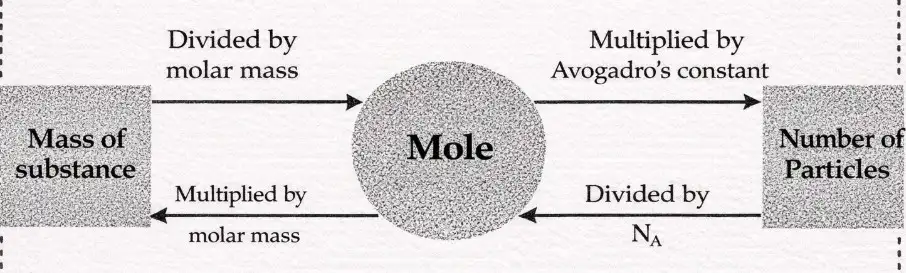
Mole is a fundamental unit representing a specific number of particles (6.022 × 10²³). Molar mass is the mass of one mole of a substance.
Percentage Composition
Percentage composition is the ratio of the mass of each element to the total mass of the compound, multiplied by 100.
Empirical and Molecular Formulas
Empirical formula shows the simplest whole number ratio of atoms in a compound.
Molecular formula shows the exact number of atoms of each element in a molecule.
Steps to Determine Molecular Formula
- Convert mass percent to grams.
- Calculate moles of each element.
- Divide moles by the smallest mole value.
- Write empirical formula.
- Calculate empirical formula mass.
- Divide molar mass by empirical formula mass to find n.
- Multiply empirical formula by n to get molecular formula.
Solved Examples
Example 1: Calculate the number of moles in 18 g of water (H₂O).
Solution:
Molar mass of H₂O = 2(1) + 16 = 18 g/mol.
Number of moles = mass / molar mass = 18 g / 18 g/mol = 1 mole.
Example 2: Find the empirical formula of a compound containing 40% carbon, 6.7% hydrogen, and 53.3% oxygen.
Solution:
Assuming 100 g sample:
C: 40 g / 12 = 3.33 moles
H: 6.7 g / 1 = 6.7 moles
O: 53.3 g / 16 = 3.33 moles
Divide by smallest (3.33):
C: 1, H: 2, O: 1
Empirical formula = CH₂O.
Practice Set
- Level 1: Define mole and molar mass.
- Level 1: What is the difference between empirical and molecular formula?
- Level 2: Calculate the number of molecules in 2 moles of oxygen gas.
- Level 3: A compound has an empirical formula CH₂ and molar mass 56 g/mol. Find its molecular formula.
Answer Key
- Level 1: Mole is the amount of substance containing 6.022 × 10²³ particles. Molar mass is the mass of one mole of a substance.
- Level 1: Empirical formula shows simplest ratio of atoms; molecular formula shows actual number of atoms.
- Level 2: Number of molecules = moles × Avogadro's number = 2 × 6.022 × 10²³ = 1.2044 × 10²⁴ molecules.
- Level 3: Empirical formula mass = 12 + 2(1) = 14 g/mol. n = 56 / 14 = 4. Molecular formula = (CH₂)₄ = C₄H₈.
Chemical Reactions and Stoichiometry
Chemical Equation
A chemical equation symbolically represents a chemical reaction, showing reactants and products.
Example: AgNO₃ + NaCl → AgCl + NaNO₃
Stoichiometry
Stoichiometry involves calculating masses or volumes of reactants and products in a chemical reaction.
Balancing Chemical Equations
- Write correct formulas of reactants and products.
- Count atoms of each element.
- Balance atoms one element at a time.
- Verify balanced equation.
Mass–Mole Relationship
Number of moles = Mass / Molar mass.
Limiting Reagent
The reactant consumed first limits the amount of product formed.
Mole Fraction
Mole fraction of component A in a mixture is the ratio of moles of A to total moles.
xₐ = nₐ / (nₐ + nB), xB = nB / (nₐ + nB), and xₐ + xB = 1.
Concentration of Solutions
Molarity (M): Moles of solute per litre of solution.
Molality (m): Moles of solute per kilogram of solvent.
Mass Percent: (Mass of solute / Mass of solution) × 100.
Normality (N): Gram equivalents of solute per litre of solution.
Strength of Solution: Amount of solute per litre of solution = Molarity × Molecular weight.
For dilution: M₁V₁ = M₂V₂.
Solved Examples
Example 1: Balance the equation: H₂ + O₂ → H₂O.
Solution:
Balanced equation: 2H₂ + O₂ → 2H₂O.
Example 2: Calculate molarity of a solution with 58.5 g NaCl dissolved in 500 mL solution.
Solution:
Molar mass of NaCl = 58.5 g/mol.
Moles = 58.5 / 58.5 = 1 mole.
Volume = 0.5 L.
Molarity = moles / volume = 1 / 0.5 = 2 M.
Practice Set
- Level 1: Define limiting reagent.
- Level 1: What is mole fraction?
- Level 2: Calculate molality of a solution with 10 g solute in 500 g solvent.
- Level 3: If 2 moles of H₂ react with 1 mole of O₂, how many moles of water are formed?
Answer Key
- Level 1: Limiting reagent is the reactant consumed first, limiting product formation.
- Level 1: Mole fraction is the ratio of moles of a component to total moles in mixture.
- Level 2: Molality = moles solute / kg solvent = (10 / molar mass) / 0.5 kg.
- Level 3: Reaction: 2H₂ + O₂ → 2H₂O. 2 moles H₂ react with 1 mole O₂ to form 2 moles H₂O.
Quick Reference Table
Key Laws and Formulas
- Law of Conservation of Mass: Mass is neither created nor destroyed in a chemical reaction.
- Law of Definite Proportions: A compound always contains the same elements in the same proportion by mass.
- Law of Multiple Proportions: When two elements form more than one compound, the ratios of the masses of one element that combine with a fixed mass of the other are small whole numbers.
- Gay Lussac's Law of Gaseous Volumes: Gases react in simple volume ratios at constant temperature and pressure.
- Avogadro's Law: Equal volumes of gases at the same temperature and pressure contain equal numbers of molecules.
Important Formulas
- Weight (W) = Mass (m) × Gravitational acceleration (g)
- Density (d) = Mass (m) / Volume (V)
- Temperature conversions:
K = °C + 273.15
°F = (9/5) × °C + 32 - Number of moles = Mass / Molar mass
- Molarity (M) = Moles of solute / Volume of solution (L)
- Molality (m) = Moles of solute / Mass of solvent (kg)
- Mass percent = (Mass of solute / Mass of solution) × 100
- Normality (N) = Gram equivalents of solute / Volume of solution (L)
- Molecular formula = n × Empirical formula, where n = Molar mass / Empirical formula mass
SI Units
- Mass: kilogram (kg)
- Weight: Newton (N)
- Volume: cubic meter (m³)
- Density: kilogram per cubic meter (kg/m³)
- Temperature: Kelvin (K)
- Length: meter (m), with subunits Angstrom (Å), nanometer (nm), picometer (pm)
Common Mistakes and Misconceptions
Common Mistakes
- Confusing mass and weight: Mass is constant, weight varies with gravity.
- Mixing up homogeneous and heterogeneous mixtures.
- Incorrectly balancing chemical equations by changing subscripts instead of coefficients.
- Using incorrect units for physical quantities.
- Misinterpreting empirical and molecular formulas.
- Forgetting to convert temperature units properly.
- Assuming limiting reagent is the reactant with the smaller mass rather than the one that limits product formation.
Misconceptions
- Atoms are indivisible: Atoms contain subatomic particles (electrons, protons, neutrons).
- All matter exists only in solid, liquid, and gas states: Plasma and Bose-Einstein condensate are other states.
- Density is the same for all states of a substance: Density varies with state and temperature.
- Mass and weight are the same physical quantity.
- Empirical formula always represents the actual molecule.
- Equal volumes of gases always have equal mass: They have equal number of molecules, but masses depend on molecular weights.
Glossary
Key Terms
- Atom: The smallest unit of an element that retains its chemical properties.
- Compound: A substance formed by chemical combination of two or more elements in a fixed ratio.
- Element: A pure substance consisting of only one type of atom.
- Empirical Formula: The simplest whole number ratio of atoms in a compound.
- Homogeneous Mixture: A mixture with uniform composition throughout.
- Heterogeneous Mixture: A mixture with non-uniform composition and visible different parts.
- Limiting Reagent: The reactant that is completely consumed first in a chemical reaction, limiting the amount of product formed.
- Mole: The amount of substance containing 6.022 × 10²³ particles.
- Molar Mass: The mass of one mole of a substance.
- Molecular Formula: The actual number of atoms of each element in a molecule.
- Mixture: A physical combination of two or more substances.
- Physical Property: A property observed without changing the substance's identity.
- Chemical Property: A property that involves a substance's ability to undergo chemical change.
- Stoichiometry: Calculation of reactants and products in chemical reactions.
- Weight: The force exerted by gravity on a mass.