CLASS 11-PCB . CHEMISTRY . CHEMISTRY PART I . EQUILIBRIUM
Chapter 6 : Equilibrium
Ch 6
CHEMISTRY
CLASS 11-PCB
Equilibrium
Equilibrium State
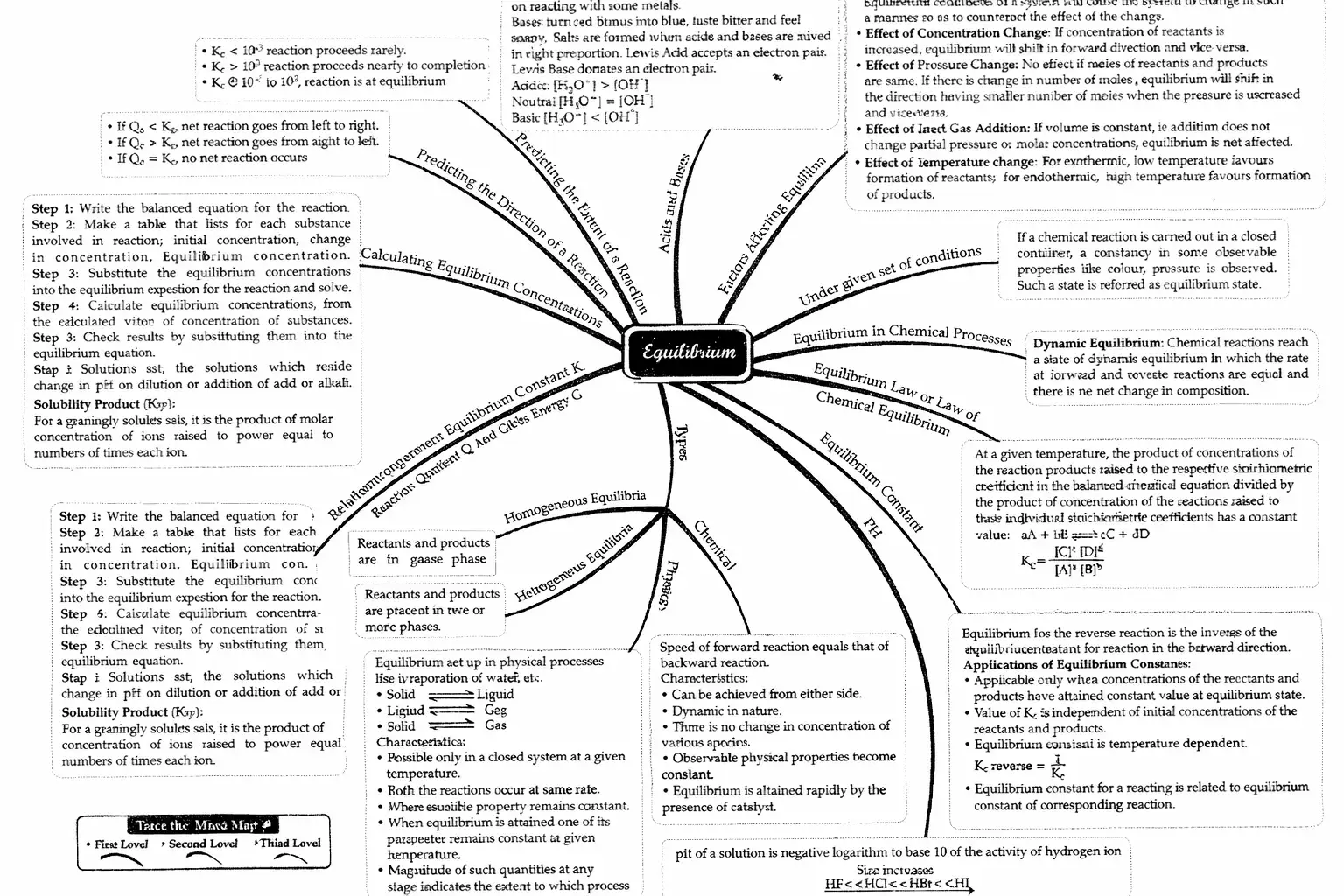
Equilibrium is a state of a system where its observable properties remain constant over time under a given set of conditions. At equilibrium, the forward and backward reactions occur at the same rate, resulting in no net change in the composition of the system.
Physical and Chemical Equilibrium
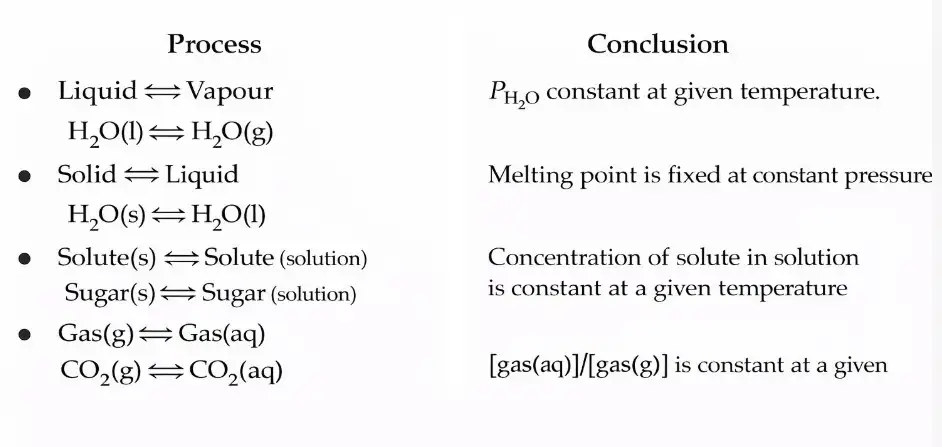
Physical equilibrium involves reversible physical processes such as phase changes or dissolution, where different phases coexist without net change. Examples include solid-liquid, liquid-vapour, and solid-vapour equilibria. Chemical equilibrium occurs in chemical reactions where the rate of the forward reaction equals the rate of the backward reaction, maintaining constant concentrations of reactants and products.
Henry’s Law
Henry’s Law states that the mass of a gas dissolved in a given mass of solvent at a constant temperature is directly proportional to the pressure of the gas above the solvent. Mathematically, m ∝ P, where m is the mass of gas dissolved and P is the pressure.
Law of Mass Action
This law states that at constant temperature, the rate of a chemical reaction is proportional to the product of the molar concentrations of the reactants, each raised to the power of their stoichiometric coefficients in the balanced chemical equation.
Equilibrium Constant
The equilibrium constant expresses the ratio of the product of concentrations of products to that of reactants, each raised to the power of their stoichiometric coefficients. It is denoted as Kc when expressed in terms of concentrations and Kp when expressed in terms of partial pressures for gaseous systems.
Homogeneous and Heterogeneous Equilibria
Homogeneous equilibrium involves reactants and products in the same phase, for example, gases reacting together. Heterogeneous equilibrium involves reactants and products in different phases, such as a solid in equilibrium with its vapor.
Le Chatelier’s Principle
This principle states that if a system at equilibrium experiences a change in concentration, pressure, or temperature, the system adjusts to counteract the change and restore a new equilibrium.
Factors Affecting Equilibrium
- Concentration: Changing the concentration of reactants or products shifts the equilibrium to minimize the change.
- Pressure: Increasing pressure favors the side with fewer moles of gas; decreasing pressure favors the side with more moles.
- Temperature: Increasing temperature favors the endothermic direction; decreasing temperature favors the exothermic direction.
- Inert Gas Addition: Adding an inert gas at constant volume does not affect equilibrium.
- Catalyst: Catalysts speed up the attainment of equilibrium but do not change its position.
Solved Examples
Example 1: Calculating Equilibrium Constant Kc
Consider the reaction: 2NO2(g) ⇌ N2O4(g). At equilibrium, the concentration of NO2 is 0.04 mol/L and N2O4 is 0.06 mol/L. Calculate the equilibrium constant Kc.
Solution:
Write the expression for Kc:
Kc = [N2O4] / [NO2]2
Substitute the values:
Kc = 0.06 / (0.04)2 = 0.06 / 0.0016 = 37.5
Therefore, the equilibrium constant Kc is 37.5.
Example 2: Effect of Pressure on Equilibrium
For the reaction N2(g) + 3H2(g) ⇌ 2NH3(g), predict the effect of increasing pressure on the position of equilibrium.
Solution:
The reaction involves 4 moles of gas on the reactant side and 2 moles on the product side. Increasing pressure favors the side with fewer moles of gas. Therefore, the equilibrium shifts towards the formation of ammonia (NH3).
Practice Set
- Level 1 (Easy): Define dynamic equilibrium and give an example.
- Level 2 (Moderate): Write the expression for the equilibrium constant Kc for the reaction: CO(g) + Cl2(g) ⇌ COCl2(g).
- Level 3 (Challenging): For the reaction 2SO2(g) + O2(g) ⇌ 2SO3(g), if the equilibrium constant Kc is 500 at a certain temperature, calculate the concentration of SO3 when the concentrations of SO2 and O2 are 0.1 mol/L and 0.05 mol/L respectively.
Answer Key
- Level 1: Dynamic equilibrium is a state where the forward and backward reactions occur at the same rate, resulting in no net change in concentrations. Example: Liquid water in equilibrium with its vapor.
- Level 2: Kc = [COCl2] / ([CO][Cl2])
- Level 3: Using Kc = [SO3]2 / ([SO2]2[O2]), substitute values:
500 = [SO3]2 / (0.12 × 0.05) = [SO3]2 / 0.0005
Therefore, [SO3]2 = 500 × 0.0005 = 0.25
[SO3] = √0.25 = 0.5 mol/L
Ionic Equilibrium
Electrolytes and Ionization
Electrolytes are substances that conduct electricity when dissolved in water due to the presence of ions formed by dissociation. Strong electrolytes completely dissociate into ions, while weak electrolytes partially dissociate establishing an equilibrium between ions and undissociated molecules.
Acids and Bases
An acid is a substance that donates H+ ions in aqueous solution (Arrhenius concept), acts as a proton donor (Bronsted concept), and accepts electron pairs (Lewis concept). Acids turn blue litmus paper red and react with metals to liberate hydrogen gas.
A base furnishes OH− ions in aqueous solution (Arrhenius concept), accepts protons (Bronsted concept), and donates electron pairs (Lewis concept). Bases turn red litmus paper blue and have a bitter taste and soapy feel.
Neutralization and Conjugate Acid-Base Pairs
Neutralization involves the combination of H+ and OH− ions to form water. A conjugate acid-base pair differs by one proton; a strong acid has a weak conjugate base and vice versa.
pH and pOH
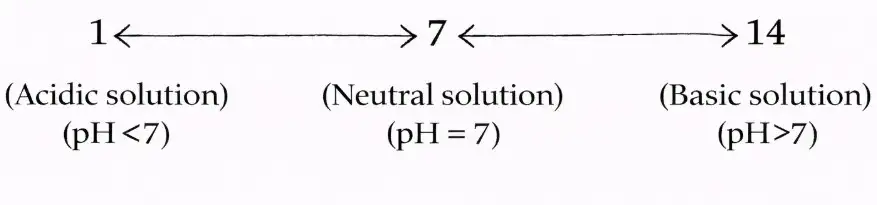
pH is the negative logarithm of the hydronium ion concentration: pH = −log[H3O+]. pOH is the negative logarithm of hydroxide ion concentration: pOH = −log[OH−]. At 25°C, pH + pOH = 14.
Strength of Acids and Bases
Acid strength depends on bond strength and polarity. Weaker H–A bonds and greater polarity increase acid strength. The dissociation constants Ka and Kb measure acid and base strengths respectively, with larger Ka or smaller pKa indicating stronger acids.
Common Ion Effect and Hydrolysis
The common ion effect suppresses the dissociation of weak electrolytes in the presence of a common ion. Hydrolysis is the reverse of neutralization, where ions react with water to produce acidic or basic solutions. Salts of strong acids and bases do not hydrolyze and are neutral, while salts of strong acids with weak bases or vice versa hydrolyze to give acidic or basic solutions.
Solved Examples
Example 1: Calculating pH of a Strong Acid
Calculate the pH of a 0.01 M HCl solution.
Solution:
HCl is a strong acid and dissociates completely, so [H+] = 0.01 M.
pH = −log(0.01) = 2.
Example 2: Effect of Common Ion
Explain the effect of adding NaCl to a solution of HCl.
Solution:
NaCl provides Cl− ions, a common ion with HCl. This suppresses the dissociation of HCl, reducing the concentration of H+ ions and increasing the pH slightly.
Practice Set
- Level 1 (Easy): Define an acid and a base according to Arrhenius theory.
- Level 2 (Moderate): Calculate the pH of a solution with [OH−] = 1 × 10⁻⁴ M.
- Level 3 (Challenging): Explain the common ion effect with an example.
Answer Key
- Level 1: Acid: Substance that increases H+ ions in aqueous solution. Base: Substance that increases OH− ions in aqueous solution.
- Level 2: pOH = −log(1 × 10⁻⁴) = 4; pH = 14 − 4 = 10.
- Level 3: The common ion effect is the suppression of ionization of a weak electrolyte by the addition of a common ion. Example: Adding NaCl to acetic acid solution reduces acetic acid ionization.
Buffer and Solubility
Buffer Solutions
A buffer solution resists changes in pH upon dilution or addition of small amounts of acid or base. The pH of an acidic buffer is given by the Henderson–Hasselbalch equation: pH = pKa + log([Salt]/[Acid]). For basic buffers, pOH = pKb + log([Salt]/[Base]).
Solubility Product
When a sparingly soluble salt dissolves in water, an equilibrium is established between the undissolved solid and its ions in solution. The solubility product constant, Ksp, is the product of the molar concentrations of the ions, each raised to the power of their stoichiometric coefficients.
Common Ion Effect on Solubility
The presence of a common ion decreases the solubility of a salt. The solubility of salts of weak acids increases with decreasing pH due to increased H3O+ concentration.
Predicting Precipitation
Using the ionic product Q and solubility product Ksp, precipitation occurs if Q > Ksp, dissolution if Q < Ksp, and equilibrium if Q = Ksp.
Solved Examples
Example 1: Calculating Solubility Product
Calculate the solubility product of AgCl if its solubility is 1.3 × 10⁻⁵ mol/L.
Solution:
AgCl ⇌ Ag+ + Cl−
Solubility, S = 1.3 × 10⁻⁵ mol/L
Ksp = [Ag+][Cl−] = S × S = S2 = (1.3 × 10⁻⁵)2 = 1.69 × 10⁻¹⁰
Example 2: Buffer pH Calculation
Calculate the pH of a buffer solution containing 0.1 M acetic acid (pKa = 4.76) and 0.1 M sodium acetate.
Solution:
pH = pKa + log([Salt]/[Acid]) = 4.76 + log(0.1/0.1) = 4.76 + 0 = 4.76
Practice Set
- Level 1 (Easy): Define a buffer solution.
- Level 2 (Moderate): Calculate the solubility product of BaSO4 if its solubility is 1.0 × 10⁻⁴ mol/L.
- Level 3 (Challenging): Explain how the common ion effect influences the solubility of a salt.
Answer Key
- Level 1: A buffer solution resists changes in pH when small amounts of acid or base are added.
- Level 2: BaSO4 ⇌ Ba2+ + SO42−
Ksp = S × S = (1.0 × 10⁻⁴)2 = 1.0 × 10⁻⁸ - Level 3: The common ion effect decreases the solubility of a salt by shifting the equilibrium towards the solid, reducing ionization in solution.
Quick Reference Table
- Equilibrium Constant (Kc and Kp): Expressions that quantify the ratio of product concentrations to reactant concentrations at equilibrium, raised to their stoichiometric coefficients.
- Le Chatelier’s Principle: Describes how a system at equilibrium responds to changes in concentration, pressure, or temperature by shifting to counteract the change.
- Henry’s Law: The solubility of a gas in a liquid is directly proportional to the pressure of the gas above the liquid.
- Law of Mass Action: The rate of a reaction is proportional to the product of the concentrations of the reactants, each raised to the power of their coefficients.
- Reaction Quotient (Q): Ratio of product concentrations to reactant concentrations at any point, used to predict the direction of reaction shift.
- Dynamic Equilibrium: A state where forward and reverse reactions occur at equal rates, with no net change in concentrations.
- Homogeneous Equilibrium: Equilibrium involving reactants and products in the same phase.
- Heterogeneous Equilibrium: Equilibrium involving reactants and products in different phases.
- Buffer Solution: A solution that resists changes in pH upon addition of small amounts of acid or base.
- Solubility Product (Ksp): The product of the molar concentrations of ions of a sparingly soluble salt at equilibrium, each raised to the power of their stoichiometric coefficients.
- Common Ion Effect: The decrease in solubility or ionization of a salt due to the presence of a common ion.
- pH and pOH: Measures of acidity and basicity, defined as the negative logarithms of hydronium and hydroxide ion concentrations respectively.
- Dissociation Constants (Ka and Kb): Quantitative measures of acid and base strengths.
- Equilibrium Shift Factors: Concentration, pressure, temperature, inert gas addition, and catalysts affect the position and rate of equilibrium.
Common Mistakes and Misconceptions
- Confusing Dynamic and Static Equilibrium: Equilibrium is dynamic, with continuous forward and reverse reactions, not a static state.
- Ignoring the Effect of Temperature: Temperature changes affect equilibrium constants and reaction direction, not just concentration or pressure.
- Assuming Catalysts Change Equilibrium Position: Catalysts speed up attainment of equilibrium but do not alter its position.
- Misapplying Le Chatelier’s Principle: The principle predicts direction of shift but does not change the equilibrium constant.
- Mixing Phases in Equilibrium Expressions: Concentrations of pure solids and liquids are omitted in equilibrium constant expressions.
- Incorrect Use of Units in Kc and Kp: Units depend on reaction stoichiometry and must be consistent.
- Confusing pH and pOH: pH and pOH are related and their sum is 14 at 25°C; misunderstanding this leads to errors.
- Overlooking Common Ion Effect: Presence of common ions suppresses ionization but is often neglected in calculations.
- Assuming All Electrolytes Fully Dissociate: Weak electrolytes establish equilibrium between ions and molecules.
- Neglecting the Role of Solvent in Hydrolysis: Hydrolysis depends on interaction with water molecules, not just ion presence.
Glossary
- Equilibrium: A state where the rates of forward and reverse reactions are equal, resulting in no net change in concentrations.
- Dynamic Equilibrium: Equilibrium with continuous forward and reverse reactions occurring at the same rate.
- Equilibrium Constant (Kc, Kp): Numerical value expressing the ratio of product to reactant concentrations or partial pressures at equilibrium.
- Le Chatelier’s Principle: Principle stating that a system at equilibrium will adjust to counteract any imposed change.
- Henry’s Law: Law relating gas solubility to pressure above the solvent.
- Law of Mass Action: The rate of reaction is proportional to the product of reactant concentrations raised to their stoichiometric powers.
- Reaction Quotient (Q): Ratio of product to reactant concentrations at any point, used to predict reaction direction.
- Homogeneous Equilibrium: Equilibrium involving species in the same phase.
- Heterogeneous Equilibrium: Equilibrium involving species in different phases.
- Buffer Solution: Solution that resists pH change upon addition of acid or base.
- Solubility Product (Ksp): Product of ion concentrations of a sparingly soluble salt at equilibrium.
- Common Ion Effect: Reduction in solubility or ionization due to presence of a common ion.
- pH and pOH: Measures of acidity and basicity, defined as negative logarithms of hydronium and hydroxide ion concentrations.
- Dissociation Constants (Ka, Kb): Constants that quantify acid and base strengths.
- Hydrolysis: Reaction of ions with water producing acidic or basic solutions.
- Neutralization: Reaction between acid and base producing water and salt.