CLASS 11-PCB . CHEMISTRY . CHEMISTRY PART I . CLASSIFICATION OF-ELEMENTS-AND-PERIODICITY-IN-PROPERTIES
Chapter 3 : Classification Of Elements And Periodicity In Properties
Ch 3
CHEMISTRY
CLASS 11-PCB
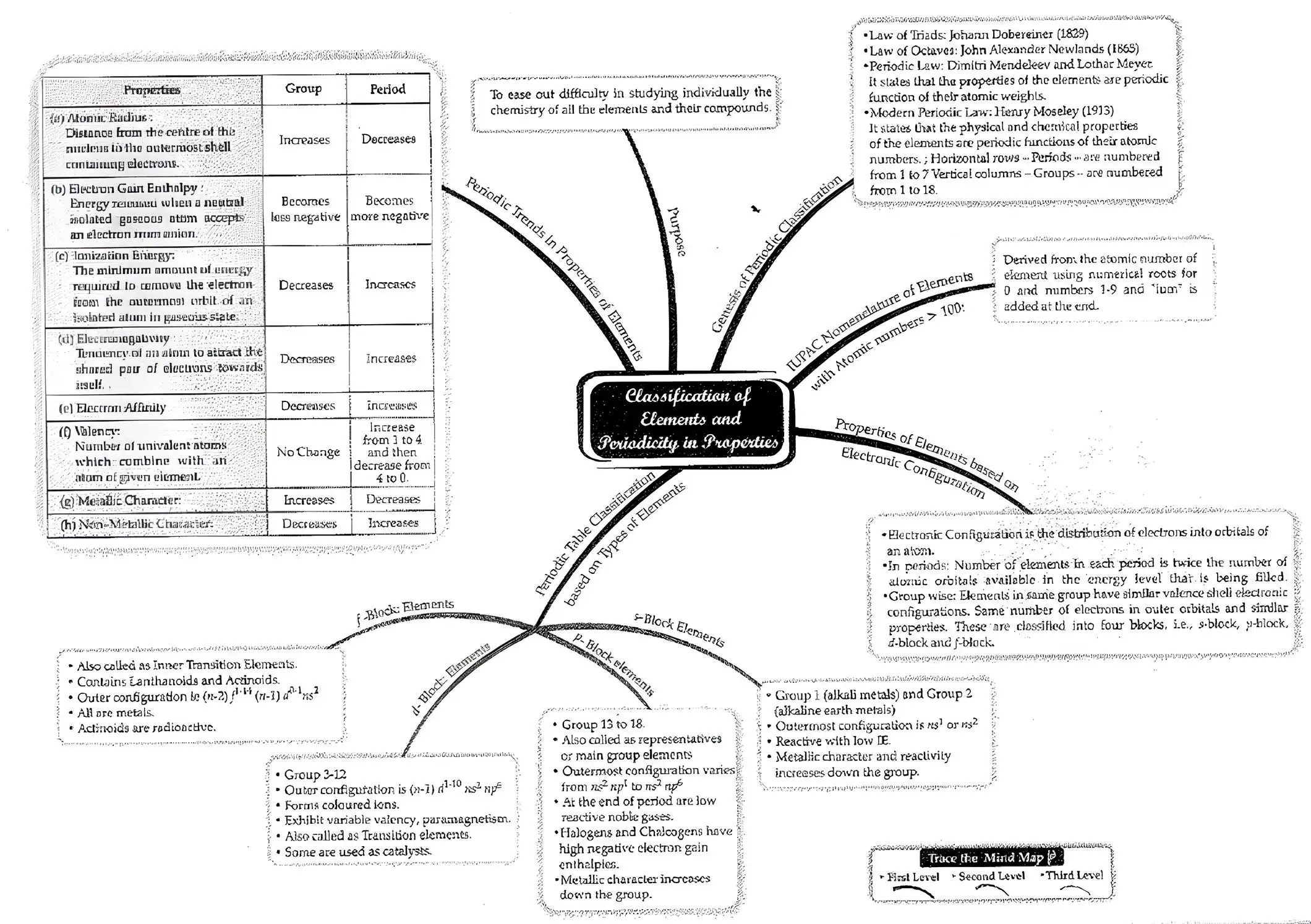
Classification of Elements
Definition and Purpose
Classification of elements is the arrangement of elements in such a way that similar elements are placed together while dissimilar elements are separated. This systematic arrangement helps in studying the properties and behavior of elements efficiently.
Periodic Table
The periodic table is a tabular arrangement of known elements according to their properties. It organizes elements to reflect periodic trends and similarities.
Historical Development
Early attempts to classify elements include:
- Dobereiner’s Triads (1829): Grouping elements in sets of three with similar properties where the atomic weight of the middle element is approximately the average of the other two.
- Newlands' Law of Octaves (1865): Elements arranged by increasing atomic weight show similar properties every eighth element, analogous to musical octaves.
- Mendeleev’s Periodic Table: Arranged elements by increasing atomic weight and grouped elements with similar properties. He predicted undiscovered elements by leaving gaps.
Characteristics of Mendeleev’s Table
- Eight vertical columns called groups, subdivided into A and B based on properties.
- Seven horizontal rows called periods.
Significance
- Systematic study of elements in groups.
- Prediction of new elements.
- Correction of atomic weights.
Defects
- Position of hydrogen is ambiguous.
- Some elements with higher atomic weight precede those with lower atomic weight.
- Isotopes placed in different groups.
- Dissimilar elements grouped together and similar elements separated.
- Group VIII elements arranged without justification.
Modern Periodic Law
"The physical and chemical properties of elements are periodic functions of their atomic number."
Long Form Periodic Table
- 18 groups numbered 1 to 18.
- Seven periods with varying number of elements: 2, 8, 8, 18, 18, 32, and incomplete 7th period.
- Lanthanoids and actinoids placed separately at the bottom.
General Characteristics
- Groups 1, 2, and 13 to 17 are main group or representative elements.
- Groups 3 to 12 are transition elements.
- Elements 58-71 are lanthanoids; 90-103 are actinoids (f-block elements).
Defects
- Unclear position of hydrogen.
- Lanthanoids and actinoids not merged within main table.
Blocks of Elements
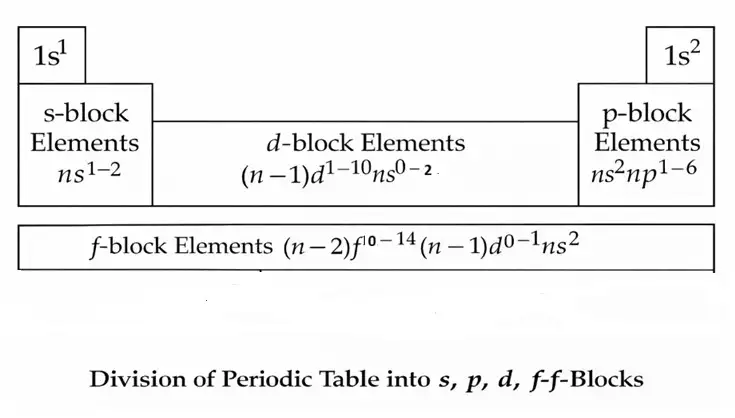
Elements are classified into four blocks based on their outermost electron configuration:
- s-block: Groups 1 and 2, with outer configuration ns¹ or ns².
- p-block: Groups 13 to 18, with outer configuration ns² np¹–⁶.
- d-block: Groups 3 to 12, transition metals with (n-1)d¹–¹⁰ ns⁰–² configuration.
- f-block: Lanthanoids and actinoids with (n-2)f¹–¹⁴ (n-1)d⁰–¹ ns² configuration.
Metals, Non-metals, and Metalloids
- Metals: Majority of elements, solid at room temperature (except mercury), high melting and boiling points, malleable and ductile.
- Non-metals: Found in p-block, can be solids, liquids, or gases, low melting and boiling points, brittle.
- Metalloids: Elements like silicon, germanium, arsenic, antimony, and tellurium with properties intermediate between metals and non-metals.
Solved Examples
Example 1: Explain why Mendeleev left gaps in his periodic table.
Solution: Mendeleev observed that certain properties of elements repeated periodically. However, some elements were not yet discovered. To maintain the periodicity and group similar elements together, he left blank spaces in his table predicting the existence and properties of these undiscovered elements.
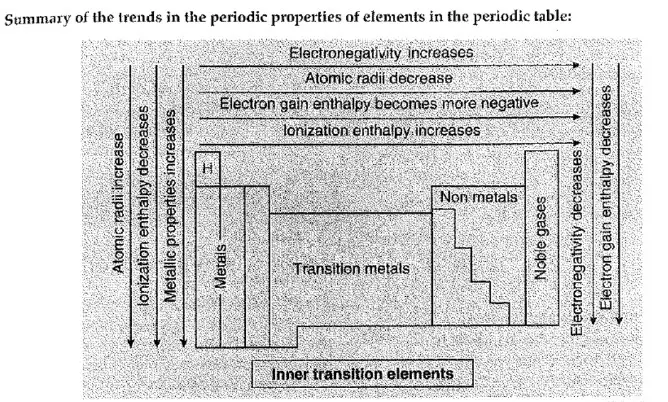
Example 2: Why is the atomic radius generally decreasing across a period?
Solution: As we move from left to right across a period, the atomic number increases, adding more protons to the nucleus. This increases the effective nuclear charge, pulling the electrons closer to the nucleus and decreasing the atomic radius.
Practice Set
- Level 1 (Easy): Define the modern periodic law.
- Level 2 (Moderate): Describe the difference between s-block and p-block elements.
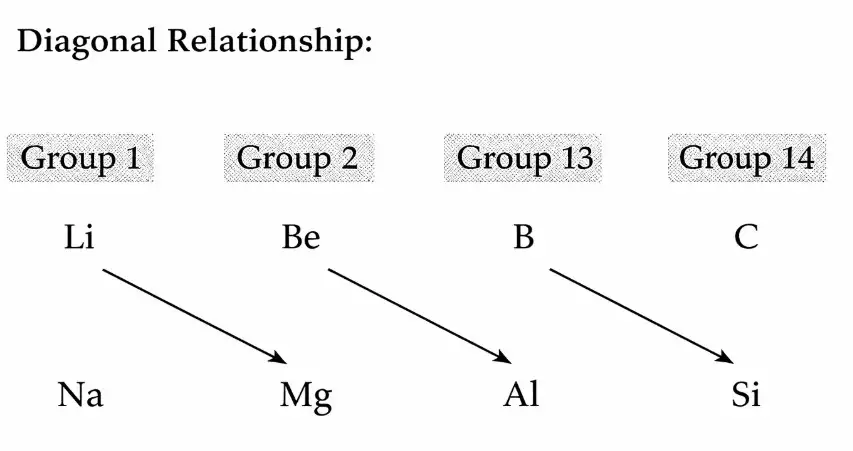
- Level 3 (Challenging): Explain the significance of the diagonal relationship in the periodic table with examples.
Answer Key
- Level 1: The modern periodic law states that the physical and chemical properties of elements are periodic functions of their atomic number.
- Level 2: s-block elements have their outermost electrons in the s orbital (groups 1 and 2), while p-block elements have their outermost electrons in the p orbital (groups 13 to 18).
- Level 3: The diagonal relationship refers to the similarity in properties between elements diagonally adjacent in the periodic table, such as lithium and magnesium, beryllium and aluminum, boron and silicon. This occurs due to similar atomic sizes and charge densities.
Quick Reference Table
Periodic Laws:
- Dobereiner’s Triads: Groups of three elements with similar properties.
- Newlands' Law of Octaves: Properties repeat every eighth element.
- Mendeleev’s Periodic Law: Properties vary periodically with atomic weight.
- Modern Periodic Law: Properties vary periodically with atomic number.
Blocks of Elements:
- s-block: Groups 1-2, ns¹ or ns² configuration.
- p-block: Groups 13-18, ns² np¹–⁶ configuration.
- d-block: Groups 3-12, (n-1)d¹–¹⁰ ns⁰–² configuration.
- f-block: Lanthanoids and actinoids, (n-2)f¹–¹⁴ (n-1)d⁰–¹ ns² configuration.
Groups and Periods:
- Groups: Vertical columns, numbered 1 to 18.
- Periods: Horizontal rows, seven in total.
Element Types:
- Metals: Left side, high melting points, malleable.
- Non-metals: Right side, low melting points, brittle.
- Metalloids: Intermediate properties.
Common Mistakes and Misconceptions
- Confusing atomic weight with atomic number in periodic classification.
- Placing hydrogen strictly in group 1 without acknowledging its unique properties.
- Assuming all elements in a group have identical properties without exceptions.
- Misunderstanding the position of lanthanoids and actinoids as separate from the main table.
- Overlooking the significance of electronic configuration in determining element properties.
Glossary
- Atomic Number: Number of protons in the nucleus of an atom.
- Atomic Radius: Distance from the nucleus to the outermost electron shell.
- Group: Vertical column in the periodic table.
- Period: Horizontal row in the periodic table.
- Ionization Enthalpy: Energy required to remove an electron from a gaseous atom.
- Electronegativity: Ability of an atom to attract electrons in a chemical bond.
- Valency: Number of electrons an atom can gain, lose, or share to form a chemical bond.
- Transition Elements: Elements in groups 3 to 12 with partially filled d orbitals.
- Lanthanoids and Actinoids: Inner transition metals in the f-block.