CLASS 11-PCB . BIOLOGY . BIOLOGY . STRUCTUAL ORGANIZATION-IN-ANIMALS
Chapter 7 : Structual Organization In Animals
Ch 7
BIOLOGY
CLASS 11-PCB
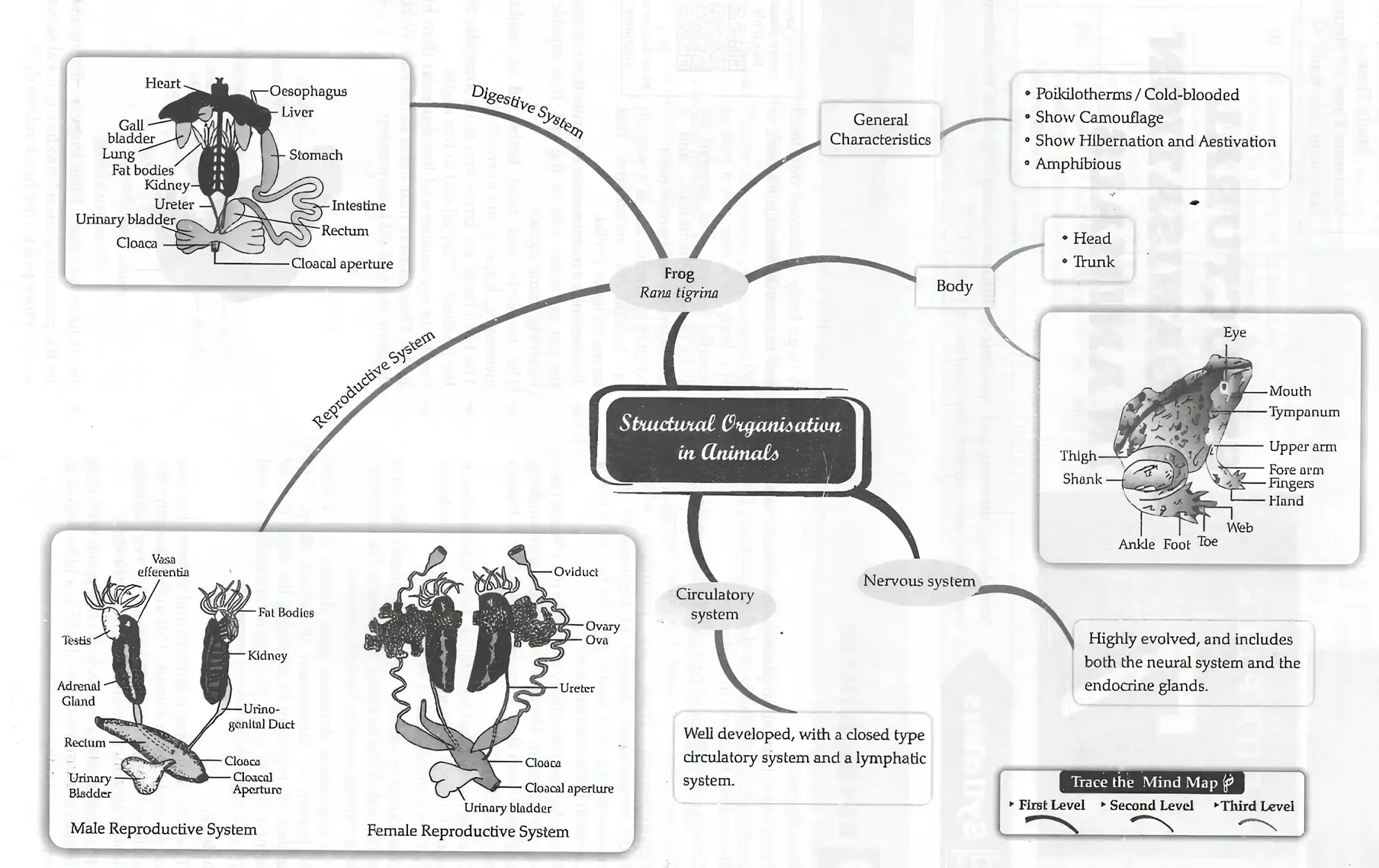
Frog Structure
General Characteristics
Frogs, specifically Rana tigrina, are amphibious vertebrates belonging to the class Amphibia and phylum Chordata. They are poikilotherms, meaning their body temperature varies with the environment. Frogs can camouflage by changing skin color and survive extreme conditions by aestivation (summer dormancy) and hibernation (winter dormancy).
Body Morphology
The frog's body is divided into the head and trunk, lacking a neck and tail. The skin is smooth and moist due to mucus secretion, aiding in respiration and water absorption. The dorsal side is olive green with dark spots, while the ventral side is light yellow. Key features include bulging eyes with a nictitating membrane, membranous tympanum (ear), and limbs adapted for walking, swimming, and leaping. Forelimbs have four digits; hind limbs have five webbed digits for swimming.
Digestive System
Structure and Function
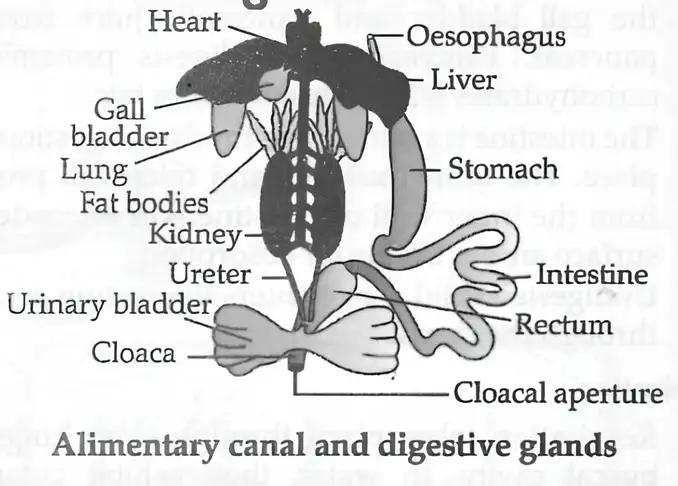
The digestive system consists of a short alimentary canal and digestive glands. Food enters through the mouth into the buccal cavity, passes through the pharynx to the oesophagus, then to the stomach, and finally the intestine. The intestine leads to the rectum and exits via the cloaca, a common chamber for digestive, excretory, and reproductive products.
Digestive Organs
The liver secretes bile, and the pancreas produces pancreatic juice containing enzymes. The stomach secretes gastric juice and hydrochloric acid to digest food. The duodenum receives bile and pancreatic juice to aid digestion. The intestine has villi and microvilli to increase surface area for absorption. Undigested waste is expelled through the cloaca.
Respiration
Modes of Respiration
Frogs respire through skin, lungs, and buccal cavity. In water, cutaneous respiration occurs where oxygen diffuses through moist skin. On land, pulmonary respiration takes place via lungs, with air entering through nostrils to the buccal cavity and lungs. During aestivation and hibernation, respiration mainly occurs through the skin.
Circulatory System
Components and Function
The circulatory system is closed and well-developed, comprising the heart, blood vessels, and blood. The heart has three chambers: two atria and one ventricle, enclosed by the pericardium. The sinus venosus connects to the right atrium, receiving blood from major veins (vena cava). The ventricle leads to the conus arteriosus, which distributes blood.
Blood and Vascular Systems
Arteries carry blood from the heart to the body, while veins return blood to the heart. The hepatic portal system connects the liver and intestine, and the renal portal system connects the kidneys to lower body parts. Blood contains plasma, nucleated red blood cells with hemoglobin, white blood cells, and platelets. Lymph is a fluid without red blood cells and fewer proteins. Blood transports nutrients, gases, and water throughout the body.
Excretory System
Structure and Function
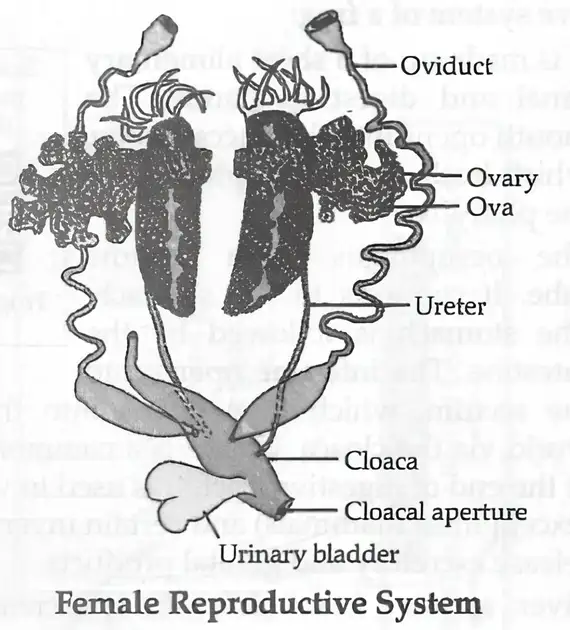
The excretory system includes paired kidneys, ureters, a cloaca, and a urinary bladder. Kidneys are red, bean-shaped organs located near the vertebral column. Each kidney contains numerous nephrons (uriniferous tubules) that filter blood. Ureters transport urine from kidneys to the cloaca. In females, oviducts and ureters open separately into the cloaca. Frogs excrete nitrogenous waste as urea, making them ureotelic animals.
Nervous System
Organization
The nervous system is highly evolved, comprising the central, peripheral, and autonomic nervous systems, along with endocrine glands. The brain is protected by the cranium and divided into forebrain, midbrain, and hindbrain. The forebrain includes olfactory lobes, cerebral hemispheres, and diencephalon. The midbrain has optic lobes, and the hindbrain contains the cerebellum and medulla oblongata, which continues as the spinal cord protected by the vertebral column.
Sensory Organs
- Sense organs: Sensory papillae
- Taste organs: Taste buds
- Smell organs: Nasal epithelium
- Vision organs: Eyes
- Hearing organs: Tympanum
Internal ears and eyes are well-organized for sensory perception.
Reproduction
Male Reproductive System
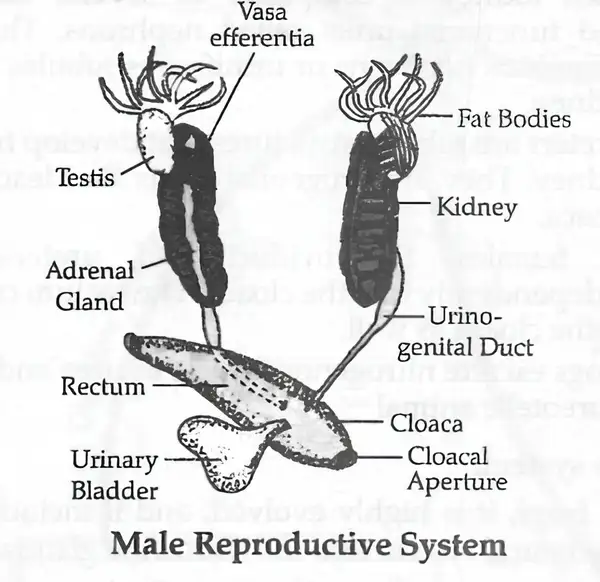
Males have a pair of yellowish ovoid testes attached to the upper part of kidneys by mesorchium. Vasa efferentia connect testes to Bidder’s canal, which opens into the urinogenital duct leading to the cloaca. Males have vocal sacs and copulatory pads on forelimbs.
Female Reproductive System
Females possess a pair of ovaries and oviducts that open separately into the cloaca. Fertilization is external, and development includes a larval tadpole stage undergoing metamorphosis into an adult frog.
Solved Examples
Example 1: Explain how the frog’s skin aids in respiration.
Solution: The frog’s skin is moist and covered with mucus, which allows dissolved oxygen to diffuse through it. This cutaneous respiration is especially important when the frog is underwater or during aestivation and hibernation when lung breathing is reduced.
Example 2: Describe the path of food through the frog’s digestive system.
Solution: Food enters the mouth, passes into the buccal cavity, then through the pharynx into the oesophagus. It moves to the stomach where digestion begins, then to the intestine for absorption. Waste passes into the rectum and exits through the cloaca.
Practice Set
- Level 1: What is the function of the nictitating membrane in frogs?
- Level 2: Explain the role of the hepatic portal system in frog circulation.
- Level 3: Describe the process of external fertilization and metamorphosis in frogs.
Answer Key
- Level 1: The nictitating membrane acts as a protective inner eyelid that keeps the eyes moist and protects them underwater.
- Level 2: The hepatic portal system carries blood from the intestine to the liver, allowing nutrients absorbed from food to be processed and detoxified before entering general circulation.
- Level 3: In external fertilization, the female lays eggs in water, and the male releases sperm over them. The fertilized eggs develop into tadpoles, which undergo metamorphosis, transforming into adult frogs with limbs and lungs.
Quick Reference Table
- Poikilotherms: Organisms whose body temperature varies with the environment.
- Aestivation: Dormant state during summer to survive heat.
- Hibernation: Dormant state during winter to survive cold.
- Digestive organs: Mouth → Buccal cavity → Pharynx → Oesophagus → Stomach → Intestine → Rectum → Cloaca.
- Respiration: Cutaneous (skin), Pulmonary (lungs), Buccal cavity.
- Circulatory system: Heart (3 chambers), arteries, veins, hepatic and renal portal systems.
- Excretory system: Kidneys with nephrons, ureters, urinary bladder, cloaca.
- Nervous system: Brain (forebrain, midbrain, hindbrain), spinal cord, sensory organs.
- Reproduction: External fertilization, tadpole metamorphosis.
Common Mistakes and Misconceptions
- Misconception: Frogs maintain a constant body temperature.
Fact: Frogs are poikilotherms and their body temperature varies with the environment. - Misconception: Frogs breathe only through lungs.
Fact: Frogs also respire through their skin and buccal cavity. - Misconception: The cloaca is only for excretion.
Fact: The cloaca is a common chamber for excretory, digestive, and reproductive products. - Misconception: Frog’s skin is dry.
Fact: Frog’s skin is moist and slippery due to mucus secretion. - Misconception: Fertilization in frogs is internal.
Fact: Fertilization is external in frogs.
Glossary
- Aestivation: Dormant state during hot summer to conserve water and energy.
- Hibernation: Dormant state during cold winter to reduce metabolic activity.
- Poikilotherm: An organism whose body temperature changes with the environment.
- Cloaca: A common chamber for digestive, excretory, and reproductive openings.
- Nictitating membrane: A translucent third eyelid that protects and moistens the eye.
- Nephrons: Functional units of the kidney that filter blood to form urine.
- Metamorphosis: The process by which a tadpole transforms into an adult frog.
- Ureotelic: Organisms that excrete nitrogenous waste primarily as urea.