CLASS 11-PCB . BIOLOGY . BIOLOGY . PLANTS GROWTH-AND-DEVLOPMENT
Chapter 13 : Plants Growth And Devlopment
Ch 13
BIOLOGY
CLASS 11-PCB
Seed Germination and Growth
Plant Growth and Development
Plants develop their root, stem, leaves, flowers, fruits, and seeds in an orderly manner. They complete a vegetative phase before entering the reproductive phase, where flowers and fruits form to continue the life cycle.
Development in plants is the sum of growth and differentiation, controlled by intrinsic and extrinsic factors. Growth is a permanent increase in dry weight, size, mass, or volume of cells, organs, or the organism, achieved through cell division, cell number increase, and cell enlargement.
Plant growth is generally indeterminate due to meristem tissues located at specific regions. Root apical and shoot apical meristems are responsible for primary growth, while intercalary meristems at nodes produce buds and branches. Secondary growth is due to lateral meristems like vascular cambium and cork cambium.
Phases of Plant Growth
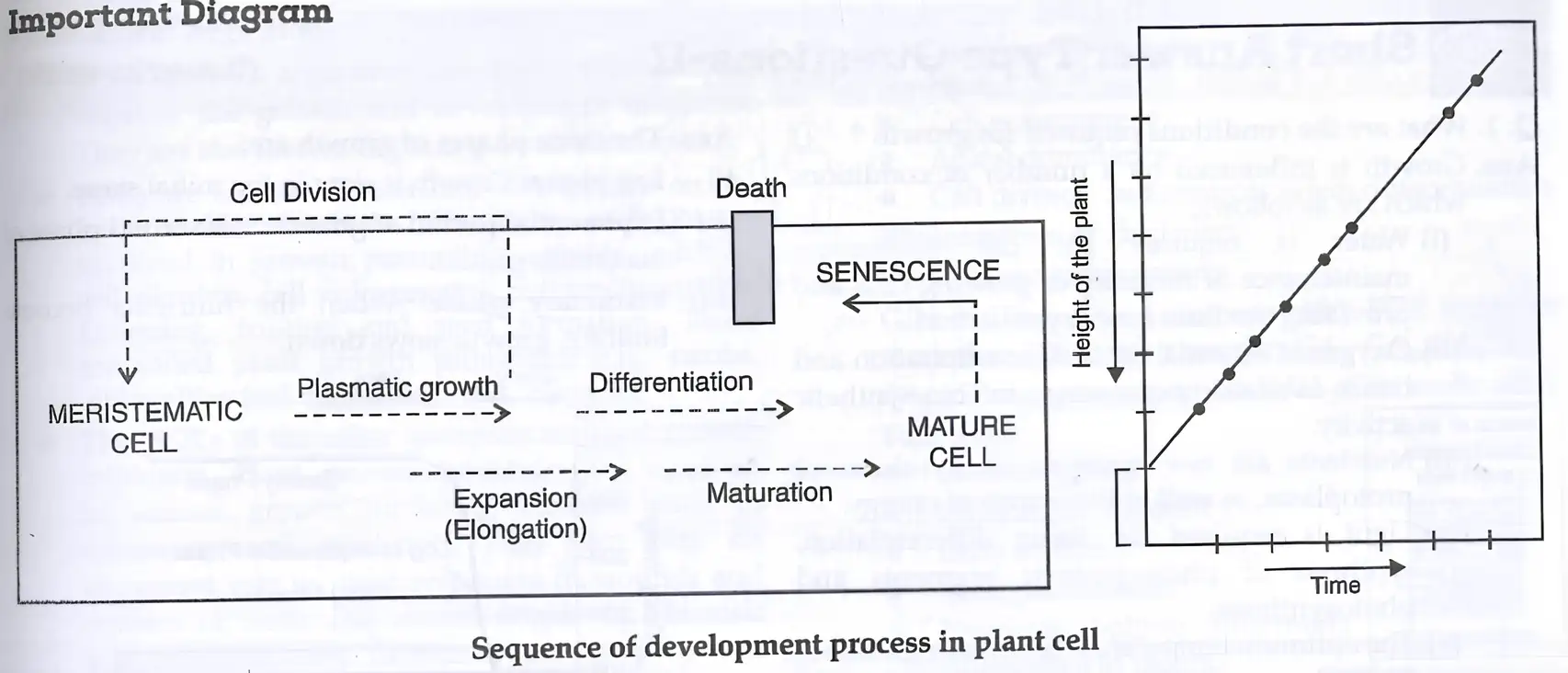
The meristematic phase involves cell division at root and shoot apices. The elongation phase involves enlargement of newly formed cells with increased vacuolation and cell wall deposition. The maturation phase involves differentiation of cells into specialized types.
Growth rate is the increase in growth per unit time and can be arithmetic or geometric. Absolute growth rate measures total growth per unit time, while relative growth rate expresses growth on a common basis.
Conditions for Growth
Water, oxygen, essential elements, optimal temperature, and environmental conditions are necessary for growth. Differentiation is the maturation of cells into specialized forms. Dedifferentiation is when differentiated cells regain division capacity, and redifferentiation is when they mature again to perform specific functions.
Development
Development includes seed germination, growth, differentiation, maturation, flowering, seed formation, and senescence. Plasticity is the ability to change under internal or external stimuli, exemplified by heterophylly.
Solved Examples
Example 1: Explain the role of meristematic tissues in plant growth.
Solution: Meristematic tissues are regions of actively dividing cells. The root apical meristem and shoot apical meristem contribute to primary growth by elongating the plant body. Intercalary meristems at nodes produce new buds and branches, while lateral meristems like vascular cambium and cork cambium contribute to secondary growth, increasing girth.
Example 2: Describe the phases of plant growth.
Solution: The meristematic phase involves cell division producing new cells. In the elongation phase, these cells enlarge by vacuolation and cell wall deposition. The maturation phase involves differentiation where cells become specialized to perform specific functions.
Practice Set
- Level 1: What is the role of apical meristems in plants?
- Level 2: Explain the difference between dedifferentiation and redifferentiation in plant cells.
- Level 3: How do intrinsic and extrinsic factors influence plant growth and development? Provide examples.
Answer Key
- Level 1: Apical meristems are responsible for primary growth, elongating the root and shoot, allowing the plant to grow in length.
- Level 2: Dedifferentiation is when specialized cells regain the ability to divide, such as interfascicular cambium formation. Redifferentiation is when these cells mature again to perform specific functions.
- Level 3: Intrinsic factors include genetic control and hormones like auxins; extrinsic factors include environmental conditions like water availability and temperature. Both regulate growth and development phases.
Growth Regulators
Plant Growth Hormones
Plant growth regulators (PGRs) are chemicals that regulate growth and development. They are divided into promoters and inhibitors. Promoters include auxins, gibberellins, and cytokinins, which stimulate cell division, enlargement, flowering, and fruiting. Inhibitors like abscisic acid regulate dormancy and abscission.
Auxin, first isolated from oat coleoptiles, is commonly indole-3-acetic acid (IAA). It promotes cell enlargement, apical dominance, xylem differentiation, and inhibits abscission.
Gibberellins, such as GA₃, promote cell elongation, break dormancy, induce early maturity, seed germination, and bolting.
Cytokinins, like kinetin and zeatin, promote cell division, differentiation, overcome apical dominance, and delay leaf senescence.
Ethylene is a gaseous hormone that inhibits longitudinal growth, promotes fruit ripening, senescence, abscission, apical dominance, and breaks bud dormancy.
Abscisic acid (ABA) is a stress hormone produced in chloroplasts, inducing bud dormancy, leaf senescence, parthenocarpy, and seed maturation.
Mnemonics
All Companions Are Going to Europe helps remember Auxins, Cytokinins, Abscisic acid, Gibberellins, Ethylene.
Solved Examples
Example 1: What are the main functions of auxins in plants?
Solution: Auxins promote cell enlargement, maintain apical dominance by inhibiting lateral bud growth, stimulate cell division, control xylem differentiation, inhibit leaf abscission, and induce parthenocarpy.
Example 2: Describe the role of gibberellins in plant growth.
Solution: Gibberellins promote cell elongation, break seed dormancy, induce early maturity, stimulate seed germination, and promote bolting by elongating internodes.
Practice Set
- Level 1: Name two synthetic auxins used in agriculture.
- Level 2: How does ethylene affect fruit ripening?
- Level 3: Explain the role of cytokinins in overcoming apical dominance.
Answer Key
- Level 1: Naphthalene acetic acid (NAA) and 2,4-dichlorophenoxyacetic acid (2,4-D) are synthetic auxins.
- Level 2: Ethylene increases the rate of respiration during fruit ripening, known as respiratory climacteric, leading to softening and color changes.
- Level 3: Cytokinins promote cell division in lateral buds, overcoming the inhibitory effect of auxins from the apical bud, thus promoting lateral growth.
Quick Reference Table
Growth Regulators and Functions:
- Auxins: Cell enlargement, apical dominance, xylem differentiation, inhibit abscission.
- Gibberellins: Cell elongation, break dormancy, seed germination, bolting.
- Cytokinins: Cell division, differentiation, overcome apical dominance, delay senescence.
- Ethylene: Fruit ripening, senescence, abscission, inhibit longitudinal growth.
- Abscisic Acid: Bud dormancy, leaf senescence, seed maturation.
Phases of Plant Growth: Meristematic (cell division), Elongation (cell enlargement), Maturation (differentiation).
Common Mistakes and Misconceptions
- Confusing growth with development: Growth is quantitative increase, development includes differentiation and maturation.
- Assuming all plant growth is determinate: Most plants exhibit indeterminate growth due to meristems.
- Believing ethylene only promotes growth: Ethylene inhibits longitudinal growth but promotes ripening and senescence.
- Mixing up dedifferentiation and redifferentiation: Dedifferentiation is regaining division ability; redifferentiation is specialization after division.
Glossary
- Apical Dominance: Inhibition of lateral bud growth by the apical bud.
- Dedifferentiation: Process where specialized cells regain the ability to divide.
- Development: Sequence of changes from seed germination to senescence.
- Growth Rate: Increase in growth per unit time.
- Meristem: Tissue of actively dividing cells responsible for growth.
- Plasticity: Ability of plants to change form in response to environment.
- Redifferentiation: Process where dedifferentiated cells mature to perform specific functions.
- Plant Growth Regulators: Chemicals that regulate plant growth and development.