CLASS 11-HUMANITIES . SOCIOLOGY . UNDERSTANDING SOCIETY . INDIAN SOCIOLOGISTS
Chapter 5 : Indian Sociologists
Ch 5
SOCIOLOGY
CLASS 11-HUMANITIES
Introduction to Indian Sociology
Sociology is a relatively young discipline in India, with formal university teaching beginning in 1919 at the University of Bombay. Early pioneers like L.K. Ananthakrishna Iyer and Sarat Chandra Roy contributed significantly to the development of sociology and anthropology in India, often working without formal qualifications but with great dedication. Indian sociology had to address unique questions related to the country's colonial experience, ancient civilization, and diverse social groups. The discipline evolved through the efforts of scholars who adapted Western sociological ideas to the Indian context, shaping the study of society in India.
Exam Question
Q: Who were some of the early pioneers of sociology and anthropology in India, and what challenges did they face?
A: Early pioneers included L.K. Ananthakrishna Iyer and Sarat Chandra Roy. They often worked without formal qualifications and had to develop sociology in India from scratch, addressing unique social and historical contexts such as colonialism and India's diverse cultures.
G.S. Ghurye: Founder of Indian Sociology
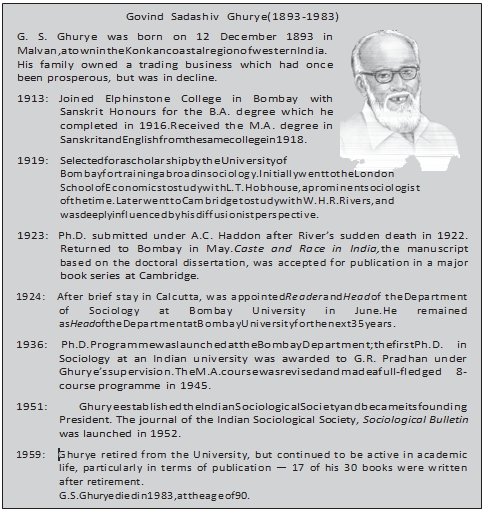
Govind Sadashiv Ghurye (1893-1983) is considered the founder of institutionalized sociology in India. He headed the first postgraduate sociology department at Bombay University for 35 years and founded the Indian Sociological Society and its journal, Sociological Bulletin. Ghurye's work covered caste, race, tribes, kinship, family, religion, and social integration. He emphasized the importance of combining teaching and research and merging sociology with social anthropology. His doctoral thesis, "Caste and Race in India," critically examined dominant racial theories of caste and provided a comprehensive definition of caste based on six key features.
Exam Question
Q: What are the six features of caste according to G.S. Ghurye?
A: (i) Caste is based on segmental division decided by birth; (ii) hierarchical division with unequal status; (iii) restrictions on social interaction and food sharing; (iv) differential rights and duties; (v) hereditary occupation; (vi) strict restrictions on marriage (endogamy and exogamy).
D.P. Mukerji on Tradition and Change
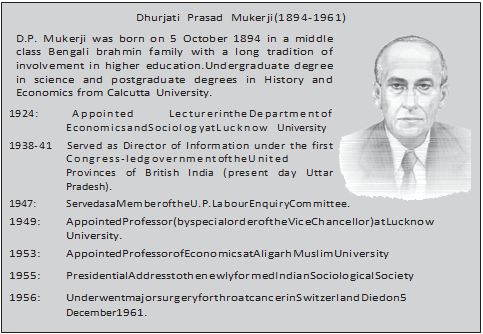
Dhrurjati Prasad Mukerji (1894-1961) emphasized the centrality of society in India and the importance of studying Indian social traditions as living traditions that maintain links with the past while adapting to change. He argued that Indian society is oriented towards group action rather than individualism, with traditions transmitted through collective experience. Mukerji highlighted the role of internal, non-economic causes of social change and the cyclical process of rebellion and transformation within tradition. He cautioned against uncritical adoption of Western ideas and advocated a balanced approach to tradition and modernity.
Exam Question
Q: What does D.P. Mukerji mean by a 'living tradition' and how does it relate to social change?
A: A living tradition maintains links with the past but incorporates new elements, adapting over time. Social change occurs through collective experiences that challenge and transform tradition without breaking it.
A.R. Desai and Marxist Perspective on Indian Society
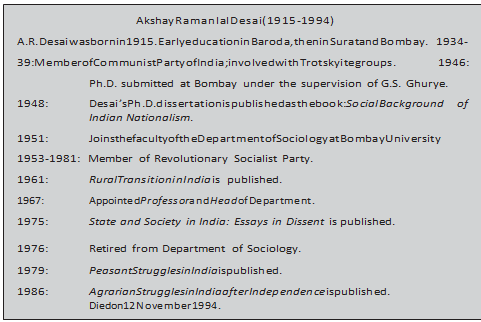
Akshay Ramanlal Desai (1915-1994) was a Marxist sociologist involved in political activism. He analyzed Indian nationalism, peasant movements, rural sociology, and the state from a Marxist viewpoint. Desai critiqued the concept of the welfare state, arguing that capitalist welfare states fail to provide adequate social security, reduce inequality, or ensure stable development. He emphasized the importance of democracy and political liberties even under socialism and highlighted the limitations of both capitalist and communist states.
Exam Question
Q: What are the key features of a welfare state according to A.R. Desai, and why does he consider it a myth?
A: A welfare state is interventionist, democratic, and involves a mixed economy. Desai considers it a myth because capitalist welfare states often fail to eliminate poverty, reduce inequality, provide employment, or ensure stable economic development.
M.N. Srinivas and Village Society
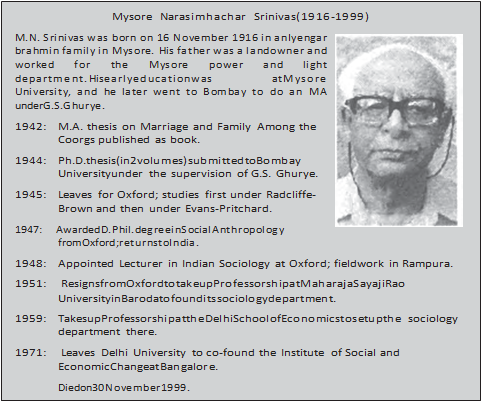
Mysore Narasimhachar Srinivas (1916-1999) was a prominent sociologist and anthropologist known for his ethnographic studies of Indian villages. He emphasized the importance of the village as a social unit and challenged views that prioritized caste over village identity. Srinivas showed that villages were dynamic, interconnected with regional economies and politics, and central to understanding social change in India. He helped establish sociology departments and research institutions, training many future sociologists.
Exam Question
Q: Why did M.N. Srinivas consider the village an important unit of social analysis?
A: Srinivas argued that villages serve as a unifying identity, experience social and economic change, and are interconnected with wider regional systems, making them relevant for sociological study.
Conclusion: Indian Sociology Pioneers and Their Legacy
The four sociologists—G.S. Ghurye, D.P. Mukerji, A.R. Desai, and M.N. Srinivas—each contributed uniquely to the development of Indian sociology. They adapted Western sociological theories to Indian realities, addressed social traditions, political economy, and social change, and helped institutionalize sociology in India. Their work laid the foundation for future generations to critique and expand the discipline, ensuring its continued relevance to Indian society.
Exam Question
Q: How did the pioneers of Indian sociology contribute to the development of the discipline?
A: They adapted Western theories to Indian contexts, studied social traditions and change, critiqued political and economic structures, and established academic institutions and research programs in sociology.
Solved Examples
Example 1: Explain the significance of G.S. Ghurye's work on caste.
Answer: Ghurye provided a systematic definition of caste emphasizing its segmental, hierarchical, and hereditary nature. His work helped sociologists understand caste as a complex social institution influencing social interaction, occupation, and marriage in India.
Example 2: Describe D.P. Mukerji's view on the role of tradition in Indian society.
Answer: Mukerji viewed tradition as a living process that maintains continuity with the past while adapting to change. He believed social change in India occurs through collective experiences that transform tradition without destroying it.
Practice Set
Easy
- Who was the founder of the Indian Sociological Society?
- Define endogamy as per Ghurye's caste features.
Moderate
- Explain the debate between protectionists and nationalists regarding tribal cultures in India.
- What are the three principles of change recognized in Indian traditions according to D.P. Mukerji?
Challenging
- Critically analyze A.R. Desai's critique of the welfare state.
- Discuss M.N. Srinivas's argument on the importance of village studies against Louis Dumont's view.
Answer Key
- G.S. Ghurye
- Marriage only within the same caste group.
- Protectionists wanted to preserve tribal cultures to prevent exploitation; nationalists wanted tribes to assimilate and develop.
- Shruti (heard), Smriti (remembered), and Anubhava (experience).
- Desai argued welfare states fail to provide social security, reduce inequality, and ensure stable development, making the welfare state a myth.
- Srinivas argued villages are dynamic social units with historical significance, while Dumont prioritized caste over village as a social institution.
Quick Reference
- G.S. Ghurye: Founder of Indian sociology, caste and race studies.
- D.P. Mukerji: Tradition as living, social change through collective experience.
- A.R. Desai: Marxist critique of Indian society and welfare state.
- M.N. Srinivas: Village studies, social change, and Indian sociology institution building.
Glossary
- Administrator–anthropologists: British officials who conducted anthropological research in colonial India.
- Anthropometry: Study of human physical measurements used in racial classification.
- Assimilation: Process where one culture absorbs another, losing distinct identity.
- Endogamy: Marriage within a specific social group or caste.
- Exogamy: Marriage outside a specific social group or kinship.
- Laissez-faire: Economic doctrine advocating minimal state intervention.