CLASS 11-HUMANITIES . SOCIOLOGY . INTRODUCING SOCIOLOGY . DOING SOCIOLOGY-RESEARCH-METHODS
Chapter 5 : Doing Sociology : Research Methods
Ch 5
SOCIOLOGY
CLASS 11-HUMANITIES
Introduction to Sociological Methods
Sociology is a social science that studies familiar aspects of human life such as social groups, institutions, norms, and relationships. What distinguishes sociologists from laypersons is their scientific method of acquiring knowledge. Sociologists seek to understand both the observable social phenomena and the subjective experiences and meanings that people attach to them. This dual perspective requires sociologists to adopt the point of view of the people they study, aiming to see the world through their eyes. Understanding both the outsider's and insider's perspectives is essential in sociological research.
Exam Question
Q: Why is the method important in sociology?
A: Method is important because sociologists differ from laypersons not by what they know but by how they acquire knowledge. They use scientific procedures to understand both observable social phenomena and the subjective experiences of people.
Objectivity and Subjectivity in Sociology
Objectivity means being unbiased and neutral, based solely on facts, while subjectivity is based on individual values and preferences. Achieving objectivity is more challenging in sociology than in natural sciences because sociologists study the social world in which they themselves live. This creates potential biases due to personal experiences and social contexts. Sociologists use self-reflexivity, continuously examining their own attitudes and documenting their research processes to minimize bias. Despite efforts, unconscious bias may remain, so sociologists disclose relevant aspects of their social background to alert readers. Additionally, sociology recognizes multiple versions of truth due to different perspectives, and it focuses on understanding these diverse viewpoints rather than judging which is correct.
Exam Question
Q: What challenges do sociologists face in maintaining objectivity?
A: Sociologists face challenges such as personal biases, influence of their social context, unconscious bias, and the existence of multiple competing interpretations of social reality, making objectivity difficult to achieve.
Multiple Methods and Choice of Methods
Sociology employs multiple research methods because there are multiple truths and perspectives. No single method is superior; the choice depends on the research question, researcher preferences, and resources. Methods are broadly classified as quantitative (measurable variables) and qualitative (attitudes, emotions), or as studying observable behavior versus non-observable meanings. They can also be primary (fresh data) or secondary (existing data), and micro (small settings) or macro (large populations). Using multiple methods, called triangulation, helps produce more comprehensive results. Prominent primary data methods include surveys, interviews, and participant observation.
Exam Question
Q: Why is triangulation important in sociological research?
A: Triangulation uses multiple methods to study the same problem from different perspectives, complementing each other to produce more reliable and comprehensive results.
Participant Observation
Participant observation is a method where the sociologist or anthropologist lives among the people studied, learning their language and participating in daily life to gain insider knowledge. It involves long-term engagement, often about a year or more, to understand the whole way of life. This method originated in natural sciences as field work and is central to social anthropology and sociology. It provides rich, detailed insights from the insider's perspective but is limited to small communities and may carry the researcher's bias.
Exam Question
Q: What are the main strengths and limitations of participant observation?
A: Strengths include detailed, insider perspective and long-term engagement allowing correction of initial impressions. Limitations include small sample size, potential researcher bias, and difficulty generalizing findings.
Field Work in Social Anthropology
Field work established anthropology as a rigorous social science. Early anthropologists relied on second-hand accounts, but from the late 19th century, direct observation and surveys became standard. Field work involves census, mapping, genealogy construction, language learning, and detailed note-taking. Informants provide crucial information. Bronislaw Malinowski pioneered modern field work by living among the Trobriand Islanders during World War I, emphasizing direct interaction without interpreters. His work institutionalized field work as essential training in anthropology.
Exam Question
Q: How did Bronislaw Malinowski contribute to the development of field work?
A: Malinowski established field work as a distinctive method by living among the Trobriand Islanders, learning their language, and conducting direct observation, which became a model for social anthropology.
Field Work in Sociology
Sociological field work uses similar techniques as anthropology but differs in context and focus. Sociologists study diverse communities, sometimes living among them or spending extensive time. Examples include William Foote Whyte's study of an Italian-American street gang and Michael Burawoy's factory work experience. In India, village studies became important post-independence, focusing on rural life relevant to national development. Field work provides rich data but is limited in scope and may reflect the researcher's perspective. Dialogic approaches involving community feedback are suggested to democratize knowledge production.
Exam Question
Q: Why are village studies significant in Indian sociology?
A: Village studies are significant because villages are the primary residence of most Indians, and studying them helps understand rural society, which is important for national development and social policies.
Surveys
Surveys are widely used sociological methods that provide broad overviews based on representative samples. They involve researchers and assistants collecting data through oral, written, telephone, or electronic questionnaires. Surveys allow generalization to large populations with manageable resources. Sample selection relies on stratification (representing sub-groups) and randomization (chance selection) to ensure representativeness. The Indian Census is the largest comprehensive survey, conducted every ten years, while the National Statistical Organisation conducts large sample surveys regularly. Surveys have limitations such as limited depth, potential errors in question delivery, and reliance on respondent cooperation.
Exam Question
Q: What are the two main principles of sample selection in surveys?
A: The two main principles are stratification, ensuring all relevant sub-groups are represented, and randomization, ensuring selection is by chance to avoid bias.
Interview
An interview is a guided conversation between researcher and respondent, offering flexibility in question order and depth. It bridges structured surveys and open-ended participant observation. Advantages include adaptability and depth; disadvantages include vulnerability to mood changes and unpredictability. Interviews vary in structure and recording methods. They are often used alongside other methods to add detail and context. Success depends on rapport and trust between interviewer and respondent.
Exam Question
Q: What makes interviews a flexible research method?
A: Interviews allow rephrasing questions, changing order, extending or shortening topics during conversation, adapting to respondent reactions, making them flexible and responsive.
Alarming Decline in Child Sex Ratio
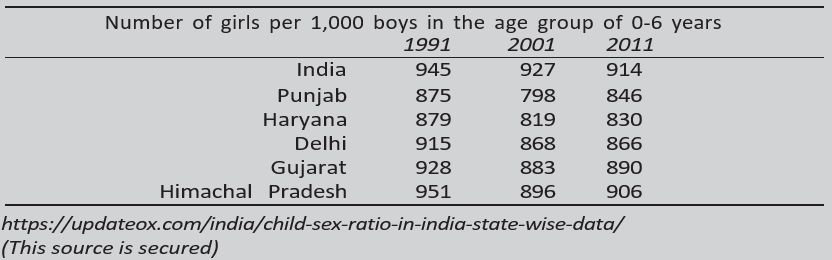
The child sex ratio is the number of girls per 1,000 boys aged 0-6 years. Natural ratios range from 950 to 975 girls per 1,000 boys. Census data from 1991, 2001, and 2011 show a decline in this ratio in India and several states, indicating gender imbalance due to social and cultural factors. For example, India's ratio dropped from 945 in 1991 to 914 in 2011. Such aggregate statistics reveal social issues invisible at the individual family level and require large-scale surveys or censuses to identify.
Exam Question
Q: Why is the child sex ratio important in social studies?
A: It indicates gender balance or imbalance in society, revealing social issues like gender preference that affect population demographics and require policy attention.
Glossary
- Census: A comprehensive survey covering every member of a population.
- Genealogy: An extended family tree outlining familial relations across generations.
- Non-sampling Error: Errors in survey results due to design or application faults.
- Population: The larger group from which a sample is drawn.
- Probability: The likelihood or odds of an event occurring.
- Questionnaire: A written list of questions for surveys or interviews.
- Randomisation: Selection based purely on chance to avoid bias.
- Reflexivity: The researcher's ability to observe and analyze oneself.
- Sample: A subset representing a larger population.
- Sampling Error: Margin of error due to using a sample instead of the whole population.
- Stratification: Division of a population into sub-groups based on relevant criteria.
Solved Examples
Example 1: Choosing a Sample for a Survey
Question: How would you select a representative sample to study the favorite break-time activities of students in different school levels?
Answer: First, stratify the student population by school levels: primary, middle, secondary, and senior secondary. Then randomly select students from each stratum proportionally to their size to ensure representation. This stratified random sampling ensures all levels are included fairly.
Example 2: Identifying Bias in Research
Question: What steps can a sociologist take to minimize bias when studying a community different from their own?
Answer: The sociologist should practice self-reflexivity by examining personal biases, document research procedures carefully, disclose relevant social background, and adopt the perspective of community members to understand their views accurately.
Practice Set
Easy
- Define participant observation.
- What is the difference between objectivity and subjectivity?
Moderate
- Explain the importance of stratification and randomization in sample selection.
- Describe the main advantages and disadvantages of surveys.
Challenging
- Discuss how reflexivity helps sociologists maintain scientific rigor.
- Compare and contrast field work in anthropology and sociology.
Answer Key
- Participant observation: A research method where the sociologist lives among the people studied to gain insider knowledge.
- Objectivity vs Subjectivity: Objectivity is unbiased and fact-based; subjectivity is based on personal values and preferences.
- Stratification and randomization: Stratification ensures all sub-groups are represented; randomization ensures selection by chance to avoid bias.
- Surveys advantages and disadvantages: Advantages include broad coverage and generalizability; disadvantages include limited depth and potential errors.
- Reflexivity: It involves self-examination to reduce bias and improve research validity.
- Field work comparison: Anthropology focuses on remote tribal communities with long-term immersion; sociology studies diverse communities with varied contexts and topics.
Quick Reference
- Methodology: Study of methods used in sociology.
- Triangulation: Using multiple methods to study the same problem.
- Informants: People who provide information to researchers.
- Sampling Error: Margin of error due to sample size.
- Non-sampling Error: Errors from research design or implementation.