CLASS 11-HUMANITIES . POLITICAL SCIENCE . POLITICAL THEORY . SOCIAL JUSTICE
Chapter 4 : SOCIAL JUSTICE
Ch 4
POLITICAL SCIENCE
CLASS 11-HUMANITIES
Social Justice
Social justice involves ensuring the well-being of all people in society by promoting fairness and equality. It requires that individuals be treated equally and fairly, taking into account their different needs and circumstances.
Principles of Justice
The principles of justice include:
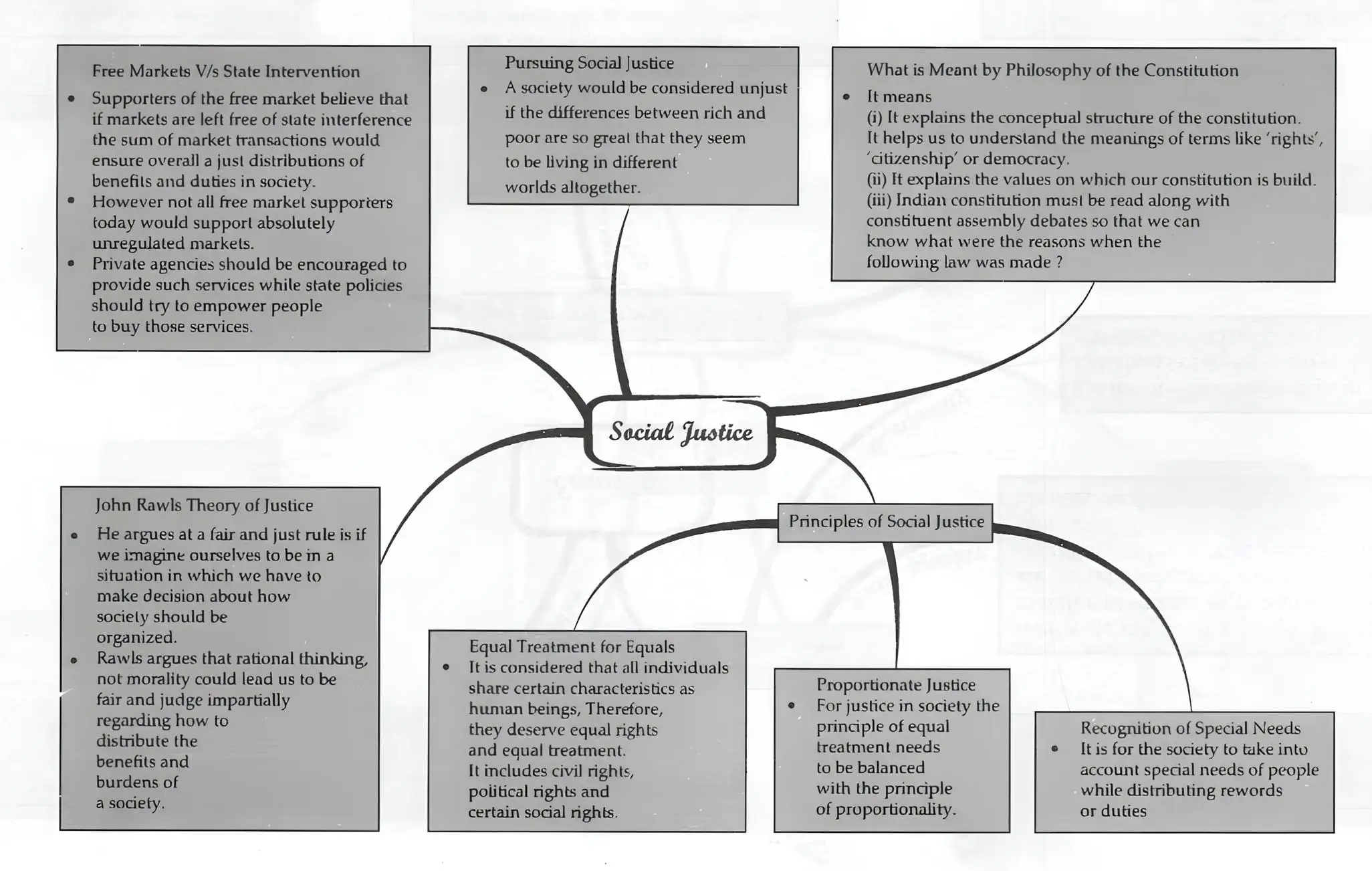
- Equal Treatment for Equals: People should not be discriminated against based on class, caste, race, or gender. They should be judged by their actions and work rather than their group identity.
- Proportionate Justice: While equal work should receive equal reward, different kinds of work may be rewarded differently based on effort, skill, and risk involved.
- Recognition of Special Needs: Society should consider special needs when distributing rewards or duties. Treating equals equally may require treating unequals differently to achieve fairness.
Governments have the responsibility to harmonize these principles to promote a just society.
Social Justice in a Country
Within a country, social justice means not only equal treatment under laws and policies but also ensuring basic equality in life conditions and opportunities for all citizens.
John Rawls' Theory of Justice
John Rawls proposed that fair and just rules for society can be determined by imagining decisions made under a "veil of ignorance," where individuals do not know their position in society. This encourages decisions that protect the interests of the worst-off.
Rawls argues that rational thinking, rather than morality alone, leads to impartial judgments about distributing benefits and burdens fairly.
Basic Minimum Conditions for Justice
A just society should provide basic minimum conditions such as nourishment, housing, clean drinking water, education, and minimum wage to enable people to live healthy, secure lives and develop their talents.
Free Markets and State Intervention
Supporters of free markets believe that without state interference, market transactions will ensure just distribution based on merit and talent. However, markets often favor the privileged.
The state should intervene to ensure basic minimum living standards and provide essential services like healthcare and education, empowering people to access these services.
Social Inequalities in India
India faces various social and economic inequalities. Efforts are ongoing to reduce these disparities and promote social justice for all citizens.
Key Terms
- Economic Justice: Providing equal opportunity to citizens to acquire basic needs or livelihood.
- Justice: The means to distribute the due share to everybody.
- Just Society: A society where reverence replaces contempt, creating compassion.
- Moral Justice: Natural principles of justice.
- Protective Discrimination: Government steps for the betterment of weaker sections.
- Social Justice: Equality among all people living in society.
Exam Questions
Question 1:
What are the main principles of justice that guide a just society?
Answer:
The main principles are equal treatment for equals, proportionate justice considering different efforts and risks, and recognition of special needs to ensure fairness.
Question 2:
Explain John Rawls' concept of the "veil of ignorance" and its significance in social justice.
Answer:
The "veil of ignorance" is a thought experiment where individuals make decisions about society without knowing their own social position. This ensures impartiality and fairness, as decisions are made considering the worst-off in society.
Question 3:
Why is state intervention necessary in ensuring social justice despite the presence of free markets?
Answer:
Free markets tend to favor the privileged and may not provide basic services to all. State intervention ensures minimum living standards and access to essential services, promoting fairness and equality.
Solved Examples
Example 1: A government wants to provide education to all children. How can the principles of social justice guide this policy?
Solution: The government should ensure equal access to education (equal treatment), provide additional support to children with special needs (recognition of special needs), and consider different learning abilities (proportionate justice) to create a fair education system.
Practice Set
Easy
- Define social justice.
- List two key principles of justice.
Moderate
- Explain the role of the state in promoting social justice.
- Describe the basic minimum conditions necessary for a just society.
Challenging
- Discuss how John Rawls' theory of justice can be applied to address social inequalities.
- Analyze the limitations of free markets in ensuring social justice.
Answer Key
- Social justice means fairness and equality in society, ensuring well-being for all.
- Two key principles: Equal treatment for equals, recognition of special needs.
- Role of state: To harmonize justice principles, provide basic services, and reduce inequalities.
- Basic minimum conditions: Nourishment, housing, clean water, education, minimum wage.
- Rawls' theory application: Decisions made without knowing social position promote fairness to worst-off.
- Limitations of free markets: Favor privileged, may not provide basic services to all.
Quick Reference
- Social Justice: Fairness in society ensuring equal rights and opportunities.
- Principles of Justice: Equal treatment, proportionate justice, special needs recognition.
- John Rawls: Veil of ignorance for impartial decision-making.
- State Role: Ensures minimum living standards and access to services.
Glossary
- Economic Justice: Equal opportunity to meet basic needs.
- Justice: Fair distribution of rights and duties.
- Just Society: Compassionate society with equality.
- Moral Justice: Natural principles guiding fairness.
- Protective Discrimination: Government measures for weaker groups.
- Social Justice: Equality among all members of society.