CLASS 11-HUMANITIES . POLITICAL SCIENCE . POLITICAL THEORY . SECULARISM
Chapter 8 : SECULARISM
Ch 8
POLITICAL SCIENCE
CLASS 11-HUMANITIES
Secularism
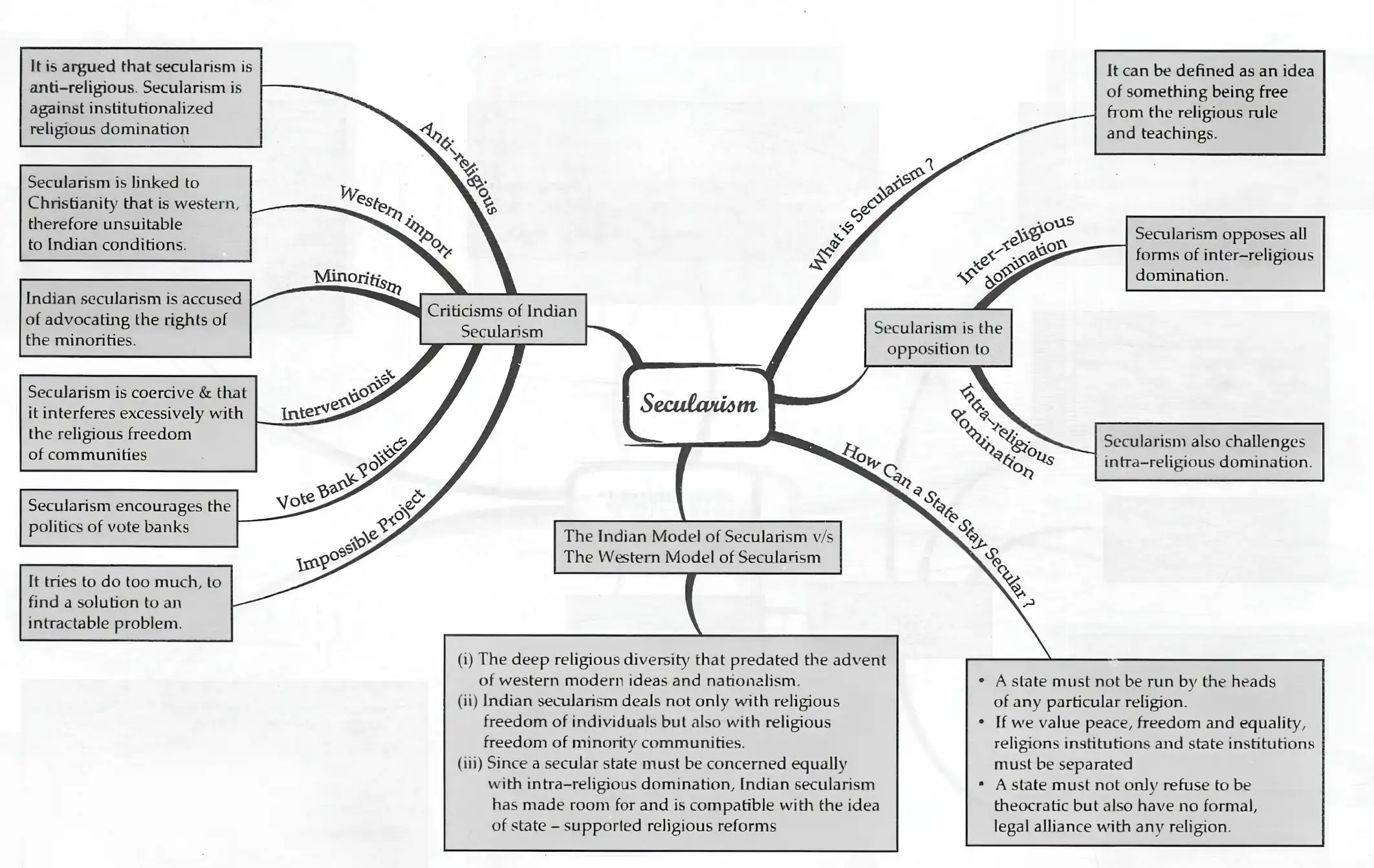
The Constitution of India guarantees every citizen the right to live with freedom and dignity anywhere in the country. Secularism is a doctrine that opposes all forms of inter-religious domination and is not anti-religious. It challenges both inter-religious and intra-religious domination, promoting freedom within religions and equality between and within religions.
Religions often fragment into sects, leading to sectarian violence and persecution of dissenting minorities. Secularism seeks to create a society free from such domination by promoting education and ensuring that the state is not governed by any religious authority. A theocratic state is one ruled by religious leaders, which secularism opposes by advocating for a state with no formal alliance with any religion.
The Western Model of Secularism
The Western model of secularism maintains a strict separation between religion and state. The state does not intervene in religious affairs, nor does religion interfere in state matters. Religion is considered a private matter, and the state neither aids nor hinders religious institutions. This model does not support state-sponsored religious reform.
The Indian Model of Secularism
Indian secularism differs fundamentally from the Western model. It evolved from the interaction between India's religious diversity and Western ideas. It opposes oppression within religions, such as discrimination against Dalits and women, and protects minority religious communities. Indian secularism allows for state-supported religious reforms like banning untouchability and child marriage.
The Indian state adopts a policy of principled distance, engaging with religion when necessary to oppose tyranny or support reform, while also allowing disengagement. The Constitution grants religious minorities the right to establish and maintain educational institutions with possible state assistance. The secular state may treat some aspects of organized religions with equal disrespect to uphold equality.
Criticisms of Indian Secularism
Anti-religious: Some argue secularism is anti-religious, but it actually opposes institutionalized religious domination and promotes religious freedom and equality.
Western import: It is claimed secularism is a Western concept unsuitable for India. However, secularism in India is adapted to protect peace and minority rights.
Minoritism: Critics say secularism favors minorities excessively. In reality, minority rights protect fundamental interests and are not special privileges.
Interventionist: Some view secularism as coercive and interfering with religious freedom. Indian secularism balances intervention and non-interference, supporting liberal voices within religions.
Vote bank politics: Secularism is accused of encouraging politics based on religious vote banks. While vote bank politics can be problematic, securing minority rights through democratic means is part of secularism's success.
Impossible project: Critics claim secularism cannot succeed due to deep religious differences. However, Indian civilization's history shows coexistence is achievable.
Exam Questions
Q1. What is secularism and how does it oppose religious domination?
A1. Secularism is a doctrine opposing all forms of inter-religious and intra-religious domination. It promotes freedom within religions and equality between and within religions, ensuring no religion dominates the state or society.
Q2. How does the Indian model of secularism differ from the Western model?
A2. The Indian model allows state engagement with religion to protect minority rights and support reforms, while the Western model strictly separates religion and state, treating religion as a private matter without state intervention.
Q3. What are some criticisms of Indian secularism?
A3. Criticisms include claims that it is anti-religious, a Western import, favors minorities excessively, is coercive, encourages vote bank politics, and is an impossible project due to deep religious differences.
Solved Examples
Example 1: Explain why secularism is not anti-religious.
Solution: Secularism opposes institutionalized religious domination but promotes freedom of religion and equality. It does not oppose religion itself but ensures no religion controls the state or society.
Example 2: Describe the principle of 'principled distance' in Indian secularism.
Solution: Principled distance means the state may engage with religion to oppose tyranny or support reforms but also disengage when appropriate, maintaining a balance between intervention and non-interference.
Practice Set
Easy:
- Define secularism.
- What is a theocratic state?
Moderate:
- Explain the Western model of secularism.
- How does Indian secularism protect minority rights?
Challenging:
- Discuss the criticisms of Indian secularism and provide counterarguments.
- Analyze the role of education in promoting secularism.
Answer Key
Easy:
- Secularism is the doctrine opposing religious domination and promoting freedom and equality among religions.
- A theocratic state is governed by religious leaders or a particular religion.
Moderate:
- The Western model separates religion and state strictly, treating religion as a private matter without state intervention.
- Indian secularism protects minority rights by allowing state support for minority educational institutions and opposing religious tyranny.
Challenging:
- Criticisms include claims of anti-religious bias, Western origin, favoritism towards minorities, coercion, vote bank politics, and impracticality. Counterarguments highlight secularism's promotion of freedom, adaptation to Indian conditions, protection of fundamental rights, balanced intervention, democratic success, and historical coexistence.
- Education helps change mindsets, promotes understanding, and supports secular values of equality and freedom.
Quick Reference
- Secularism: Opposition to religious domination, promoting freedom and equality.
- Theocratic State: State ruled by religious authority.
- Western Model: Strict separation of religion and state.
- Indian Model: Principled distance, state engagement with religion to protect rights.
- Principled Distance: Balanced state intervention and non-interference in religion.
Glossary
- Secularism: Doctrine advocating separation of state and religion and opposing religious domination.
- Theocratic: Relating to a government ruled by religious leaders.
- Principled Distance: Policy allowing the state to engage or disengage with religion as needed.
- Religious Domination: Control or oppression by one religion over others or within its own sects.
- Minority Rights: Constitutional protections for religious minority communities.
| Year | Event | Significance |
|---|---|---|
| 1950 | Adoption of Indian Constitution | Established India as a secular state guaranteeing religious freedom |
| 1950s-60s | Implementation of social reforms | State-supported reforms like banning untouchability and child marriage |
| 1976 | 42nd Amendment to Constitution | Declared India a secular state explicitly in the Preamble |